How to Install Anchor in Concrete
Install Anchor in Concrete With Epoxy and Magic
When you install anchor (s) in concrete or concrete block, you want it to stay put.
The best method in my opinion is to create a wedge-shaped hole in the concrete using a hammer drill.
The hole will be wider deep in the concrete than the smaller entry hole you see on the face of the wall or ceiling.
The above video was one of Tim's favorite projects he did with Steve Loyola. Steve helped with the Server Transfer for AsktheBuilder.com.
Related Links
Concrete Epoxy Repair Products
Anchor Concrete With Epoxy Video
Free & Fast Bids
CLICK HERE to get FREE & FAST BIDS from local carpenters who can install anchors using my method.
Anchor Dovetail Trick
I borrowed this secret tip from dentists and woodworkers. The fillings in your teeth don't come out because the hole the dentist drills is wider at the bottom.
Dovetail joints in woodwork don't fail for the same reason.
Permanent Epoxy for Anchoring Into Concrete
CLICK HERE to get the best epoxy to install anchor in concrete.
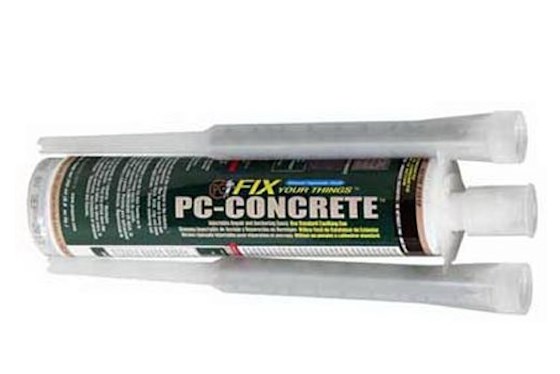
This is the magic epoxy that fits into a regular caulk gun. I've used it with great success. CLICK THE PHOTO NOW TO HAVE IT DELIVERED TO YOUR HOME.
It's important to realize the hammer drill needs to be angled about 20 degrees from perpendicular in both directions. This creates the required wedge-shaped hole.
Use Blower to Blast Dust
Use a turkey baster to remove all drilling dust. A wet-dry vacuum works well too.
Reverse the vacuum hose so it's blowing instead of sucking. Slide just a small part of the blower hose over the edge of the hole. LOOK AWAY from the hole as clouds of abrasive concrete dust will begin to blow out of the hole.
Twist Anchor While Installing
After squirting in the wonderful PC Concrete epoxy you see above, twist the anchor back and forth as you slowly insert it into the hole.
The twisting motion coats the entire anchor and ensures the entire hole has no air in it. You want the hole to be completely filled with the anchor and epoxy.
CLICK HERE to get FREE & FAST BIDS from local carpenters who can install anchors using my method.

Tim built custom homes and did ultra-custom remodeling for 20+ years before launching his Ask the Builder media presence. He was selected as one of the Big 50 by Remodeling magazine in 1993. This award gave birth to Ask the Builder in October 1993. Tim also operates https://DrawPlumbingPlans.com. His @askthebuilder YouTube channel was the first home improvement channel on YouTube.
GREAT TIP! Drilling a wider inside wedge to anchor epoxy and bolt after epoxy cures. Thank you, Tim.
I like the new format. Short video but exactly on point. Thanks.
Tim, the short video instructional format is very nice. You showed the steps, and kept the viewer engaged with the questions about why at the end. (and yes - I knew what you were doing as I have learned the hard way about the bolt and plug coming out when applying tension...)
Hi Tim,
I feel the short video was clearly communicated for drilling the hole.. The written next steps were clear and it would be excellent to see the whole step by step process on video.
Excellent. Straight to the point and not a lot of time wasted in the setup or the conclusion. Keep it up.
Great tip and video Tim. It's right to the point and leaves no guessing as to why you make the hole that way. The comparison to a dove tail makes it easy to understand also.
Love the new format Tim. Concise and to the point. Keep the tips coming!
Well done! I like the format, short and sweet.
Hi Tim, The new format is good. I figured out what you were doing early on. Another way to blow out the cement dust would be to sue a straw or a pump that is use to inflate bike or auto tires.
Hi Tim, the new format is good. I figured out what you were doing early on. Another way to blow out the cement dust would be to use a straw or a pump used to inflate bike tires.
Nice work Tim, Short and to the point. I usually find myself looking on-line for a video right before starting a project. So many drone on and on.
I think you are on to something here. Keep it up!!
I liked it because it follows the steps to training that I learned long ago.
Lecture; tell them what you are teaching.
Show; demonstrate the task
Make do: not possible here but if they watch it felt the same
Follow up: ask questions to check for understanding
Train or retrain: repeat what has preceded in four previous steps.
Great video. I like the teaching aspect of the video. This should help new DIY'ers understand why things are done and the benefits from doing it right the first time.
Thanks
Interesting. Such a simple logical tip, yet I've never seen anyone do this before. I'll have to try this next time. The new format works as long as someone doesn't read ahead in the article before viewing. Thanks!
The new format makes it more interesting and informative. I think you have a winner!
I cheated and read ahead. But I live the concept! I did a railing the other way, and am glad it's not mine... I'll do all my future ones this way!
Tim,
I really liked the question and answer in your video. If you just drilled the hole without asking the question, some might might miss that you dovetailed the hole. Not only did you explain what you were doing, you told us why.
I appreciate the new format. Its short, thoroughly visually detailed, explained well and a fabulous quality audio/video presentation. I assume its part of a sequence of short videos that would help the viewer put the anchor installation process into perspective?
Tim, I liked the format. To the point, concise and easy to follow. At first I was concerned about drilling brick at the mortar joint. To me it is a good way to separate the bricks. But as soon as the wedge shape was started the hole went into the brick above and below the mortar.
Jim
I like the format. Very clear and to the point. The only missing step (blowing out the dust in the cavity) is explained in the concise narrative that follows the video.
As others have said, terrific video. Can't overstate the need for a quality hammer drill. I tried for 20 minutes to drill through a brick with my little Ridgid hammer drill, then gave up and rented a Bosch. Like a hot knife through butter as they say. Maybe 4 seconds to drill the hole. Thank you.
Tim, I first encountered this approach when I had a concrete foundation installed to expand my Dallas, TX home. The whole Dallas area is considered unbuildable by some standards because of the soil which is extremely sensitive to moisture changes. The contractor who was drilling the pier holes (which go down to what they call bedrock in Dallas-actually soft limestone, I think) asked if I wanted the holes "baled". Not understanding what baled was I questioned him and the translation from his strong Texas accent was "belled". We agreed he would make the bottom of the holes bell-shaped.
Great Tip, and the new format is good too. Keep up the good work.
Great, concise information. Really liked the demo followed by explanation.
Thanks!
Hello Tim - nice video & great tip. The only thing I do not like is the hand-held movement of the camera making the background move around. This is way overdone in Hollyweird movies & I find it distracting. Mounting the camera on a tripod or using a tracking camera like SoloShot3 would in my opinion be better. Thanks.
I found the question & answer format engaging. It's good to get people thinking about what's going on rather than just passively listening. As long as it doesn't turn into a quiz!
Very much liked it. But why ask, in the video, the question you have already answered in the accompanying text?
Because many many people watch the video directly from YouTube or when my video gets embedded on some other page on the Internet. You can't assume everyone is going to watch it on this page and read the text *below* the video. 😉
Much better formate, short and to the point.
Excellent tip too and just in time for one of my projects.
This was good---straightforward and to the point! I like it!
Great! Except the annoying music while drilling! Agree with the mount the camera on a tripod content. Overall grabs the attention. Can you also make links to your products to Amazon.ca? Then you would benefit from Canadian followers too.
TNX for the comment! As you know it's impossible to please all when it comes to music beds. Some may say an opera song might fit better here! I didn't realize my amazon links don't appear for Canadians. What do you see when you click them? Since I'm in the USA, I see what I see.
I like the format. Viewers will remember the lesson better if we have to think about what we are watching.
I like the format - straight forward
I agree with others - you clearly explained what you did and why.
In terms of your link to Amazon for us Canadians, there is one mid-step after the click: at the top of the Amazon page, there is a huge banner saying: Shopping from Canada? and the link to amazon.ca. This is how I see it, using Mac, and a Chrome browser.
Thanks, Tim
You are always teaching me new things, Tim. Thank you. I liked the new format.
I like how you asked us to figure out what you were doing and why, then giving the reason after you had finished drilling the hole. Also, liked that you showed the brand of tool you were using to do the drilling. Helps me to know what is a good tool brand. Thank you!
Great tip! Nice video.
I like the format. Thanks for the explanation, too.
Makes good sense. The epoxy is something I had not considered. The reviewer who commented on Amazon.ca is right. Not all companies ship to Canada due to a small market and border issues.
Thanks have a good day.
Great tip on creating the proper hole for this purpose.
Thanks Tim!
Great tip but wonder if it would also work with a regular masonry drill bit? The music was a bit distracting though - just as happy being able to hear everything involved in the project. Thanks for all your videos and great tips..
Hi Tim,
Great trick, my Dad showed me how to do this many years ago while installing a handrail for his Mom, my Grandmother, on her steep concrete front steps. But, we used a star drill and a hammer and it took forever! And I don't believe the adhesive was epoxy, but rather something Dad called 'hydraulic cement' that was a grey powder he mixed with a small bit of water and it got warm and set up fast. That railing is still there - my 40-yr old niece lives in Gram's old house! I like the new format, too, you do a great job. Thanks and Happy Thanksgiving, enjoy the turkey and all the fixin's!
Very clear and concise. I do a lot of things but I hadn't thought of this. Also the turkey baster is better than me trying to blow it out.
hi tim, very nice , i liked it!!!!!!!!!!!!!!!
HAPPY THANKSGIVING!!!!!!!!!!!!!!!!!
JAY
Good format, quick to the point and shows the process.
Hi Tim, Living in a brick/block old ranch here in Cinci, I've used many of your videos to learn how to deal with this environment. One quick question. I used to mount in the mortar joints like you're doing here, but I found myself corrected that the mortar joints are relatively weak and that you should drill/mount directly into the brick.....Any comments on that so I know the next time which to do? I mounted a yard sink years ago inbetween the joints, and it's still there without any sagging or movement so that seems fine, but I wonder now....
If it's a vertical head joint, those can be weak. The issue with going into the brick is that many are not solid and your anchor may not have gripping power deep in the brick as it's suspended in air.
Horizontal brick joints are almost always solid fill.
Great job, Tim. Well done video and clearly explained. My question actually has to do with a different application of the "wedge" concept. Do you have a video explanation of how to deal with a long vertical crack in a poured cement basement wall, where it's also recommended that the inside of the crack be wider than the outside (a wedge like you did here)? The crack in the wall allows a small trickle of water and is several inches long and furthermore, the poured wall has stone aggregate in it, not just one consistency of cement, which tends to throw the drill bit off track.
I keep soda straws in my truck to blow out the dust in masonry holes. I am the air compressor (and never a vacuum!). And, Duhh! always close your eyes before blowing into the straw!
I USE A CAN OF 'AIR DUSTER' THAT IS USED FOR CLEANING KEYBOARDS AND STUFF.