Wide Variety of Blacktop Sealers

red blacktop driveway

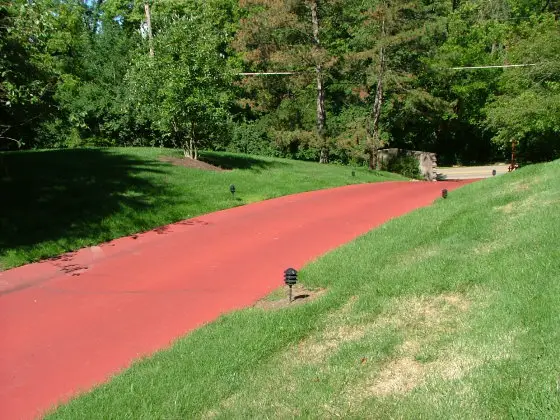
Blacktop Sealer | Your monitor is fine. This is a red blacktop driveway sealer applied by a professional driveway sealing company. Not only do they seal driveways, but they also seal tennis courts on a regular basis. Start thinking outside the box if you want something other than a black driveway. Photo Credit: Tim Carter

Best Blacktop Sealing Checklist - Get Mine and Hire the Pro

DEAR TIM: My asphalt driveway has seen better days. The original deep-black asphalt surface is now gray and the drive has several cracks in it. The surface is not in bad shape. What is the best sealer for the money? What do I have to do to achieve professional results? When is the best time to apply asphalt sealer? Bobbie S., Lolo, MT

DEAR BOBBIE: It sounds to me as if you have captured the perfect moment to save your asphalt drive surface. Of course, if you were from the East coast, I would have said hot top drive, and had you been from the Midwest, I would have mentioned blacktop. It is fascinating how the same paving material is called different names by different people. No matter what you call it, the process to preserve and maintain it is the same.

What are the types of asphalt sealers?

There are two basic asphalt sealer products. One is a simple asphalt emulsion where regular asphalt is suspended in water. Water-based asphalt sealers are earth-friendly as they do not cause ozone pollution. Perhaps the most popular asphalt sealer is a coal tar-based product. Coal tar is a by-product distillate when coal is made into coke for the steel industry.

Do You Want the BEST Contractor to Seal Your Blacktop? 

Go Here and Get my Ask the Builder Blacktop Sealing Checklist!

It's GUARANTEED to help you Hire the BEST CONTRACTOR.

What are the advantages of coal tar asphalt sealers?

Coal tar asphalt sealers have many advantages over their asphalt competitors. For one, they have built-in ultraviolet stabilizers, and as such, they stay blacker much longer than an asphalt-based sealer. Coal tar sealers are chemically different from asphalt, and this difference allows them to resist damage from spilled gasoline, oil, brake, and transmission fluids. These fluids can rapidly eat away at asphalt drives and sealers.

How do you apply asphalt sealers?

To obtain professional results when applying asphalt sealers, you need to do many things. Patience is the first thing you need to pull out of your toolbox. The preparation work can often stretch over several days and possibly a week. The driveway surface must be cleaned. You must remove all fine dirt, silt, mud, oil and any foreign material. You can pressure wash the surface, so long as you do not use so much force as to erode the asphalt surface. Pressure washers are excellent tools to deep clean cracks in asphalt drives.

Once the cracks are clean and dry, you can begin to fill them. Follow the instructions on the label of the crack filling products. Deep and wide cracks will probably need two applications as the material often shrinks as it dries. Many crack fillers insist that their products are thoroughly dry before you apply a coat of sealer. It may take several days for the crack filler to become sufficiently hard so that it can be coated with sealer.

What is the best sealer to purchase?

If you purchase a high-quality sealer, you will not have to struggle to mix it. Most modern, high-quality sealers are formulated as no-stir or easy-stir. It is important to make sure the product is mixed well and homogeneous if you want consistent color results. Your neighbors will know if you slack off when mixing any asphalt sealer. Failure to mix well results in a blotchy appearance with different shades of black. Low cost and quality sealers must be stirred very well as the resins separate from the water.

You should buy one of the highest-priced products since you are a person who lets their driveway sealer wear until the blacktop turns gray. Some people prefer to have a jet-black driveway each season. These people should use low-cost sealers that wear quickly. It is a huge mistake to install top-quality sealers each year. Doing so creates layers of sealer that can actually peel over time.

When is the best time to apply an asphalt sealer?

The best time of year to apply asphalt sealer is when the weather is warm to hot. All too often, people procrastinate and wait until fall to seal their asphalt driveways. Virtually every sealer tells you to avoid applying it if the outside temperature drops below 50 F during the application and drying phase. It simply makes better sense to avoid brushing up against this low temperature. I recommend that you get busy right now while the summer sun is high in the sky.
New Water Heaters are Safer

water heater

New Water Heaters are Safer


DEAR TIM: I was shopping for a new gas water heater and looked closely at the labeling. I never realized that the pilot light and actual burner flames could ignite vapors from flammable liquids. I have a friend who stores gasoline and other flammable liquids in their garage which also happens to be where their water heater is located. Why hasn't their house gone up in smoke? Is the danger real or imagined? Are gas water heaters safe? Should I buy an electric heater? Sally F., Lansing, MI

DEAR SALLY: Existing gas water heaters are safe. The unsafe part of the equation happens to be us. We humans frequently do unsafe things. Stop by your local fire department and ask the officer in charge how many fires they have extinguished that were caused by negligent humans who stored flammable liquids in a very unsafe manner. Common sense should tell you that any flame or spark in the presence of invisible flammable vapors is a recipe for disaster. Loss of life is a reality. But do you need to buy an electric water heater? I think not.

What are water heater manufacturers doing about the flammable vapor issue?

Interestingly enough, the major manufacturers of gas water heaters decided to be very proactive with respect to the flammable vapor issue. With the approval and cooperation of the Consumer Products Safety Commission, these major water heater manufacturers began to jointly study the issue. They shared research and patents while they individually developed separate new gas water heater products that stop the ignition of flammable vapors outside of the water heater. This was a voluntary effort on the part of the manufacturers.

What is a flame arrestor barrier?

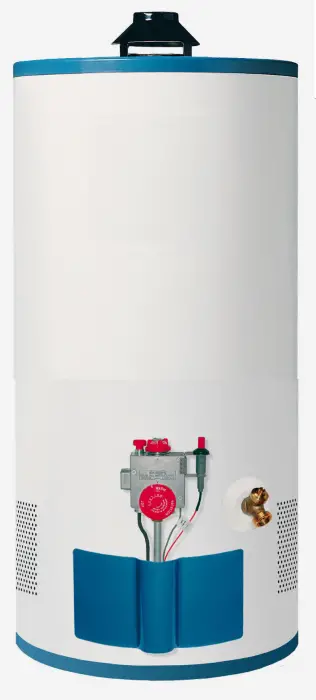
Flame arrestor barriers represent an enormous technological safety advancement for traditional storage water heaters.

Effective July 1, 2003, all new 30, 40 and 50 gallon gas water heaters that use a traditional atmospheric vent must meet a new standard. This standard was written by the American National Standards Institute (ANSI) and it basically states that any heater meeting the above description made after this date must be designed so that vapors created by spilled gasoline near the heater will not ignite outside of the water heater. Thirty, 40 and 50 gallon power vent water heaters must meet this standard on July 1, 2004. All other residential models must meet this same ANSI standard on or before July 1, 2005.

These new heaters are very interesting as they all employ a special one-way technology that allows regular combustion air as well as flammable vapors to enter the combustion chamber of the water heater. But if flammable vapors enter the sealed combustion chamber and ignite, the fire can't go backwards and ignite the rest of the vapors just outside of the heater. More importantly, the heaters have built-in sensors that detect the burning vapors. The designs of the heaters are such that the supply of gas to the heater and pilot light is shut down.


CLICK or TAP HERE to get FREE BIDS from local plumbing contractors.


What is the biggest problem for water heaters?

Perhaps the biggest problem that all of the new water heaters face is lint, dust and oil. In the past, many people were not concerned with dusty and lint-covered appliances in a basement or garage. But the new heaters built with this advanced safety technology will work best when you keep them free of as much lint and dust as possible. As you begin to see these new water heaters in the marketplace note that some will have filters and others will not.

If there happens to be airborne dust and lint in your environment, be aware that this particulate matter can and will find its way into the water heaters unless you stop it in some manner. You may choose to maintain a cleaner environment to stop problems before they begin. You may choose to use a water heater that sports an external filter that is easy to clean. Or you may choose a heater that claims to never need cleaning, although the dust and lint most certainly is accumulating somewhere within the heater. My advice is to do your best to eliminate lint and dust in the vicinity of the water heater and buy a water heater that fits your lifestyle.

How to protect your family from flammable liquids?

If you want to really protect yourself, your loved ones and your possessions, I think the best advice is to schedule a fire prevention meeting at your home with your local fire department. Ask the visiting official about flammable liquids and the absolute safest way to store them. Be aware that these include gasoline, kerosene, paint thinner, etc. I am quite certain the fire official will tell you how to safely store them.

Finally, do not be lulled into a sense of security with these new, safer water heaters. When you buy one, do not think for a moment you can now store or work with flammable liquids and be immune to danger. Gas water heaters are by no means the only thing that can ignite the invisible and deadly flammable vapors!

Edging With Granite Cobblestones

granite cobblestone

Granite Cobblestones Make Great Edging

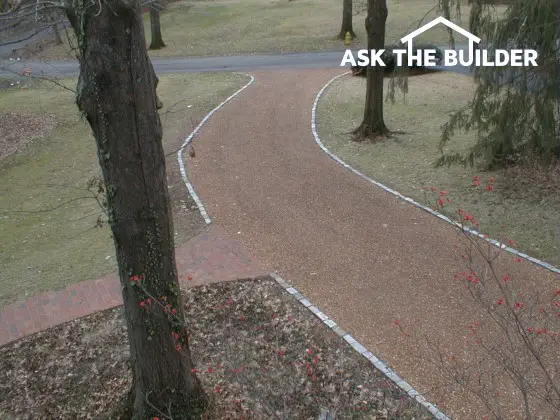
"The cobblestones I have used in the past often served as ballast in sailing ships. They were often unloaded while the ships were in port and used as pavement in many older city streets and roads."

DEAR TIM: I have several gravel garden pathways and a gravel drive. They look swell but I am constantly battling vegetation that creeps into the gravel. Mud will also wash onto both paved surfaces during periods of heavy rain. I am sure you have solved a problem such as this. The trick in my case is to install an edging on a very limited budget. I would also prefer to use a material that is very earth friendly and possibly one that is recycled. Beth D., Worcester, MA

DEAR BETH: You have very strong mystic powers. I have solved the problem of migrating weeds for both past customers and my wife. There are any number of ways to do this some of which are more economical than others. But the solution I have used most often gets the highest amount of praise for both beauty, durability and creativity. As you might expect, this solution will be a bit pricey. But the edging I have in mind is one of the few materials that actually holds its value. In some instances, the materials I use actually are worth more money over time.

Where Can You Find Granite Cobblestones?

Visit any home center, garden center or landscaping supply business and you will see all sorts of garden edging products. Some of these products are metal, while others are wood or plastic. Perhaps the least expensive edging products are the thin plastic ones that have a rounded top. Thin edging material comes in handy if your path and drive are curved. These materials bend around very tight radius curves.

The metal, wood and plastic materials might satisfy your earth-friendly requirement as they could be made from recycled materials. Wood edging that comes from sustainable forests would be a very responsible choice.

CLICK or TAP HERE to get FREE BIDS from local cobblestone contractors.

Why is Granite the Best Edging?

But the material I prefer to use for garden edging is one that meets or exceeds your environmental concerns by a longshot. I have a soft spot for rock-hard stones. In particular, I prefer to use salvaged and recycled granite cobblestones for garden and driveway edging. The cobblestones I have used in the past often served as ballast in sailing ships. They were often unloaded while the ships were in port and used as pavement in many older city streets and roads. Modern redevelopment often unearths these stones and the demolition contractor sells them to landscape supply or stone-supply businesses.

Can You Get New Cobblestones?

You can also buy new granite cobblestones. White, pink and gray are perhaps the most common colors. You may find ones that have been tumbled to produce softer edges. Laborers in India, South America and other nations still shape thousands of cobblestones each day and these imports stream into the USA on a regular basis.

Is it Hard to Install Cobblestones?

Installing the cobblestones is very easy. Typically the stones are only five inches thick. I like to have about 1.5 inches of stone show above the paved surface. This creates a formidable barrier for weeds, grass and mud. If you dig a four-inch deep trench you can install a thin base of coarse sand or small crushed gravel under the stones. This material helps you position the cobblestones as they are very rarely the exact same height. It is very important to keep the top of the cobblestones in the same plane so the edging appears uniform.

Do not install the cobblestones one at a time. I find it is best to dig the narrow trench and then position perhaps 15 or 20 stones in a line or around a curve. Use a short piece of 2x4 to help you maintain the finished height above the gravel surface. After you have the stones positioned, stand back and look at the curve or the line. If it looks good to your eye, then add small crushed gravel on the side that contacts the gravel path or driveway. Soil can be used to backfill the other side of the cobblestones. Use coarse sand or very small gravel chips to fill any spaces or cracks where one cobblestone touches another. This gravel helps lock the stones together.

Can Cobblestones Be Installed in Sections?

If the granite cobblestones are too expensive for you, you have two choices: You can install them a few at a time as you can afford them or you can use a more affordable stone product. There is a distinct advantage when you select recycled granite cobblestones. There is only a finite amount of these worn cobblestones left on the planet's face. People are noticing the beauty and unique character of these stones. As such, the price is actually going up each year for these prized works of Mother Nature. I can tell you for a fact that my wife Kathy thoroughly enjoys the granite cobblestones that tame the grass and plants along our gravel driveway.

Paying A Contractor In Cash

Paying A Contractor In Cash

100 dollar bill cash us currency

Pay a Contractor in Cash | This is the Big Green. It's dangerous to pay a contractor in cash. Be SURE you get a signed receipt and better yet, a notarized affidavit BEFORE handing over the cash.

DEAR TIM: My contractor has offered me a 10% discount if I pay him in cash. This seems like too good of a deal to pass up. Is there a danger in doing this? P. V.

DEAR P.V.: Paying your contractor in cash can be very risky. Generally, building and remodeling projects cost hundreds and thousands of dollars. Usually, business transactions dealing in sums such as these are not done with cash.

WATCH THIS VIDEO to see what a CPA has to say!

What's a Good Way to Pay in Cash?

If you decide to pay your contractor in cash so as not to pass up the deal, you must do several things. I recommend that the payment transaction occurs at your bank at a prearranged time. You should not get the money and take it to your home or to the contractor's office. This is very dangerous.

Get FREE BIDS from Local Remodeling contractors.

Should I Get a Signed Receipt?

The contractor must produce a receipt for the amount you are giving him. Make him sign the receipt in your presence and mark the receipt 'PAID'. Have his signature notarized.

Is a Notarized Affidavit the Best Receipt?

A notarized affidavit is the best legal receipt. This is your protection against a valid mechanic's lien being filed against you and your property. The contractor is swearing under oath that as the date on the affidavit he's been PAID IN FULL for all work. This means that he can't file a valid lien for the days BEFORE the signing of the affidavit. The date on the affidavit should be the same day as you hand over the cash.

Obtain a signed, notarized affidavit from the contractor at the same time. This affidavit should clearly state that all workers and material suppliers have been paid. If they have been paid, they will gladly supply a similar affidavit stating that they have, in fact, been paid. Demand these documents.

Should I get Materialmens' Certificates Too?

Yes, if your state has this document, get those as well. This certificate signed by the material suppliers states that they've also been paid in full for the material they delivered to your home. Not all states require this, so call the supply house accounts receivable employees and ASK THEM. Don't trust what the contractor says. A supply house can also file a valid lien on your property if they've delivered material and NOT BEEN PAID.

After you have received all of these documents and you are satisfied with their accuracy, you can then hand over the cash to the contractor. Remember, do this at your bank in the presence of a bank officer. This person will witness that you, in fact, paid the contractor. This same person is often a notary public and will notarize all of the necessary signatures. Dealing in cash can be dangerous, simply because it cannot be traced. You must have a receipt!

Column 001-3

When To Pay Contractor

DEAR TIM: My contractor has asked to get paid in three installments, 1/3 at each time. Is this fair for both myself and my contractor? J. D.

DEAR J. D.: Not necessarily. The best way to pay your contractor is to make agreeable periodic payments based upon the amount of work he has completed. Do not pay for work which has not been performed.

Get a list of each phase before your project begins

Before your job begins, you must obtain from your contractor a breakdown of the costs of your job. This breakdown will list each phase of the project (demolition, rough carpentry, electric, drywall, contractor's profit and overhead, etc.).

When your contractor submits a bill to you, he must list each category and the amount of work completed for each item. You must verify if it is accurate. Make sure that he is not asking for too much money in any one category.

Pay Contractor as a phase is completed

The contractor is entitled to collect a portion of his overhead and profit at each billing. However, he should only receive an amount in proportion to the percentage of the job which is in fact complete. You should always hold back a portion of the contract amount until the entire job is complete.

Remember, you must always have enough money in your possession to finish all uncompleted tasks as well as a proportional amount of the contractor's profit and overhead. This arrangement is fair to both parties.

Column 001-2

Contractor Cash Advance

DEAR TIM: My contractor has asked for money "up-front" before he starts my room addition job. I don't feel comfortable doing this. Should I give him the money? M. M.

DEAR M. M.: There are very few occasions where you should advance money prior to the start of a project. Only when your project requires a special planning or a custom ordered item which is non-returnable, should you advance money to your contractor.

You should advance only the cost of that item or an agreed upon amount for the planning services. In the event you pay for plans in advance, be sure to stipulate that the plans are your property, not the contractor's. Certain state laws may also allow or require cash deposits. If you live in such a state, be sure that the deposit does not exceed the maximum amount allowed by law.

Many contractors have established credit with their suppliers. They pay these companies on a monthly basis. Often these same terms are available with subcontractors. These individuals sometimes will often be satisfied with a payment from a general contractor within 15 to 30 days of completion of their work.

CLICK HERE to get FREE & FAST BIDS from local remodeling contractors.

Rest assured that your contractor will not pay his suppliers in advance for standard in-stock items. I absolutely can guarantee you that he will not pay his subcontractors in advance. If a contractor needs money prior to the start of a project, it is possibly a sign of his financial weakness. Maybe this individual does not have established credit. Maybe he is in a cash pinch because of poor business management.

The deposit from your job may be used to pay bills on his current job or maybe even a past one! Advancing money up front reduces your leverage power at the end of the job. Why? Because you are also basically giving the contractor his profit before he has started the project. This is an extremely dangerous thing to do.

Financially strong contractors do not need money at the beginning of a project. They generally have sufficient cash reserves to carry a project for 30 or more days. Contractors pay their suppliers and subcontractors on a regular basis for completed work or delivered supplies. You should consider doing the same with your contractor.

CLICK HERE to get FREE & FAST BIDS from local remodeling contractors.

Column 001

Preconstruction Anxiety

DEAR TIM: My wife and I are getting ready to start a large room addition project. We are both experiencing anxiety. Our contractor is as cool as a cucumber. Is this normal? A. N.

DEAR A. N.: Generally speaking, yes. Your feelings of anxiety are well founded. The project you are facing is complex and will be very disruptive.

You will have to make numerous decisions. Sometimes, you will not be given much time to think about them.

You will host strangers on a daily basis. Your normal daily routine will be disrupted. There possibly will be massive quantities of dust.

Your contractor, on the other hand, does this for a living. He is accustomed to the difficulties. He will hopefully deal with them so as to minimize the disruption you will experience.

If you have selected a good contractor, his "cool as a cucumber" attitude is probably a result of his confidence.

If you are unsure, ask him pointed questions as to how he intends to deal with your concerns. Hopefully, his answers will relieve your anxiety.


Construction Blueprints

DEAR TIM: My husband and I want to remodel our kitchen. We would like to relocate the sink, install a larger window, new cabinets, etc. Do we really need "plans" or can we just tell our contractor what we want? E. G.

DEAR E. G.: You need plans. Every successful project has a plan. A plan can be a highly detailed set of blueprints or a simple set of written instructions accompanied by some simple sketches.

A well thought out and detailed plan verifies that what you want to do is possible. This is a vital step in the building process which is frequently overlooked. Countless projects have been started without a plan only to find out that what you or the contractor wanted to do is not possible. When this happens, you generally get stuck with paying for the mistake.

The plan also becomes the core of the contract between you and your contractor. It serves as the only viable way of communicating what you want to the contractor. Plans are a must, don't get stuck without one!


How would you like me to build your new home? It's probably impossible for me to fit your job into my schedule, but I will gladly share hundreds of my tricks and building secrets with you and your builder. Check out my New House Specifications.


Contractor Bid Differences

DEAR TIM: I just received five bids for my remodeling job. There is a wide difference in prices and work to be done. Why so much confusion? T. T.

DEAR T. T.: You did not have clear and concise plans and specifications for the contractors. You probably talked to each contractor and told him what you wanted.

Each contractor has figured the job differently. There is no guarantee that each contractor is going to do the same amount of work as the others. Some may have bid doing too little, others bid doing too much. They may be using different materials. They possibly are using the wrong materials for the job.

This confusion can be avoided by having precise instructions for each contractor to follow. These instructions can be a basic set of plans and specifications.

These plans and specifications have specific information which contractors must follow. Each contractor must perform the same task or set of tasks.

When you have contractors bidding using specific instructions, the bids should be very close in price. This should make it very easy for you to determine who can give you the best value for your money.

Eliminate Delays with Job Schedules

DEAR TIM: We are getting ready to do a major remodeling of our kitchen. We want to eliminate delays so that we can use our kitchen again as soon as possible. What steps can we take to achieve this goal? Q. T.

DEAR Q. T.: In a nutshell, you must do extensive 'preplanning' and scheduling of materials shipments and workers to eliminate delays. It is possible to eliminate delays, however, your planning must be flawless.

The first step is to make sure that you have an excellent set of drawings for your project. Your contractor and his sub-contractors will rely on these documents heavily. If there is an error on the plans you will have a delay. I guarantee it.

Before any work begins, you must request from your contractor a very detailed schedule of how long each aspect of the job will take. There are many aspects to the job, so make sure that they are all listed. Make a separate list of all the materials you intend to use for your job. You must pre-select every item. Remember, some items will have to be ordered.

Ask each supplier how long it will take to obtain each item. Add a minimum of 3 days to whatever you are told. Request order confirmations from all suppliers, because , believe me, people forget to order things. Make repeated follow-up phone calls to insure that things are on schedule.


How would you like me to build your new home? It's probably impossible for me to fit your job into my schedule, but I will gladly share hundreds of my tricks and building secrets with you and your builder. Check out my New House Specifications.


After you have all of this information, you must create a simple time line chart showing when each aspect of the job will occur. You must prepare this chart, because each sub-contractor and material supplier will need to see when his services or goods are required. Distribute a copy of this chart to all parties and ask them if it is reasonable. If they agree, cross your fingers and hope for the best. Remember, once the project is underway, make frequent reminder calls to all suppliers and workers to keep your project fresh in their minds.

Adding to a House BookNo builder or designer's library should be without Adding to a House written by Philip Wenz. Here is the ideal book for designers and builders who understand basic construction but have not had access to a single source of information that covers the entire process of planning, designing and building an addition. Adding to a House is also perfect for home owners who intend to contract the work out and want to understand the process so they can make intelligent decisions and work effectively with people they hire. This book will help you avoid costly mistakes, make sure no potential problems are overlooked and handle tricky construction details. By following the advice in this book designers, builders and home owners will be able to create an addition that solves space problems and increase the value of a house. This book is published by Taunton Press, one of my favorite book publishers, and has wonderful color photographs and easily understood illustrations.