Cellulose vs. Fiberglass

Be sure to read the special Author's Note at the end of this column. It provides updated information on this topic.

DEAR TIM: I would like to upgrade my attic insulation. However, I understand that fiberglass insulation is now considered a suspected carcinogen. Cellulose insulation, I've been told, possibly is a fire hazard. Can you help with this dilemma? Also, are there any factors that affect the R-values of each material? C.T.

DEAR C. T.: The information you heard about concerning fiberglass being a suspected carcinogen is correct. In July of 1994, the federal government labeled fiberglass as a substance that quite possibly could be a carcinogen. However, the U. S. Department of Health and Human Services, in a letter to Congress, exclaimed that they felt that fiberglass does not pose a threat to persons in their daily lives.

The risk appears to be centered around the fact that when installing either blown or batt type fiberglass, small glass fibers become airborne. These fibers can then be inhaled into your lungs. This can in fact happen. Years ago, as an uninformed rookie, I installed fiberglass without using a facial mask. After working with the material for several hours, I could feel the fiberglass in my throat.

However, once installed, fiberglass is almost always covered with some material. Or, it is in an attic space where it can not be easily disturbed. This is why it does not pose a serious health threat to the average person.

Fiberglass manufacturers have responded to this concern. You can now purchase fiberglass batt insulation that has a combination plastic and kraft paper covering. The back side usually has small perforations in the plastic to prevent the buildup of water vapor within the insulation.

Cellulose insulation is made primarily from recycled newspaper. Yes, newspaper is very flammable. However, cellulose insulation is treated with either sodium borate, boric acid, or ammonium sulfate. These chemicals, which have been deemed safe for humans, make cellulose insulation fire retardant. These chemicals also repel rodents, insects, and mold.

However, I have a concern about quality control when the chemicals are applied to the ground up paper. What happens if the chemicals are not mixed correctly? What happens if not enough chemical is applied? Is it possible for there to be a malfunction at the factory and you receive a bad batch? How can you test for yourself that enough chemicals have been applied?

These chemicals apparently retain their ability to retard fires in the hot temperatures found in many attics. However, there have been instances when cellulose has indirectly caused a fire. This usually happens when either type insulation is installed in direct contact with an older style recessed lighting fixture. The insulation traps the heat created by the light bulb. This, in turn, causes the lighting fixture to overheat. Some modern recessed fixtures have thermostats within the fixture that turn the light off if it begins to overheat.

Settling of blown insulation can affect its long term R-value. R-value is the term used to measure the flow of heat through an object or material. A higher number indicates that the object or material has a higher insulating capability.

Most blown-in fiberglass and cellulose insulations settle, or compact, after installation. Cellulose seems to settle more than fiberglass. Some fiberglass manufacturers have developed newer loose fill fiberglass that evidently does not settle. Once it has settled, fiberglass has an R-value of 2.1 - 2.7 per inch, while cellulose has an R-value of approximately 3.0 per inch.

Loose fill blown fiberglass insulation has another slight problem. As the temperature difference between the living space and attic increases, the R-value of blown fiberglass diminishes. In extreme situations, such as the upper Midwest, this reduction in R-value approaches 50 percent.

This phenomena seems to occur as a result of thermal convection. The trapped air molecules in the insulation are pulled up through the insulation into the colder attic air. This problem has been successfully solved by installing fiberglass batt insulation over the top of loose fill or blown insulation.

The bottom line is that cellulose can burn, but fiberglass will not support combustion. Fiberglass may melt in an extreme fire, but will not add to the fire load. Choose your insulation wisely.

Author's Note:

Routinely I am blessed to hear from professionals and industry experts who share in-depth and updated information about a topic. You'll absolutely want to read the letter I received from the President of NAIMA (North American Insulation Manufacturers Association). It really helps clarify some of the points I just touched on in this column.

...

I received this very interesting email from E. G. who is a remodeling contractor. He related to me a frightening incident that happened on one of his jobs in 1997, in Champaign, Illinois:

"I just read your article comparing the virtues and vices of Fiberglass vs. Cellulose Insulation. Let me share with you an anecdote from my own personal experience.

A few years ago, I was remodeling a room in a client's home -- moving a wall, adding a skylight, stuff like that. I finished mudding the drywall about noon and headed home for the day. Two hours later, I got a call from the homeowner, telling me that the job would be delayed for awhile.

After I left, the electrician doing some work in the attic had set his trouble light down in the cellulose insulation. He then went down to his truck for a bite of lunch.

I'm sure you can tell where this is going: the "fire-retardant" cellulose insulation caught fire, and by the time the fire trucks arrived, a big hole was burned in the roof, and my lovely new work was ruined.

You say in your article that the fire hazard of cellulose insulation has been magnified. Perhaps it has. But having seen it with my own eyes, I can't trust the ground up newspaper insulation any more. For my money, it's fiberglass all the way. I've never heard of it catching fire."

Eric Gentry
Anti-Scald Tub and Shower Faucets

DEAR TIM: My wife has requested that I install a new anti-scald tub and shower faucet. I told her that I could eliminate the possibility of scalding by simply turning down the temperature on the hot water heater. Will this work? Do the anti-scald valves really work, and if so, just how do they regulate the water temperature? P. G.

DEAR P. G.: Beware! Turning down the temperature on your hot water heater is not the answer. Installing an anti-scald valve is the best way to minimize your chances of being scalded by hot water.

Hot water is a real danger. A person can receive a blistering second degree burn in several seconds as water temperatures approach 150 - 160 degrees F. It is a very real possibility for water to leave your water heater at or above this temperature, even though your water heater's thermostat is set at a much lower temperature.

The cold water which enters your hot water heater does so through a long tube called a dip tube. This tube extends almost to the bottom of the hot water heater. The thermostat for virtually all hot water heaters is located near the bottom of the tank. Herein lies the problem.

Water temperatures within hot water heaters are not always uniform. In fact, there can be a huge difference in temperature between the water at the top of the tank and the cold water entering the bottom of the tank. The temperature difference at the top of the tank, away from the thermostat, can be up to 30 degrees hotter than the thermostat setting. This means that if your thermostat is set at 120 degrees F, water can leave the tank at up to 150 degrees F.

Some anti-scald valves can protect you against this danger. However, it requires a specialized thermostatically controlled valve. The problem is, a large majority of anti-scald valves purchased by homeowners and plumbing contractors are not this type. The most popular anti-scald valve currently sold is a pressure balance type valve. Current plumbing codes allow either type to be installed.

The pressure balance valve controls water temperature by sensing pressure differences between the hot and cold water pipes that feed the valve. You can get scalded by pressure differences. If you happen to be showering and another individual somewhere else in the house turns on a hose or flushes a toilet, the pressure and volume may change in the cold water line leading to the shower faucet. This may cause the temperature of the water coming from the valve to increase, even though the hot water was not turned up.

However, pressure balancing valves have a slight drawback. When they are installed, they have a high temperature limit stop which allows you to set the maximum temperature of the water which comes from the shower head. This setting is based upon the temperature of the water leaving the hot water heater. If you make an adjustment on the thermostat of your hot water heater, either up or down, after you have installed the valve and adjusted it, the temperature of the water coming out of the shower or tub faucet will be directly affected. Remember, the pressure balance valves react to pressure, not temperature.

The ultimate tub and shower faucet is one that can adjust for both temperature and pressure differences. These valves can be expensive. They also have minor drawbacks as well. Once you have selected a water temperature, often it can't be readjusted unless you turn the valve completely off.

Granite and Marble Flooring

DEAR TIM: I'm giving serious consideration to using granite and/or marble as a flooring material in an upcoming building project. Will they both perform equally? How about stain resistance, durability, and care? Are there any natural stone product alternatives that you might recommend? A.C.

DEAR A.C.: I must compliment you on your taste and choice of building materials. Both granite and marble are wonderful flooring materials. These materials have seen explosive growth during the past 5-10 years. Marble sales have increased approximately 400 percent during the past five years.

Believe it or not, during the past ten years, hard stone products have experienced an incredible 2,000 percent growth in sales. There is no doubt that homeowners have discovered the advantages that commercial builders have known for quite some time. Aside from flooring, homeowners are using marble and granite as countertops, back splashes, tub platforms and surrounds, and fireplace surrounds and hearths.

Both marble and granite are natural stone products. Recalling my college days, as a geology undergraduate, marble is a metamorphic rock. Limestone, when subjected to various high temperatures and pressures within the earth, recrystallizes into marble. For years, much of the fine marble used in building was quarried in Italy. However, fine marble is now quarried in Mexico, China, Spain, and the former Soviet Union.

Granite is a fine to coarse grained rock which often contains quartz, feldspar, and mica crystals. It can form as a result of igneous (volcanic) or metamorphic geologic activity. The presence of quartz in granite gives it incredible durability and hardness characteristics. Granite is almost always more durable than marble.

Because granite and marble are natural products, they exhibit a wide range of stain resistance. Marble is more porous than granite. Certain marbles can stain quite readily. Common household liquids such as orange juice, nail polish remover, shampoo, and even water can cause serious stains in certain marbles. Granite, on the other hand, is very stain resistant. Professional installers recommend the use of neutral pH breathable sealers for both marble and granite, once they have been installed. These sealers need to be reapplied on a regular basis, depending upon how much use or foot traffic that the marble or granite is exposed to.

If you choose to use marble for an entrance foyer, it might have to be professionally cleaned and resealed every 12 - 18 months. Marble used in bathrooms and kitchens should be cleaned and resealed every 9 - 12 months.

There are several alternative natural stone products that might interest you as well. Slate and terrazzo make beautiful and durable floors. Terrazzo is very unique. It is made by mixing different colored marble chips with colored cement and / or epoxy. This mixture is honed and polished to a mirror like surface. By using a variety of different colored marble chips, you can create virtually any colored floor or pattern. Terrazzo requires virtually the same care as natural marble flooring.

Slate is a unique flooring material. It is available in shades of green, brown, red, and mottled green. It is very durable, and when sealed it is virtually stain proof.

All of the stone products, except for terrazzo, are installed similar to ceramic tile. They are available in different sizes, commonly 12 x 12 inch squares. Slate often is available in random sizes that fit together in a pattern. The thickness of the materials varies, depending upon what you choose. However, most flooring pieces are either 1/4, 3/8, or 1/2 inch thick. Visit your local stone products center and see the wide variety of products that are available. I'm sure that you will not waste your time.

Column 056

Replacing Cabinets

replacing cabinetsDEAR TIM: My husband and I just got back from looking for new kitchen cabinets. We are so confused! We know what stock cabinets are, however, there doesn't seem to be a big difference between semi-custom and custom cabinets. What is the difference? Can you offer any suggestions regarding current trends? Also, is there a standard of quality that manufacturers must meet? J. T.

DEAR J.T.: Your confusion is very understandable. Many of my customers have returned from a day of cabinet shopping dazed and confused as well! A large part of the problem lies in the huge variety of styles, types of cabinet construction (frame vs. frameless), finishes, and accessory trim pieces. Do not underestimate the time it will take you to view all of the options that are available to you. Often it can take 2 - three days to visit different cabinet shops.

Semi-custom kitchen cabinets are factory-produced on assembly lines. Manufactures of these cabinets often allow you to select specific door styles, wood species, and stain finish types. These cabinets usually offer a wide variety of interior options such as cutlery trays, drawer dividers, towel racks, cookie sheet holders, trash can holders, etc. Often these cabinets are built using stock cabinet sizes. Separate cabinets are butted against one another in a typical installation. Some manufactures offer custom size possibilities.

Custom kitchen cabinets are made solely for your kitchen. They result from extremely specific measurements and detailed design criteria. They can be very personalized, down to exact drawer sizes for specific items. Often these cabinets are made by local fabricators who can produce furniture grade quality.

Custom cabinets offer a unique feature. A fabricator can assemble a single base cabinet or wall cabinet that is 6 - 8 feet long without seams. This cabinet can have a variety of doors, drawers, etc. depending upon your wants. Because it is one piece, installation time is minimal.

Current design trends appear to be leaning toward making kitchen cabinets look as close to furniture as possible. Some manufacturers offer a wide variety of accessory trim pieces such as crown molding, valances, cabinet legs, and highly customized appliance panels. These items, when professionally installed, can produce dramatic effects.

There is a minimum standard of quality which you should look for. This quality standard has been developed by the Kitchen Cabinet Manufacturers Association (KCMA, www.kcma.org). The quality standard covers virtually every aspect of the cabinet's construction. Joint tightness, hinge, doors, rigidity, corner bracing, finishing details, and other details are checked in a series of more than 60 specific tests. These tests are conducted by independent testing laboratories approved by the KCMA.

Cabinets which pass these tests are eligible for the KCMA certification seal. Manufacturers must regularly provide cabinets for testing in order to continue to bear the KCMA certification seal.

You should pay particular attention to the finishing process and types of finish that your cabinets will receive. Remember that the KCMA standards, just like many standards, are minimum quality standards. Many normal foodstuffs, such as vinegar, fruit juices, olive oil, and mustard can possibly damage cabinet finishes that do not meet KCMA standards. Some detergents, alcohol, and water can also harm finishes. Ask detailed, specific questions regarding the number and types of finish coats that your cabinets will receive. Ask how thick the combined layers of finish are. Ask if the finish will dull or yellow with age. Remember, the finish takes the abuse, not the wood.

Electronic Tools For Home Use

DEAR TIM: Every time I visit my local home improvement center, I seem to see another new exciting electronic tool. Just what tools are you aware of? Are these tools safe in the hands of a homeowner, or should they only be used by professionals? Also, are the manufacturers' claims of accuracy, dependability, etc. factual? What is your personal experience with some of these tools? E. R.

DEAR E. R.: I share your excitement with respect to electronic tools. The industry has experienced fantastic growth during the past few years. Not only have sales gone through the roof, but new products seem to be introduced to the marketplace on a monthly basis. I only wish that some of these tools had been available years ago. There is no doubt that all of these tools would have saved me vast sums of time and money on my building and remodeling jobs!

Currently, I am aware of a wide variety of electronic tools. Electronic building calculators, electronic levels, ultrasonic measurement devices, laser levels, and ultrasonic sensing devices are currently on the market. I have been told that a new ultra wide band radar tool capable of "seeing" through concrete is ready to be released as well.

electronic calculator

This is the type of calculator you should own if you're going to build a new home. It allows you to CHECK to make sure things are SQUARE!!!

The electronic calculators are very interesting. They have many unique features such as the ability to add and subtract fractions, conversion to any dimensional format, including metric, automatic solutions for roof framing, instant solutions for circle area and circumference, and much more. If you like to work with electricity, you can even purchase a specific calculator which solves many common electrical problems.

The new electronic levels, I think, are very exciting. These items operate on a nine-volt battery for up to 500 hours. They are extremely accurate. Some models even let you control the degree of accuracy. Several of these levels allow you to choose the mode in which to work. The display will indicate a simulated bubble, degrees, percent either slope, or pitch. Some levels feature a hold button which can freeze a reading on the display, in case the level is in a hard to read location. You can also purchase an electronic water level which can be used by one person. This level allows you to create level marks around corners and across rooms by simply listening for a tone.

The ultrasonic measurement devices are fantastic tools if you hate fiddling with a steel or wood tape measure. What's more, several of these can measure, using a narrow ultrasonic beam, up to 60 feet with 99.5% accuracy. Some models are equipped with an aiming light which allows you to aim the device directly at what you are measuring. These devices are also calculators which can measure instantly the area and volume of a room. Virtually every device offers format conversion.

The laser levels I have seen are wonderful. In the old days, it required two persons to operate an optical level or builder's transit. Laser levels require only one person. You simply set the level up, turn it on, and watch for the rotating red beam of light. The light beam strikes whatever surface you are working on, or if out in the open, it strikes a reflective target pole which you adjust up or down. These levels are very handy.

Soon to be released is a new radar tool. This tool will enable you to see right through concrete or walls. The results will be displayed on a screen. You will be able to clearly see pipes, wires, studs, etc. The current sensing devices are useful for finding studs, however, this new device represents a giant step forward.

I personally feel that you or any homeowner can operate these tools and obtain professional results. I have used many of the tools and have never been disappointed. These tools will serve you well for many years, however, you must handle them with care. The accuracy of the tools depends upon their often sensitive, electronic components.

Asphalt Shingles and High Winds

DEAR TIM: Within the past few weeks, I had a new asphalt shingle roof installed on my house. Several days after the roof was installed, a fierce winter storm blew 30 percent of the shingles off my house. The manufacturer has indicated that the shingles were improperly installed. My roofer disagrees and says that the self sealing compound didn't work properly. I'm in the middle. What do you think? Also, the manufacturer noted that felt paper was not installed under the shingles. Was this a mistake? J. M.

DEAR J.M.: Based upon the photographs you sent to me, I feel that the manufacturer is telling you the truth. There are numerous problems with the workmanship on your roof. There is a chance that the self sealing compound is defective, however, this can easily be tested.

Asphalt shingles are far and away the most common roofing material used by American homeowners. They are well engineered and, when properly applied, will provide many years of leak-free performance. Unfortunately, your shingles were not applied properly.

The self sealing compound that your roofer is speaking of is a thermoplastic asphalt compound. It is a common ingredient of virtually every asphalt roofing shingle currently manufactured. This compound was introduced, at first as an option, during the mid-1960s. Its purpose is to bond each shingle to the one immediately below it. When the bonding process is completed, the shingles are less likely to develop wind-related leaks and failures.

This self sealing compound is activated by heat from the sun. In your case, a majority of your shingles didn't stand a chance. The greatest amount of wind-related failure on your roof occurred on the exposure which faces north. That portion of the roof, in your geographic location, doesn't even receive direct sunlight until April. The installation of asphalt shingles, in colder climates, during the winter months is not always prudent. If you wish to test the integrity of your self sealing compound, simulate the heat of the sun with an electric hair dryer. Do this inside with some of the pieces of the shingles that are scattered about your yard. Don't climb on the roof this time of year!

Your photographs also indicated two major problems. Many of the nails that were used to install the shingles were driven in the wrong location in each shingle. In many cases, they were installed through or above the self sealing asphalt strip. This practice is clearly wrong. Because your roofer was installing a shingle which exposes 5 inches of the shingle to the weather, the nails should have been installed 5 5/8 inches up from the bottom edge of each shingle. A minimum of four nails should be used for each shingle. If you live in an area subjected to high winds, a minimum of six nails should be used.

The starter course of shingles was also improperly installed. Your roofer simply rotated a full shingle and applied this under the first course of shingles. This is unacceptable. The starter course, or strip, is made by trimming the bottom 5 inches from a standard shingle. This places the ever-important self sealing compound at the bottom of the roof. This prevents wind from lifting the first course of shingles.

Felt paper is a must. Roofers that fail to use it under asphalt shingles are making a big mistake. Without felt paper, your shingles lose their fire rating. Shingles, in and of themselves, are not fire rated. They are a component of a system, of which felt is an important part. Felt also helps to prevent leaks from wind driven rains that may, somehow, penetrate the shingles. Imperfections in the wood decking also can be a problem in the absence of felt underlayment. These imperfections will more readily telegraph through today's thinner fiberglass shingles. Finally, many manufacturers will not warrant their shingles unless felt is used over a bare wood deck. It's that simple.


Garage Door Spring Adjustments

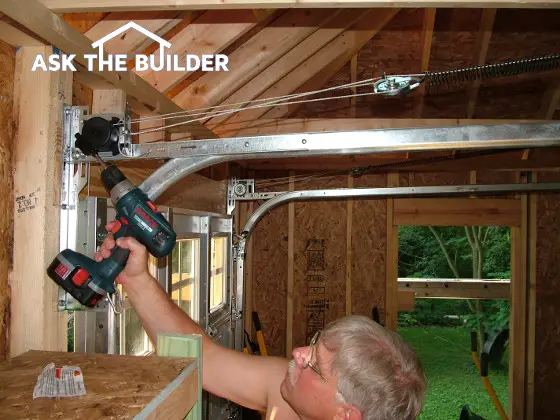
garage door springs

PHOTO BY: Kathy Carter

DEAR TIM: My husband and I recently purchased a house that is approximately 15 years old. It has an overhead garage door which is approximately 16 feet wide. I can open it, however, it takes quite a bit of effort. My husband says he can adjust the door so that I can open it with less effort. I would like to have an automatic opener installed. Can my husband make simple adjustments which will permit me to open the door? Do you think we can install an automatic opener successfully? L. M.

DEAR L.M.: Unless your husband works full time for a garage door service company, don't let him adjust the springs on the garage door. Garage door springs can be extremely dangerous. You must treat them like loaded weapons. Many a homeowner has been seriously injured by garage door springs and the cables which are attached to them. Garage door springs should only be adjusted by knowledgeable, professional individuals.

Garage doors are large, heavy mechanical objects. When you stop and think about it, they frequently are the biggest moving thing in your home. Your door, for example, probably weighs between 300 - 375 pounds. Give that some thought the next time you walk beneath it.

Garage door springs are designed to do virtually all of the work necessary to lift your garage door. They simply need a little help from you to get the job started. When garage doors are in the closed position, the springs are stretched very tightly and in their most dangerous state. The cables that are attached to the springs are under tremendous tension. Never loosen any hardware which is attached to a cable or spring.

In your case, I believe that your springs are either worn out or out of adjustment. Think how much force those springs must exert to lift your 300 + pound garage door. Think how many times in 15 years they have lifted that garage door. You would be tired too!

Very few homeowners are aware that garage doors require periodic maintenance. The hinges, rollers, springs, pulleys, cables, etc. are subject to wear and tear every time the garage door is operated. Rollers have been known to break when a door is opening. The result of a failure such as this can be catastrophic. Garage doors have been known to fall on top of a car, a person, or the garage floor. Regular routine inspections can prevent accidents such as these.

If you are mechanically inclined and have the proper tools, you can successfully install an automatic garage door opener. However, you must have the door springs adjusted prior to installing the opener. If the door springs are not adjusted properly, the life expectancy of the opener can be significantly reduced. Remember, the springs are supposed to open the door, not the opener.

When installing the opener, be sure to follow the manufacturer's instructions to the letter. Mount the push-button wall control at least 5 feet above the floor. Small children love to push these buttons and often play games with moving garage doors. Should the built in safety features fail, tragedy is a real possibility. Also, try to disguise or hide the remote transmitters as well. Don't tempt children with these playtoys.

Finally, after installation of the opener, test the door to make sure the door automatically reverses. Virtually every new opener is equipped with infrared detectors mounted low to the floor. These detectors sense if someone or something walks beneath the door as it is closing. The openers also are equipped with sensing devices that tell the opener if it is striking an object before it is fully closed. These sensors, when adjusted properly, will also reverse the door and send it back to the open position.


The Contractor Selection Interview

DEAR TIM: I am really frustrated. Before awarding the contract to build my new home, I went to great efforts to hire a knowledgeable builder. However, after moving in to the house many problems have begun to surface. In many instances, the materials were not installed according to manufacturer's recommendations. I know that many other homeowners have suffered this fate. Is there a solution? B. R.

DEAR B. R.: I am sorry to hear about your misfortune. You are correct. There are thousands of homeowners who have been victimized by unknowledgeable and non-professional contractors. In many instances when problems arise, these individuals try to cast the blame on product or material failure. There is a solution, however, the problem will not be solved overnight.

The construction industry is a very unique field. It is one of a few professions where no formal education is required. On a very routine basis, individuals purchase trucks, tools, and business cards and become builders, remodelers, or sub-contractors overnight.

As a builder, I encountered numerous builders, remodelers, and sub-contractors who rarely, if ever, had read technical journal information regarding their trade. Vast numbers of these individuals had learned their trade by either observing other craftspeople, listening to verbal instructions, or learning from their past mistakes. In other instances, individuals relied upon information given to them by supply house employees. These methods of learning are not always acceptable, as the instructions are not always based upon facts.


How would you like me to build your new home? It's probably impossible for me to fit your job into my schedule, but I will gladly share hundreds of my tricks and building secrets with you and your builder. Check out my New House Specifications.


The building and remodeling industry is very aware of the problem.National and local associations are attempting to broaden the educational opportunities for their members about all aspects of the profession. Educational seminars are becoming a regular attraction at national and regional conventions. These associations are making significant progress, however, they can only educate those individuals who want to learn. Vocational education is also beginning to make a comeback. These programs often allow individuals to blend both textbook and on the job training.

Numerous manufacturing associations exist which also have enormous resources with respect to written information about the proper installation of their product. Much of this information is available at no charge to a builder or homeowner. Often these associations have training videos as well.

The past decade has also seen enormous growth in the amount of high quality books, magazines, periodicals, etc., that have very in-depth educational articles concerning every aspect of residential construction. Individuals who work in construction who regularly read these materials can easily keep abreast of the most up-to-date construction techniques and technologies.

When you decide to hire a contractor in the future might I suggest a few things. Ask the individual if he or she has any professional designations. Ask if they are a member of an association. Call the association's local chapter and see if the individual attends meetings on a regular basis. Ask the individual if he or she attended the most recent national or regional convention.

Finally, consider asking the individual what magazines / periodicals he or she receives on a regular basis. See if it's possible for this individual to bring the most recent issues for you to browse through. Judge for yourself the depth of the editorial content of these items. Education is an ongoing process. It requires continuous reading on the part of a professional. Make sure you hire a professional who reads on a regular basis.

Author's Notes - March 26, 2004

Yesterday, I had the good fortune to be deposed as an expert witness in a civil lawsuit. I do this type of work on a routine basis. In this particular matter, the attorney who represents the homeowner (plaintiff), hired me. The attorneys who represent the defendants wanted to ask me questions so they can gauge the strength of their case.

There were three attorneys who were asking me questions. One represented the builder, one the bricklayer and the third the painter. The lead attorney who represented the builder, during the course of his questioning, produced a copy of the above column you just read. It, of course, did not contain these comments I am now writing.

Just prior to presenting the column as an exhibit in the deposition, the builder's attorney was asking me all sorts of questions about many of the above points. He was trying to see if I met the criteria for being a good or great builder.

The point of the above column is simple. A great builder does not necessarily do all of the things above. He or she may only do half of them. There may be a rare individual who is an excellent builder who has never been to one convention nor read any technical journals. Maybe this person possesses mystic powers that keep him up to date with what is going on.

I have attended many conventions. As I was driving home from the deposition, I remembered clearly attending numerous seminars at a Remodeling Magazine convention. I subscribe to Fine Homebuilding and the Journal of Light Construction. Technical journals and bulletins from numerous associations grace my bookshelves. I am a member of NARI. Much of the data you read in my columns comes from one-on-one conversations I have with the top scientists in the field or with product managers who actually see a new product go from the drafting board to the store shelf.

But even still, this particular attorney was trying to discredit me by making me say I don't do everything I wrote above. He missed the point entirely. Hopefully you won't.

Many of you are probably thinking the same thing I thought as I drove home. Wouldn't you love to ask him how many law conventions he attends, how many different trade publications he reads cover to cover on a regular basis each month, how many different associations he belongs to, etc.?

But that is just a fantasy - neither you nor I will ever get to ask him those questions. My hunch is if we did get to ask him, he would probably ignore us. TC

Cast Iron Plumbing Pipe – It’s Quiet!

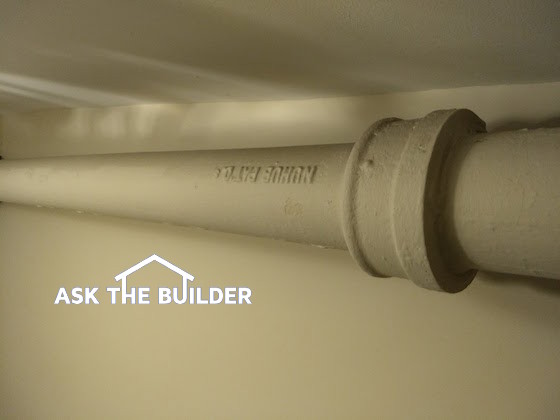
Cast Iron Pipe

Here's a typical cast iron drain pipe. It's suspended from the ceiling in a stairwell in one of the oldest buildings in Southwest Harbor, Maine. You can see how the lettering is cast into the pipe. Copyright 2018 Tim Carter

DEAR TIM: I recently was visiting with some friends. While sitting in their family room, I heard water rush down the wall next to me. It was very objectionable. Evidently, someone had just finished using the toilet facilities in an upstairs bathroom. I don't have that problem in my older home and I'm afraid it might develop over time. What caused the noise? Is the problem avoidable? W. D.

DEAR W. D.: Based upon your description, your friends' plumbing drainage system is constructed of either PVC or ABS plastic piping. This piping material was introduced in the early 1970's. These products were sold on the basis that they were cheaper and easier to install than cast iron and galvanized piping. However, plastic piping materials have two major drawbacks: they are very noisy and they expand and contract readily.

You do not have the problem in your home because your drainage piping is constructed of cast iron. Cast iron plumbing pipes are very durable and quiet. Cast iron piping installed 372 years ago in France is still in service. The same is true for cast iron installed in the White House during the 1800's. Rest assured that the noise problem will not develop in your present home.

Cast iron piping manufactured today is very different from the cast iron piping made at the turn of the century. Cast iron pipe, years ago, used to be static, or sand cast. This method allowed for wide variances in pipe wall thickness. Also, the sand casting methods often produced tiny pinhole leaks. The old pipes were connected by inserting the spigot end of one pipe into the hub end of another pipe. This joint was then partially packed with oakum (hemp impregnated with tar). Molten lead was then poured into the joints to complete the seal. The process was very labor intensive.

New cast iron pipe is cast using a centrifugal spinning process. This process assures consistent pipe wall thicknesses. Many manufacturers water test their pipe to check for leaks. Cast iron fittings are still static cast, however, modern casting methods assure high quality pieces. The cast iron pipes and fittings of today are joined with rubber and stainless steel clamps. Believe it or not, cast iron piping can be installed faster than plastic piping.

Cast iron plumbing is very quiet. This results from its dense molecular structure and the use of rubber between sections of pipe and fittings. The rubber gaskets and seals isolate the pipes and fittings and help to absorb sound vibrations. The sounds you heard at your friends' house were created by the vibrations of the water bouncing against the sides of the lightweight plastic piping. Plastic piping can also create popping noises when hot water passes through it. The plastic pipes expand and often rub against the wood framing members inside of walls. Cast iron piping will rarely, if ever, cause this problem.

Should you decide to build or remodel, cast iron piping is also very affordable. In fact, it only costs on average, $150 per bathroom to upgrade to cast iron pipe. You can minimize this extra cost by using both cast iron and plastic piping in your home. Use cast iron for all of the drainage pipes that handle water wastes and use plastic piping for all of the fixture vent pipes.

Cast iron is also environmentally friendly. It is made from 100 percent recycled scrap iron and steel. Should your home be demolished in the future, you can recycle cast iron. Plastic piping, on the other hand, can not make these claims. The solvents which are used to weld the pipes together are highly toxic. They produce fumes which dissipate into the atmosphere. In order to avoid becoming sick while using these solvents, adequate ventilation becomes a necessity. Plastic piping is not easily recycled. Often it ends up devouring space in our dwindling landfills.

Rustproof Wood Siding Nails

DEAR TIM: We are getting ready to install some plain beveled wood siding on a room addition project. As you can see from the photos (not shown in this column), we live next to the ocean. We are afraid of stains. What kind of nails do you recommend that we should use? Are galvanized nails sufficient? Also, do you have any suggestions with respect to nailing the wood siding? N. B.

DEAR N. B.: Does that room addition happen to have a spare bedroom for a traveling columnist? Seriously, I do love the ocean and the ocean environment loves to corrode metal. As such, you should only use one type of siding nail, that being a type 316 stainless steel siding nail. High quality galvanized nails will work in just about every location except for yours.

Galvanized siding nails are available in many different types and grades of quality. There are four types of galvanized nails: mechanical plated, hot-galvanizing, electroplated, and hot dipped. All of these types have a zinc coating which is applied to a standard steel nail. However, the thickness of the zinc coating and manner in which it is bonded to steel varies significantly.

Mechanically plated galvanized nails receive a thin coating of zinc dust which is applied to cold steel nails. Sometimes an extra thin layer of chromate is added to these nails. Hot-galvanized nails are not to be confused with hot dipped galvanized nails. The hot-galvanized nails receive a zinc coating by tumbling steel nails in a drum with small zinc chips. The drum is heated and rotated and the zinc chips melt. However, the coating results are often uneven. The bond between the steel nail and the zinc is not as good as it could be.

Electroplated galvanized nails often are very shiny. The thin zinc coating is applied to the steel in an electrolytic solution. The coating of zinc is very thin. This method is often used for nails that are used in pneumatic nail guns. These nails often begin to rust in short order when exposed to any type of weather.

The best galvanized nails are those that are hot dipped. Steel nails are bathed in molten zinc. The temperature of the molten zinc is so hot that the zinc actually forms an alloy with the outer layer of the steel. The best process involves the nails being dipped a second time. This adds a thick layer of zinc to the nail. If you must use galvanized nails for any outside purpose, only use double hot dipped galvanized nails.

The ultimate exterior nail is stainless steel. These nails are commonly available in two grades: type 304 or type 316. The type 304 stainless steel nails contain 18 percent chromium and 8 percent nickel. These nails will never corrode in most environments. However, ocean spray and mist can contain chlorides which will corrode 304 stainless steel. Type 316 stainless steel contains molybdenum which makes it resistant to attack by ocean water spray or mist.

Nailing your beveled siding is very critical if you want the best results. A large majority of this type of wood siding is often incorrectly nailed. Wood siding will expand and contract in response to changes in moisture content. Because of your ocean location, your siding will be on the move. This movement is greatest across the grain of the wood. The siding must be allowed to move freely with changes in moisture.

To permit this movement, only one nail should penetrate each piece of siding at each wall stud location. These nails must pass through the siding just above the hidden top edge of the piece below. Should you nail into the piece below, you will effectively pin it. Cracks or bulges may appear at a later date. Finally, make sure that the siding nails are long enough to pass through the siding, the exterior sheathing, and into the wall studs a minimum of one and one-half inches.

This column was featured in the May 6, 2014 AsktheBuilder Newsletter.