Asphalt Sealers

DEAR TIM: I'm a do-it-yourselfer and would like your opinion. My blacktop driveway is 3 years old and has never been sealed. It still appears black in color. My boyfriend tells me that I can wait another few years before sealing it. I have also heard that gasoline and oil can hurt blacktop. Is this true? If so, can you recommend a treatment to prevent this damage? How often should I seal my driveway? C.O.

DEAR C. O.: Hurry! Get to the local building supply store as fast as you can. You have already waited too long! Your driveway should have been sealed at some point within its first year depending upon your geographic location.

Blacktop or asphalt paving is a very interesting surfacing material. The asphalt industry actually markets the material as a flexible pavement. This claim arises from the fact that the asphalt cement, the material that holds together the small pieces of stone and sand in the blacktop, can remain pliable for a long period of time. This quality helps the asphalt or blacktop to resist cracks if installed properly.
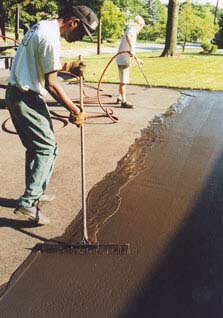
However, asphalt which is exposed to air and sunlight will begin to loose this flexibility. The asphalt actually begins to oxidize. Ultraviolet light (UV) from the sun also helps to breakdown the asphalt cement. This is where problems begin to happen. If the asphalt oxidizes, it becomes brittle.The bond between it and the sand and stone particles(aggregate) begins to fail. The result of this process is cracking and loosening of individuals pieces of aggregate. If you live in a climate that experiences cold weather, this process is accelerated by water which enters these cracks and then freezes.

Blacktop sealers block air and sunlight from attacking the asphalt cement. There are several different types of sealers. The traditional sealers contain the same asphalt that is used in the original blacktop. The asphalt in these sealers is often mixed with water and a soapy compound called an emulsifier. This sealer tends to have the shortest lifespan and offers little or no protection from the UV rays from the sun.

Another type of sealer contains refined coal tar. These sealers offer excellent resistance to gasoline and oil. Gasoline and motor oil can actually dissolve the asphalt cement in blacktop. The coal tar sealers also contain small clay particles and an emulsifier which enables you to apply it easily. Some refined coal tar sealers are polymer modified. These added chemicals often provide, extra UV protection, richer color, and longer life.


Would you like to have a gorgeous driveway? How about step-by-step photos and instructions that show you how I had my own tar and chip drive installed? If so, you might want my Instant Download Tar and Chip eBook.


The most expensive sealers are those that are entirely man made. They usually contain high amounts of acrylic polymers. These are the sealers you often see on tennis courts. They are available in black for driveways. These sealers offer the best overall protection and frequently can last twice as long as a conventional sealer.

You have probably seen these sealers available with sand. Sand is a beneficial ingredient. It helps to seal the pores in the blacktop, improves foot and car traction, and helps the sealer to last longer on your driveway.

One of the biggest mistakes I see homeowners make is sealing their driveways too often. It is best to wait until the previous coat of sealer has worn off before applying a new coat of sealer.This will happen at different rates on different driveways because of traffic volume and exposure to weather and sunlight.

The test for wear is really quite simple. The aggregate used in the blacktop is often some other color than black. Here in the Midwest, the small stone chips are primarily limestone, which is gray in color. When you see your blacktop beginning to gray, as my daughter constantly tells me when looking at my hair, it is time to reseal your driveway. By the way, do not use blacktop sealer as a hair colorant, it can burn your scalp.

Treated Lumber – Clean & Seal

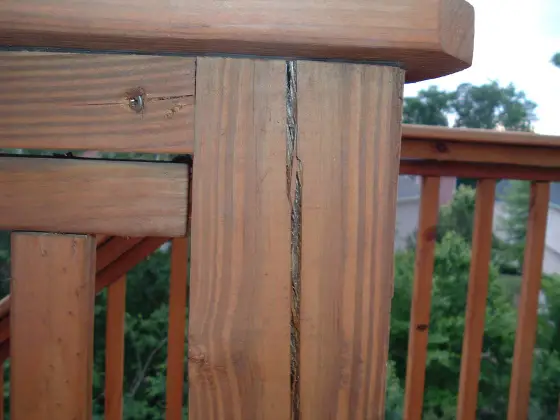
cracked deck post

Look at the giant crack in this 4x4. The post was probably fine when installed, but the loss of moisture created tension within the lumber and caused the wood to split apart. PHOTO CREDIT: Suzanne Wieczorek

DEAR TIM: What do you know about treated lumber? I purchased treated lumber for a deck many years ago. At that time, the lumber companies said it would last a lifetime. Now they are saying that the lumber should be treated and sealed on a regular basis, even brand new lumber. Is this true? If so, why? What is the best way to clean and seal my treated lumber? R. A.

DEAR R. A.: I am by no means an expert on treated lumber, however there are several things that I can tell you which may shock and surprise you. Number one, your treated lumber must be sealed. The lifetime warranty that many of the treated lumbers carry covers rotting and insect infestation. The warranty does not cover appearance characteristics.

Wood is one of the most fascinating building materials that I have ever had the pleasure of working with. You can do just about anything with it. But, as with all things, you must take the good with the bad. The only bad quality that wood possesses, in my opinion, is that it is not dimensionally stable. The size of a piece of wood changes, often dramatically, in response to the amount of water which it contains at any given time.

Treated lumber, by its very nature, has massive quantities of moisture in it when it leaves the treatment plant. Untreated boards are stacked inside a giant vacuum chamber. The air in the chamber (and from inside the cells of the wood) is sucked out. The chamber is flooded with water which contains chemical preservatives. The chamber is then pressurized. The chemicals, because of this process, penetrate deeply into the wood. Often pieces of wood are so saturated with these preservatives, that it squirts out when driving a nail.


Wood deck surfaces need to be cleaned and sealed to keep them in good condition. The cleaner I recommend is oxygen bleach.


EB015 Cleaning & Sealing Deck eBoo Cover

Wind and sun action begin a slow, destructive process that results in cracks, twisting, warping, cupping, and discoloration of any type of lumber. The top layer of wood fibers exposed to the sun's ultraviolet light can be rapidly destroyed. These effects can be minimized by blocking sunlight and slowing the evaporation of the water from the wood. That is why you must seal treated lumber. Some treated lumbers are available with factory applied sealants. Those that are not must be sealed immediately.

Cleaning and sealing treated lumber must be done on a periodic basis. There are many different cleaners and sealers that you can choose to use. Some are good and some not so good.

First, let's talk about cleaners and brighteners. Some cleaners and brighteners contain chlorine bleach. Chlorine bleach is not a great thing to use on treated lumber or any lumber for that matter. It can leave your deck looking quite white and unnatural.

Bleach can also harm surrounding vegetation. Consider using a cleaner that contains oxygen bleach. Oxygen bleach is very effective at removing dirt, mildew , and algae. It also does a great job of removing the sun damaged wood fibers. When using a cleaner, always brush it with a stiff scrub brush to get the best results. The brushing action removes the top layer of damaged wood fibers.

Treated lumber sealants can be very confusing. I'll bet that you have seen water repellents, sealers, preservatives, and clear finishes on store shelves. They are not all the same by any stretch of the imagination. To begin with, try to avoid using "all purpose" products. Stick with products that are designed specifically for treated lumber or exterior wood.

When selecting a sealer, try to choose one that is a penetrating water repellent. Look for ones that are formulated using synthetic oils and resins. Look for products that have three things in particular: mildewcides, algaecides, and ultraviolet (UV) blockers. Products that contain these three things (or any combination) are much better than a simple wood sealer or water repellent. Don't underestimate the importance of the UV blocker.

Remember, treated lumber needs to be sealed immediately after installation. If you wait any length of time, all kinds of problems will begin to occur. Quality products are available which can be applied directly to your new treated lumber. Don't hesitate to apply them!

Message from Tim:

Years ago while researching a column about cleaning decks, I discovered the wonders of Oxygen Bleach. It is perhaps the 'greenest' cleaner I know of as it uses oxygen ions to break apart stains, dirt and odor molecules. There are no harsh chemicals, and it works on just about anything that is water washable.

I decided to create my own special blend using ingredients made in the USA. In fact, the raw materials in the active ingredient are food-grade quality registered with the FDA. I call my product Stain Solver. I urge you to use it to help clean your cedar shakes. You will be amazed at the results!

Exterior Front Doors

DEAR TIM: It's time for a new exterior front door at my house. I love the look of our existing 70 year old wood door, but it never seems to fit right. It's either too tight or too loose. After looking around, I am astonished at the variety of different materials that are now being used to construct doors. Is there any one you prefer? Is there anything I should watch out for? T. I.

DEAR T. I.: I couldn't agree with you more. Exterior door systems have seen tremendous technological breakthroughs in the past 5-10 years. The most appealing doors to me are those that combine several different materials to make a realistic, if not actual, wood door.

Based upon your photo, your existing front door appears to be a 6 panel solid fir door. Solid wood doors can behave in an unruly fashion if not sealed completely. The humidity in the air can make solid wood doors warp and bow, causing them to fit poorly in the frames. My guess is that the top and bottom edges of your door have been neglected. They should have been varnished each time the door was refinished.

There are four primary categories of new exterior doors: steel, fiberglass, composites, and real wood. Believe it or not, the first three categories contain doors, which may be of interest to you.

Steel doors make up a majority exterior door sales in today's market. Steel is dimensionally stable. Humidity will not cause a steel door to warp or twist. You can purchase steel doors that have synthetic wood grained embossed finishes that accept stains. When finished, it is hard to tell these doors from the real thing. Just about every steel exterior door is filled with some type of foam. This foam allows the doors to achieve R-values almost five times that of an ordinary wood door.

Fiberglass entry doors are gaining in popularity. They are very similar to steel doors, however, they tend to be much more resilient. Steel doors can be dented somewhat easily. Many fiberglass doors are also stainable and have rich, realistic wood graining. When finished properly, it is almost impossible to distinguish that the door is not really wood. Fiberglass doors are also insulated with foam and have high R-values.

Some of the most fascinating doors are the composite doors. These doors often take two different materials and blend them together. For instance, one manufacturer uses a composite fiber-reinforced core that is twice as strong as wood. This core will not rot, warp, or twist when subjected to high levels of humidity. This core is then completely surrounded with real wood. The door is actually wood, but yet its not. It offers the beauty of wood, but not the problems.

Last, but not least, are real wood doors. Not all wood doors made today are like their ancestors. Many of the wood doors are made by laminating different, more stable pieces of lumber into a core. This core is then covered with a thin veneer of just about any species of wood you care to have.

Other solid wood doors are manufactured using a cut and turn method. Different parts of the door start out by using one solid piece of lumber. However, this piece of lumber is often sliced lengthwise into one or more pieces. After being cut, every other piece is rotated 180 degrees and then all the pieces are glued together. This makes the re-solidified' piece of wood much more resistant to warping and bowing.

When shopping for a new door, pay strict attention to finishing instructions. Many of these new doors require specific stains and finishes to achieve good results. Follow directions to the letter. Also, be sure to look for doors that offer adjustable thresholds. These devices allow you to adjust the threshold up or down seasonally, in the event the bottom door sweep fails to contact the threshold for some reason.


Cedar Shake Roof Care – Special Cleaner

DEAR TIM: I just purchased a home that has a cedar shake roof. My concern is maintenance. The previous owner of the house says I don't have to do anything. My intuition tells me he is wrong. Is there anything I should be doing to maximize the life of the roof? Also, I am very concerned about the possible fire hazard of a cedar roof. Is there a danger? Are cedar shakes really that great when compared to other roofing products? V. E.

DEAR V. E.: Cedar shake roofs have many positive qualities. When installed properly, they are extremely wind resistant. Believe it or not, they actually have twice the insulating value of standard asphalt shingles. Hail does not easily damage cedar shakes. When treated with certain chemicals, cedar shakes can be made permanently fire resistant.

Cedar shake roofs, no doubt, have a certain amount of prestige as a roofing material. That explains why many of the other roofing product companies manufacture materials that simulate real cedar shakes. The texture, color, and appearance of a cedar shake roof is undeniably appealing. However, this beauty comes with a price tag. Cedar shake roofs do require a certain amount of maintenance to maximize their useful life. The enemies of cedar shakes, as you might expect, are water and sunlight.

Many people know that cedar contains high amounts of naturally occurring chemicals which help preserve the wood. These chemicals are called extractives. They dissolve easily in water. Need I say more. In certain conditions, rainfall can leach these chemicals from the cedar shakes in less than 10 years.

Ultraviolet light (UV) from the sun actually causes the surface cells of the cedar to break down. This microscopic refuse is washed away with each rainfall. UV rays also cause very tiny cracks to develop which allows water to drive deeper into the shakes. This simply accelerates the process of dissolving the extractive chemicals.

The key to maintaining a cedar shake roof is to keep it dry. Yes, I realize that sounds funny. What I mean is that after a rainfall, a cedar roof needs to dry out as rapidly as possible. The shakes must be free of moss, fungus, debris (twigs, pine needles, leaves, etc.), or any other thing that can trap and hold moisture. Overhanging tree branches must be sufficiently high so as to provide good air circulation above the roof.

Chemical preservatives are available which can be applied to cedar shakes. These preservatives when applied to clean, dry cedar shakes can dramatically add years of life to a cedar roof. Most of these chemicals can be applied with a hand held sprayer. Professionals who treat cedar roofs for a living have pressurized machines that allow them to do large roof areas in a short amount of time.

If you decide to clean and treat your roof yourself, you need to exercise extreme caution. You need to protect yourself from the dangers of falling. You need to protect your roof from the dangers of cleaning. Cedar shake roofs that are damp, covered with moss, or any object can be extremely slippery. I once stepped on some moss on a low pitched cedar roof and ended up at the gutter before I realized what had happened. Serious and fatal injuries are a very realistic threat.

The use of mechanical power washing equipment used in untrained hands can seriously damage your shakes. Cedar is a soft wood. Cedar that is covered with damp moss is even softer. A power washer that has too much pressure or is too close to the shakes can erode the wood. Simply use some common sense when cleaning.

A great cleaner for cedar shake roofs or decks is oxygen bleach. This non-toxic cleaner is a powder you mix with water. It will not harm the cedar roofing nor anything else it contacts. You must saturate the shakes for about 10 minutes with the solution making sure it does not evaporate. Lightly scrub the shingles with a push broom and rinse with a garden hose. The shakes will look brand new!

Message from Tim:

Years ago while researching a column about cleaning decks, I discovered the wonders of Oxygen Bleach. It is perhaps the 'greenest' cleaner I know of as it uses oxygen ions to break apart stains, dirt and odor molecules. There are no harsh chemicals, and it works on just about anything that is water washable.

I decided to create my own special blend using ingredients made in the USA. In fact, the raw materials in the active ingredient are food-grade quality registered with the FDA. I call my product Stain Solver. I urge you to use it to help maintain your cedar shakes. You will be amazed at the results!

Water Pressure Drop Problems

DEAR TIM: Every time two or more plumbing fixtures are used in my brand new house the water pressure is horrible. The water flow is reduced to a trickle. When just one fixture is used the water flow is fine. It is very annoying. The plumber who installed the 1/2 inch diameter piping says this is normal. Is there anything that can be done to correct the problem? T. H.

DEAR T. H.: Ah hah! Another victim of slow flow! Did your plumber mumble something about "... normal for undersized pipes"? Don't despair, there is a good chance I can help you with your problem. Thousands of people like you suffer unnecessarily.

It all started a little over 300 years ago with a guy named Robert Boyle. He figured out that when all the faucets are turned off in your house, the pressure is the same just about everywhere in your water piping system. But, when you turn just one faucet on and let water start to flow, crazy things start to happen.

First, when the water leaves the big water main pipe in the street, it has a certain amount of energy. As it starts to go through the pipe under your lawn, it rubs against the edges of the pipe and looses energy. This loss of energy results in a pressure drop. Then, when the water starts going around bends and turns in the pipe, it looses even more energy. Deposits on the inner walls of older pipes, also, can add to this energy loss.

The rate at which water looses energy or pressure depends upon the size of the pipe the water is flowing through. It can be dramatic. Let's say your water pressure is 60 pounds per square inch (PSI) as it enters your house. It's 7 a.m. and 4 people are using two bathrooms. If the water has to travel through just 80 or so feet of 1/2 inch pipe to get to the bathrooms, the pressure, as it leaves any of the bath fixtures, is now only about 28 PSI.

Guess what the pressure would have been had your plumber substituted 3/4 inch pipe for the 1/2 inch pipe? 54 PSI!!! Guess how much extra money it would have cost your (you!) plumber to put this larger pipe up to those two bathrooms? It could have been done for less than $70. You can partially relieve this problem by replacing as much visible 1/2 inch pipe as possible. Do this for both your hot and cold water lines. Replace it with 3/4 inch pipe. In an average sized house, this replacement project can be done by purchasing about $150 worth of pipe and fittings.

If you are getting ready to build a new home, insist on using 1 inch pipe from the street to your house. Assuming your house is 100 feet from the water main, you will only loose 2 PSI by the time the water enters your house. The cost to upgrade to this pipe is often less than $100.

Water pressure problems are easily avoidable. Simply tell your plumber to use 3/4 inch pipe as the main feeder pipe. Only use 1/2 inch pipe to branch off this main pipe as you head to each fixture. Do this, and you will always be singing in the shower.

High Efficiency Air Filters

DEAR TIM: My air conditioning system didn't work when I turned it on for the first time this season. After spending $60 on a service call, I found out that a huge block of ice had formed inside my furnace. The service woman said my coil was dirty. That doesn't make sense. Seems to me, the air would be much cooler if it was blowing over a block of ice. What happened? Can it be prevented in the future? I'm hot about this problem! R. A.

DEAR R. A.: Cool down, take a break! Once that ice melted and the coil was cleaned, I'll bet you were in good shape. However, you possibly caused the problem by not changing your furnace's air filter on a regular basis.

There is a coil inside your furnace through which air blows. This coil has lots of thin fins. Attached to these fins is a small continuous tube which contains refrigerant. This refrigerant begins to boil inside the tube as the warm or hot air from your house passes over the coil. Prior to boiling, the refrigerant was very cold and as the heat from the air is transferred to the refrigerant the air temperature drops.

When you turn your air conditioner on, the main blower in your furnace begins to recirculate the air through your house. The moist, humid air passes over the cold fins of the coil. The water in the air condenses on the fins just like on a cold glass of iced tea on your patio table. Everything works fine if enough warm moist air can pass over the fins fast enough. If not, the temperature of the fins can drop below 32 degrees F. Ice starts to form on the fins and soon your coil is a solid block of ice.

In your case, the air passageways between the fins became blocked by dirt. This dirt slowed down the air trying to get through the coil. A clogged air filter in your furnace can also slow down the air passing through the coil.

You can prevent this problem by considering the use of higher efficiency air filters. Standard inexpensive spun glass filters are almost always less than 20 percent efficient. Some of them may only be 6-8 percent efficient. These filters are designed to protect your heating and air conditioning equipment, not cleanse the air.

You can purchase air filters that will not only protect your equipment, but also do a remarkable job of cleaning your interior air. These filters can trap very small particles of dust, pollen, mold, and other irritants. Some of these filters work much like the air and oil filters in your car. They are made using pleated filter paper. Other filters are made with fine synthetic polyester fibers. Higher efficiency air filters can sometimes be coated with chemicals that can kill tiny microbes such as bacteria and mold.

There are several advantages to using these higher efficiency air filters. Not only will your heating and cooling equipment perform better, your operating costs may well be lower. The air you breathe will be cleaner, as will your furniture and drapes. That $60 service call could have bought 10 filters that may have lasted through five cooling seasons!

Patching Concrete

DEAR TIM: I have tried to patch several areas of my concrete steps, driveway, and sidewalk with little success. Usually, after one year or so, the patch material either crumbles, or completely detaches from the concrete. The weather is always excellent when I patch: sunny, breezy, and hot. Help! What can I do to make the patches stick to the concrete? S.H.

DEAR S. H.: The first thing you need to do is reorganize your schedule. Sunny, breezy, hot days are great for the beach. They are not so great for patching concrete. Sweater weather (50 - 60 degrees F) is a good time for patching concrete.

Your patching attempts failed for any number of reasons. Many of the reasons involve water. High temperatures, sunlight, and wind can rapidly remove water from concrete patching compounds. What's more, the concrete you were trying to patch was probably very dry. In all likelihood, it absorbed water from the patching compound much like a sponge.

This is concrete made to look like brick. Believe it or not, this would be an easy surface to patch. The pattern of the brick is much easier to mimic than a perfectly smooth regular concrete slab.

This is concrete made to look like brick. Believe it or not, this would be an easy surface to patch. The pattern of the brick is much easier to mimic than a perfectly smooth regular concrete slab.

The water, you added to the dry patching compound, is needed for two reasons. It makes the mix workable. It also is a chemical ingredient. A certain amount of water must be retained within the patching compound for it to become strong. When mixing, water must be added to the dry patching compound with respect. Add too much water and the mix will be weak. Add too little water and the mix might not bond well to the old concrete.

There are numerous things you can do to increase your chances of success. Some of them involve work practices. Others involve your choice of patching materials. Let's start with the different types of patching materials.

Consider purchasing patching materials that contain polymer additives or blended cements. Patching materials that contain these things often stick much better to older concrete. If you see the words "acrylic", "vinyl", or "gypsum cement" on the label, chances are you are in good shape. You can also use liquid additives. Some of these additives are mixed with the patching compound, while others are applied to the surface to be patched. 100 percent epoxy patching compounds are also available.

It is important to prepare the area to be patched. Take some time and remove all loose material and dust. Consider chiseling or saw cutting the edges of the area to be patched. If the edges of the patch are just 1/8 inch deep, the thinner patching compounds often have a better chance to stick to your old concrete. Be sure to wear safety goggles to protect your eyes if you choose to do this.

If using a patching compound that requires water, dampen the area to be patched with a little water. This added water will prevent the dry concrete from stealing water from the patching compound. Try to perform your work on cool, overcast days. If you must work in hot weather, after you are satisfied with the finished texture of your patch, cover it with a piece of plastic and shade the patch from the sun. The plastic and shade will slow down the evaporation of water from the patching compound. Keep the plastic on the patch for a minimum of 3 - 4 days, if possible.

Washable Flat Wall Paints

washable wall paint

Washable Flat Wall Paints

DEAR TIM: I really like flat wall paint. I also like to wash my walls on a regular basis. That's my problem. In the past, flat paints have been tough, if not impossible, for me to clean. I know glossy paints clean well. Why can't you clean ordinary flat wall paint? My husband has suggested professional help for my compulsive behavior. What do you think? E.R.

DEAR E. R.: Good news! Technology advancements in the paint industry have produced new, washable, flat wall paints. A trip to the paint store is all the therapy you will require.

Thousands of people, including myself, have had problems cleaning flat wall paint. Many older flat paints would readily stain. Worse yet, if you were successful in removing a stain, the area you cleaned often had a glossy appearance. Sometimes the paint would end up on your sponge or wash rag. Many of those problems are gone forever.

To make flat wall paints washable, the paint companies had to overcome some hurdles. If you look at conventional flat wall paint under a microscope, it would look something like the Rocky Mountains. The rough texture does an excellent job of scattering light rays. This gives the paint its flat sheen. However, the valleys between the mountains provide great places for dirt to hide.

Paints have three primary ingredients: pigments (color), resins (adhesion), and vehicle (water or paint thinner). Pigments give paint its color. Resins coat the pigments and are the glue that allows paint to stick to things. Vehicle is there just for the ride. Without it, you couldn't apply the paint. Once paint is applied, the vehicle evaporates into the air.


Have you picked out the paint color but don't have the time to paint? Find the professional painters by using my Interior Painting & Staining Checklist. I offer a 100% Money Back Guarantee.


Resins are the most expensive component of most paints. Some washable flat wall paints use vinyl resins. Some use acrylic resins. Others use a blend of vinyl and acrylic. Acrylic resin is often twice as expensive than vinyl. Acrylic resin is so durable, that it is the resin of choice in most exterior paints. Resins are also shiny. That's a problem.

The shape of pigment particles is critical in flat washable wall paints. The shape of older pigment particles resembled balls or rocks. Newer pigment particles are sometimes shaped like snow flakes. They are more two dimensional than three dimensional.

The challenge in creating a washable flat wall paint is to use these newer pigments and coat them with enough high quality resin to make them washable. If too much resin is added, the valleys between the pigment particles will fill up. If this happens, you end up with a smooth, shiny surface.

Shopping for a quality washable flat paint is not too difficult. In years past, the resin content of a paint was often printed on the paint can label. This is no longer done by most paint companies. As such, use price as a guideline. The most expensive paints often contain the highest quality resins. This is the ingredient that gives you washability. Furthermore, a paint company that includes lots of high quality resin in their paint simply has to pass that cost on to you.

Related Column: Super Washable Wall Paint

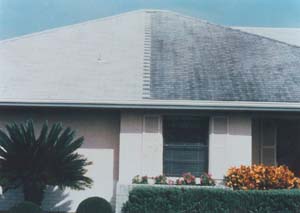
Black Algae Stains On Asphalt Shingles

Black Algae Stains On Asphalt Shingles

The shingles on the left are made with granules that contain copper. The copper leaches out each time it rains and creates a toxic environment for the roof algae. Photo by: 3M Corporation

DEAR TIM: I've got a problem. Three years ago, I had a new fiberglass asphalt shingle roof installed. It was the same color as my old roof, a light tan. Within the past 6 months, several areas of the roof have developed a dark, mildew-like stain. It is spreading. The climate hasn't changed and there are no trees that shade my roof. What in the devil is going on? Can I easily remove the staining? Can it be prevented? Ginny U., Ft. Pierce, FL

DEAR GINNY: They're heeeeeere! You, my friend, have been invaded by Gloeocapsa magma, a very hardy algae. These dudes have probably been up on your new roof since day one. The streaks and discoloration you are now seeing is an accumulation of their dead, dark colored cells. While this algae can grow just about anywhere in the continental USA, it really likes humid environments. The algae was deposited on your roof by wind and/or wildlife.

This algae most probably invaded your last roof as well. But, it starved to death. The new fiberglass shingles you just installed are actually quite different from your old shingles. Your new shingles contain lots of ground up limestone. It is used as a filler to increase the weight of the shingles.

Guess what? Gloeocapsa magma loves to eat limestone. Older shingles used an asphalt saturated felt paper made from scrap cotton rags and wood chips. New synthetic textiles eliminated the cotton rag market, so roofing companies switched to fiberglass. They solved one problem but created another.

This algae can be prevented from growing on roofs. All you need to do is introduce copper or zinc into the picture. Gloeocapsa magma hates copper or zinc. These metals are a very effective poison. Because your roof is still quite new, you are going to have to install some copper strips as high as possible on your roof. Rain will wash small amounts of copper down your roof which will poison the algae.

Consider installing long, seven inch wide strips of copper underneath the last full course of shingles at the top of your roof. You should be able to slide the copper up under the shingles approximately five inches or so. This will leave approximately two inches exposed to the weather.

If you are getting ready to install new shingles, you need not do this. Many fiberglass shingles are available with colored granules that contain copper. There are enough granules present on each shingle to kill the algae. The copper is slowly released over time. Many of these shingles are guaranteed to kill the algae for the life of the shingle.

To remove the existing stains, you need to use a safe cleaning solution. Believe it or not, there are several treated wood deck cleaners that will do the job without hurting you, the roof, your gutters, and any vegetation below.

Look for deck cleaners that contain bleach. Do not use cleaners that contain chlorine bleach. Oxygen bleach is a non-toxic powder that mixes with water. Do not use a pressure washer. Apply the oxygen bleach solution to a cool roof surface on an overcast day. Do not let the solution dry. If windy or sunny, be sure to continue to apply a light spray of the oxygen bleach solution.

After it has soaked for 30 minutes, brush the solution with a stiff broom or brush. Always aim the rinsing hose down the roof, not up under the shingles. Be sure to wear a safety harness while working on the roof, as wet shingles are very slippery. BE CAREFUL!

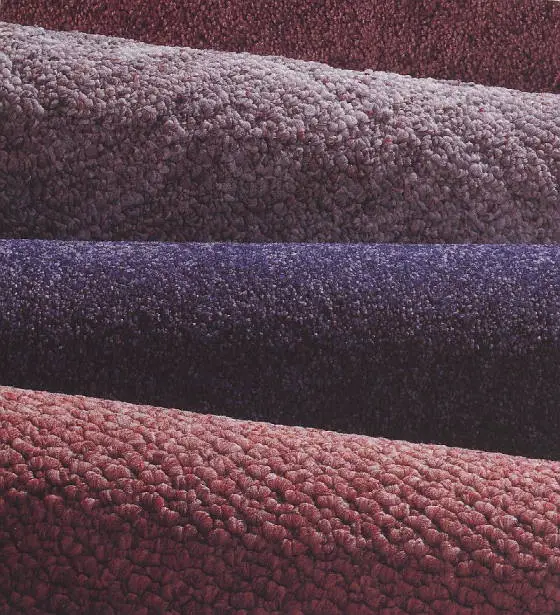
Carpet Comparison Made Easy!

Types of carpet

Carpet Comparison Made Easy!

DEAR TIM: My husband and I just returned from trying to buy wall to wall carpeting. What a nightmare! Can you help us? It is so confusing trying to compare different carpets, fibers, stain resistance, warranties, and padding. Also, I would like a really a soft floor, so should I have a really thick pad installed? L.M.

DEAR L. M.: I couldn't agree more with you concerning the difficulty of trying to select carpeting. Until recently, even highly experienced professional carpet buyers had difficulty really analyzing different carpets. The carpet industry is changing. Some manufacturers are disclosing the facts about each piece of carpet they make.

Testing standards have been developed by the Carpet and Rug Institute and independent testing labs that evaluate the type of fiber used in a carpet, the carpet's face weight (ounces of fiber per square yard), carpet fiber density, and the amount of twist each fiber has per lineal inch.


Carpet samples are then subjected to an actual walk test where it receives 20,000 foot steps by real humans. After this test, the carpet is compared to an original piece and a durability rating is assigned.

Most residential carpet is made from one (or a blend) of four fibers: nylon, polyester, olefin, and wool. All of these fibers can make a great carpet. Face weight is a common sense measurement, as more fibers are almost always better. Fiber density is a measurement of how closely packed carpet fibers are to one another. Carpets with high density tend to look better longer and will help give you that soft feeling you are looking for.

Carpet fiber twist is very important, primarily with cut pile types of carpet. Fibers that have more twists per lineal inch tend to make more durable carpeting. The 20,000 walk test is simple. Put the carpet on the ground and have people walk on it. It's a great way to see how a carpet will actually perform in real life.

Prior to this type of comparison, homeowners had to depend upon warranties, the feel of the carpet, and other things that are tough to measure. The new system, which is grabbing hold in the industry, should help to relieve your anxiety.

Stain resistance is sometimes misunderstood by homeowners. Carpet fibers are treated with clear chemicals that simply coat the individual fibers. This coating, however, can be compromised by many household solvents, cleaners, plant foods, etc. You must be very careful about what you spill on your carpet and how you clean up spills. Don't be an amateur chemist!

Finally, carpet padding is critical to carpet performance. Too much or too little can cause premature failure of many carpets. Many carpet manufacturers publish strict minimum and maximum padding thickness for their carpet. The best pads, believe it or not, are those that are thin and firm. Thick pads allow carpet to flex too much. Avoid padding thicker than 7/16 of an inch and you should be fine.