Washable Flat Wall Paints

washable wall paint

Washable Flat Wall Paints

DEAR TIM: I really like flat wall paint. I also like to wash my walls on a regular basis. That's my problem. In the past, flat paints have been tough, if not impossible, for me to clean. I know glossy paints clean well. Why can't you clean ordinary flat wall paint? My husband has suggested professional help for my compulsive behavior. What do you think? E.R.

DEAR E. R.: Good news! Technology advancements in the paint industry have produced new, washable, flat wall paints. A trip to the paint store is all the therapy you will require.

Thousands of people, including myself, have had problems cleaning flat wall paint. Many older flat paints would readily stain. Worse yet, if you were successful in removing a stain, the area you cleaned often had a glossy appearance. Sometimes the paint would end up on your sponge or wash rag. Many of those problems are gone forever.

To make flat wall paints washable, the paint companies had to overcome some hurdles. If you look at conventional flat wall paint under a microscope, it would look something like the Rocky Mountains. The rough texture does an excellent job of scattering light rays. This gives the paint its flat sheen. However, the valleys between the mountains provide great places for dirt to hide.

Paints have three primary ingredients: pigments (color), resins (adhesion), and vehicle (water or paint thinner). Pigments give paint its color. Resins coat the pigments and are the glue that allows paint to stick to things. Vehicle is there just for the ride. Without it, you couldn't apply the paint. Once paint is applied, the vehicle evaporates into the air.


Have you picked out the paint color but don't have the time to paint? Find the professional painters by using my Interior Painting & Staining Checklist. I offer a 100% Money Back Guarantee.


Resins are the most expensive component of most paints. Some washable flat wall paints use vinyl resins. Some use acrylic resins. Others use a blend of vinyl and acrylic. Acrylic resin is often twice as expensive than vinyl. Acrylic resin is so durable, that it is the resin of choice in most exterior paints. Resins are also shiny. That's a problem.

The shape of pigment particles is critical in flat washable wall paints. The shape of older pigment particles resembled balls or rocks. Newer pigment particles are sometimes shaped like snow flakes. They are more two dimensional than three dimensional.

The challenge in creating a washable flat wall paint is to use these newer pigments and coat them with enough high quality resin to make them washable. If too much resin is added, the valleys between the pigment particles will fill up. If this happens, you end up with a smooth, shiny surface.

Shopping for a quality washable flat paint is not too difficult. In years past, the resin content of a paint was often printed on the paint can label. This is no longer done by most paint companies. As such, use price as a guideline. The most expensive paints often contain the highest quality resins. This is the ingredient that gives you washability. Furthermore, a paint company that includes lots of high quality resin in their paint simply has to pass that cost on to you.

Related Column: Super Washable Wall Paint
Black Algae Stains On Asphalt Shingles

Black Algae Stains On Asphalt Shingles

The shingles on the left are made with granules that contain copper. The copper leaches out each time it rains and creates a toxic environment for the roof algae. Photo by: 3M Corporation

DEAR TIM: I've got a problem. Three years ago, I had a new fiberglass asphalt shingle roof installed. It was the same color as my old roof, a light tan. Within the past 6 months, several areas of the roof have developed a dark, mildew-like stain. It is spreading. The climate hasn't changed and there are no trees that shade my roof. What in the devil is going on? Can I easily remove the staining? Can it be prevented? Ginny U., Ft. Pierce, FL

DEAR GINNY: They're heeeeeere! You, my friend, have been invaded by Gloeocapsa magma, a very hardy algae. These dudes have probably been up on your new roof since day one. The streaks and discoloration you are now seeing is an accumulation of their dead, dark colored cells. While this algae can grow just about anywhere in the continental USA, it really likes humid environments. The algae was deposited on your roof by wind and/or wildlife.

This algae most probably invaded your last roof as well. But, it starved to death. The new fiberglass shingles you just installed are actually quite different from your old shingles. Your new shingles contain lots of ground up limestone. It is used as a filler to increase the weight of the shingles.

Guess what? Gloeocapsa magma loves to eat limestone. Older shingles used an asphalt saturated felt paper made from scrap cotton rags and wood chips. New synthetic textiles eliminated the cotton rag market, so roofing companies switched to fiberglass. They solved one problem but created another.

This algae can be prevented from growing on roofs. All you need to do is introduce copper or zinc into the picture. Gloeocapsa magma hates copper or zinc. These metals are a very effective poison. Because your roof is still quite new, you are going to have to install some copper strips as high as possible on your roof. Rain will wash small amounts of copper down your roof which will poison the algae.

Consider installing long, seven inch wide strips of copper underneath the last full course of shingles at the top of your roof. You should be able to slide the copper up under the shingles approximately five inches or so. This will leave approximately two inches exposed to the weather.

If you are getting ready to install new shingles, you need not do this. Many fiberglass shingles are available with colored granules that contain copper. There are enough granules present on each shingle to kill the algae. The copper is slowly released over time. Many of these shingles are guaranteed to kill the algae for the life of the shingle.

To remove the existing stains, you need to use a safe cleaning solution. Believe it or not, there are several treated wood deck cleaners that will do the job without hurting you, the roof, your gutters, and any vegetation below.

Look for deck cleaners that contain bleach. Do not use cleaners that contain chlorine bleach. Oxygen bleach is a non-toxic powder that mixes with water. Do not use a pressure washer. Apply the oxygen bleach solution to a cool roof surface on an overcast day. Do not let the solution dry. If windy or sunny, be sure to continue to apply a light spray of the oxygen bleach solution.

After it has soaked for 30 minutes, brush the solution with a stiff broom or brush. Always aim the rinsing hose down the roof, not up under the shingles. Be sure to wear a safety harness while working on the roof, as wet shingles are very slippery. BE CAREFUL!

Carpet Comparison Made Easy!

Types of carpet

Carpet Comparison Made Easy!

DEAR TIM: My husband and I just returned from trying to buy wall to wall carpeting. What a nightmare! Can you help us? It is so confusing trying to compare different carpets, fibers, stain resistance, warranties, and padding. Also, I would like a really a soft floor, so should I have a really thick pad installed? L.M.

DEAR L. M.: I couldn't agree more with you concerning the difficulty of trying to select carpeting. Until recently, even highly experienced professional carpet buyers had difficulty really analyzing different carpets. The carpet industry is changing. Some manufacturers are disclosing the facts about each piece of carpet they make.

Testing standards have been developed by the Carpet and Rug Institute and independent testing labs that evaluate the type of fiber used in a carpet, the carpet's face weight (ounces of fiber per square yard), carpet fiber density, and the amount of twist each fiber has per lineal inch.


Carpet samples are then subjected to an actual walk test where it receives 20,000 foot steps by real humans. After this test, the carpet is compared to an original piece and a durability rating is assigned.

Most residential carpet is made from one (or a blend) of four fibers: nylon, polyester, olefin, and wool. All of these fibers can make a great carpet. Face weight is a common sense measurement, as more fibers are almost always better. Fiber density is a measurement of how closely packed carpet fibers are to one another. Carpets with high density tend to look better longer and will help give you that soft feeling you are looking for.

Carpet fiber twist is very important, primarily with cut pile types of carpet. Fibers that have more twists per lineal inch tend to make more durable carpeting. The 20,000 walk test is simple. Put the carpet on the ground and have people walk on it. It's a great way to see how a carpet will actually perform in real life.

Prior to this type of comparison, homeowners had to depend upon warranties, the feel of the carpet, and other things that are tough to measure. The new system, which is grabbing hold in the industry, should help to relieve your anxiety.

Stain resistance is sometimes misunderstood by homeowners. Carpet fibers are treated with clear chemicals that simply coat the individual fibers. This coating, however, can be compromised by many household solvents, cleaners, plant foods, etc. You must be very careful about what you spill on your carpet and how you clean up spills. Don't be an amateur chemist!

Finally, carpet padding is critical to carpet performance. Too much or too little can cause premature failure of many carpets. Many carpet manufacturers publish strict minimum and maximum padding thickness for their carpet. The best pads, believe it or not, are those that are thin and firm. Thick pads allow carpet to flex too much. Avoid padding thicker than 7/16 of an inch and you should be fine.

Copper Water Pipe Corrosion – Aggressive Water

DEAR TIM: I'm getting ready to build a new home. I am deeply concerned about my drinking water lines. I have heard from some friends in different parts of the country that copper water lines can corrode from aggressive water. Is this possible? What is aggressive water? My parents had copper water lines that never were a problem. Is there an alternative pipe I can use? A.N.

DEAR A. N.: Aggressive water is drinking water that can cause corrosion. It is a real and growing problem in many parts of the country. Leaks are developing in new homes that are less than 2 years old in some cases. These leaks can cause high water bills and structural damage. Homeowners or municipal water systems that obtain their water from wells are susceptible. Rarely, does surface water (that obtained from rivers, lakes, etc.) become aggressive.

The causes and mechanisms that are responsible for the corrosion are not always the same. Water that is slightly acidic is sometimes to blame. High levels of dissolved minerals and carbon dioxide also can cause problems. High levels of chloride or sulfate can be serious.

copper pipe corrosion

Poor workmanship can lead to corrosion. Plumbers who use excessive amounts of flux when soldering and/or leave excess flux on copper pipe and fittings are to blame as well. Flux is an acid that is brushed on copper pipes and fittings that allows solder to bond more easily to copper. Municipal waters works usually have chemists who regularly test the quality of the water being drawn from wells, rivers, lakes, and aquifers. These chemists are responsible for maintaining water quality. Not only do these individuals treat water to make it safe to drink, they sometimes alter the water chemistry to make it less aggressive. Some municipal water works add corrosion inhibitors to the water.

Believe it or not, these chemists try to adjust the acidity and hardness of the water so that it actually coats the inside of your pipes with a thin scale of calcium carbonate. This scale can protect copper pipes from corrosion by insulating' the copper from the aggressive water. This may be the reason why the pipes in your parents house are not suffering from corrosion. New copper is very susceptible to corrosion, as the protective scale has yet to form.

Water chemistry can change. Those parts of the country that are experiencing growth may find out that their municipal water works are either drilling new wells, or sinking existing wells deeper. In either case, aggressive water may be mixed or injected into a previously non-corrosive water system.

For this reason, you may wish to consider plumbing piping which is not affected by aggressive water. CPVC plastic piping is a good choice. This piping has been used by the plumbing industry for over 40 years. It is regularly tested by the National Sanitation Foundation to make sure that it can deliver water which meets all U.S. EPA standards. However, CPVC piping should be used carefully in outdoor underground installations. There have been instances where solvents in polluted ground have actually migrated into the piping. Choose your piping materials carefully.

Read in my September 10, 2009 Newsletter about Jenee's question about PEX vs Copper tubing.


Author's Notes:

July 6, 2001

I just received an email from Gold Pipe and Fittings and they have information that says solvents in polluted ground areas do not migrate into the piping. Stay tuned to the website to get the facts.

Termite Elimination

termite elminationtermite elmination
DEAR TIM: This past spring my neighbor's house was invaded with termites. I am concerned that my house might be next. Even though my neighbor's house was treated with chemicals, is it possible for the termites to come over to my house? Also, being very environmental, I am concerned about the chemicals that are injected into the ground to kill termites. Is there another way? T.E.

DEAR T. E.: You bet it's possible! In fact, there is a strong possibility that your house may be already infested. Being quite the social insect, they are constantly expanding and attempting to start new colonies. The termites that your neighbor saw may actually have originated from your house.

Remodeling contractors love termites, as they do over $1 billion worth of damage a year to structures in the United States. They like to live in warm, moist soil near wood food sources, such as fallen trees, wood piles, and houses. In the forest, termites help make top soil by munching on dead trees. In houses, they simply add to our shrinking landfills by creating construction debris.

There are over 40 species of termites found in the USA. The termites live in colonies that have highly developed social systems dominated by a king and a queen. Special termites care for the queen who can live for up to 50 years and lay thousands of eggs each year. Other residents of the colony include worker termites, soldiers, and reproductives.

The worker termites are the ones that eat wood. They supply food for the entire colony. The king, queen, soldiers, and reproductives all stick around the nest doing their jobs. The worker termites are the ones that leave the nest to pick up the carry out meals from your home.

The worker termites work 24 hours a day, seven days a week. It is possible for them to travel through a crack in concrete or steel as small as 1/64th of an inch in their constant search for new food sources. Once a worker termite gets his fill from your floor joist or wall stud, he heads back to the nest where he shares the food and gets a drink. Termites are quite thirsty, as they must revisit the soil or nest every 24 hours or so.

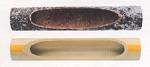
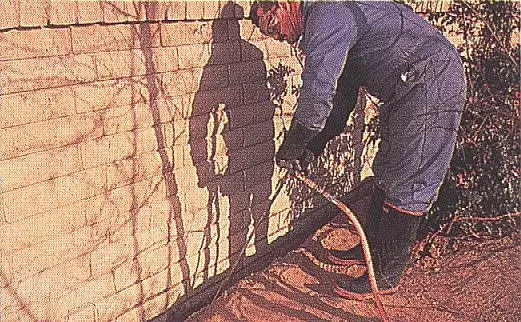
Chemicals used in the past, and still in use today, simply provide a barrier around your house. They do nothing to actually wipe out the entire colony. In fact, some of these chemicals can actually harm other wildlife. A new system has been developed which has the capability of killing the entire colony. Small plastic monitoring stations are inserted into the soil around your house.


Termite infestation? Pick the best exterminator using my Termite and Carpenter Ant Checklist. I offer a 100% Money Back Guarantee.


A professional checks these periodically for termites. Once detected, a growth regulator, which is toxic to termites, is installed into the monitoring stations. The worker termites eat the tasty toxic food and share its location with the other workers. Soon, many workers die. This is a major problem for the termites who hang out back in the colony, as they depend upon the workers to bring them food. This system can wipe out a colony completely within six months.


Author's Notes:

September - 1999

I recently received a letter from the public relations firm that represents the Bayer Corporation. One of the head scientists at this company was kind enough to review all of my past information on termites and offered some suggestions in order to keep my content as accurate as possible.

This individual, Dr. Byron Reid, said that up until his company developed a new product called Premise, my statements about liquid chemicals not killing termite colonies was accurate. The Bayer Corporation folks maintain that their product will kill foraging worker termites immediately but does not harm pets or humans. I would ask about this system when you speak with professional exterminators. Remember, a barrier chemical treatment system is only as good as the person who is injecting the chemicals into the ground. TC

Stair Railing Assembly


Farmcrest stars lower flight wide

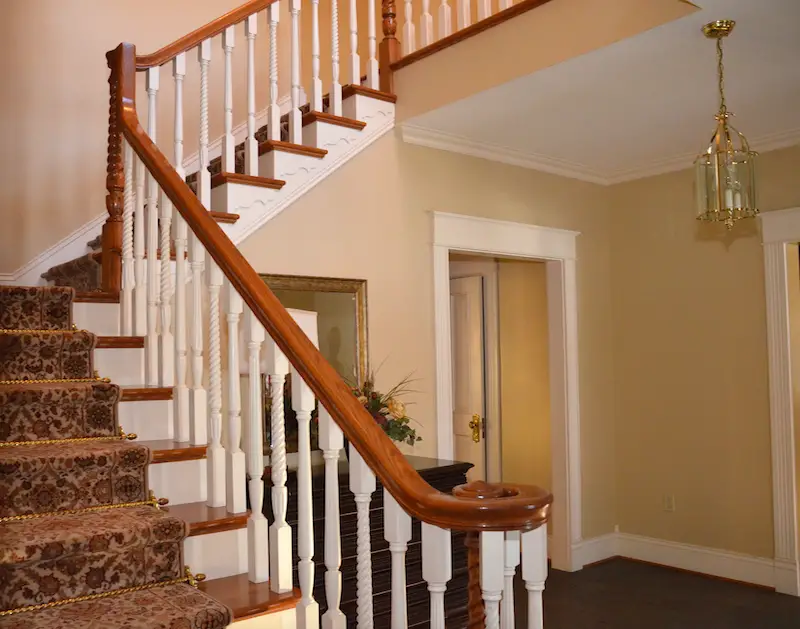
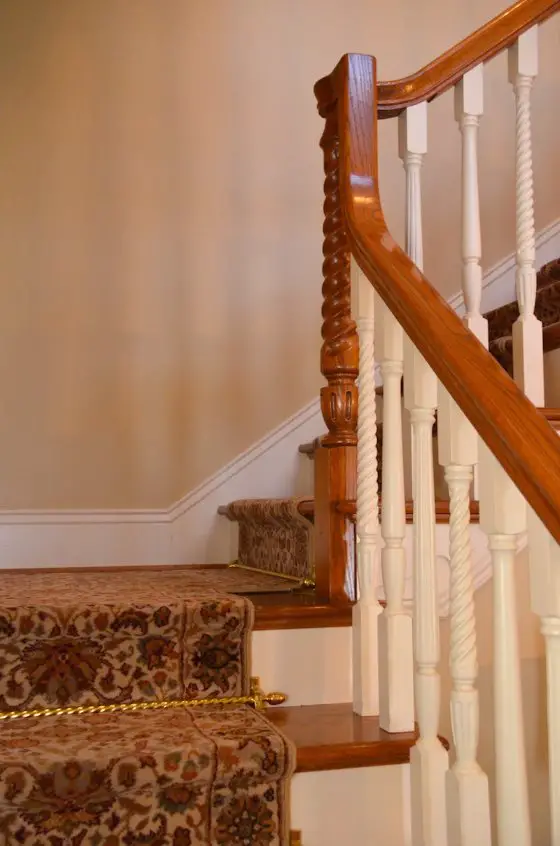
I installed this handrail system in my Cincinnati Queen Anne Victorian home. Look closely and you'll see three different styles of balusters under the stained-oak handrail. It required intense concentration and special skills to install all you see in this photo. Do NOT underestimate the painstaking work you see here. Copyright 2023 Tim Carter

Stair Railing Assembly

DEAR TIM: I'm in the midst of renovating my first old house and need help with the stair railing. The staircase leading to the second floor has an oak handrail with spindles and a curlicue thing on top of the post at the bottom of the stairs. The handrail and large, decorative posts are loose. Do I just renail all the spindles to tighten it back up? Is there something else I should / can do? Or, is it best just to start over with a new handrail system? M.I.

DEAR M. I.: Did you slip on some sawdust and bump your head? Do the words volute (your curlicue thing), newel, gooseneck, or turnout sound familiar? I didn't think so.

We're about to go on an anxiety-filled journey. You're about to enter a dimension of space and time filled with infinitely small measurements and angles and finish carpentry that only a select few can navigate successfully.

Your next stop.

The twilight zone of carpentry.

Staircase handrail systems are, in my opinion, the most difficult aspect of finish carpentry. A typical installation may take an experienced carpenter, with a helper, 4 - 5 days to install!

Probably less than 1 percent of the finish carpenters in the trade can correctly install handrails and balusters.

Your handrail was installed by a carpenter who is in the 99 percent group. Handrails and balusters installed correctly simply won't come loose unless large children use them as indoor playground equipment or a piano-moving company bashes into a railing or newel post while you're not looking.

Handrail systems derive their strength and stability from the larger, often decorative, newel posts that are found at the bottoms, tops, and landings of staircases. If the newel posts are not securely fastened, the entire handrail system will shake. The thin balusters that extend from the handrail down to each stair tread offer little strength. Their purpose is to form the barrier so you and your children do not fall off the stairs. Toenailing your spindles will do little to help the loose handrail or posts.

Newel Posts - The Foundation

Newel posts at the top, bottom, and balconies of a staircase often have long, thick dowel pins at the bottom of each post. These dowels fit into precisely drilled holes of the same size. Drill the hole too big, even by 1/16th inch and your newel post may wiggle. Newel posts installed at landings incorporate long, heavy lag bolts which are attached to hidden rough framing members. Often these posts are notched into the stair tread nosings for additional stability.

Farmcrest Staircase landing newel post

This is a close-up shot of the landing newel post. It had to be notched so it was centered on the two lines of the intersecting balusters. Copyright 2023 Tim Carter

To fix your loose handrail system, you must attack the problem from below. It will not be easy. Newel posts at the bottom and top of the stairs will be the hardest to tighten. Simply put, you now face the task of inserting a 16-inch long one-half-inch diameter lag bolt up into each post from below! This lag bolt must pass through solid blocking attached to your floor joists directly into the center of the dowel pin. The lag bolt should penetrate up into the newel post at least 8 inches.

Thinking of starting over? If so, there are several companies that, build, precut, assemble then knock down the entire handrail system for just about any project. These same companies preassemble the staircases. You, or your builder, simply provide them with a few basic measurements. The manufacturers claim that an average staircase and handrail system can be assembled in 4 hours. This sounds like something that may be of interest to you.

Avoid Over Budget Plans

DEAR TIM: My husband and I engaged the services of an architect for our project. At the beginning of the process we told him how much money we had to spend on the project. The bids for the job are all coming in about 40 percent over our budget. What went wrong? What can be done, if anything, to salvage the project? Can this agony be avoided? C.R.

DEAR C. R.: I am sorry to hear of your misfortune. On more than one occasion, I had to deliver cost estimates to homeowners that exceeded their budgets. I know the anger and frustration you are feeling. The sad thing is, in almost all cases, it can be avoided. In my opinion, you may have a legitimate beef with your architect.

Frequently, problems such as yours happen in the earliest stages of planning. Homeowners communicate their project wish list to the architect. Often, dramatic preliminary drawings of the project are produced. You can become entranced and intoxicated by these sketches. The emotional attachment to the project intensifies. It is difficult, if not impossible, to turn back at this point. Architects who permit this to happen are guilty of a major infraction: failure to maintain an assured, clear distance.

Your cost overruns are severe. There is little you can do to maintain the integrity of the project. Cost cutting measures that maintain project integrity usually only produce savings in the 5 - 7 percent range. To achieve further cost savings, major product substitutions have to be initiated and/ or the size of the project has to be reduced. These are painful procedures.

Architects can avoid problems like this. However, it requires some work on their part. Fortunately, with computer advancements it is not that hard to do. A simple system of tracking job costs, detailed cost breakdowns, project size and style, and difficulty rating is all that is needed.

An architect can quickly calculate the square foot area of recent projects. They know what these jobs cost. From this, they can calculate finished square foot costs. Because they drew the plans, they can assign a difficulty factor.

Imagine what could have happened in your case. Immediately after hearing what you and your husband wanted, the architect could have stopped the conversation. He could have taken your budget number and divided it by the current cost per square foot for similar projects. Within a matter of minutes, he could have told you the maximum square footage of your planned project. Given this number, you and the architect could quickly determine if the size would fit your needs.

This exercise can often take place in as little as 1 hour. You need a disciplined architect who is armed with accurate and up to date square foot cost figures. Ask for the availability of this data when choosing your architect. If you get a puzzled look, continue to interview prospective candidates.


How would you like me to build your new home? It's probably impossible for me to fit your job into my schedule, but I will gladly share hundreds of my tricks and building secrets with you and your builder. Check out my New House Specifications.


Water Softeners – The Basics

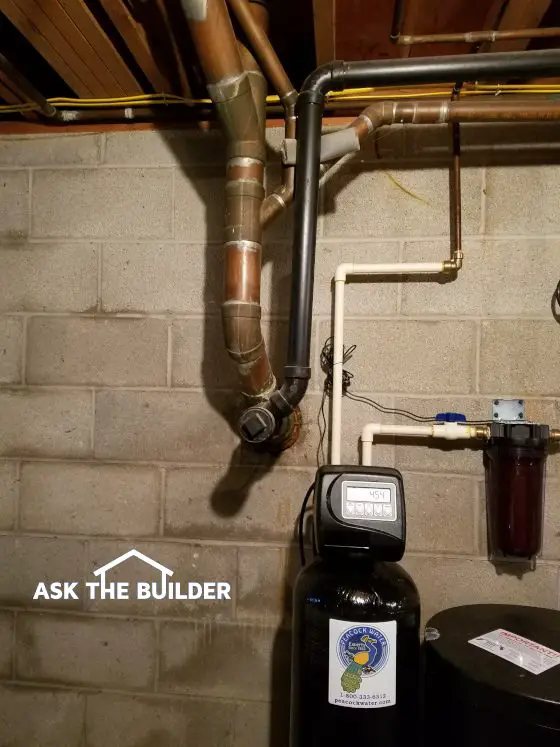
Water Softeners

Water Softeners - The Basics

DEAR TIM: I'm thinking about adding a water softener to my plumbing system. Just what is hard water? Are there any real benefits to soft water? Are any piping changes necessary? O. S.

DEAR O. S.: You are making a smart move. Soft water makes it easier to clean just about anything. It prevents the buildup of scale in pipes, water heaters, and boilers. The Soviets figured this out in 1910. They were the first to use soft water in electric power plant boilers.

Water from wells, aquifers, rivers, etc. contains dissolved chemical elements. Two of these, calcium and magnesium, cause water to be hard. The higher the amounts of these elements in a given measure of water, the harder the water. Water hardness is measured in grains per gallon. One grain weighs 1/7000th of a pound. Water containing 7 or more grains of these elements per gallon is considered hard.

Hard water can cause big problems. When water is heated, the calcium and magnesium decide it's time to get up and leave. They exit the water and begin to form a scale on the inside of pipes, boiler tubes, and hot water heaters. This scale buildup in hot water heaters and boilers can slow down the transfer of heat into the water. This slowdown can raise your fuel bills by as much as 30 percent.

A majority of your laundry problems are also caused by hard water. Hard water interferes with the cleaning action of soaps. Your white clothes turn grey because of unremoved dirt. Colors fade for the same reason. Soft water eliminates mineral deposits commonly found in toilet bowls and on ceramic tile and plumbing fixtures.

You soften water by removing the calcium and magnesium. It reminds me of a game I played as a kid: King of the Mountain. Hard water enters your water softener. It begins to pass through a bunch of tiny resin beads (mountains) that contain sodium. The calcium and magnesium jump out of the water and onto the beads. In the process, the sodium is knocked off into the water.

Eventually, the softener begins to fill with calcium and magnesium. These elements are removed from the softener in a regeneration process. A brine solution containing a high concentration of sodium is injected into the softener. This sodium jumps onto the beads and knocks off the calcium and magnesium. The calcium and magnesium are flushed out of the softener. The softener is now ready to work again.

Because you pay to soften water, you don't want to waste' soft water on your lawn, flowers, and shrubs. So, make sure your plumber pipes outside hose bibs with hard water. However, give serious consideration to installing a soft water hose bib in your garage. Cars rinsed with soft water don't experience water spotting.

Attic Ventilation – Ridge and Soffit Vents

DEAR TIM: Yesterday afternoon, I went up into my attic to retrieve an old book. It was so hot that I became dizzy and almost passed out. The 3 square metal vents in my roof were not clogged. The air was stagnant. Should I improve my attic ventilation? Is it necessary? F. B.

DEAR F. B.: You're lucky you made it out of your attic alive. Had you passed out, it's possible you might not be reading this column. Attic temperatures in non or poorly ventilated attics can soar to 160 degree Fahrenheit. This type of heat harms your body, books, and your house.

Attic ventilation awareness is at an all time high. This awareness, I believe, is a result of the energy savings breakthroughs the home building industry has and continues to experience. Your house, when it was built, probably had state of the art ventilation. Times have changed and so must your ventilation.

Ventilating an attic needs to be done on a continual basis. The temperature and dew point of the air inside your attic needs to be as close as possible to the air on the other side of your roof. Wide differences in either of these numbers can cost you money in repairs or higher heating and cooling bills.

Poor attic ventilation in colder climates can cause frost and condensation to form on the underside of your roof. It can rain inside your attic. I have personally witnessed this phenomena. In hot climates, elevated attic air temperatures cause your air conditioner to work longer and harder. Asphalt shingles, roof boards, and insulation can be damaged by elevated temperatures.

Your photos reveal two major problems. First, you have no lower undereave or soffit ventilation. Secondly, based upon this lack of lower ventilation and the size of your attic (1,025 square feet), you need an additional 17 roof vents to satisfy most current minimum code requirements.

You need flow through ventilation for your attic spaces. Outside air enters your attic space at the bottom edge of your roof. It is exhausted near the top of your roof. These ventilating systems use wind and thermal convection to continually exchange the air in your attic with outside air. On breezy days, wind blowing across the top of your roof creates a partial vacuum which sucks air out of your attic. On days with no wind, hot air, which builds up in your attic, simply floats out of hidden vents located at the top of your roof.

Many continuous ventilation systems are available that are virtually invisible. Upper roof ventilation products can hide beneath your cap shingles. Lower roof ventilation can be achieved either behind or above your gutters. If your roof needs to be replaced soon, your roofer can remove your three metal pot vents, repair the holes, and install these newer continuous ventilation materials. When installed properly, most of these ventilating systems meet or exceed minimum building code requirements and recommendations.

Chimney Crown Repairs

mortar fungus - Efflorescence

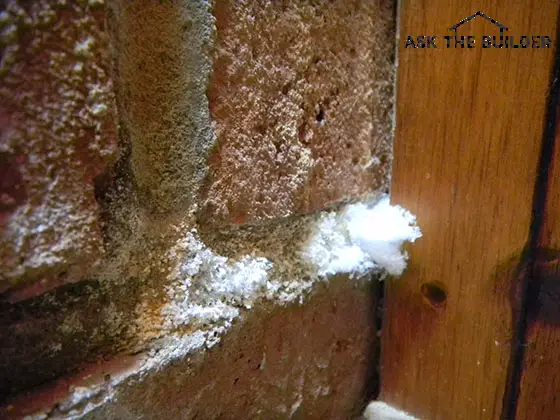
Efflorescence growing in the mortar of a brick fireplace. PHOTO CREDIT: Michael Hannum

DEAR TIM: My three year old house has a brick chimney. While performing a routine inspection of my roof, I noticed numerous cracks in the mortar cap on the top of the chimney. Furthermore, the face of some bricks are beginning to flake. Is it possible that water is entering my chimney through the cracks and causing the bricks to flake? Is it normal for this amount of deterioration to occur in such a short amount of time? Was my chimney constructed properly? P. E.

DEAR P. E.: The photos of your chimney tell the tale. You were victimized by a non-professional brick mason. Your chimney crown (mortar cap) has numerous defects. Unless you correct these problems, you can expect further, rapid deterioration of your chimney.

Chimneys are basically very small structures. Just as your house needs a roof to keep water from entering, so to your chimney. Chimney crowns are simply chimney roofs. The crown should slope down from the flue liner. The angle of this slope should be a minimum of 3 inches of fall per foot of run. Flat or low slope crowns can allow water to enter the interior of the chimney. This water can cause efflorescence (white salt deposits on brick surface), brick spalling (the flaking you are experiencing), and the deterioration of the mortar between individual bricks.

All too often, brick masons simply use mortar mix to finish off the top of a chimney. Chimney crowns should be constructed using either pre-cast concrete slabs, cast-in-place steel reinforced concrete, solid stone, or metal. Masonry crown materials should not directly contact the chimney flue liner. This gap should be caulked with a flexible cement stable silicone caulk. The cracks in your crown possibly occurred because the flue liner expanded from the heat of the fires below. This expansion popped your weak mortar cap much like a chick hatching from an egg. Also, excessive shrinkage cracks often develop in cast-in-place chimney crowns that lack adequate reinforcing steel and/or are not cured properly.

I also noticed that your chimney crown does not extend beyond the outer surface of your chimney. A chimney crown should extend a minimum of 2 and 1/2 inches beyond the face of the chimney on all sides. This overhang helps to keep water from running down the chimney face. The bottom of the crown should contain a small kerf (drip). Without the kerf, water can roll underneath the crown and flow down the face of the chimney.

Your photos indicate that your brick mason failed to install a flashing underneath the chimney crown. This flashing is the last line of defense in the war against water. This flashing is placed beneath the chimney crown. When installed properly, it prevents water from entering the interior of your chimney. Use copper, galvanized steel, or stainless steel for this purpose. Do not use aluminum as a flashing material in masonry chimneys. The chemicals in mortar and cement will cause it to corrode.

The deterioration you are experiencing is normal for a poorly constructed chimney crown. When you rebuild your chimney crown properly, it should perform flawlessly well into the next century.

Over the years, I've seen many different spellings of efflorescence. Here's my growing list: effervesce, effervescence, effervescent, effleresants, effloreflance, efflorescence, efflorressance, effluorescence, eflorescence, eflorescents, ellforesce and ifflorescence.