DEAR TIM:I am on the fence deciding which remodeling contractor to choose. The one contractor uses pneumatic nailers for just about every task. The other company uses traditional hand nailing for all tasks. Is there a difference between the two methods? Are the air driven nails inferior? Is there an advantage to using pneumatic nailers? How do you drive your nails? A. R.
DEAR A. R.: I drive my nails to the jobsite in my truck. Ha Ha! Just kidding! To be honest, I have a wide assortment of pneumatic nailers. Several have served me without a breakdown for more than eight years. I still use my hammer as well for certain rough framing tasks, however.
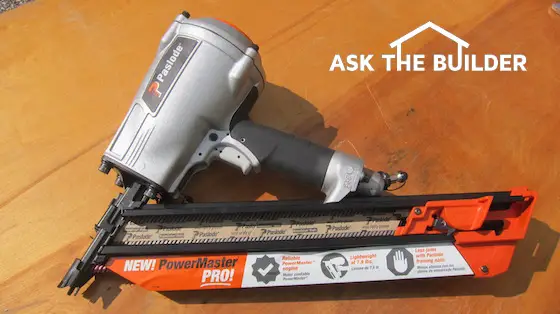
The use of pneumatic nailers has grown significantly in both the new home construction and remodeling industries. The reasons are simple. Pneumatic nailers increase productivity and offer superior fastener withdrawal resistance when compared to certain hand driven nails. An average home may use up to 70,000 nails. Nail guns don't get tired like arms do.
Major tool manufacturers offer an extensive assortment of nail guns. Yes, I said guns. Pneumatic nailers fire sharp objects at high speeds. If used improperly, they can cause serious injury.
My collection of pneumatic nailers includes a framing tool that can shoot a three and one-half inch nail into a piece of solid oak. I also have a nail gun that can shoot a small one half inch brad for fine trim or cabinet work. My favorite gun is one that fires two inch finish nails into interior trim lumber.
Nails driven with pneumatic nailers are tough to remove. The nails are coated with a resin that performs two primary functions. The resin glues one nail to another much like a strip of common staples. When the nail gun fires, friction is produced as the nail enters the wood. The resulting heat melts the resin. The liquid resin acts as a lubricant. Within seconds the resin becomes solid once again. The nail is actually glued into the wood!
If you choose the remodeler who hammers everything by hand, your interior trim may have an occasional beauty mark where a hammer kisses your wood trim. Most customers find these dents objectionable. A nail set may also slip off the nail head and mar the trim. Pneumatic nailers, when adjusted properly, will not create blemishes. In fact, they drive and countersink the nail in one rapid motion.
There are some slight disadvantages when using these fine tools. For example, when nailing roof or flooring plywood it is virtually impossible to tell if a nail misses a joist or roof truss. You need to visually check the underside of the plywood to make sure each nail is buried in wood. Also, the electrogalvanized coating on exterior nails does not offer the same level of protection as a twice dipped hot galvanized nail. If you must use a pneumatic nailer for outside work, use stainless steel nails.
The above is an affiliate link. I get a tiny commission if you purchase this item from Amazon.
DEAR TIM:My older home has a slate roof. Some of the pieces of slate have cracked and fallen. Entire pieces have come loose. The slate is very brittle. Is it time for my roof to be replaced? If not, why is the slate breaking and falling? In my attic you can see the bottom of the slate. Half of my roof boards are missing. Is this the cause of my problems? D. D.
DEAR D. D.: Brittle is good! If you had told me that your slate was soft and flaky like my favorite dinner rolls, you would have a major job ahead. Slate is one of the finest roofing materials available. It is fireproof, resists hail damage, possesses unquestionable beauty, and often has a service life of 100 years or more.
Prior to the development of asphalt roofing products, slate was a major player in the roofing products industry. Slate peaked in popularity at the turn of the century. The move away from steep roof slopes and less expensive roofing products have caused the slate roofing industry to shrink to one twentieth of its original size. Cost is a factor as well. New slate roofs can cost as much as $900 per square (100 square feet) installed! Compare that figure to say $60 per square for a standard asphalt shingle roof.
There are several possibilities why your slate is cracking and falling. Slate is a rigid natural stone product. Think of it as a piece of glass. If you stress a piece of glass, it usually cracks. Slate is no different.
Stress can be introduced to slate in several ways. The nails used to attach the individual pieces of slate are possibly to blame. They need to be fastened so that the slate merely hangs on the nail much like a picture on your wall. If the nail is pounded too tightly, it will pinch the slate. Should the nail stick slightly above the slate, the overlapping piece above may crack from this hidden pressure point. There is very little room for error.
The wood decking may be to blame. Wide swings in temperature and humidity cause your wood roof sheathing to expand and contract. This creates stresses on the slate. If the nails are in a bind, a corner may pop off and the slate will crack or fall.
The nails themselves may have failed. If a galvanized nail was used, it simply may have reached the end of its life. Nails, flashings, etc. used in conjunction with slate roofing should have the same service life as the slate itself. Copper nails and heavy gauge copper flashings are a must.
Slate can succumb to the forces of nature. Not all slate is created equal; quality can vary significantly. Acid rain and freezing temperatures can damage slate and shorten its life. It is important that slate dries as rapidly as possible after a rain. Your missing roof boards allow the slate to dry rapidly. Your roof was built this way on purpose.
DEAR TIM: I recently purchased a home with a septic tank. Prior to this, all of my houses had public sewers. How in the world do these things work? Should I be concerned with what I put down my drains? What about maintenance, is it required? Bea S., Sugartown, PA
DEAR BEA: Don't worry about a thing, septic tanks are fairly common. Your household as well as approximately 25 million others in the USA rely on these simple, yet highly efficient systems to treat household wastewater. Septic systems, when designed, installed, and maintained properly do a fantastic job of protecting your family's health and that of the environment.
A typical household septic system consists of two major components: the septic tank and the drainfield. Wastewater from your house travels, in most cases, by gravity to the septic tank. The tank's main purpose is to detain the wastewater for 1 - 2 days. It uses this time to separate solids, greases, oils, and floating objects from the wastewater. Bacteria within the tank starts to attack and break down the waste immediately.
Although the bacteria does a good job, it can't eat everything. Septic tanks develop a layered look. Scum floats on the top, partially treated wastewater is in the middle, and sludge settles at the bottom.
After its 1 - 2 day stay, the partially treated wastewater leaves the tank. If everything is working right, virtually all of the solids have settled out of the water. The wastewater now heads for the drain field. This area is comprised of a series of interconnected pipes that lie in sand or gravel filled trenches. The pipes are perforated. The wastewater exits the perforations and enters the soil. The soil acts as a biological filter. Oxygen and organisms in the soil combine to break down any remaining toxins, bacteria, or viruses in the wastewater.
Septic tanks must be sized in accordance with the number of people in the household. Tanks with too little capacity allow the wastewater to enter the drain field too quickly. Solid particles that were supposed to settle into the tank are inadvertently carried into the drain field. These tiny solid particles can clog the sand, gravel and soil filters in the drain field. If this happens, your septic tank can backup and/or the drain field can become flooded with untreated wastewater. Both of these situations are unsanitary and pose serious health risks to you and the environment.
Click below to view Tim's video on the care of Septic Systems.
You can extend the life of your entire septic system by watching what you put into your drains and toilet. Minimize the introduction of solid particles and scum forming compounds. This means no food scraps, coffee grinds, sand, gravel, greases, oils, washing machine lint, etc. Beware of chemicals or solvents that will kill the helpful bacteria in your tank. Do not put pesticides, paints (even latex!), organic chemicals, paint thinner, etc. into your drains. Finally, have your septic system inspected annually and pumped clean on a regular basis. Remember, the sludge and scum must not be allowed to accumulate. If they enter the drain field, you will have an expensive repair bill.
The beneficial bacteria that break down waste inside the septic tank can be stimulated if they get a dose of oxygen every week or so. The oxygen enhances their growth and more bacteria simply means more rapid breakdown of waste particles. One of the best ways to accomplish this is to pour 4 ounces of powdered oxygen bleach into a toilet and flush it immediately. Do this two times a week and your septic system will silently thank you.
Author's Note: We've received other questions with similar problems or questions. Here's one from Howard Stein of Oklahoma City, OK, regarding his home septic system.
"We have ten inches of snow and the temperature is near zero Fahrenheit. It will stay like this for several days. Is it safe to use our washing machine (doing regular laundry) in this frigid weather since we have a septic tank and fear that the "arms" cannot properly dispose of large volumes of water into the ground? Many thanks for your help."
Howard, typically in most septic systems, the tank and drainage fields are located well below the frost line.
Message from Tim:
Years ago while researching a column about cleaning decks, I discovered the wonders of Oxygen Bleach. It is perhaps the 'greenest' cleaner I know of as it uses oxygen ions to break apart stains, dirt and odor molecules. There are no harsh chemicals, and it works on just about anything that is water washable.
I decided to create my own special blend using ingredients made in the USA. In fact, the raw materials in the active ingredient are food-grade quality registered with the FDA. I call my product Stain Solver. I urge you to use it to help maintain your septic system. You will be amazed at the results!
DEAR TIM:Every spring for the past several years I have battled carpenter ants in my house. They invade my kitchen. I have purchased every off the shelf product in an attempt to defeat these pests. Are they hurting my house? Is there a way to control these pests? Can I win the war? V. E.
DEAR V. E.: Ah! A comrade in arms. I too have been battling carpenter ants for several years. However, I feel that I have turned the tide in my battle. Our foe is formidable. Carpenter ants of one species or another are located just about everywhere in North America. The greatest concentration of species is in the eastern United States.
Carpenter ants do not eat wood like termites. They are incapable of digesting cellulose. However, they do excavate wood as a nesting site. Outdoor nest sites might include trees, logs, fence posts, wood piles, or other large pieces of wood. Indoor nesting locations can be floor joists, hollow doors, window and door trim, or any other hollow or hidden location.
The excavations into wood can cause serious structural damage. The ants can burrow deeply into wood in a constant effort to create space for a growing colony. The pathways or galleries usually start in soft or moist wood. However, once established, the voracious ants can easily gnaw into perfectly sound, dry wood.
The insurance company needs to be sent a copy of the letter to put them on notice of a possible claim. These letters need to be sent to both companies via certified mail with a return receipt being sent to you. Keep these very valuable receipts.
! ! ! See Author's Notes at Bottom of Column ! ! !
DEAR TIM:Hel! Water is pouring through cracks in my basement walls. It happens every spring and during periods of extended rainfall. Are there ways to successfully patch the cracks? Can I apply an interior waterproofing compound? What do you think is causing the problem in the first place? S. T.
DEAR S. T.: I know how desperate you are. I once owned a house where water would actually squirt up through cracks in the floor. Water also streamed through various wall cracks. I was able to solve my water problem. I'm confident that you will too.
Among other things, soil contains air. Except for sandy well drained soils, the greatest amount of air is in the upper two feet of most soils. As you go deeper they become more compact. Clay rich soils can become extremely dense the deeper you go.
When it rains, water fills the void spaces occupied by the air. This water is pulled by gravity both vertically and horizontally through the soil. In sandy soils, the water may drain deeply into the soil. Most clay soils react differently. The water begins to move sideways towards natural springs and creeks. Basements tend to get in the way of this sideways movement.
To make matters worse, the soil around your foundation might have tremendous amounts of air in it. During the original excavation process and the backfilling process this dirt was fluffed up. That is, it became uncompacted. When it was dumped alongside your foundation as backfill, the air was not removed. It can take years before Mother Nature does it naturally. What's more, you may actually have a bowl shaped depression that has formed at the surface that collects rainwater or irrigation water. This depression may be hidden by mulch or gravel.
Check for these low spots. Fill them with well compacted soil. The ground around your foundation should slope away from your house. A 1 inch fall per foot is desirable. Make it slope away for at least 5 - 6 feet if possible. Do not allow downspouts to drain directly onto your soil as well.
There are numerous ways to repair your cracks and waterproof your foundation. The cracks in your walls can be patched with Hydraulic Cement Compounds. These wonderful cements actually expand as they dry. The cracks can be injected with epoxies or polyurethane grouts. Some of these compounds are actually stronger than the original concrete. Some companies inject special crack filling grouts around the outside of your foundation. These compounds react slowly with soil moisture to fill the cracks from the outside. You can also apply cementitious waterproofing compounds by brush on the inside walls.
Prevent leaks in your basement by using this Basement Waterproofing Checklist to hire a great professional. I offer a 100% Money Back Guarantee.
Installing a curtain or linear French drain around the uphill portion of your home will help. This narrow trench contains a perforated drain tile covered with rounded washed gravel. This simple, yet effective device can capture and divert the water before it even becomes a problem.
You may wonder if my advice is worth anything. Well, read what Jim Sanders wrote to me when he was at the end of his rope:
"Hi, I just wanted to write to give you the results of my "Trench Drain". I have had a wet crawlspace for 15 years. Water would fill the crawlspace at times, so we actually had to drill weep holes at the base so that it would enter the basement and eventually, the sump pump.
I have tried everything. Several contractors said that the only thing we could do was to bring the water into the house via drainage tile and let it enter the sump pump. That would work, but because I live on a 6' elevation, there is no reason that I should have water problems. It became like clockwork...when it rained, we would rush home from the lake or wherever we were vacationing so that we could be prepared to start the backup generator, in case the power failed. We even had our alarm company put a sump alarm on our system, so they could notify us if we had a power failure. Battery backup was not an option, because sometimes we lose power for days and during any rain, our sump would run every 7 minutes...just like clockwork.
I found your site and read the article on the trench or French drain. At first, it sounded a bit like "holistic healing" to me. I failed to understand why a 2 ft. deep trench, 4 ft. away from the house would do any good. How could this simple thing correct an extreme water problem that has plagued me for years, cracked my foundation, settled my garage floor and ruined almost every vacation?
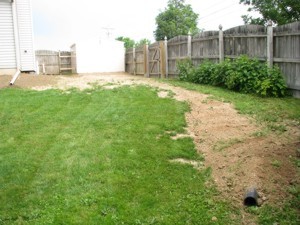
The Linear French Drain trench running from the house. PHOTO CREDIT: Jim Sanders
I decided "what the heck". I had to dig by hand using a trenching spade and a pick-ax, because the builder back-filled our property with brick and blacktop. It took quite a bit of time. Because the ground level varies so much on that side of the house, I was not able to achieve exactly 2 ft. deep. It varied from 18" to 30" in spots, but the slope was downhill. The trench is about 80 ft. long. At times, I thought about filling it all in, because I just didn’t believe that it would work.
I stoned it, put tile in, and filled it with #1 round stone. I socked the pipe just for safety measure and I also used geotextile fabric on top, so I could cover with dirt and grass. I also ordered some clay and pitched from the house to the drain.
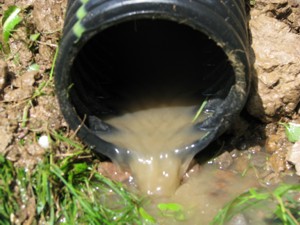
After a short rain, water is running away from the house. PHOTO CREDIT: Jim Sanders
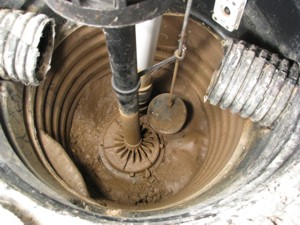
Result? For the last month, we have had 7 or 8 torrential rains, the worst of which was last night. It rained so hard, that our lawn washed out in spots because of the high clay content. Our sump pump, that normally ran every 7 minutes during and after rain, has not turned on for 4 weeks. The silt at the bottom of the sump well is now dry and cracking. Our crawlspace has not shown a trace of water or even moisture.
Since I couldn’t see correcting the foundation cracks or the garage floor settling and tilting until I corrected the problem's source, I waited to see if the trench drain worked first.
This week, I had a company come in and perform sort of a "mud-jacking" technique on the garage floor, which worked perfectly. Also, during the past few weeks, I parged the cracks in the foundation.
A dry sump pump. PHOTO CREDIT: Jim Sanders
I just wanted you to know how this worked. I stressed for many years over this issue and the solution was nowhere near as difficult as I thought it would be.
As a side note, I went to the end of the drain tile during a hard rain to see what was happening. Water was running out of the drain tile in about the same exact volume that it previously ran out of the weep holes in my crawlspace. This winter will be interesting, because last year, the ground next to the house was so saturated that during a thaw, my sump would run constantly. I'm guessing that the ground between the trench and the house will probably be drier now going into this winter."
DEAR TIM:We have a yellow water saving toilet in our home which is approximately 4 years old. It acts like it has something clogged in it. I often have to flush it twice or three times. A plumber checked it and found no obstruction. What can I do? I sure wish I had my old toilet! M. E.
DEAR M. E.: I understand your frustration. If it is any consolation, there are thousands of people who are suffering with you. You probably have a first generation ultra low flush (ULF) toilet. Regional water conservation acts beginning in the late 1980's brought about the need for these toilets. They use only 1.6 gallons of water per flush. Their use has been mandatory in all non-commercial structures since January 1, 1994.
Prior to these conservation acts, toilets used between 3.5 and 5 gallons of water per flush. The water surface area within toilet bowls was larger and the trap passageway had a larger diameter. Each flush provided enough swirling water to adequately cleanse the bowl and syphon the waste into the plumbing drainage lines.
However, problems arose when these new laws went into effect. The 1.6 gallon standard was chosen before the toilet manufacturers had a chance to complete the necessary hydraulic engineering. They got caught with their pants down, so to speak.
Existing toilet designs were hastily converted to meet the new standards. Water surface area within the bowls was drastically reduced. The internal passageways were made smaller. Because of the reduced amount of water leaving the tank, there was a drastic drop in energy per flush. This caused paper and sometimes waste to be left in the bowl. Repetitive flushing caused the new toilets to actually use more water than the old toilets.
The engineers have been busy. New designs are now available that maximize the energy and cleansing ability of each drop of the 1.6 gallons of water. The water surface area is enlarging. The internal passageways are widening. Sleek designs with smooth sides are available. One flush attempts are more successful.
You may also be interested in another alternative. You can purchase new ULF toilets that have a pressure assist mechanism in the tank. These toilets use the existing pressure from the water supply line to compress air in a bladder mechanism that fits inside the toilet tank. When you activate the flush handle the water rapidly enters the bowl. Rarely, if ever, do you need to flush twice.
The pressure assist toilets offer another advantage. Water and waste is forced down the plumbing drains rapidly. The likelihood of a sewer pipe clog is greatly reduced. The gravity flush ULF toilets have a tough time making this claim. Sewer clogs can happen on a more frequent basis.
You can solve your existing problem easily. Consider trading in that lemon. Get yourself a late model ULF and have your husband install it this weekend. It's a one hour job!
DEAR TIM:Ackkkkk! The wallpaper and/or the adhesive I installed in my new house must be defective. There are several places where the paper has delaminated from the paper backing.
In addition, there are numerous places where the paper pulled completely off the wall exposing the drywall. It also blistered and bubbled during installation. I painted the new drywall before I started. What do you think happened? L. P.
DEAR L. P.: I'll tell you what happened. You very likely made some major mistakes during your installation or you installed the wrong paper in a given location.
Although manufacturing problems do happen, I doubt that your problems can be traced to flaws in either the paper or the adhesive you applied.
Wallpaper hanging is a true craft. Certain wall coverings require specific adhesives. Wall surface preparation prior to the actual hanging of wallpaper is critical.
Successful installations of the many different types of wall coverings require years of experience. Professional wallpaper hangers often have a deep knowledge of paper characteristics, wall preparation techniques, and adhesives.
One of your problems, I believe, is directly related to improper wall surface preparation. In order for wall coverings to stay put for many years everything on the wall must stick to one another.
The drywall paper must stick to the gypsum core, the paint to the drywall paper, the wall covering primer to the paint, the adhesive to the wall covering primer, the paper backing to the adhesive, and so on.
Wall coverings will succumb to the forces of gravity when the weakest adhesion fails. In your case I'll bet that you failed to remove all of the drywall joint compound dust created in the sanding process.
Wallpaper is unforgiving. If you don't get rid of dust, dirt, grease, and stains wallpaper can fall off, show every defect, or cause stains to bleed through the wallpaper.
Very few homeowners know to perform this crucial step. As the adhesive dried behind the paper it created a strong tension force. This literally ripped the paint from the wall. There is a possibility that you will see related failures for up to one year in any room where you failed to remove the dust.
Your paper delamination problems were probably operator error. You may have let the paper relax for too long. When adhesive is applied to wallpaper it causes the paper to swell.
Papers need to expand or relax completely prior to being applied to the wall. This relaxation period changes with different papers. The water in the adhesive soaked deeply into the paper backing (substrate) possibly causing the delamination.
The blisters you experienced are possibly related to this same relaxing requirement. Those sections of paper that bubbled probably didn't relax long enough. The paper continued to swell after it was applied to the wall.
Your paper may also have had an inexpensive pulpy paper backing. These papers perform poorly in areas of high humidity such as bathrooms and kitchen back splashes near cooking or sink areas.
Expanded vinyl papers can also delaminate or pull away from walls in these areas. You must be certain to select wall coverings that are made to perform adequately in high humidity environments.
Just A Few Tools
Let's get started with the tools. Fortunately, you don't need many tools to wallpaper.
Here's a list that will get you going on this job:
retractable razor knife with snap-off blades
4.5 or 6-inch drywall taping knife
smoothing brush or plastic smoother
4-foot level
grout sponge
measuring tape
paint roller & pan
paint brush
Click the Image Below to get all, or some, of the tools now:
UPDATE: New information regarding painting aluminum has been added to this column. Be sure to check the Author's Notes following the article.
DEAR TIM:My husband and I just purchased a 25 year old house covered with aluminum siding. The siding is in excellent shape. It's factory painted finish has faded. In some areas the paint is completely worn down to the aluminum. Can aluminum siding be successfully repainted? I read a book that says to use a latex primer? Is this good advice? What else should I do to insure a professional job? P. A.
DEAR P. A.: The first thing I would do is throw away that book. It may contain some other questionable advice. Many latex primers are not suitable for use with weathered aluminum siding.
Sunshine, rain, and pollution erode all paints. The paint film develops tiny cracks and pinholes. These permit water and air to penetrate the actual siding. Aluminum isn't harmed by water, but air does cause problems. The air oxidizes the aluminum.
Just about every latex paint, including primer, contains ammonia. When ammonia comes into contact with oxidized aluminum it creates a gas. This gas can cause small bubbles to form beneath the paint film. This creates poor adhesion which in turn leads to premature paint failure.
A better alternative is to prime the weathered aluminum siding with a thinned down oil based metal priming paint. Leading manufacturers recommend using one pint of paint thinner to one gallon of high quality oil based primer. This primer creates a barrier between the oxidized aluminum and the finish paint. However, before you even think of mixing up and applying this primer, you need to prepare the surface for paint. If you read the labels on most paints, they will instruct you to apply the product to a clean, dry surface. How do you get yourself clean? Soap, I thought so!
Using any high quality powdered soap product, a heavy sponge, and a scrub brush, wash and rinse down your aluminum siding. You will notice that some of the old paint will wash off in this process. Don't be alarmed. Rinse the siding until no additional paint pigment can be detected in the rinse water. Avoid the use of a power washer for this job. Power washers, when used by a rookie, can direct water behind the aluminum siding. This may cause a leak into your home.
Allow the siding to dry for several days. Apply the thinned metal primer. Consider having the primer tinted to one half strength the color of your finish paint. Your finish coat should consist of a 100 percent acrylic latex exterior house paint. Buy the most expensive paint you can find. It usually contains the highest volume of acrylic paint resin. A higher volume of resin translates into a longer lasting paint job.
You should apply the finish coat of paint within 48 hours of applying the primer. Absolutely do not paint in direct sunlight or on windy days. These conditions reduce the dwell time of the paint. The finish paint needs to dry slowly to achieve the best mechanical and chemical bond. Cool, overcast days are the best for painting aluminum siding.
Author's Notes: The following updated information was received from the Paint Quality Institute. Debbie Zimmer addresses ammonia in latex paints and the resulting bubbling.
"Hi Tim,
Thanks so much for your questions and comments. Regarding ammonia in latex paints, it is so low today that the off gassing (resulting in bubbling) is really not a factor. Here are a few detailed points to consider: 1. Bare Aluminum: forms a strong oxide layer which is easy to stick to and is relatively inert to ammonia. Some folks confuse ammonia with acid. Yes --- acid will generate some hydrogen gas but there should not be a reaction with ammonia. 2. All Aluminum Siding is coated. This again generally results in a surface that is easy to stick to but for all intents and purposes, relatively inert to waterbased paints. Even under poor conditions, incidental exposure to Aluminum should not be a problem because of above (1). Also, on occasion, we do speak about oxygen bleach but typically use the more common (common to homeowners) "bleach" term. Perhaps we should use oxygen bleach more often. We don't use brand names (in any of our materials), such as Clorox. Tim, I'm really glad you asked the questions --- it helps us make our educational information stronger. If you are ever in the Philadelphia, PA area, I would love to take you on a tour of our PQI facilities --- we have over 30,000 paint panels on exposure (a few dating back to the 1950's) and 1000's with the most recent and forward looking technologies. In addition, our "farm" contains over 200 different surfaces and substrates (painted/not painted) on exposure as well. Thanks again," Debbie Zimmer
PQI Director of Communications and Alliances
Dow Coating Materials, North America
The Dow Chemical Company
DEAR TIM:A two foot long by approximately 4 inch thick chunk of concrete detached from one of my outdoor steps. The remainder of the steps are in good condition. Is it possible to restore the broken step? What can I do to insure that the patch will not separate? What are your suggestions as to mixing concrete? Do you feel I can tackle this project? My boyfriend is betting that I will fail miserably. E. R.
DEAR E. R.: Do you have some scrap wood? How about a concrete block or two? Can you rent or borrow a hammer drill? Is there a masonry supply house near your home? Great! Tell your boyfriend, we will take the bet. I'll split the winnings with you!
Repairing a broken concrete step or a cracked corner of a driveway or sidewalk is not a problem. The trick to a successful patch job depends on pinning the new concrete patch to the old concrete.
You need to get the following things: one bag of Portland cement, three 4 inch long pieces and one 20 inch long piece of one half inch steel rebar, a bucket of coarse sand, and a bucket of clean gravel. Pick up the hammer drill from the tool rental shop with a 6 inch long, 1/2 inch bit.
Begin your repair by removing all loose concrete from the broken step area. Use a one half inch cold chisel with a hammer to remove partially loose stones. Wear safety glasses! Drill three holes approximately 2 inches deep into the old step area. These holes should be spaced equally in the area to be patched. Drive the 4 inch long pins into these holes. Take a broom or old paint brush and sweep away all the dust.
Using your scrap lumber, cut and size a board which will act as your vertical form. This form will be held in place with the concrete blocks. You may need to put shims between the board and the concrete block to achieve the correct angle.
Take some pure Portland cement and put it in a bucket. Add water and stir until you achieve the consistency of a thick bodied paint. Slightly dampen the area to be patched with some water. Apply the cement paint to the old concrete and the pins. Mix 3 measures of gravel, 2 of sand, and 1 and a half of Portland cement to make your concrete. Add enough water so the mixture will pour from your mixing basin. Don't add too much water, as it will weaken the concrete.
Pour the concrete into the form. Insert the 20 inch piece of steel into the middle of the fresh concrete. Using a scrap piece of wood, strike off any excess concrete using a back and forth motion as you scrape. At this time take a bricklaying trowel and slide it up and down between the vertical form board and the concrete. This will minimize the presence of stones on the face of the patch.
Within two - three hours, the concrete should begin to stiffen. Gently remove the vertical form. Rub the face of the concrete with a small block of wood to achieve a sandy finish. Do the same with the top of the step. When you are satisfied with the texture, replace the form carefully. Cover the patch with plastic. Don't remove the form or plastic for three days. Also, be sure to get our money!
DEAR TIM:I am thinking of installing a ceramic tile floor in my kitchen. The floor consists of 2 x 10 southern yellow pine floor joists 16 inches on center. The subfloor is 3/4 inch plywood. Is this floor strong enough to prevent cracks in the ceramic tile. If not, what do I need to do before installing the tile? Can I install the tile directly on the plywood? N.G.
DEAR N.G.: The single layer of plywood is insufficient. You will need to add additional underlayment prior to installing the ceramic tile. However, you need to check something else before you proceed. The floor joist span may be too great.
Ceramic tile is a very rigid material. Most ceramic tiles have very little tensile strength. In other words, if you try to bend or stretch a tile it will crack. Some wood floor systems, when designed to minimum standards, have too much bounce. This bounce will crack the tiles.
Floor joists are basically wood I beams. For a given floor joist, as you increase the distance between supports, the joist will deflect a greater amount. Floor joists beneath ceramic tile floors must not deflect more than 1/360 of their span. Assuming your joists are #1 grade and the span is no greater than 16 feet 9 inches, you can proceed.
If you're putting ceramic tile in your home, check out my Ceramic Tile Installation Checklist to learn exactly what you should know about the process. Avoid making costly mistakes with the help of this document. I offer a 100% Money Back Guarantee.
You have two choices of underlayment: 3/8 inch exterior grade plywood or 1/2 inch cementitious board. Both will perform exceptionally as long as you install them carefully. Your existing subfloor should be securely attached to the floor joists. Drywall screws work well. Use ones that have coarse threads.
If you choose to use exterior plywood, the spacing of the sheets is critical. The 3/8 inch plywood edges must be offset from the existing plywood edges at least 2 inches in each direction. You must also be sure to maintain a 1/8 inch spacing around each sheet of plywood.The plywood expands with changes in humidity. If spaced too tightly the plywood will buckle and crack the tile. Attach the plywood with nails or screws that will penetrate the floor joists at least 3/4 inch. Be sure to screw the edges.
Cementitious board makes a great underlayment, however, it requires some additional labor. It is necessary to install the cementitious board in a layer of fresh thinset or dry set mortar. This material acts as a filler for any low spots in the plywood. Without this layer of thinset, the board may flex under foot traffic causing the ceramic tile to crack. The cementitious board is attached to the existing plywood and floor joists with galvanized nails and screws.
If you choose exterior plywood as your underlayment, you must use either an organic adhesive or an epoxy mortar as your bonding agent between the tile and the wood. A latex modified Portland cement mortar will create a long lasting adhesive should you decide to use the cementitious board underlayment. Remember, without a stiff floor your ceramic tile job is doomed to failure.
Restore the "clean" to your grout. Just go to STAIN-SOLVER to see the beautiful, quick results.
Author's Notes:
April, 2002
Tile installed over wood floor systems MUST have a minimum of 1-1/4 inches of solid material beneath it. This means you can have a 3/4 inch wood subfloor covered by 1/2 inch plywood, cement board, or approved gypsum fiber underlayment.
If you want an even stiffer floor, be sure the wood floor system is designed to a 1/480 deflection maximum standard in lieu of the 1/360 standard mentioned above.
Expert Advice For Your Home
Subscribe to the FREE Ask the Builder newsletter to receive professional advice for your home. Complete the form below and each week you'll get:
DIY Tips
Tool Reviews
Project Guides
Product Discounts, Giveaways & more.
Unsubscribe at any time. We respect your email privacy.
 . These wonderful cements actually expand as they dry. The cracks can be injected with epoxies or polyurethane grouts. Some of these compounds are actually stronger than the original concrete. Some companies inject special crack filling grouts around the outside of your foundation. These compounds react slowly with soil moisture to fill the cracks from the outside. You can also apply cementitious waterproofing compounds by brush on the inside walls.