Septic Tank Design
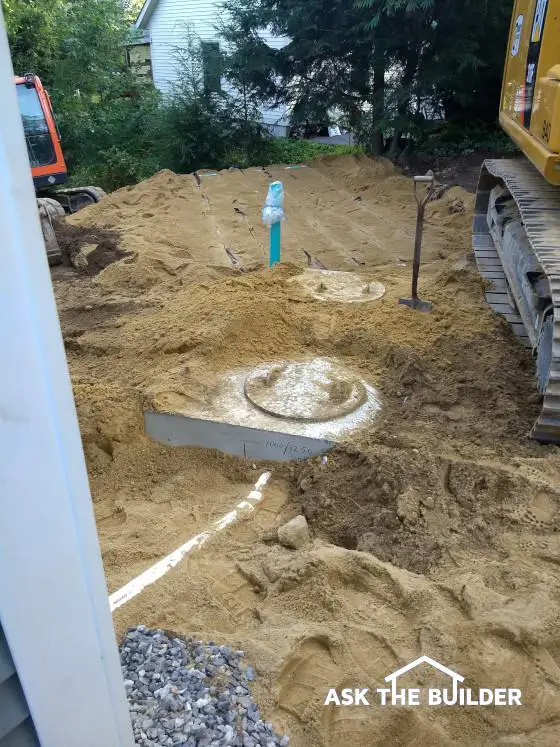
Septic Tank Design | This is a complete septic tank design. You can see the top of the concrete septic tank and the level leach field on the other side of the vertical green vent pipe. House drain pipes that flow into septic tanks require maintenance to keep the septic tank working well. Copyright 2018 Tim Carter
"The size of the septic tank is determined by the number of bedrooms in almost all cases."
Septic Tank Design Checklist
- You need a professional design drawn by a pro
- Each house is different because of load, soil, and topography
- A leach field can be under a road
- Use gravity - avoid pumping septic tank water up hills
Septic Tank Design - You Need a Professional
Septic tank design is a science. Professional septic tank designers are trained to know exactly what type of system to put in for each location.
Related Links
Free & Fast Bids
CLICK HERE to get FREE & FAST BIDS from local septic tank companies.
What Size Septic Tank is Required?
The size of the septic tank is determined by the number of bedrooms in almost all cases. The septic designer has to know how many people might be living in the house. I have a four-bedroom home here in New Hampshire and my tank has a 1,000-gallon capacity.
What are the Basic Septic Tank Design Components?
A basic septic tank design will have:
- a precast concrete or fiberglass septic tank
- a distribution box
- a leach field piping system
What Does a Septic Tank Design Look Like?
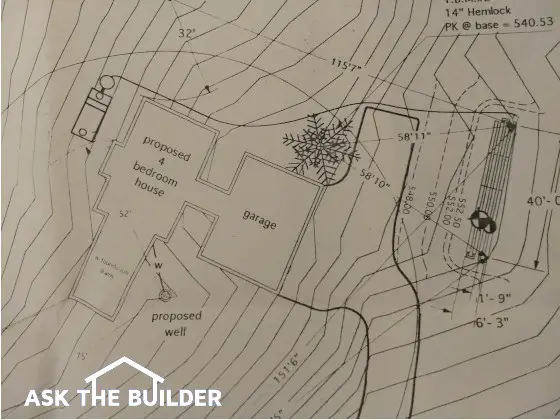
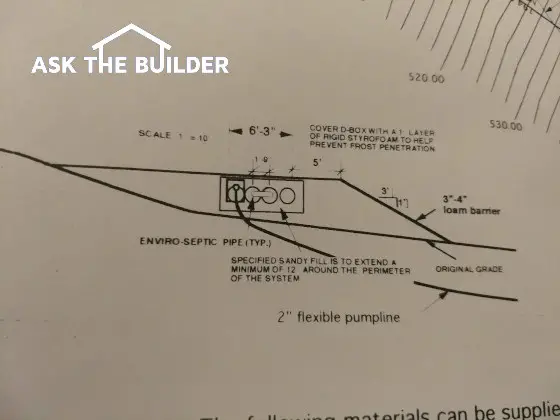
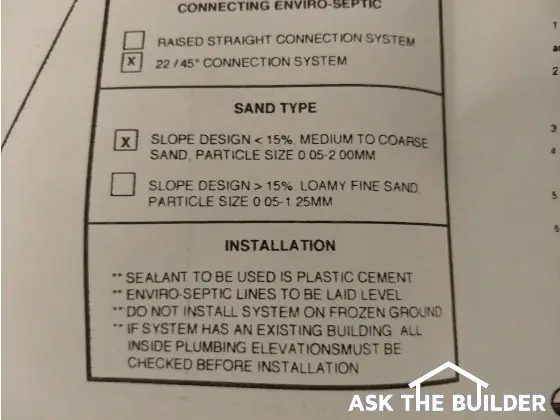
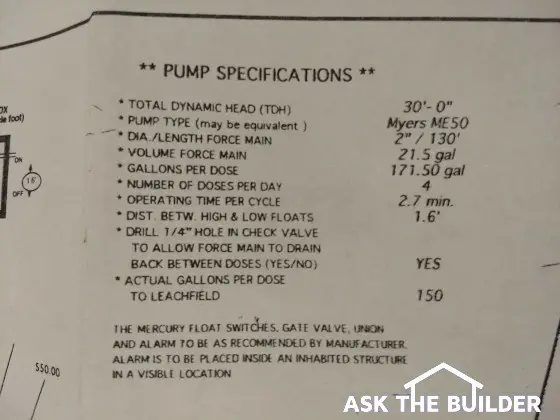
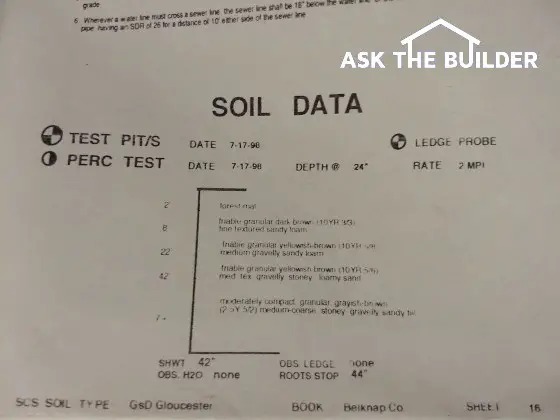
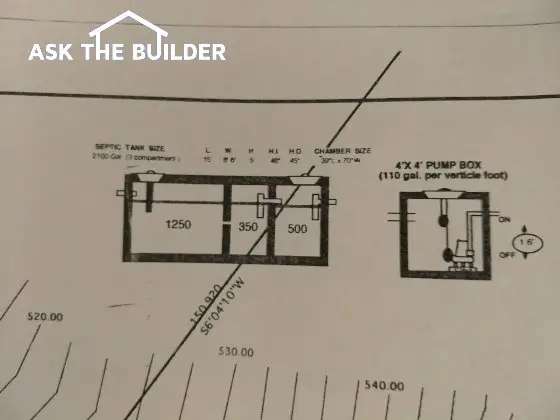
The following photos show you an overall septic tank design. Look at the close-up photos to see the specific design details.
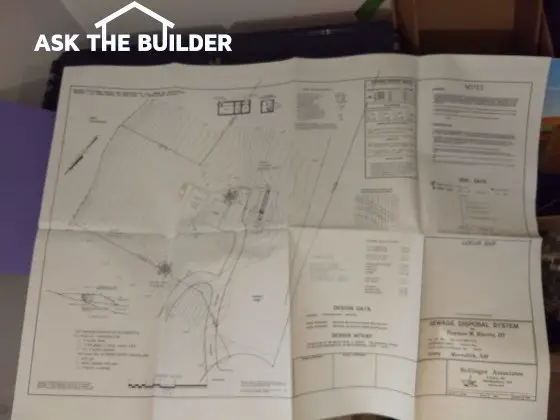
This is a large format septic tank design plan with all the information the contractor needs to install the entire system. Copyright 2018 Tim Carter
What Soils Are Best for Septic Systems?
A well-drained soil is best. The more sand that's in the soil the better. Dense clay soils are the worst.
What is a Raised Leach Field?
A raised leach field is one where the pipes and sandy filter soil are placed up above the normal grade height. These raised leach fields resemble Indian burial mounds.
Can a Leach Field be Placed Under a Driveway or Road?
Yes, a leach field can be placed under a driveway or road. These require a special pre-cast concrete panel system that protects the sand filter medium under the roadway or driveway. Watch the following video to see one.
Should I Have a Pump in My Septic Tank Design?
I'd avoid septic tank pumps at all costs. Pumps fail and are expensive. Request a septic tank design that uses gravity flow at all stages. If that's not possible, consider purchasing a different building lot.
CLICK HERE to get FREE & FAST BIDS from local septic tank companies.

Tim built custom homes and did ultra-custom remodeling for 20+ years before launching his Ask the Builder media presence. He was selected as one of the Big 50 by Remodeling magazine in 1993. This award gave birth to Ask the Builder in October 1993. Tim also operates https://DrawPlumbingPlans.com. His @askthebuilder YouTube channel was the first home improvement channel on YouTube.

Great overview of septic systems. Thanks!
Tim in the picture it looks like the discharge line to tank has correct fall but then it appears that they put in a 22/1/2 degree fitting rising up into tank in my opinion not good.
Larry,
There's nothing wrong at all about the 22.5-degree fitting. Putting in the tank so the pipe would be straight would have caused a hard 90 fitting from the tank to the leach field. That's unacceptable.
Interesting video. My septic system is about 40 years old and either a 500 or a 1,000 gallon one. You mentioned having it pumped out every 3-4 years. I now live alone and have mine pumped out every 2 years. Is this too soon or can I leave it at that? Thanks.
Since you live alone, you can extend the pumping time. It's all about what you put into the tank. Do NOT put in grease. Save used paper towels and always sop up cooking grease to throw away in the garbage. Just put soap, human waste and tiny food scrapes in the septic tank. Nothing else.
Mr Tim, we are putting in a rather large shop area. The existing septic tank will be above it for two bathrooms. Would it just be better to dig a second septic system?
Your professional septic designer will tell you what to do.
Your suggestions for purchasing another building lot or even moving away from the heavy clay soils is excellent. Also your advice to avoid pumps is top notch.
I would recommend checking the veracity of the designer by asking where his design has been used.
Going to the site and talking with the home owner is worthwhile
Don't laugh too hard, but at first sight I was thinking a typical Long Island street! Right, that's how bad a lot of streets are out here. High taxes and nothing to show for them.
Tim, I did not notice any baffles in this septic tank. Shouldn't there be one to prevent sludge from flowing into the leach fields?
I'm not quite certain I know what tank you're talking about. I clearly see a baffle drawn in the illustration in the side view above.
Sludge falls to the bottom of all tanks. It's pretty impossible for sludge to make it to a leach field. You might be thinking of scum.
I was happy to see that our septic seems to look ok. I wasn't sure what to look for until your newsletter arrived. We've lived here for 42 years and have never had it looked at, not even pumped out as we haven't had a problem. So last week I decided I'd better check it out as people were telling me that wasn't normal. After a lot of digging I had a guy come in to see if it needed to be pumped out and was told it didn't need it. The guy said he didn't know what we were doing but it must be something right. I didn't think to ask him how often it should be pumped out. And I was hoping that he was correct in saying it was built right. Your newsletter was right on time as I always feel better when I check and see what "Tim would do or say." Thx.
My only beef is that in Minnesota a septic system can only be installed by a licensed contractor. Once the soil/percolation tests have been made and passed I fail to see why I can't dig the holes for the tank and ditches for the leach fields like we did when I was a kid (I've helped dig and build at least 3 systems since I was 8 years old) although these consisted of tanks built from blocks similar to pit well linings and had slots molded into the bottom of each block to allow the tank to leach directly into the surrounding soil. We usually added leach fields about 8 years later in each case. Most septic systems run about $8000.00 for a simple system. Mound systems run between $15-20K. The water tables in this area are fairly close to the surface. You can usually draw water on a sand point if you drive it down 15 feet (or used to be able to before urbanization and storm sewer ponds were added.