Solid Stain
DEAR TIM: I visited a national-brand paint store and talked with an employee about solid stain. I told him I wanted a solid color on my home, but that I didn’t want to paint my home because it would peel eventually. The salesman said I should use solid color stain on my home. I bought ten gallons of a custom color on his recommendation and took it home. When I opened up the first can, I was shocked to see how thick the product was. It was full bodied, just like paint. The label says it’s non-returnable because it’s a custom color. Will it be a mistake to apply this to my home? What can/should I do? Bobbie B., Edison, NJ
DEAR BOBBIE: The first thing I would do would be go back to that paint store and discuss the situation with the store manager. I feel you got very bad advice. With all due respect, the employee who serviced you is perhaps one of the lowest-paid employees in the entire company. I doubt he has a chemistry background. Furthermore, my guess is that this employee hasn’t had extensive training as to the difference between film-forming coatings and penetrating wood stains. You wanted to buy a product that would not peel. What you were sold was a paint that’s marketed as a stain. Ask for a full refund.
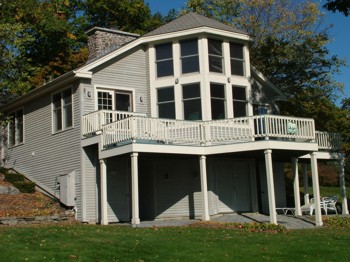
This association clubhouse has low-quality paint on it. It was sold as a solid stain. PHOTO CREDIT: Tim Carter
Let me share a story that just happened to me. I’m convinced that it will help you solve your problem. This past weekend I attended an association meeting in the community where I live in New Hampshire. It’s called Waldron Bay, and has a stunning clubhouse covered with lap cedar siding on the shore of Lake Winnisquam. Years ago, the wood siding on the clubhouse was treated with, what I believe to be, an acrylic solid stain. It’s peeling in places, and needs to be recoated.
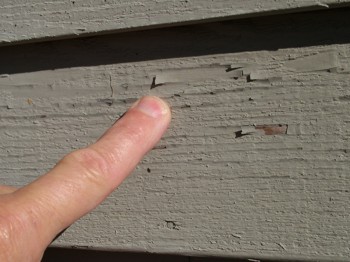
You can clearly see the low-quality paint - sold as stain - peeling. It never penetrated into the pores of the wood siding. PHOTO CREDIT: Tim Carter
I was asked a year ago to write a specification for painters to follow so they could give us a bid. The association board wanted the clubhouse to be a solid color just like your home. I discovered years ago that some paint companies play a little shell game with their products as a marketing gimmick so that you buy a product thinking you have something else entirely. It even happened to me 25 years ago on my own home.
Yes, I went into a national paint store 25 years ago asking for the same product you wanted. I didn’t want paint that would peel, so the employee told me to use a solid color stain that would never peel. Guess what? I can show you many places on that house where the “stain” is peeling. In your head and mine, you equate the word stain with a colored liquid that soaks into the pores of wood and doesn’t lay on the surface of the wood. Thus, it can’t peel. Imagine if you label a thin or even thick-bodied film-forming liquid as a stain and sell that? Yes, you’ll confuse and trick many people.
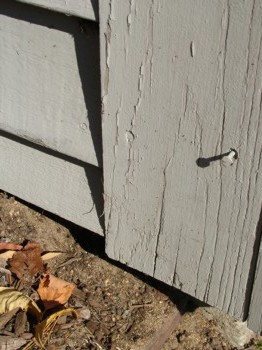
PHOTO CREDIT: Tim Carter
These powerful mind tricks happened to our association board this weekend and even many of the homeowners who attended the meeting. The president of the association visited a local paint store and got the same advice you did. The association members voted to coat the exterior of the clubhouse with a solid color stain that in reality is a lower-quality paint. In a spirited debate, I was defending my specification to use the best paint available that’s made in the USA.
When the votes were counted, there was one person in the audience who voted against the motion to use solid color stain - it was me. The sad thing is that for the amount needed to paint our clubhouse, there was only a difference in price of less that $180 between the solid color stain and the best paint on the market. Oh well, you can aim a hose into a person’s mouth, but you can’t make them swallow.
If you open can after can of solid stains and they have the consistency of paint, that’s what they are - paint. Paint is a film-forming coating. It’s supposed to lay on the surface of what’s being painted and bond to it mechanically and sometimes chemically. Paint doesn’t soak completely into wood pores taking the tiny color pigments with it. Thin-bodied stains that have the consistency of water are formulated to do just that.
Since you want your house to be a solid color, you’re forced to use a paint. There’s nothing wrong with that. But to minimize future peeling, you want to purchase the absolute best paint on the market. The chemistry of paint is nearly identical to many adhesives. Think about it - glues or adhesives are formulated to stick to things or bond two things together. Paint is simply glue with color in it. Great paints stick very well to skin, wood, metal, clothes, rugs, etc. I’m sure you know all about that if you’ve spilled any!
You want to bond the paint film to the wood, so you want to buy the best glue (paint) made and follow the directions on the label to the letter to ensure it will stick for a very long time to the wood. The best thing you can do is wash the outside of your home with soap and water by hand to remove any and all dirt that will interfere with the ability of the glue to stick to your home.
The Federal Trade Commission is tasked with eliminating deceptive trade or advertising practices. It’s my honest opinion that this is one area where strict definitions of words cause a problem. Think about it for a moment.
If you want a piece of wood to have no color change, you coat it with a clear urethane or varnish. If you want to change the color of the wood, you apply a stain. I can live with that. So the paint companies can say with all validity in a hearing that when you use a solid stain, you’re indeed changing the color of the wood. Once again, that’s the truth.
But the disconnect happens because transparent penetrating wood stains have been sold for years as a non-peeling product because, in fact, they don’t peel. Thus consumers equate stain with no peeling. It’s a very gray area. Don’t be fooled.
This column was SO GOOD that I shared with the 31,000 subscribers who read my August 2, 2020 newsletter.
Column 800

Tim built custom homes and did ultra-custom remodeling for 20+ years before launching his Ask the Builder media presence. He was selected as one of the Big 50 by Remodeling magazine in 1993. This award gave birth to Ask the Builder in October 1993. Tim also operates https://DrawPlumbingPlans.com. His @askthebuilder YouTube channel was the first home improvement channel on YouTube.
My house was built in 1964, the front is cedar shake and the back is cider siding. The original owner used a solid color oil based stain on everything wood outside. I continue using solid color oil based wood stain from a high quality stain company and it's beautiful with no chipping or peeling. I have never had to scrape anything. In fact when I put new gutters on my house I had my stain color altered to match the color of the gutters. It is a deep color and it does fade so about every 7 years we put on a new coat. I would never put paint on cedar.
Hi Kurt, I know that your response is a year old, but have a home similiar in age/construction that needs maintenance/prep and new stain. Can you tell me what stain company you use? I'm getting the run-around with people trying to push paint as stain for my cedar clapboard and shake siding Massachusetts house (built in 1959). Thank you.
Solid stain, as I say in the above column, is PAINT.
If you want semi-transparent stain so you can still see the wood grain, you may want to look at my deck stain test results.
The results are STILL VALID because there's been no major technology advancements in the coatings industry in the past four years.
Deck stain will last about 3X longer on house siding than a deck because the sun's UV rays glance off it at slight angle in the worst part of the day. GO HERE:
http://shop.askthebuilder.com/deck-stain-test-results/
Tim, thank you for this. We live in a log home and the vertical fascia boards are 2x treated boards that were originally done in a solid stain. We are now 12 years later and have had to repair some carpenter bee damage to the boards (treated and filled with epoxy/putty) and now we need to recoat with a solid color. What product do you recommend for this? There have recently been some "resurfacer" products released but it seems that reviews are initially good and then people complain of blistering and peeling. I just need great coverage so that the putty is effectively unseen. Thanks for any help.
Hello,
We moved in to a 30 yr old home with cedar siding. Whatever had been applied to the home prior to us moving in, starting to peel and chip. We were told the previous owner had someone spray a "solid stain". My husband has spent two whole summers, around work and life, power-washing, scraping, woodfilling any crack or holes, priming and replacing any damaged boards and then painting two coats of a solid stain. This should of been his last summer on this project, but instead, most of what he has completed has already started peeing off and chipping again, except for the brand new boards.
What a frustration!! To say the least!
Since we do not know what was previously used on the house, we wondered if that would be what woud be causing the new application to peel?
Is it possible it was an oil base and we went over it with a solid stain that wouldn't adhere?
Please tell me what can be done to stop the problem now!
Thank you!
Eileen,
I believe the answer to your question is in the above column.
Please re-read it. Solid stains are *not* penetrating stains.
Read this column too:
https://www.askthebuilder.com/adhesive-chain/
Dear Tim, I’m replying as you requested in the news
letter. I think the FTC needs to correct the paint companies that sell paint with primer. There is no primer in the paint. In fact, the directions tell you that you must use primer. I had the go- around with a painter when we had a bathroom gutted and redone. He insisted as the can says on the front that it has primer. I had to show him the directions on the back. Damage done.
There are no shortcuts in my opinion when it comes to a good long lasting paint job. Taking time with proper prep is 90% of the work. When dealing with treated lumber, most don’t give it time to dry out enough when they get it from the big box stores.
Deepest regards,
Elaine
Elaine, the only way the Federal Trade Commission knows if a company is doing something wrong is for you and THOUSANDS of others to notify them. You can start the process here: https://www.ftccomplaintassistant.gov/#crnt&panel1-1
Hi Tim,
Years ago, I had not heard of you yet, but did know that all of the paint-on "stains" would peel and asked a handyman to stain a front deck. I specifically asked him NOT to use a paint on stain. He did anyway and within months the same area that was peeling, peeled again. I live in a house in TX, put up a fence and need to seal it. I have been consistently told after I say I want to keep the color of the cedar and so no color, that color is what will shield the wood from the UV rays. All around me are folks who have used those paint on "stains" on their fences and they are peeling with months. It's really annoying that the places you go to for advice on the products are giving wrong advice and selling the wrong products for what is needed. I will give the stain you talk about a go. I know it will be just what I need, just like all of your other advice to me.
Great article Tim. Second generation painter here. If someone is intent on using a solid body latex stain then it should, by all means, be primed with an appropriate slow dry oil base primer (with a required overnight dry time) beforehand applying the stain. I have used this method with great success. In fact, there is a house down the street that I painted almost 15 years ago and still looks really good. Not bad for the florida sun. Applying a solid latex stain over raw wood has disappointing results and I do not recommend it. Applying a quality solid color oil base stain is probably still one of the best options available. This is all we used back in the 1970's and the stuff was bulletproof. I haven't found anything on the market that has been an improvement over that product so many years ago.
So I may be faced with this situation in the near future. I have a front deck that is stained, but not treated. I just invested in a pressure washer and plan to clean the wood. Any words of advice what the best stain and/or sealant I should use on my deck?
Secondly, I have a back deck that has been stained/painted. It's peeling. Again, I'm thinking about using the pressure washer to remove the paint and apply something to it that changes the color, but doesn't peel. Is there such a thing?
Find my Boat Dock Sealer video. Watch it. READ all my columns about using pressure washers on WOOD!!!! DANGER!!!