Treated Lumber Ratings
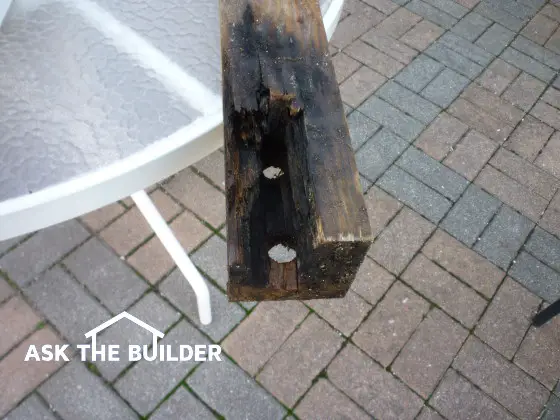
Treated Lumber Ratings | This is the bottom of what used to be a treated lumber post. GASP! The WRONG type of treated lumber was used for this job. Copyright 2020 Tim Carter
Treated Lumber Ratings - Twelve at Last Count
- Twelve different treated lumber ratings
- Identifying the rating
- Treated lumber corrodes fasteners
- Why decks collapse
- CLICK or TAP HERE to subscribe to my FREE newsletter
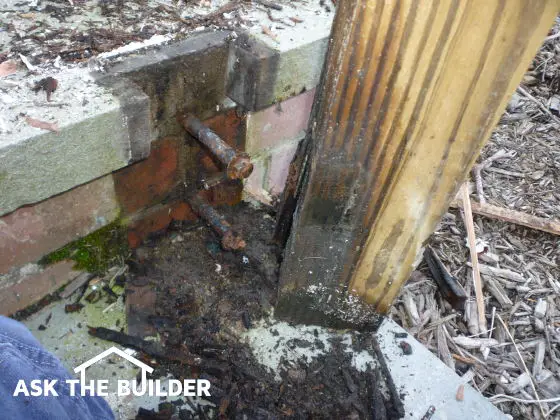
DEAR TIM: I’m a remodeling contractor and have started to see a disturbing trend in the failure of treated lumber. I was hired to rebuild an outdoor stair railing that had a treated 4x4 post wrapped with redwood. A vast majority of the bottom of the post rotted away and the post was very wet once I removed the redwood. The bolts were very corroded too. The post was less than fifteen years old. I was also called to raise back up an outdoor shed that was built on 6x6 treated lumber posts that were partially buried in the soil. It turns out termites had eaten the post! I thought the treatment process was supposed to deter insect attack. Do you have any insight and knowing this, what would you do to create more permanent installations? Jonathan S., Milford, OH
You may not be a remodeling contractor like Jonathan, but you should have your head on a swivel when it comes to treated lumber. My guess is you might think that all treated lumber you see at the local home center or traditional lumber yard is all the same. That’s not true - not by a long shot.
Who Creates Treated Lumber Ratings or Treated Lumber Types?
Treated lumber ratings can also be called treated lumber grades or treated lumber types. Confusion can result because lumber grade is a term that speaks to the strength of a piece of timber. A higher grade means there are fewer or no knots in a piece of lumber.
A quick visit to the American Wood Protection Association (AWPA) website will clear up this matter for you in minutes, if not seconds. At the time I wrote this column, there were no less than twelve different treated lumber ratings or categories for treated lumber. Each one is given a specific acronym category code such as UC1, UC2, all the way up to UCFB. GO HERE to view a PDF file of AWPA Standards listing the twelve classifications.
Related Link:
Dramatic Treated Lumber Rot Photos
How is Lumber Treated?
Untreated raw lumber from the forest is treated with different chemical brews at different concentrations to achieve a pre-determined level of protection.
A good analogy might be winter jackets. You may put on a light puffer jacket if the outdoor temperature is in the mid-40s F. But if Old Man Winter is in a foul mood and the wind is howling with a temperature of -10 F, you might want to have on a Maine mountain parka.
Can Mistakes Happen at the Treated Lumber Factories?
Ed Collins, a subscriber to my FREE Ask the Builder newsletter, shared this with me: "Excellent treated lumber treatise! A few years ago, I had a conversation with a former manager at a treatment plant. He stated that some yellow pine heartwood does not absorb the treatment chemicals as well as the sapwood; also, after every load is removed from the treatment cylinder, the correct amount of chemicals need to be added to restore the water to the proper strength (which doesn't always happen).
From my own experience, the small deck behind our house was framed by a contractor who insisted on doubling 2X10s for the frame around the perimeter (which I thought unnecessary for an 11' X 10' deck) - I did the decking using 5/4 X 4 cedar. Twenty years later, I needed to replace a few of the cedar deck boards; to my surprise, some of the doubled boards on the perimeter had rot going down more than 2". I believe what led to this is that the wood was always wet between the boards. I cut away the worst rot with a recip saw and put in new treated lumber, then put on a copper flashing over all exposed joists. Moral: try to avoid doubling wood deck understructure at all costs or use flashing!"
Does Treated Lumber Need to Dry Out?
It’s quite possible the treated lumber that Jonathan is replacing was only rated for interior dry locations. Or, it could have been rated for outdoor use but was rated for rapid water runoff. Note that he said the post was wrapped in redwood so it stayed damp or was wet most of the time.
How Do You Identify the Type of Treatment?
When you purchase treated lumber, it’s supposed to have a small plastic tag stapled to the end of the lumber. This tag should show the AWPA use category. If I were using treated lumber outdoors and wanted maximum protection from rot and insects, I’d want the tag to say UC4C.
Does Treated Lumber Corrode Steel and Iron Bolts & Nails?
It’s very important for you to realize that much of the modern treated lumber has a very high concentration of copper in the wood. If you paid attention in high school chemistry class, you know that when you put copper and steel or iron in a beaker full of water, you start a chemical reaction that starts to corrode the iron or steel.
This is why it’s so very important to use bolts, nuts, nails, etc. with modern treated lumber that have the highest amount of corrosion resistance. The best would be stainless steel fasteners, but you’ll probably have to settle for double-dipped hot galvanized. Some high-quality fasteners are sold with a corrosion-resistance scale printed on the box. Match the corrosion resistance to your application.
Why Do Decks Collapse?
Deck collapse autopsies often reveal the cause to be corroded fasteners. If you couple this with poor framing practices and dubious structural construction methods, you can see why I never go onto a tall deck before I inspect it first.
Just a little over a year ago, a friend of my daughter almost died in Puerto Rico because she stepped alone onto a small outdoor deck and it collapsed under her weight. She broke her neck in the fall and had to have her spleen removed. Never trust an outdoor deck that’s more than 4 feet off the ground.
Can You Trust Treated Lumber?
There are other issues I have with treated lumber. While these are quite cynical in nature, the possibility that the lumber really doesn’t have the protection the tag states is possible. Imagine these scenarios. What happens if the concentration of the brew is not what it’s supposed to be? What happens if there’s a failure in the gauges connected to the pressure vessels where the lumber is being pumped full of chemicals? What happens if the plant operator had a fight with his spouse or boss that morning? Yes, these are all very remote possibilities, but nothing is certain in this world except death and taxes, right?
You do have other options in many cases when it comes to building things exposed to the weather. Instead of using treated lumber, you can use metal. The treated 4x4 post that Jonathan removed could have been a galvanized 4x4 metal tube. While the homeowner may not have liked the look, the railing system could have been aluminum.
It pays to talk with a contractor with at least twenty years of building experience in situations like this. I’d also suggest talking with several, not just one, so you get a variance of opinions. You would do yourself a favor by engaging your own critical-thinking skills and ratchet back your trust factor. Keep in mind that some marketing managers for products push the envelope on their product claims. For example, do you really believe in a lifetime warranty on roofing shingles?
Column 1359
Over the years ,, , this DIY'er has tried a few off the wall techniques. For posts in the ground : I have coated the inground portion with roofing cement ( & am aware that a lot of breakdown occurs at ground level ) , esp the end grain that facilitates the wicking process. I pack ( with a tamping spud ) the hole cavity around the post with gravel for god drainage. I only use concrete in the upper portion .
Do not know yet if these techniques are worth the effort or even Best Maintenance Practices , , , but I feel better.
Great commentary. I had no idea there were so many grades of PT lumber and/or the corrosive nature of the chemicals. This will definitely help in upcoming builds.
Tim--- it's hard for me to believe that the way that lumber was stack all to gather it was going to get proper treated----------but i guess it works
Hi, Tim. I've been a long-time subscriber to your online newsletter and found it very helpful in many instances. Your article on rotted treated lumber really came home to me. My deck was originally built about 1987; i have no idea with what. I moved into the house in 1993 and the deck seemed OK. Probably 10 years after moving in, I stained the deck with a penetrating stain, but it turns out the color was awful.
I stood it for several years, and finally had the deck painted with special deck paint. However, in a few years, rotten places began to appear, so in 2013, I had the deck rebuilt with "pressure treated" lumber. I don't know where it came from and had no idea of the different ratings. All was well until last year when a couple of the deck boards began to show rot, and worse the fascia board to which the steps were attached, was really bad. I replaced those boards myself without too much difficulty, using stainless steel screws instead of nails. I didn't use manufactured deck boards, such as Trex, because I was told Trex required 12" spaced joists and mine were 16". Now, I'm wondering about the possibility of simply securing manufactured deck boards on top of the existing deck boards. That would solve the problem of the joist spacing, but not necessarily any further rotting of the underlaying boards. What are your thoughts, please?
Thanks.
My next door neighbor fell through his rotted deck a couple days ago. I told him years ago to do a pavers laid in sand and not a deck.
Have had to replace some rotted posts on one of my barns. The posts seem to be oak and the barn is many years old. Seems the posts rotted right at the surface of the concrete pad and underneath in the ground, the rest of each post is still good. Assume it has to do with oxygen exposure.
In replacing the posts, I am using post brackets that raise the base of the posts an inch or so off of the pad and digging under the pad and putting in concrete with L anchors.. Before using the brackets, cleaning and pickling them and spraying them with liquid truck bed liner. Plan to also spray the lower portion of the posts with the truck bed liner after installation. The real BS and CS gets deep in there sometimes and sure that makes for lots of biological activity that could lead to post rot or rusting brackets. Not sure if ground contact rating also means cow poo rating.
I've seen many more problems with treated wood rotting since they banned CCA treated wood from residential projects in 2002.
It seems the MCQ and ACQ variations of treated wood have gotten better than the 2003-2008 ones but time will tell.
Excellent treated lumber treatise! A few years ago, I had a conversation with a former manager at a treatment plant. He stated that some yellow pine heartwood does not absorb the treatment chemicals as well as the sapwood; also, after every load is removed from the treatment cylinder, the correct amount of chemicals needs to be added to restore the water to the proper strength (which doesn't always happen). From my own experience, the small deck behind our house was framed by a contractor who insisted on doubled 2X10s for the frame around the perimeter (which I thought unnecessary for an 11' X 10' deck) - I did the decking using 5/4 X 4 cedar. 20 years later, I needed to replace a few of the cedar deck boards; to my surprise, some of the doubled boards on the perimeter had rot going down more than 2". I believe what led to this is that the wood was always wet between the boards. I cut away the worst rot with a recip saw and put in new treated, then put on a copper flashing over all exposed joists. Moral: try to avoid doubling wood deck understructure at all costs or use flashing!
Do not buy 'Top Choice treated Lumber'. I built a large 25x27 deck with treated 2x6 as the main deck floor in 2016 and now it is black, rotted, even some completley rotted through you can see the ground 4' away. Lowes sold it to me, but they can't give you a contact phone number, even called their customer care. They finally found a number of a rep (I assusme) but it was no good, not in service. Their home office is in Cyprus, wonder why? Can't sue them! The only contact method is thru their website by sending them a message, but I've had no response from that either.