Poured Concrete Walls vs. Concrete Block
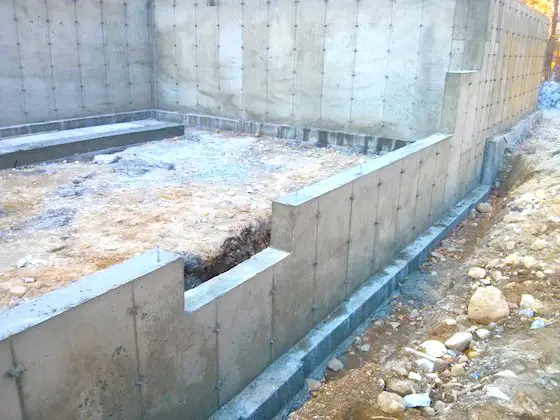
Here are some great cast concrete, formal term for poured walls, foundation walls that were formed and poured in ONE DAY just down the street from where I live. You'd NEVER build block walls that fast. (C) Copyright 2016 Tim Carter
Poured Concrete vs Block Wall TIPS Just Below
FAST TIPS for Poured vs Block Walls:
- Block walls can be as strong or stronger than poured walls
- Block and concrete are strong in compression, but weak in tension
- Reinforcing steel needs to be in block walls - both vertical and horizontal
- Block cores must be filled with pea-gravel concrete
- Poured, or cast, walls must have horizontal steel top and bottom
CLICK HERE to get FREE & FAST BIDS for foundations walls for your new home.
DEAR TIM: I am getting ready to construct a new home with a full basement. I am convinced that poured concrete walls are stronger than concrete block walls. However, a friend of mine has told me that there is no difference. My contractor has indicated that there are many factors that control overall strength in each type of wall. Can you shed any light on the subject? J. D.
DEAR J. D.: First of all, I can tell you that your contractor is quite right in his statement. There are many variables which control overall strength of masonry or poured concrete basement foundation walls. Design strength of the concrete, concrete blocks, and mortar are very important. The thickness of the wall with regard to its height is also extremely important.
For the most part, each type of wall has two categories, reinforced and non-reinforced. A reinforced wall, either poured concrete or concrete block, always contains some form of reinforcing steel. The presence of reinforcing steel dramatically increases the overall strength characteristics of masonry or concrete.
However, let's compare two 8 inch thick walls. One will be poured concrete, while the other one will be standard 8 inch hollow core block. There are two forces which act primarily upon foundation walls. The one force is a downward force (gravity load) created by the load placed upon the wall. The other force is a sideways or lateral force caused by the backfill or earth which is placed against the wall.
The strength of concrete is often measured in pounds per square inch. This is a measure of the weight that it will support before fracturing. You can apply these same standards to concrete blocks and mortar. Let's assume that each of the test walls have the same strength. The strength of each wall is directly proportional to its cross sectional area. In our example, a standard concrete block wall may only be half as strong as the poured concrete wall when a gravity load is applied to it. This is due to the hollow voids within the wall.
When you apply a lateral load to these two walls, you will achieve similar results. The poured concrete wall has more mass or interlocking cement paste crystals to resist the cracking force. The hollow block wall is depending solely on the strength of the thin mortar bed between each concrete block.
The addition of reinforcing steel to either wall system complicates the issue. For example, you can make a concrete block wall stronger than a poured concrete wall, by simply adding some reinforcing steel and additional mortar to the block wall. The trick is to insert vertical steel rods from top to bottom in the hollow cores and fill those hollow cores to the top with mortar. The addition of thin wire truss reinforcing steel in between the layers of block will add even more strength. This block wall would be far stronger than a similar non-reinforced concrete wall.
CLICK HERE to get FREE & FAST BIDS for foundations walls for your new home.
Your best bet, in my opinion, is to install a steel reinforced poured concrete wall. Have your foundation contractor install two 5/8 inch horizontal reinforcing bars about 16 inches from the bottom and top of the wall. These bars will minimize cracking if your soil beneath the footer rises or falls.
Consider installing singular vertical bars approximately two inches away from the inside face of the foundation wall every two feet on center. These bars will help withstand the bending force caused by the backfill dirt.
Remember, you only get one chance to install reinforcing steel. Spend the extra money and your foundation will not let you down.
GET THIS BOOK NOW. CLICK THE IMAGE TO BUY IT.
If you want to learn lots about how concrete should be installed, you must buy a copy of a neat paperback book published by the Portland Cement Association. It is titled Design and Control of Concrete Mixtures. This book is a little technical, but it has many very important facts and guidelines that will help you order and place concrete under all sorts of site and weather conditions.
The Portland Cement Association has another book called The Homeowners Guide to Working With Concrete, Brick and Stone. This swell book contains some great photos, illustrations and numerous tables. It educates you about how to order and work with concrete. The book also shows you how to install brick and stone. It is a must have! To buy it now, just click it.
Column 046

Tim built custom homes and did ultra-custom remodeling for 20+ years before launching his Ask the Builder media presence. He was selected as one of the Big 50 by Remodeling magazine in 1993. This award gave birth to Ask the Builder in October 1993. Tim also operates https://DrawPlumbingPlans.com. His @askthebuilder YouTube channel was the first home improvement channel on YouTube.
In general, while a poured concrete wall may be stronger...it also may not be necessary. For example. If you are building a wood frame wall with a window, and a 2x6 header is adequate to support the loads above, then you don't need to spend the money on a 2x12 header. For the foundation the same is true, if a concrete block wall (whether reinforced or not) is adequate, and typically quicker to put up, why spend the money and time (time=money) on a poured concrete wall.
From the cost perspective this is true. But when you spend the same amount of money to buy the house, you always want to have a better quality.
Hi Tim, we are about to start building our home and boundary wall in Cebu , Philippines, we will be using the column, beam and hollow block process, my question is to do with the filling of the hollow block after its laid. Standard procedure they use is to lay the hollow block a course at a time and fill the brick with the mortar mix, they do have horizontal rio every 3 courses and vertical rio every 600mm, I have read many blogs saying that filling the hollow block with a concrete mix of , cement sand and gravel gives a stronger wall. Is this true, what would the mix be, and the process, my understanding would be they lay the mortar on the brick edges and webs then place next block on top and so on up to 3 to 4 rows then fill with the cement mix, then repeat, your advice would be greatly appreciated , thanks , rob
I would read all of my columns about concrete block and the proper way to reinforce these walls. I tell you exactly how to do it in my past columns.
i am planning to build an effiecient home about 30 miles from Tacloban in the Philippines inland. How deep can i go with a basement in such areas? I planned on a 4-6 ft deep basement with a styrofoam dome over the top. The inground poured cement area would give us an added benefit to the hot climate there.
Well, I'd be inclined to hire an excavator that can dig the hole. That's how I'd approach the project. Make sure you have great drainage so you don't build an indoor swimming pool.
I was in Palo just south of Tacloban Nov 8th 2013 I would build the foundation 5 to 6 feet above grade unless you would like an indoor pool with various critters swimming in it. I was hit by a 20 foot storm surge and my first floor room filled to the ceiling with water with me in it. I am thinking also what construction will withstand the next typhoon and how to build a strong roof that will stay on. we would build in MacArthur about 45 min south of Tacloban
Hello I'm working on a project to make a 606 m concrete wall that is 6 feet, how much do you think that will cost and how long will it take?
Hi,
If I have retaining wall ( concrete block), 9000 LB what kind and demotions of foundation I should use please?
Hi Tim
I have a hoyse in Phil, with a poured wall. I am pkannng to expand the house to first floor, is hallow blocks wall better than poured wall?
Best regards
Wendy
i,m about to build a concrete house on a Caribbean Island
How sturdy is an exterior privacy wall made with gunite? Where would that application be cost wise compared to CBS block with mortar and rebar enforced?
My GC had left over gunite from my pool and used it to construct wall in two sections of my existing 6' high CBS block wall where there was wood fence
Without me being there to inspect it, I can't give you an accurate answer. I'd have to know exactly how the wall was constructed.
On a block basement wall hoe many inches or feet between each core?