Gravity Hot Water System
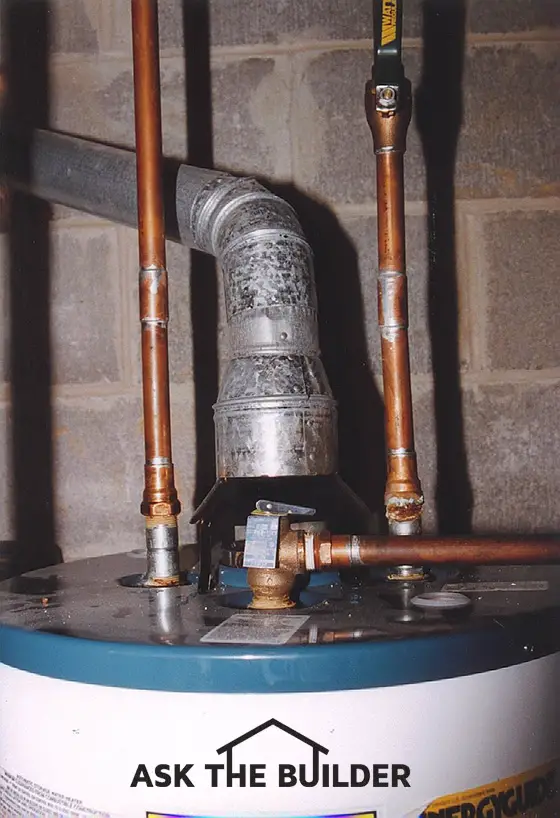
Gravity hot water system | This is the top of a gas water heater. The hot water leaves the tank on the left side. The recirculating loop pipe re-enters the tank down at the drain valve below.
Gravity Hot Water System TIPS
- Easy to install in ranch homes with a basement or crawl space
- Works using the magic of convection - no electricity or pump needed
- WATCH the alternative pump video below
- Enjoy hot water instantly at all fixtures
- CLICK HERE to Get Tim's FREE & FUNNY Newsletter!
Gravity Hot Water Recirculating System
"A gravity hot water system works because the heated water, which is lighter, rises through the loop. As the water cools at the end of the loop where the last part of the loop is not insulated, it is thermo-siphoned back into the hot water heater."
DEAR TIM: I am not a big fan of cold showers. I have to wait 15 - 20 seconds each morning for hot water to arrive in my shower.
It seems like a terrible waste of water and money. Is there a way to avoid this?
Can something be done to my ranch house? Is it possible for a DIY'r to accomplish the remedy? H. O.
DEAR H.O.: Brrrrrr! I know the feeling.
Cold Showers Not Acceptable
Cold showers are a bummer. Guess what? We can solve your problem with a simple gravity hot water recirculating loop. They're effective, inexpensive and easy to install.
Do You Waste Water?
First, however, I want to put into perspective the waste situation. Clean water is a natural resource and should not be wasted if you're getting it from a municipal water system.
Until your loop is operational, why not capture the shower water with a bucket? Use it to water plants or to fill your washing machine.
Free & Fast BIDS
What is the Actual Cost of Wasted Water?
The cost of the wasted water is minuscule. Let's assume you pay only 1.5 cents for each cubic foot of water (that was my rate when I wrote this column).
If you have 25 feet of 3/4 inch water pipe between your hot water heater and the shower, you waste .076 cubic feet of water each morning or $0.001178.
It would take 849 showers for you to waste $1.00 worth of water. Keep that in mind if you choose a fancy way to solve your problem.
Recirculating Pump Alternative
If you don't want to install the actual loop and want hot water at your plumbing fixtures instantly, you can install a nice pump that does what a gravity loop will do.
These pumps work on timers and move hot water through the system when you think you'll need it. They have a special valve that connects under a sink so there's NO WATER WASTE.
The cooled water in the hot water line is pumped back into the cold water line as soon as the pump fires up. When hot water reaches the special bypass valve the valve shuts off so hot water is not wasted.
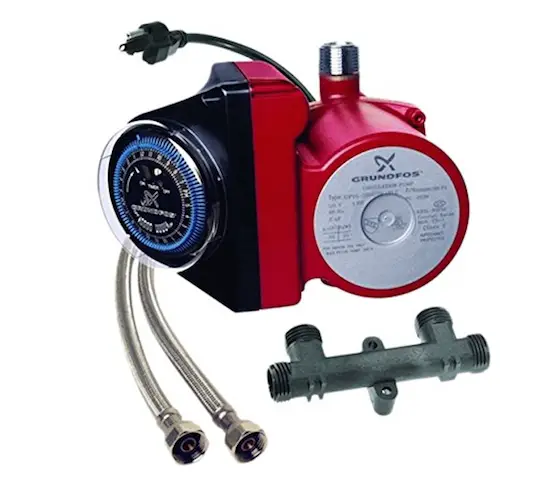
This is a reliable recirculating pump you can install on top of your water heater. The weird threaded fitting goes under the sink that's farthest away from the pump. CLICK THE IMAGE NOW TO ORDER THIS PUMP.
Recirculating Pump Video
Watch this short video to show where the pump is installed and the special bypass valve.
Customer Reviews About My Gravity Loop
"I phoned you about my gravity loop that I recently installed. You clearly indicated what I did wrong. I had the theory and connections right, but the wrong pipe size. I used 1/4 inch copper tubing for the return loop. As you know, it did not work. Per your information, I increased it to 3/4 inch pipe. You said 1/2 inch might work, but I didn't want to take the chance. Bingo! - It works beyond what I had hoped for - Instant Hot Water." Bob Chartier, Westland, MI
CLICK HERE to set up a phone call with master plumber and founder of AsktheBuilder.com - Tim Carter!
# # #
"I remodeled about a year ago and read this column on gravity loops. We installed the loop and it works fantastically. There is instant, well almost, hot water on the far end of the house. I would not have believed something so simple could work so well....." Paul Wiegert
Are Recirculating Loops a New Idea?
Hospitals, hotels, motels, and other large buildings have used hot water recirculating loops for years. Some of these loops use electrical recirculating pumps while others use gravity.
Based upon the fact that your water heater is in the basement of your home, Mother Nature is going to do the work for free!
How Does the Gravity Hot Water System Work?
A gravity hot water system works because the heated water, which is lighter, rises through the loop. As the water cools at the end of the loop where the last part of the loop is not insulated, it is thermo-siphoned back into the hot water heater.
The water enters the bottom of the heater at the drain valve inlet. This flow of water is slow but constant.
Where Must the Water Heater Be Located?
The water heater must be located at the bottom of the loop. Ranch houses and two-story houses with basements are perfect candidates. Houses built on slabs or that have hot water lines below the water heater must use a simple in-line recirculating pump.
Finish The Loop
All you need to complete your loop is a return water line from the far end of your hot water line. Locate the end of your existing hot water line.
Cut into the pipe at this location where the pipe in the basement turns up to go into the fixture on the first floor. Install a tee fitting in place of the 90-degree fitting.
One part of the tee will allow you to reconnect to the hot water line. The other portion of the tee fitting will be the start of the return loop back to the water heater.
IMPORTANT TIP: Do not decrease the size of the return loop pipe. The system will work best if you use 3/4-inch diameter pipe. One-half-inch tubing may work, but don't take the chance.
Drain Water Heater
Turn off your water heater's power supply before you start this project. This is especially true if you heat water with electricity. If a heating element is on and not surrounded by water in the tank, it immediately burns up.
Then turn off the water leading to the water heater. Drain the hot water heater and remove the drain valve by turning counterclockwise.
Remove Drain Valve - Install Tee and Boiler Drain
Install a dielectric union or insulating nipple in place of the valve. This will to reduce corrosion possibilities if you are working with copper or galvanized iron water lines.
The next step is to install a tee fitting at the base of the heater. The loop pipe connects to one part of the tee and you'll install a new boiler drain out of the other part so you can drain the heater in the future.
Insulate 98% Of The Loop
To save energy and have the loop function, you must insulate the loop as it leaves the top of the water heater. The insulation must start inches above where the hot water line leaves the water heater and must continue along the entire loop as it makes its way through the house and starts its trip back to the water heater.
In new construction, insulate all of the hot water supply pipe up to each fixture.
Last 15 Feet - NO INSULATION
Do not insulate the last 15 feet of pipe as it gets near the heater. This pipe must be uncovered so the water cools. This cooling of the water is what powers the gravity convection engine that makes the hot water flow slowly towards through the loop.
Foam insulation is available which will slide over the pipe as you install it. You can also choose to use pre-molded fiberglass with a protective coating. The foam insulation is much more user friendly. Remember, to ensure good performance leave insulation off of the last 15 feet of loop piping as it returns to the heater.
Flapper Check Valve
If the loop fails to work, water may be flowing backward through the system from the water heater. You can stop this with a check valve. Install a check valve in the uninsulated part of the loop about 5 feet away from the bottom of the water heater.
You MUST use a flapper-type check valve, not a spring-loaded one. Spring-loaded check valves will not work and block the slow trickle of water through the loop.
Drill a 1/8-Inch Hole
Drill a 1/8 inch hole through the flapper so that a small amount of water can flow back to the heater to maintain circulation of the water within the loop. If the loop doesn't seem to work well, slowly increase the diameter of this hole but do not exceed 1/4 inch diameter. It's important to realize this hole must be drilled or there's a very good chance your loop line will rattle and clank. The rattle happens because the flapper starts to vibrate back and forth in response to the demand for hot water. The pressurized water in the loop is trying to flow backwards but the flapper springs shut.
The small hole stops the chatter because water can flow both ways through the loop. However, the volume of water flowing backward through the loop is not enough to satisfy the demand called for by the open valve in the loop.
Modern Heater Heat Traps!
If you're installing a new water heater, you need to remove a pesky device installed to keep heat in a heater. Many modern heaters have a heat trap device at the top of the hot water outlet. These are small flapper check valves that stop hot water from drifting up the hot water line when the hot water is not being used. Remove the heat trap device to get the gravity loop to work.
Column 147

Tim built custom homes and did ultra-custom remodeling for 20+ years before launching his Ask the Builder media presence. He was selected as one of the Big 50 by Remodeling magazine in 1993. This award gave birth to Ask the Builder in October 1993. Tim also operates https://DrawPlumbingPlans.com. His @askthebuilder YouTube channel was the first home improvement channel on YouTube.
I am uncertain about the flapper valve and the backwards flow of water. Is there actually water flowing in this loop (with no vales opened anywhere in the loop) or is it just heat transfering through the water as it cools off. Does a flapper valve need to be installed horzontally? Can I accomplish the same thing by putting a valve near the water heater end of the loop and keep it partially closed? Thanks for your help.
Ted, you should consider investing in a 15-Minute Consult with me. Look at my cart for that. Lot's to discuss. I just do short pithy answers here.
I read that one of the tricks is to make sure the veritcal return is longer than the vertical supply line. So if I relocate my water heater to the garage in my one-story 1500 sqft house, it will be a longer travel to the bathrooms. So plan to take the hot-water-loop across the attic and back. Going up into the attic is about 3 feet, and coming back down is about 7 feet because of the length down to the drain bib on the heater.
So, do you think this will work if the last 15 feet are left uninsulated?
I had a new State water heater (model GS6 75 YRVHTL, 75-gal nat. gas) installed 2 weeks ago, and have a problem that has my plumber (30+ years of experience)"baffled". The hot water re-circulation line is no longer working (it was working with the old water heater). The pump appears to be working according to my plumber, but there is no water flowing through the line. It is almost as if a valve was closed, except that all valves are open. Swapping the water heater was the only change made, and other than a faulty gas valve that had to be replaced when it was first installed the water heater has been fine otherwise. What should I do at this point? Thanks for any suggestions that you may have.
An air lock can cause this to happen. What did State tell you when you contacted them? Do they have a drawing of how to connect a circulation loop for that heater?
Could you give me an example of a flapper type check valve and where to order one. I am confused by Swing valves, ball valves, diaphragm, etc. I want a 3/4" check valve. Your instructions are excellent.
Michael
I just put a new 75gal water heater in and my gravity re-circulator stopped working. It worked for 8 years taking only 10 seconds and now it takes over 1 min. I checked to make sure that the swing check valve was not stuck and it was moving freely. Then I took the check valve out and replaced it with no luck. Suggestions ?
Newer water heaters are required to meet the new energy standards and this means they install flow restrictors (rubber flaps) in the outlet piping of the water heater to prevent gravity circulation which causes stand-by heat loss on the water heater. (unless you need it for a gravity recirculation system) My company provides forensic Investigations and litigation support for Plumbing & Mechanical system failures.
We recently purchased a home (15 yrs old m/l) with a recirculating loop. According to what I read on your site, the loop appears to be done right (slab home, recirculating pump, last few feet uninsulated, etc etc etc) but when we use the loop the electric costs go through the roof (100kw per day v. 25kw per day usage). I installed a shutoff and unplugged the pump and tested - yes, it takes forever to get hot water to some of the faucets, but water is about 3 cents for 10 gallons, and electricity costs 10 cents per kilowatt. What can I modify to make the loop work without costing me an additional $200 a month for electricity?
I have a Gravity Hot Water Recirculating Loop already installed in my home. I have a flapper type check valve installed. It works at the kitchen sink and hall bathroom but not at the farthest point, my second floor master bathroom. Each h room room has a return line and they all joint in the basement. Do I need to restrict the closest faucets so it will recirculate from the farthest point? Or maybe turn up the temperature of the water at the hot water tank? I have checked there are no restrictions from any room for the return to the tank. I'm at a loose as why it works on the closest faucets and not the farthest? Thanks for your help. Dan.
You probably need a flapper on each return. Otherwise, water can recirculate between loops and not return to the tank to be re-heated.
I achieved super results without a return line, using a thermostatic valve at the farthest faucet to connect the hot and cold lines, making the cold line the return line. I added one more valve to the upper floor bathroom that was on a longer branch as well. Both are functioning with gravity because my heater is in the basement with no heat traps and no pipes plumbed as heat traps. I am using a Watts rebadged Grundfos valve that is marketed as part of their pump kit but can be bought alone. I do get some warm water in the cold line at the farthest faucets but don't mind at all as it lasts only a few seconds of water running and I have instant hot water compared to waiting about a minute before.
My gravity loop system and a new water heater were installed a couple of years ago, and it worked very well until recently. We get a little warmth quickly, taking the edge off, but full heat now takes a minute where it used to take a few seconds. Contractor suggests replacing "swing check" on heater. Does that make sense when everything is less than 3 years old?
How do you get the Heat Trap out? It seems to be molded into the nipple. Is it enough to drill a hole through the ball/stopper?
Be sure your heater does not have a heat trap device at the top of the hot water outlet. These are small check valves that stop hot water from drifting up the hot water line when the hot water is not being used. Remove the heat trap device to get the gravity loop to work.
Tim,
I recently replaced our old water heater with new A.O. Smith 50 gal. model, connecting to existing copper lines including the gravity loop that has been in place since before we bought the house 15 years ago. We have instant hot water, but during a shower the water temp tapers from hot/comfortable down to near luke-warm in about 5 minutes. What could be causing this with 50 gallons of hot water in the storage tank? Thanks
I'm no expert, but it sounds like you have a backflow problem in your gravity loop. I suspect your check valve isn't closing (possibly due to a low flow shower head and an old check valve?) or is stuck open. If so, you're drawing water from the return line, which ultimately draws from the bottom of your water heater, where the cold water enters the tank from the dip tube.
If you do replace your check valve, I believe it should be with a swing check valve, and you should drill a small, e.g. 1/8" hole in the flapper before installing.
Alternatively, you might have a ball valve which was formerly open just a crack. If there's a ball valve on your return line near where it enters your water heater drain, closing it nearly all the way may fix your problem. Especially if there is no check valve present.
A superior check valve would be to take apart an existing check valve and gut it, (or just make one from scratch) using a 0.75" hollow PDVF (Super Teflon) balls. The check valve, when installed vertically, will allow zero resistance to convection loop flow as the ball floats, and 100% resistance to reverse loop flow. When the ball floats, it must not be able to close off in both directions, which is why an existing check valve body might be a good start. PVDF is very heat and chemical resistant. Alternately, a food grade plastic ball could be used, but they're awfully close to their operational limit at the recommended hot water tank temp of 140F.
Thank you for the great information about hot water recirculation. I have it in my house and it is working, I used a 1/2 copper return had not drilled a hole through the check valve flapper, and it worked fine. Seems the cold water weight is enough to flow around the flapper since is pushes the flapper open. I'm about to replace check valve after 10 years, hope the system will work with the new check valve.
Tim,
Should the return looped line back to the water heater be smaller diameter than the supply? I have 1" supply and thought of going down to half inch after the last fixture.
Should the flapper check valve be on the supply side coming out of the heater or on the return side going back into the drain of the heater?
Reduce to 3/4-inch. I thought it was pretty clear in the above column that the check valve is in the uninsulated portion of the loop about 5 feet from the bottom of the heater. But I've been wrong before!
Thank you for this page!! The tip about heat traps interfering with the gravity loop saved me. Even my plumber who says he is a Master Plumber didn't know that was the issue
Hi: I have installed a convection recirculation hot water system in my ranch home, which has a basement.
I have the return line connecting at the inlet to the tank on top. The return line is fully insulated to the tank.
I have a horizontal flapper check valve which I had to drill a 1/8 hole in the flapper to get it to work. The system does work ok, but I would like to have a check valve that does not let any cold water short circuit the hot.
I was thinking if I moved the check valve to a vertical position it might work without the 1/8 hole?
Alternatively I have been looking for a very low cracking check valve that may work in either orientatiion?
Comments please.
DougQ
So I guess this brilliant project is not compatible with a tankless water heater.
Tim, is it a good idea to place a ball valve just above the water heater's drain tee/reciculator connection? This would serve to isolate the gravity system when doing periodic tank flushing. (And also strve to make unwelcome {mother-in-law type} guests wait for their hot water, and leave early!!)
Paul Bembower
Farmington, MO
You can do that if you want. The better in-law deterrent is to get a dog and then ask the inlaws to help do the dishes after dinner. Casually place the plates on the floor and let the dog lick them while you chatter away with the inlaws. Once the dog has licked them clean, pick up the plates and put them back in the cabinet ready for the next meal. This works EVERY TIME.
Thanks for this, it's great.
So if you install a flapper valve (I did) is it a must to drill a hole in the flapper? Or do you only do that if the flapper starts to stick and the system doesn't work? And...can I just take the valve out and let it flow more freely?
Gravity Systems for domestic hot water is by far the best economical design for distribution of hot water. If we could save the energy and water and sewer fees in every home built forward think of the money saved (Average home waste 10 - 20 thousand gallons a year waiting on hot water). The best check valve for this is spelled out in the Grav-Flow patent. A simple reverse valve with non buoyant plastic check will maintain flow and check the water and with adjustable flow stem without water hammering. Don't take the insulation off any of the feed or return line, if you must then you have exceeded distance to vertical height of the system. Get with a qualified gravity flow installer before closing up your pipes. Remember a few buck will save you a lifetime of wasteful energy. I learned this system from my Father in 1974 and have gone back to homes built in the 1960's that are still working great.
Can you use pex for gravity recirculating line
Question: my household water supply line from the street is 90 PSI. My water heater is in my basement. The pressure at the drain cock is 90 PSI The water temp in the heater is 115 degrees. I have a return line from the shower on the second floor of our house. The hot water pressure at the shower is 80 PSI and 110 degrees. I'm assuming pressure and temp drops with distance. Isn't the hot water in the return line pushed back to the heater with water pressure rather than gravity or siphoning? Second question: my return line is connected to a tee at the drain cock. How does the return line water enter the heater if the heater is pressurized at 90 PSI and the water in the return line is less than 90 PSI? Note: my system works great without a pump...I just don't understand how it works. Thanks.
Why do I have to tie the warm return loop into the drain valve of the heater?
Could it be t-ed in the cold water supply line?
Hi, I read your response to a Gravity Hot Water System question. My kitchen sink is only 7ft from the water heater in the garage, but it takes 0.84 gallons and 33 seconds to get hot water. Florida home on a slab. How much rise over the top of the water heater is need? Is 16 inches enough? I could go up 4.5ft then
down to 30 inches through the wall to my sink. Then back to the bottom of the water heater. Is rise important as long as you have some rise?
Also, it says "30 Responses to Gravity Hot Water System" but I only see one, how do I see those?
Does the return loop need to pitch back to the water heater or can it be run level?
Thanks, Bill
My house was originally plumbed to recirculate hot water through a dedicated hot water return, utilizing a Grundfos pump. The return line entered the tank at the top through the cold water supply line, not through the bottom drain line. The system worked great for 20 yrs as a gravity system with the pump off, which we did 90% of the time. We just replaced the hot water tank and the plumber installed the it following the original configuration but it will no longer works as a gravity system and the pump must be used constantly. He did replace all the ball valves and check valves and removed the heat trap valves in the hot and cold inlets. Why won’t the gravity flow work now?