Insulated Concrete Forms – Great But a Bugaboo or Two
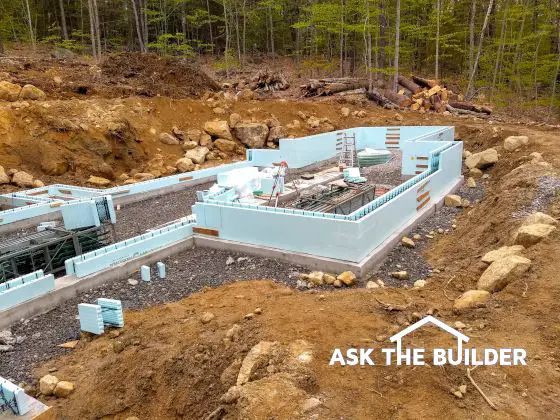
Insulated Concrete Forms | This is a house foundation being built with insulated concrete forms. It's on the street I live on in central New Hampshire. It's a great idea to have warm basements in this frigid climate! (C) Copyright 2019 Tim Carter
Insulated Concrete Forms - They're Great But Not Without a Bugaboo or Two
DEAR TIM: I saw the strangest thing today. A new house was being built using hollow foam blocks. I was told they're insulated concrete foundation forms. I found out that the blocks are going to be filled with concrete. Is this method of construction substantial? Can you finish the interior and exterior as you would a wood-framed house? Are these houses well insulated? Do you think this method of building will just be a fad? Cathy B. Oregon, OH
DEAR CATHY: You saw an Insulated Concrete Form (ICF) house under construction. It was a fledgling industry back in the late 1990s that may soar to incredible heights. As with any revolutionary product, the ICFs need to be affordable and they need to be easy to work with before they become the belle of the ball.
Are ICFs a Fad?
Fad you ask? The ICF method of construction is so revolutionary that it may go down in history right next to asphalt shingles, drywall, plywood, and plastic laminate. These building materials dramatically changed residential construction methods. These innovative products increased productivity, eventually lowered building costs, and made major strides forward in building technology. I feel that ICFs might also be a shoo-in for the building products "Hall of Fame".
CLICK or TAP HERE to get FREE BIDS from local contractors who install ICFs.
What are ICFs?
The ICF system uses insulating foam panels as a form to accept steel reinforced poured concrete. Once the concrete hardens, you have a wall system that outperforms standard wood frame construction in the following categories:
- heating & cooling costs
- strength
- fire resistance
- structural pest resistance
- sound deadening
- natural disaster resistance
Can You Apply Different Material on Top Of ICFs?
You can apply any interior and exterior wall treatment to ICF houses. You install exterior wall treatment systems in the same manner as you would on a wood-framed wall.
What are the Basic ICF Types?
There are three basic types of ICF systems each with variations. The categories describe the way the hardened concrete looks with the foam stripped away. One system - the flat wall - resembles traditional poured concrete walls. Another system is called the waffle pattern. The concrete configuration looks nearly identical to the waffles I commonly eat for breakfast. The final system is classified as the screen grid. These systems resemble an oversized window screen. With the foam out of the way, you could actually pass an object through a screen grid wall.
What Holds the ICFs Together Before the Concrete is Poured?
The foam panels and block systems contain either plastic or steel components. These hold together the forms during construction. Screws or nails driven into the plastic or steel members allow you to apply your wood or fiber cement siding, brick, traditional or synthetic stucco, artificial stone, drywall/plaster, or wood paneling. The manufacturers have designed the systems so that you can easily cut horizontal and vertical channels in the interior foam layer to accommodate electrical wiring and plumbing pipes.
Are Some ICFs Fire-Resistant?
Some ICFs are fire-resistant.
ICF houses will undoubtedly be attractive to people who live in areas plagued by natural disasters such as wildfires, hurricanes, and tornadoes. The foam used in just about every system has been treated with a fire retardant and will not support fire on its own.
Concrete is a fireproof material. Steel reinforced concrete walls are known to withstand strong winds much better than traditional wood framed wall systems, especially if the roof is blown off the walls. Steel strapping members can be poured into the top of ICF walls that allow you to attach the roof framing more securely than in wood houses.
Do ICFs Save Energy?
Energy savings may be substantial in ICF houses. The walls in most systems approach an R-factor of approximately 25. Some systems are as high as R-35. A traditional 2x4 wood frame wall in comparison might have an R-factor of 13 to 17. The thermal mass of the ICF system employs technology that was developed thousands of years ago by native Americans. Adobe houses stay cooler in the day and radiate stored heat back into the house during the night.
Do ICFs Leak Cold Air?
Air infiltration in a typical ICF house is far less than a traditional wood-framed house. This is actually a slight negative. So little air leaks past the outer shell that it is almost always necessary to install a fresh air exchanger or a simple makeup air duct to lower indoor pollution levels that can build up over a heating or cooling season.
Can Termites Tunnel in ICFs?
Yes, termites can and do tunnel inside ICFs. In some areas of the USA, you can't get termite-treatment contractors to treat the house because the termites can invade the home without having to build their traditional mud tunnels.
The second issue is on re-sale. Some lenders require a termite-treatment certificate or warranty if you want a loan. If you can't get treatment, you can't get the certificate!
How Much More do ICFs Cost?
Currently, an ICF house costs just 1 to 4 percent more to build than a traditional wood framed home. This cost will drop as more houses are built and the manufacturing economy of scale filters through to consumers. I intend to use the ICF system when I construct my new office. It will definitely transport me back to my toy house block building days!
Author's Notes:
October, 2002:
How popular are ICF homes? Very popular. The growth from 2000 to 2001 was 29%. ICF homes accounted for 2.7% of all above-grade homes built in the USA in 2001. That is up from 2.1 % in 2000. Look for strong continued growth in this sector.

Tim built custom homes and did ultra-custom remodeling for 20+ years before launching his Ask the Builder media presence. He was selected as one of the Big 50 by Remodeling magazine in 1993. This award gave birth to Ask the Builder in October 1993. Tim also operates https://DrawPlumbingPlans.com. His @askthebuilder YouTube channel was the first home improvement channel on YouTube.