Powered Attic Fans – Attic Insulation Facts
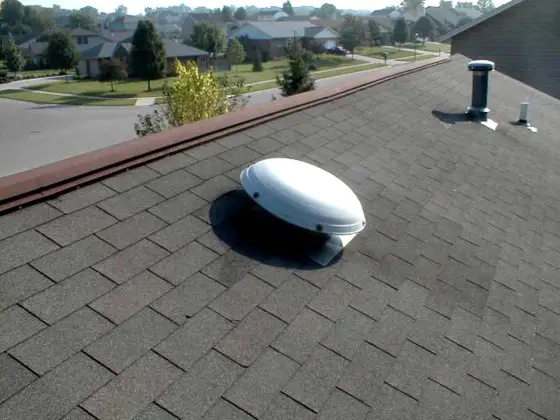
This is a powered attic ventilation fan. If it doesn't have excellent intake air around the soffits, it can actually vacuum air from inside your home.
DEAR TIM: I am trying to make my house more comfortable and lower my air conditioning bills at the same time. It seems to me that a powered attic ventilation fan will help. Will such a fan exhaust enough air to lower my attic temperature significantly? If not, what is the best way to exhaust hot air from an attic and lower cooling costs? Amy V., Magnolia Park, FL
DEAR AMY: This is a classic example of where common sense does not always prevail. I used to think like you that powered attic ventilators (PAVs) are a great way to get hot air out of attic spaces. It turns out that these rooftop and sidewall mounted attics fans can actually suck air conditioned air from your house into your attic space. What's more - in extreme cases - they can actually create serious life safety problems by back-drafting combustion gases into a house living space. I used to recommend PAVs for houses, but I don't anymore.
When a PAV is turned on to exhaust hot attic air, it begins to move massive quantities of air. Smaller fans can easily move 1,000 cubic feet of air per minute (cfm). More powerful or multiple fans can extract thousands of cfms of air.
This movement of air creates a natural low pressure inside your attic space. To equalize this pressure difference, air begins to rush into the attic space from multiple points. If you have many passive roof vents, large side gable vents, and/or excellent unobstructed soffit vents, then there is a good chance that most of the makeup air will originate from outside your home. If you have few passive attic ventilation inlets, then most of the replacement air will come from the inside of your home.
If you have your air conditioner running at the same time your PAV is operating, you are sending expensive cool air from your living space into your attic. This air seeps into your attic through the attic access panel and hidden holes in the interior wall top plates where plumbing vent pipes and electrical wires enter the attic. Air also can easily slip between the space between bowed wall plates and drywall. To complete the circle, hot and humid exterior air enters your living space. Your air conditioner now has to work harder and longer to keep you cool while that PAV is merrily spinning away up in the attic!
Recently, completed studies by the Florida Solar Energy Center have proven that as the sun heats up the wood roof sheathing and framing members in your attic they quickly and invisibly send this heat directly to the top layer of your attic insulation. The insulation in turn re-radiates this heat into the attic airspace. PAVs can lower the overall attic temperature to a slight degree but the secondary effects of sucking cool air from your house and possibly combustion gases into your living spaces offset this benefit.
The danger of sucking combustion gases from hot water heaters and any other combustion appliance is real. This is especially true in tighter, newer homes. To feed the voracious appetite of the PAVs, air will enter your home at the point of least resistance. This point is often a chimney or hot water heater metal B-vent pipe.
Your desire to lower energy costs and keep cool should begin by boosting the amount of attic insulation to offset high attic temperatures. Not only will the added attic insulation help you in the summer, it will also help you to lower winter heating costs. Remember that you must maintain at least 2 inches of air space between insulation and the roof sheathing. At the same time, you must be sure that air can easily enter the attic space through the lower portions of your roof or soffits and travel unimpeded into the attic space. Once there it can be gently vacuumed from your attic through continuous roof ridge ventilation systems every time Mother Nature exhales across your roof.
Related Articles: Continuous Ridge & Soffit Vent Manufacturers, Insulation Values, Ventilation - Keeping Home & Attic Cool

Tim built custom homes and did ultra-custom remodeling for 20+ years before launching his Ask the Builder media presence. He was selected as one of the Big 50 by Remodeling magazine in 1993. This award gave birth to Ask the Builder in October 1993. Tim also operates https://DrawPlumbingPlans.com. His @askthebuilder YouTube channel was the first home improvement channel on YouTube.
Wouldn't the same problem exist with turbine vent fans?
I live in Malaysia, where it is always hot and mostly humid. The house is hot at night even when the temperature is colder at night, probably from the heat from roof. I have a silly question, can I install a solarr air conditioner inside the roof attic?
You talk about adding more insulation to the attic. Is it better to add more to the attic floor, already 6" rafter deep (the fluffy kind), install batts under the sheathing, or something else? You can feel the temperature rise in the house after a hot CA summer day. In the mean time I'll try to find if you covered this in any of your videos.