Heat Pumps – How Well Do They Work?
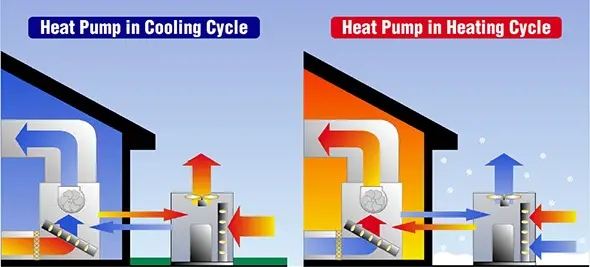
How does a heat pump work? A heat pump is not much different than a car. You can go forward or reverse in a car. In the winter, the heat pump gets heat from the outside air and brings it into your home. In the summer, the heat pump works in reverse and takes heat from your home, and dumps it outside. In other words, a heat pump is both a heater and an air conditioner! It pumps the heat in different directions depending on the season!
"As the outdoor temperature continues to drop, the heat pump needs help from traditional electric resistance heat coils."
How Does a Heat Pump Work?
- Heat pumps extract heat from cold outdoor air
- They produce a cold heat from forced-air vents
- If outside temperature is below 37 F, heat pumps need to use electric resistance head coils inside the furnace to keep house warm
- Federal regulations require a refrigerant that can be more difficult to use
- CLICK HERE to subscribe to Tim's FREE & FUNNY Newsletter
Related Links
Return Air Ducts Key to Comfort
DEAR TIM: I am going to have a heat pump installed in my home. Can these systems really heat a house in cold weather? How does a heat pump work?
I'm confused about the energy efficiency ratings. Are some heat pumps more efficient than others?
Will I save money in the long run by buying the most efficient unit? Is it true that the refrigerant Freon-22 has been outlawed? Dennis S., Oregon City, OR
CLICK HERE to get FREE & FAST BIDS from heat pump technicians in your city or town.
DEAR DENNIS: Believe it or not there is heat in cool and cold air. Heat pumps can extract this warmth and inject it into your home. They achieve this by doing the same thing air conditioners do only backwards!
In hot weather air conditioners, using the magic of special refrigerant chemicals, take heat from the inside of your house and dispose of it outdoors. It only makes sense that the modified machines can do the exact opposite and pull heat from outdoor air and pump it into your home.
Do Heat Pumps Work Best at 50F?
Heat pumps work very efficiently when the outdoor temperature is in the 50 F range. As the outdoor temperature drops, the heat loss of a home is greater and the heat pump needs to operate for longer periods of time to maintain a constant indoor temperature.
Around 37 F many heat pumps reach what is called the balance point. At or near this temperature the heat pump needs to run constantly to produce enough heat to maintain a comfortable indoor temperature.
What Happens When The Temperature Drops?
As the outdoor temperature continues to drop, the heat pump needs help from traditional electric resistance heat coils. These coils resemble the glowing wires inside your toaster and consume vast amounts of electricity as they burn to keep you warm.
Your thermostat will most probably have a light that comes on when this happens. It is usually labeled as emergency or auxiliary heat.
If this light is on whenever your heat pump is working when the outdoor temperature is above 40 F, you should have a professional service your system.
CLICK HERE to get FREE & FAST BIDS from heat pump technicians in your city or town.
Do Heat Pumps Create Cold Heat?
Heat pumps have a reputation for producing what's called a cold heat. The air flowing from the air vents is around 90 F, and sometimes as low as 85 F.
This may seem warm or hot, but it's not when it's cold outdoors.
The temperature of the air coming out of floor registers that connect to a furnace burning natural gas, propane, or oil might be in excess of 110F if you're close to the furnace.
Are All Heat Pumps the Same Efficiency?
No, manufacturers can make heat pumps operate at different levels of efficiency. The more heat a system can produce or remove from a given amount of electricity, the more efficient it is.
A common measurement of this performance is the Seasonal Energy Efficiency Ratio (SEER).
What are the Newer Heat Pump SEER Regulations?
SEER numbers can vary widely if you compare old heat pumps to new ones. Heat pumps made and installed in the 1980's often had peak SEER numbers of 6.
Before the year 2015, the minimum SEER you can buy today was 13. Federal regulations are always changing and after January 1, 2015, the USA was divided into three regions:
- North (green area in the map below)
- South (red area in the map below)
- Southwest (purple area in the map below)
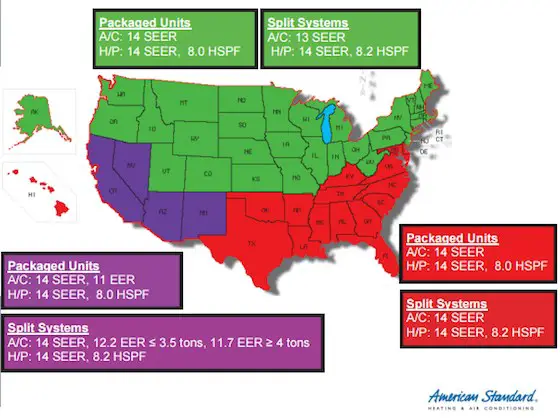
This map shows the three regions in the USA. Map is made possible by the Fair-Use portion of the US Copyright regulations and is courtesy of American Standard Heating and Cooling. CLICK the IMAGE to see the entire document.
CLICK HERE for a .pdf file created by the Air Conditioning, Heating, and Refrigeration Institute that explains the requirements. Remember, the requirements can change all the time.
The highest SEER heat pumps made at present are a tad over SEER 16. Any heat pump that has a SEER rating above 14 is very high efficiency.
Can SEER Numbers Be Misleading?
The SEER numbers are a little misleading. They actually are a measurement of the efficiency of the heat pump when it is in the cooling or air conditioning mode.
If you live in a warm or hot climate, it might make great sense to purchase a heat pump with a high SEER value. People who live in cool or cold climates may not get a payback for the extra money they spend for a high-value SEER heat pump.
What's more, those who have high electricity costs will save more than those who have access to inexpensive electricity. It can be confusing, to say the least.
For example, if your house needs a 3-ton heat pump, your average electric rate is $.0867 per kilowatt-hour, and you live in New England, you might only save $36 per year in cooling costs when you upgrade from a SEER 10 to a SEER 13 heat pump. Your overall savings when you heat and cool for an entire year might only be $189. A person who lives in south Florida who has the exact same system and utility rates could possibly save $173 per year in cooling costs and an overall annual savings of $215 by upgrading from a SEER 10 to 13. Professional heating and cooling contractors can help you estimate savings for your area.
Why is Freon-22 No Longer Available?
The Environmental Protection Agency, in accordance with the Montreal Protocol, is obligated to phase out over a period of years hydrochloroflourocarbon (HCFC) refrigerants used in heat pump and air conditioning systems.
Most residential systems years ago used a refrigerant called Freon-22 that happens to be in this group. Back in January 2004, contractors had to scale back the use of Freon-22. In 2020, Freon-22 will not be permitted to be imported nor manufactured in the USA.
Do New Refrigerants Operate at Higher Pressures?
The issue with the new refrigerant for you is that it requires much higher operating pressures within the heat pumps. This means the tiniest leak can turn into major problems.
The new regulations also created huge issues for contractors and technicians because they needed new meters, test equipment, etc. to work with the newly mandated refrigerants. But at the same time, they had to keep all old equipment to work on units with Freon-22.
Who Pays the Cost For The New Regulations?
This is but one example of how government regulations put a hidden tax on you. The contractors raise their prices to cover the huge investment they have to make in all the new equipment.
I say this so you understand that there are often secondary unintended consequences to what appear to be wonderful regulations. In the end, you and I pay for all of this. It's always passed through to the consumer.
If you still own one of the last Freon-22 heat pumps, you may have to pay a king's ransom to get your heat pumps filled with refrigerant if a leak develops.
If you’re interested in learning more about heat pump replacement cost I have an article here.
If you want the best heat, and this is my opinion, you want to have radiant floor heat. Once you've been in a home that has radiant floor heat, you'll never want a heat pump.
In the March 7, 2021 AsktheBuilder Newsletter, Wayne emailed asking about replacing or installation a new heating system. This popular column provided the information he needed.
CLICK HERE to get FREE & FAST BIDS from heat pump technicians in your city or town.
Column 294

Tim built custom homes and did ultra-custom remodeling for 20+ years before launching his Ask the Builder media presence. He was selected as one of the Big 50 by Remodeling magazine in 1993. This award gave birth to Ask the Builder in October 1993. Tim also operates https://DrawPlumbingPlans.com. His @askthebuilder YouTube channel was the first home improvement channel on YouTube.

I I read some of your responses on heat pump on their operation in cold weather. but I have another question. Is there a temperature below which it makes to just turn off the heat pump and use the supplemental heat system. As I sit here, it is about 12 degrees and the Supplemental light heat is on a significant amount of time. It seems to do all of the work. Note that above 20 degrees or so, the supplemental heat never turns on.
Thank you
Being Canadian , I require HP rated for a - 20+ C .have had salesmen tell me their HP'S are rated @ -15 C but do not shut off until -25 C .I'm confused , as I have talked to owners who explained their HP's were rated @ -20 C but were useless last winter.(they used Infrared Heaters instead) Hopefully someone can explain it to me correctly.
I did a test where I ran my heat pump/aux at 20 degrees vs emergency heat (solely the electric furnace). The heat pump, despite its nearly constant running used much less electricity per hour than the furnace which only ran 2 minutes at a time and shut off for 8 minutes.
My heat pump is simply useless below 40°F. As far as I'm concerned it's a scam when they're installed anywhere but extremely temperate zones. They make a high profit for the installers, not least because since they run 24/7 they need to be replaced every few years. When you add this fact to their general ineffectiveness you can see that they're not a very good choice for those of us who don't live in Florida.
I would make several observations about this article on heat pumps. Heat pumps do NOT stop working at 37F, what actually happens is the efficiency starts dropping from around 3 to 4 BTU for each BTU of electricity to around 1 to 1 as the temperatures approach 0F. Also not all installations have electric resistance auxiliary heat, my home installation has a propane furnace as aux heat, the system we had installed at our last Habitat house has natural gas as aux heat. In my case I have the aux heat essentially turned off as my HP is able to maintain a comfortable temp down to -5F which is as low as it ever gets in Northern Virginia. I operate without the aux heat as a BTU heat from the HP even at 0f is still less expensive than a BTU from the propane aux heat. With natural gas a BTU from gas is roughly the same as a BTU from the HP when it is operating at 1 to 1 which is the efficiency as the temp drops below 0f.
As to SEER ratings, in today's market, mini split HP systems can be purchased with SEER ratings in excess of 30, which is likely what we will install in our next Habitat house.
Not sure when this article was first written, but the third paragraph of your response seems dated and prejudicial for cold climate folks.
I live in Cincinnati, OH on a street with no option for natural gas. House is a 1800 ft^2 ranch built in 1976. My old heat pump (installed circa 1993) would not require Aux heat until the temperature dropped below 20F.
In 2012, I replaced this unit with a near top of the line dual stage unit with a variable speed blower. There is no noticeable difference in the operation of this unit when outdoor temperatures are above 20F. It may cycle a bit more frequently, but the blower only runs at max of 80%.
This week, we had temps down in the single digits. I never saw the Aux heat light kick on, but it was noticeable that the blower ran at 100% when temps dropped below about 12F.
The original article was written in the late 1990's. The physics of how heat pumps work has not changed. The balance point may have shifted a tiny bit because of new engineering and better refrigerants, but when things like that happen, the comments here below the column get FLOODED by HVAC engineers and technicians. They provide a valuable service by helping to keep the content up-to-date.
To date, I've not seen comments like this from them. That tells me the technical information in the above column is still rock solid and accurate.
Rest assured that as the temperature drops outside your home and it gets farther and farther below the balance point, you're using more and more direct resistance heat inside your air handler. All you have to do is use a FLIR, or similar, infrared camera to see how orange or red your air handler is glowing! That's the giant *toaster* coils in your air handler keeping you and your family warm!
I’ve had 3 all electric homes, we build a new home about every 5 years on 5 acre rural lots outside town, so there is no gas service available and I like the simplicity and initial savings of going all electric, I could get a propane tank, but I’ve never done that. Of course the worst part of all electric is the electric back-up heat.
In my experience here in SE Kansas, we only run into the back-up heat issue in December and January, usually only 10 or 20 days for the whole year. But when we do it is massive, like 200KWH per day instead of 75 or 80 KWH per day. It’s ridiculous. They put in 2 10KW heat strips for my houses (2000 sf upstairs, finished basement), so 20KW is a lot IMO, I toyed with only putting in one strip but the HVAC contractor said that was a bad idea. To tell the truth I’ve toyed with the idea of disconnecting the back-up heat strips and just deal with the cold for the few days.
In the end I still pay less than if I had propane backup heat, when you figure in the initial cost, etc.
Everything was fine on home 1, but on home 2, four years in the heat pump compressor leaked out the refrigerant, it was an inexpensive capillary tube. Didn’t realize this, and ran back-up heat all month and got a $700 electric bill. Got tube fixed and got “reamed” no pun intended, it was a Rheem unit, on the Freon because it was in 2008 and the old stock of R whatever was running low so it cost $600 dollars for the Freon load, the original HVAC contractor wanted $1000 for the freon. Well then the compressor failed and labor wasn’t covered, and even the indoor coil was leaking, turns out it was builder grade unit R13 Rheem and didn’t have low pressure compressor protection.
So on house 3 I upgraded, didn’t get a builder unit, got a lennox xp17 (r16 for the 5ton unit). It has the low pressure compressor protection.
TWO THINGS I LEARNED…..
1. Shop HVAC contractors because most charge way more to install the higher efficiency unit, not just the higher equipment cost, they charge more labor too….really makes the payoff questionable. I finally found a contractor who didn’t do that
2. HVAC installation is very important, not just the equipment quality, but a quality install is very important, duct layout and all that.
One thing I’m still on the fence on is most of my neighbors have two smaller systems instead of one large, I’ve run into needing a 5 ton unit, and my HVAC contractor tried to talk me into going with two smaller compressors, I didn’t do it, it was $4000 more and I estimate only a couple hundred dollars a year savings if that much. I’m only spending $200 per month avg on electric. I’m all electric, and it’s 3700 sf. So that’s pretty good (our electric rates have skyrocketed last 10 years too). But I’m very energy conscious, I air dry my cloths, etc.
I am finding that the energy auditors are teamed up with heating contractors in our area (Boston) and they are pushing "mini-splits" which are downsized heat pumps for supplementary heating, so you still need your current heating system. I question the validity of the idea since supplementary heating gets used during power outages. One of these would need a hefty backup generator.
I am thinking of a pellet stove instead, They appear to have some kind of igniter and a blower fan. Would this work with a generator?
Are heat pumps practical in New England climate? They would make sense in southern areas, but 37F is downright balmy for NE.
Almost a year ago, we moved into our new, super-insulated (R40 walls, R60 ceiling), 1500 sq. ft. house in upstate New York (Saratoga County). It is heated by two Mitsubishi mini-split heat pump units. They have kept us warm on a number of below-zero days, including one minus 14 degree F morning last February. We keep the temperature at 68 degrees, and don't turn it down at night. Our total electric consumption for that month was 1040 kWh, the highest so far. We thought of installing a wood stove for backup heat in case of a power outage, but opted for a whole-house generator, which cost only a little more than the wood stove would have. The mini-splits also worked great as air conditioning during the summer.
I did a dual fuel heat pump in mid-Georgia using natural gas in 2001. Never again. Too complex and apparently requires more training and expertise than most service people can handle. It was easily a year before it was working correctly with many service visits. Additionally, the 10-10-10 year warranty required a maintenance contract that cost darn near as much as a new unit.
I also opted for a larger unit for my upstairs than I originally had (have two units) but it still comes on at 9 am in the summertime and often runs nearly 12-13 hours and barely shuts off during that time.
I'm not knocking a heat pump - I'm saying I wouldn't do the DUAL FUEL version again and not the brand I purchased.
It sounds like the installer goofed up on his heat-gain calculations because the unit should not have to run continuously to keep the upper floors cool. What a darn shame.
You might check your ductwork to make sure that it's not leaking. We sold a house that seemed to have issues with upstairs cooling and the buyer's inspector found an 18" slice in one of our ducts. We had been air conditioning our attic! At minimum, you might have some old loose or cracked mastic that is allowing leakage, reducing the amount of cool air being delivered and making the unit run more to keep up. Hope this helps!
In spite of my effusive review below of our geothermal HVAC system I had to jump on this and add that I've spent hours, and hours fixing the joke of a ductwork job done on our place. What I've discovered could've easily been done better by a Middle School shop class. Based on this and past experience with HVAC contractors I have little reason to trust the trade in general. You can pick up an endoscope on Amazon for under US$20 that you can USB into a laptop that will let you look inside your ductwork which I highly recommend.
While this is a pretty good overview of the "traditional" heat pump, as is typical of Tim, it falls short in not mentioning another use for a heat pump; in a geothermal system. We're now in our 6th year on ours in Upstate NY at 1000' elevation and we are thoroughly pleased with our decision. It does have the dreaded auxiliary resistive heating but I have not seen it come on yet (unless I test it).
It's a bit of a misnomer to call it "geothermal" and could be closer to being a "solar" system in that we don't have thermal springs here or any volcanic activity creating heat in the ground. The heat energy in the ground we use is close enough to the surface that it's sun-warmed.
Anyway, what we do have is a 2400sf excavation to around 6' depth and 3 loops of Pex-type flexible tube laid out on the bottom which connect to a manifold inside the house foundation. There they combine to a single loop that circulates through a Climatemaster 3 ton heatpump where heat energy is either transferred into the fan coil or removed from it and sent back out to ground for air conditioning. This is exactly how the air-source heatpump others here are talking about works (in fact we retained the fan coil when we dumped the existing air-source unit that came with the house) except that we utilize a more consistently tempered energy source since ground temps don't vary more than a few degrees throughout the year.
The lifestyle adjustment we made for it amounts to trying to avoid large temperature swings in the house. If we need to raise the interior temps 3-4 degrees it will take 20-30 minutes, likewise if we want to lower with the AC. But again, I've yet to see the operating mode move out of Stage 2 to the AUX mode. And this whole business makes no more noise than a refrigerator, in the basement.
This is an all electric house, 2400SF and pretty well insulated and based on usage records left to me by the former owner our overall usage is down roughly 20%-25% since we've been here. Further, our usage charges have been far more stable than if we depended on fossil fuel (I know, 'where do you think your electric comes from'. Well, it comes from a variety of sources including significant percentages of hydro and wind).
Gonna jump in! This is an older thread, but still relevant. In Omaha, NE, we had a poorly insulated home with a Trane HVAC system and an add on heat pump. It was installed in 1983, so it was OLD. That sucker was still kicking in 2009 when we sold the house. Even in -10 weather I never had an electric bill higher that $185 in an all electric house. I think we paid around $.08/kWh. We relocated to north Texas a few years back and are planning to build soon. I am looking at concrete floors, so radiant in-slab heat makes sense. We will have a fireplace, too, likely high efficiency. For cooling, though, I am seriously looking at a heat pump. I was so happy with ours in Nebraska that it just makes sense. With solar panels, good insulation, reflective roofing, and concrete floors, I am betting the electric bills will be cheap cheap cheap.
This is a comment to your article in today’s Tribune Home section regarding what you said about heat pumps. We had one for over 20 years. Our resistance heat never kicked on unless the outdoor temperature was below 10 degrees. It was very efficient. We last had the air-to-air heat pump 18 years ago so they are much more efficient now.
Regarding the feel of the air from the registers, we thought that it kept the temperature of the house at an even temperature versus cycling hot and cold. I understand some may like the hot/cold cycle since that is traditional.
Eighteen years ago we switched to a heat pump that uses an in-ground loop versus air to capture the heat (geothermal). The resistance heat never goes on with this system. A few years ago I figured we heated and cooled our 2000 sq ft house in northern Indiana for about $100 a year after deducting our geothermal property tax credit.
My favorite comment here was about the "hidden tax". The government does many things that raise consumer costs, like Biden stopping the pipeline building causing gasoline prices to rise significantly. No tax increase to anger the voters and many won't understand how the government just dug into their pockets through new law.
Just a note that many newer heat pumps including mini splits can work down to 0 degrees F, with some reduced efficiency. The balance point then becomes a cost comparison to other fuels. They are widely used here is Eastern Canada and only fail to hold their own when the temperature is toward Zero F.
Atlanta GA
I had a LENNOX dual fuel heat pump. Expensive, required a 10 year service contract to keep warranty in effect and I used that warranty a fair amount. I concluded it was too complex (it took a year to finally get it set up and working properly), mostly junk and have warned people to stay away from the brand. (Are they still in business?) And just FYI, it worked in pump mode all the way down to ~0F but could not keep the house “warm”.
Good morning Tim.
I enjoy reading your columns and get reminders and new facts. My suggestion to you is ALWAYS put 2 dates on your columns so that you and readers can ascertain if it may be out of date. When in my prior career I wrote manual pages for the State of California and for a county prior to that, 3 dates were used: write date, effective date, and publication date. Skip the effective dste unless a new code is coming and you are alerting readers. Please use the writing and publication dates.
I am an owner-builder who my subs say is the architect's architect. My designs are checked by licensed CEs and architects. But I get a bit lazy or rushed and take unwise shortcuts. Like last fall, I was drilling just 4 holes in stainless steel braces for a SS sink that I designed and had manufactured in Reno. Waited a long time for this item to be installed in my laundry room. I thought that I would not bother geting oil out to lube the bit: mistake. Bit is duller than dirt now.
What comments or advice do you have concerning earth coupled or geo-thermal heat pumps?
Tim, I live in Western KY. Paducah area. Our heating system is Propane. And is sixteen years old. And Propane prices are ridiculous. Over $1300.00 for the last two years and climbing.Would a Propane heat pump solve this pricing problem? Or should I pursue another System. Living on Social Insecurity is FUN.
Thank you,
Bob
Tim, Your information is outdated. The newer Inverter Heat Pumps work efficiently to well below 0 degrees. My inverter heat pump produces 85% of its maximum output at -5 degrees. It has no electrical resistance heat for operation or defrost. Its output air temperature is 120 degrees. My unit has a 20 SEER and some units have up to 24 SEER. Also, for those people that are into the environmental considerations, in the area where I live, the electricity generation is 40% nuclear, so the carbon output is less with a heat pump than oil fired. I am not suggesting that a person replace an oil fired heating system with a heat pump because there are other factors to be considered, but you should update your information to include the new technology inverter heat pumps.
Tim,
This article on heat pumps needs some updating. Minisplits with SEER's over 30 are now available. Not all heat pump systems use resistance back up; mine has a propane furnace as back up. Here in Northern Virginia my system produces adequate heat down to zero or lower. I set it so the back up heat does not come on except for failure. Yes the efficiency of the heat pump drops off dramatically as the temperature drops but the electric BTUs are still cheaper than propane BTUs. The house that I recently finished for Habitat, was super insulated and sealed ( blower door tested at 1 ACH) I installed a ducted mini split with a 28 SEER, no auxiliary heat and rated at 12K BTU for a 1200 sq ft house. Modern mini splits can operate at much lower temperatures than the heat pumps of the past.