Flexible Gas Lines- Are You Serious?
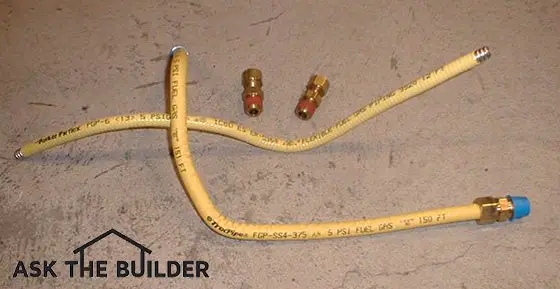
Flexible Gas Line | Here's a flexible gas line. These are two short pieces of the flexible stainless-steel gas lines or CSST. You can practically tie it in a knot it's so flexible. If you have lots of pipes to run, this may be the way to go. But before you decide, realize there's a fire and an explosion hazard with this because of lightning! Keep reading! © 2021 Tim Carter
"A flexible gas line is made from thin-wall stainless steel. It's not durable as a traditional black-iron pipe. Lightning has caused many house fires that have flexible gas lines."
Revised January 2021
Flexible Gas Line TIPS
- Flexible gas lines are safe so long as you have little lightning
- Not as durable as traditional black iron
- Require special installation tool for fittings
- Installs faster than black iron
- CLICK HERE to Get Tim's FREE & FUNNY Newsletter!
DEAR TIM: The natural gas lines that are being installed in our new home are not the heavy black iron pipe. They're a new flexible stainless steel piping system that is installed like electrical wire.
What is this material? Is it safe to use? Are there advantages to using this pipe?
Can you cut into the pipe at a future date to install an added gas appliance? Is there another alternative gas piping material? Betsy F., Augusta, GA
Related Links
Easy How To Thread Black Iron Pipe Video
Pipe Threading Compound To Permanently Seal Black Iron - Great Video
Sizing Gas Lines - Tim Carter Can Draw Your Gas Line Plan
Free & Fast Bids
CLICK HERE to get FREE & FAST BIDS from local plumbers who install gas lines.
DEAR BETSY: Congratulations! You're now the proud owner of some wonderful corrugated stainless steel tubing (CSST). This material was approved for residential use in 1988 by the National Fuel Gas Code.
Are Flexible Gas Lines Safe?
A flexible gas line is an ingenious method of supplying natural gas to fireplaces, furnaces, cooktops, clothes dryers and any other gas appliance. Virtually all state and local code authorities permit its use and many contractors are finally embracing it.
I have this flexible gas line in my own home in central New Hampshire and never worry about it at all. Some plumbers will tell you it's faster and cheaper to install this new CSST piping. However, we don't get frequent thunderstorms here in central New Hampshire.
I happen to be a master plumber and given the choice, I'd install traditional threaded black iron pipe. More on this in a just a moment.
CLICK HERE to get FREE & FAST BIDS from local plumbers to install flexible gas lines in your home.
CSST Video
Watch this video to see how CSST pipe is installed.
When Was CSST Flexible Gas Line Introduced?
I remember when the material was first introduced in 1989. Many of my fellow contractors who install gas lines thought it was unsafe. Some of their arguments never made sense to me.
For as long as I have been in the home building business, we always used similar brass appliance connector tubing when gas was supplied to a clothes dryer, a cooktop, or a gas range.
Hundreds of thousands of houses have these corrugated appliance connectors in service right now. They have worked well for many years.
Why Were You Afraid of CSST?
I was afraid of CSST because of the thin nature of the pipe. There are lots of instances of houses that have been destroyed in gas fires because CSST pipe was ruptured by a lightning strike.
The pipe in the walls acts as an interior lightning rod. It's vital to follow all instructions provided by CSST manufacturers and to BOND the tubing electrically.
Errant screws or nails used to attach cabinets, trim, pictures, etc. can puncture this pipe. That would never happen with a piece of traditional black iron pipe.
Only a direct hit from a hot bolt of lightning will bore a hole in a traditional black iron pipe.
Dangers Of CSST Video
Watch this video to see what you think about the dangers of the material.
Do You Have CSST in Your Home, Tim?
The current home I live in here in central New Hampshire had these flexible gas lines installed in 2001. I've had no issues with them at all and I even had to do a kitchen remodel where I extended an existing line.
CLICK HERE to get FREE & FAST BIDS from local plumbers who install gas lines.
What are the Advantages of CSST?
The CSST has many advantages. Perhaps the biggest one is labor savings. Traditional black iron pipe takes a lot of time to cut and thread.
I know as I have installed thousands of linear feet of the heavy material. As you said, the new CSST is installed like electrical wire.
You simply pull the material between two points and cut it to length with simple tubing cutters.
Is Black Iron Gas Pipe Labor Intensive?
Black iron pipe is very labor intensive. A typical black iron pipe installation requires a professional to precisely measure, cut, and thread the individual pieces of pipe. All of these steps are very time-consuming.
It's important to realize you need to think about overall safety. Spending hundreds of dollars more for black iron pipe may be well worth it in the long run if you have a house fire.
CLICK HERE to get FREE BIDS from Plumbers to install Flexible Gas Lines.
Does CSST Create Fewer Leak Locations?
When you use CSST, you can minimize potential gas leaks. A typical black iron pipe installation has many 90-degree, tee, and coupling fittings.
These fittings are used each time you change directions or join two pieces of straight pipe together. Each of the cast fittings can be the source of a leak.
What's more, the threaded joints on both sides of the fitting can also be potential leak points. Because the CSST snakes its way around bends and obstructions as one solid piece of tubing, you only have a fitting at each end of the line. If you do have a leak, these fittings are almost always readily accessible for adjustment.
Is CSST DIY Friendly?
CSST is not user friendly for a DIY installer. It's not really a do-it-yourself proposition. Many of the manufacturers of this material require professional installers to take a short training course that familiarizes them with the small nuances of this unique gas piping system.
What are the Two Gas Line Install Choices?
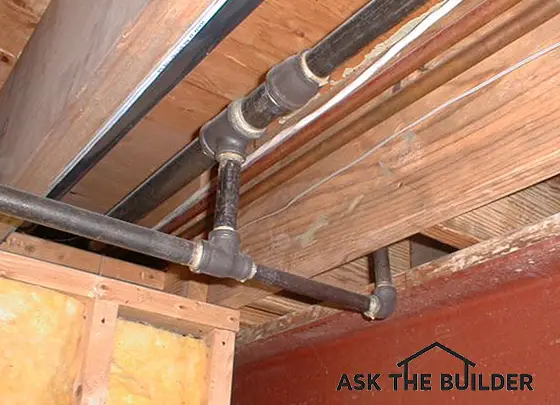
These are traditional black iron pipes that I installed in 1987. Each end of a piece of pipe must be threaded. It's messy and hard work, but I must admit I sort of enjoy it. The pipe is extremely durable and rarely has a lightning strike cause a fire in a house with black iron pipe. © 20187 Tim Carter
Is it Easy to Install Additional Gas Lines?
Adding additional gas lines at a future date is not a problem if you plan for the possibility during the original installation. The CSST systems can be installed one of two ways:
- series
- parallel
The series installation resembles traditional black iron piping. A larger diameter mainline CSST pipe supplies gas to smaller branch tubes that feed each appliance. This is often the easiest system to adapt at a future date.
What is a CSST Manifold Method?
A parallel CSST manifold system mimics an electric panel. All of the gas lines that feed each appliance start at a central distribution point or manifold. To add a line in the future you need to have an extra gas port on the manifold within the panel.
Can I Use Soft Copper for Gas Lines?
Yes, you can use approved soft copper for gas line work.
If you are not able to get CSST tubing and can't handle working with black iron pipe, consider using soft copper. It offers all of the same advantages of the CSST systems.
Soft copper is approved for interior residential gas piping in many cities and towns. You don't solder it like water lines.
How Do You Make Soft Copper Connections?
Connections are made with common flare fittings that tighten with standard wrenches. The only specialized tool you need is a flaring tool made to fit the pipe size you are working with.
If you use copper for gas lines in your home, be sure to paint them yellow and label them with red lettering "GAS LINE" so a future weekend warrior doesn't mistake them for a water line!
CLICK HERE to get FREE & FAST BIDS from local plumbers who install gas lines.
Author's Notes:
If you have ANY DOUBTS about flexible gas lines or CSST, visit a local firehouse and talk to the team leader that's on duty. Visit SEVERAL firehouses to get different opinions.
In regard to your article on the CSST systems being installed in new homes. If you care to, read an article that was published in April of 2003 in the Dallas News regarding banning this installation in the city of Frisco, Collin County, Texas. Lightning strikes have caused numerous fires in residential homes as a result of CSST failing. Although the manufacturer states that it is completely safe, in fact safer than ridged black pipe, it has some serious issues. I have seen three fires in our own community as a result of CSST failure. The manufacturer accepts no responsibility for improper installation, and does not provide in any great detail, of detrimental or catastrophic failure if done so. I just saw your article and thought I would provide feedback. If you have questions on the article I mentioned, you may contact the Dallas News. Thank you for your time.
Maxwell J. Brunner
Lieutenant
Menomonee Falls Fire Department
Email- [email protected]
I responded to this very interesting email with a few thoughts of my own. My first suspicion would be that the tubing acts like a lightning rod of sorts. The thin walls of CSST might not seem to handle as much of a strike as black iron. Black iron is so much thicker that it may actually take a lightning strike better.
I suggest you look up the article in the Dallas News if you want more details.
Column 296

Tim built custom homes and did ultra-custom remodeling for 20+ years before launching his Ask the Builder media presence. He was selected as one of the Big 50 by Remodeling magazine in 1993. This award gave birth to Ask the Builder in October 1993. Tim also operates https://DrawPlumbingPlans.com. His @askthebuilder YouTube channel was the first home improvement channel on YouTube.
Lightning strikes have caused some revisions to be made to the installation instructions for CSST. Arcing between the CSST and electrical lines was found to be the cause of these fires.
The gas line is now required to be grounded and BONDED to the electrical system. This is usually accomplished by connecting the CSST gas line to the main ground rod with ground clamps and #6 solid copper wire.
The 2009 editions of the International Fuel Gas Code and the Uniform Plumbing Code state in Section 7.13.2: "CSST gas piping systems shall be bonded to the electrical service grounding electrode system at the point where the gas service enters the building. The bonding jumper shall not be smaller than 6 AWG copper wire or equivalent."
When the CSST piping is installed properly there is no more danger from lightning strikes that with any other gas system. Most manufacturers supply instructions on how to properly install ground clamps.
I just installed a furnace in my attic with CSST piping. It was a little more expensive materials wise but saved me a lot of headaches with the complex bends and turns that were required to connect the gas line. It took me approximately 2 hours to run a CSST gas line that would have probably taken a full day of cutting and threading cast iron pipe.
If there is a problem with lightening strikes why don't they put a insulating type pipe at certain points to prevent the csst from being grounded making it safe from strikes. Or use pure plastic lines that are tough enough for the job. I can't believe in this modern time we only have three choices for gas lines.
Tim,
I read your article and agree. I also read the email from the fireman. Rest assured, as an electrician we are already being told of the situation and in New York State, we are now required to bond the gas lines to the main electrical grounding electrode, in order to make sure such problems don't happen or are extensively minimized.
What is meant by "bonded gas line"?
We hired a contractor to convert an attic mounted heat pump to gas. They ran CSST from the basement to the attic alongside the refrigerant lines. Very neat install. They did attach a solid copper ground wire between the gas meter and main electrical ground using wire clamps, but how can I tell if it is "bonded"?
Better have a pro electrician look at this for you.
Garry,
"Bonded" simply means that there is a physical wire/electical coupling between the conductive materials (Only the grounded materials of course). The goal here is that the CSST and the elecrical circuit share the same path/circuit to potential earth, or ground. A meter or a visual check gould help you, but remember, residential 120V is the most deadly. If you don't know electrical, do what Tim says and call a pro.
Right, but it is purely not an electrician's job (unless he knows it already). It is material science and conductivity.
You would need an alloy of copper and steel/iron to join/bond/connect a copper wire to an iron pipe. At millions of volts, the conduction will take the easy route to disaster.
Is there a metal gasket inside the end of the flexible pipe to keep the pipe from twisting? I unscrewed the pipe and it looks like half of one fell out. Can I just replace the end with another end piece with the gasket in it?
Most of these flexible lines are simple flare fittings..... Read about that at my website.
I've heard of the lightning issue and assumed there was a way to protect against it. It sounds as if that assumption was right; knock on wood. But my objection to any flexible gas lines in the walls of a house concerns what happens when someone tries to put up a big picture, shelving, framing for new partition, just about anything that would require screws or nails into the wall. Most people do this without a thought of hitting anything sensitive, and I'm aware that they hit water pipes and even cables from time to time, but the risk from hitting a gas line seems much higher. Are there any places where such lines require steel conduits when run in closed up dead space? Seems like a small price to pay for peace of mind.
PS: Robert M. has an interesting point. I know plastic tubing (HDPE, PEX-AL-PEX, etc.) has been used underground for years. But I wonder if pure plastic would eliminate the risk for lightening strikes; there is, I believe, some water accumulation in these systems, and a resistive path could be even more dangerous than a direct short. I can imagine a pipe heating up and bursting if the right current makes its way through the moisture, thought I can't say for sure how plausible that would be. Similar questions must come up when water lines that had been used for grounding are spliced with plastic.
Isn't all natural gas line buried and most come out of the ground in
the black pipe, question is do I still to ground the flexible line?
Yes, most natural gas lines are buried. You need to install the pipe according to all LOCAL regulations. Contact your gas supplier for instructions. DON'T GUESS or LISTEN to advice from others online. Don't HOPE you're doing it right. Contact the gas supplier.
Underground metal pipe as installed by the gas company is coated and cathodically protected (CP), meaning that a negative voltage is imposed on the material to prevent corrosion using anodes or rectifiers. As long as the pipe is more negative than the surrounding soil, the metal will not rust. In order to maintain this negative potential, the pipe is coated (as best as possible) to isolate it from the soil and has an insulator installed at the meter to prevent a home's AC grounding electrode system from bleeding the CP voltage off. LDCs (local gas distribution companies) frown on the practice of grounding their CP protected pipe.
Polyvinyl is approved for underground lines now so no it doesn't have to be black pipe.
Could you use a grounding rod near the entrance of the gas pipes into the house instead of running a wire all the way back to an electrical panel that is in the opposite end of the house. It would be grounded by ground rod correct?
What does the electrical inspector and gas company inspector say to do? Did you ask them?
You must run the ground wire back to the panel. If you drive another ground rod there will be a difference in potential. The bond must go back to the GES grounding electrode system.
Is the flexible SS tubing okay for LP gas too?
I have it in my home. Code-approved in New Hampshire. I can't say where you live
When I attach my #6 ground wire to my flex gas line fitting, can I just attach the running length of the ground wire to the side of my brick on the house as it makes its way to the panel box on the inside of my home. Thanks
What does your local electrical inspector say about this?
I am considering using the yellow flex line to run from the basement up through the old fireplace ash shute to connect to a set of vent free fireplace logs in an existing fireplace. Is this something that would be safe?
I am also looking for step by step instructions from someone who may have done this type of install before.
What does your local building inspector have to say about this?
I am in the process of changing out my CSST. First of all after it was installed everyone in the house would hear a high pitched ring when the furnace and stove ran at the same time. If you have high pressure gas ringing through the lines at too quick of a rate the lines can hum or ring. In our case we had xcel come out and they said they see it all of the time. Manufactuer acknologed this issue. As far as the safety issues they are very real even if you bond it correctly the issue is really the thickness or in its case thinness of its walls. Soft copper has none of these issues and is fairly easy to work with. I would stay away if you can.
does each length of the csst have to be grounded, since there are rubber gaskets in the fittings?
No. Think about it. What is TOUCHING where the CSST connects to other metal piping?
I install gas lines for a living. I am also a firefighter. This gas line, the yellow stuff is great if properly installed. There is a new type hitting the market. It's coated with rubber to resist lighting issues. You can cut down on the whistling noise simply by going to the shut off up stream and turning it down till the noise stops. Your slowing the speed of the gas going thru the pipe. That's the issue. It cannot be installed in fireplaces.
This article and it's associated comments were fantastic, helpful and informative for a new homeowner like me.
I'm having my 26 year old Trianco Heatmaker boiler replaced soon with a Bosch Greensaver 100 Combi propane boiler in my basement. The install will be done by a large, local energy company here in Maine.
When the energy company representative came over he measured out rooms, checked our forced hot water baseboard in each room, checked our boiler and took pictures of it. During this process, he mentioned that our CSST line needed to be grounded, and that getting my own electrician would be cheaper than what his would charge.
I'm wondering what this work would typically cost. My CSST line runs through the basement ceiling near the circuit breaker, and my rudimentary understanding is that it would require a clamp and copper wire to the main ground.
I'm wondering what the typical local electrician might charge for this, as the energy company representative seemed to imply that it's expensive.
Thanks in advance for any possible help.
Just a quick update. I'm told that I need to have #6 copper wire run from the grounding bar at the main circuit to the pipe where the gas first comes in outside, secured with a clamp and some scrubbed section of pipe.
I'm told the wire can be stapled to joists along the basement ceiling to the circuit breaker box.
My question was whether this would be a huge expenditure or not, and I'm now being told by the energy rep that it won't be a massive expenditure.
Thanks!
I have been reading all the informative emails from other professional gas line installers and fireman and trying to understand the grounding/bonded issue for using CSST....My question deals in that I already have the black iron pipe 3/4" thick for my gas line coming into my house which has been installed throughout my house which was built in 1987 and I wanted to reroute the existing gas line from it's current location in one wall on the main level (flipping my kitchen into my dining room) and it would be better suited to reroute the gas line using the flexible CSST to snake around already installed vents and air ducts running into my basement and instead of using the more rigid black pipe which might be hard to install around those confined spaces.
So my question is would I still need to ground/bond the flexible CSST if I am hooking it up to the existing Black Gas line in my home?
Bruce,
Yes as far as I know you would need to ground/bond any CSST in your home. The black iron does not insulate CSST that may be connected to it
I have read all of the emails and questions concerning CSST and it's use. I like the response of "What does your local Electrical Inspector say?" & "What does your local Building Inspector say?" I have been working with these "Inspectors" for years ands can tell you that they can read the code book but interpreting it and putting the code to practical use in the field are two totally separate things altogether. First, yes the installation of CSST takes less labor time. That is where the advantages end for me and for anyone with some knowledge about building practices and common sense. The Black Iron pipe is "sized" for the amount of gas appliances intended to be installed and used in the home. This MUST be done by a professional that knows how to use the gas sizing charts in the code book. The same is required to be done for the use of CSST. This practice is commonly overlooked and also many times undersized gas piping is not caught by "inspectors". Black Iron Pipe is cut and threaded and does take a lot of time, knowledge and expertise to install correctly, (it is Gas, how do you want it contained in your home?) the system is then pressure-tested with air at pressures above what it will endure when the gas is finally introduced. If there are any leaks in the system, they must be corrected at that time. Same as CSST. Tim's statements make it seem as though leaks occur from time to time and it is easier to fix them and the potential is greater when using Black Iron Pipe, nothing could be further from the truth.
AUTHOR (Tim Carter)-INSERTED RESPONSE:
Please go back and re-read what I said. My comparison is that with CSST you only have a leak potential at each end of the run where you have a fitting. With black iron - and I've installed THOUSANDS of feet of it - you have a leak potential at each side of each fitting as you install the pipe throughout a house. In one run, you may have ten or more 90's, couplings, tees, etc.!
END AUTHOR-INSERTED RESPONSE
There is always a potential for a leak in ANY system utilized. When installed by a Licensed and Insured Professional Plumber the chances are minimized and then eliminated when a proper inspection/pressure test is done. If one adds up the amount of hours spent worrying and contemplating the grounding and bonding issues associated with the use and installation of CSST, how much labor did you really save? This CSST and other like materials to save on labor was embraced by builders who wanted to save money on labor. One question, did the price of the house go down? Answer: NO
The labor savings went into the builders pocket. Like many of the other products introduced into the marketplace as being "just as good" or "think of the money saved on labor" Why do we want to eliminate the professionals from the marketplace? When there is a problem the builder or consumer can't solve, they call a professional to solve it and usually complain about the price, why? They saved all this money on putting in cheaper, less labor-intensive materials and now want to scream when it ends up costing them the same and they don't have near the quality of product in the end.The attitude of "It's somebody else's problem when I sell the house" is ludicrous. If everybody has that outlook/attitude, who are you buying your next house from and what attitude do they have?! Soft copper simply should not be used on Natural Gas, the odorant that they put in the gas has been shown to "eat away" at the copper over time, you don't see this because the gas is on the inside of the pipe doing the damage. A professional sees this when they take apart the pipe or are working on gas appliances a few years labor and notice all of the black flakes in the gas system. Do your research, better yet, hire a licensed professional. Stop trying to "save a Buck" on something that could kill you in the end.
My home is 12 years old. The natural gas line (CCST exactly like pictured in your post) had a cut in it right where it entered my home from outside. The repair man said the break was right where the line rubbed on the edge of the heating duct work and he surmised that the duct work edge cut into the pipe.
However, what I didn't tell him was that my husband had just moved out of our home the night I began smelling the gas (repair man came the next morning) and it was under difficult circumstances. I had to get a court order to force him out due to abuse.
The portion of damaged pipe was thrown out and I know I'll never get a definitive answer, but the original repairman is insisting the duct work did the damage, however, his colleague told me that the inside steel lining would never be able to be "cut" by duct work and that the circumstances are highly suspicious.
What are your thoughts?
Kathy,
Without having a photo to look at I can only take a guess. My instincts tell me that the rounded corners of standard ductwork will not cut through the wall of CSST pipe.
Years and years of rubbing may cause an issue, but there'd have to be a reason why there was movement causing this friction.
That damaged piece of pipe should have NEVER been discarded. Don't let that happen again. SEND me a photo via the Ask Tim link above of the situation. I wish you the best and will include you in my prayers.
I have about 95 feet of black steel pipe in my home and 5 feet of CSST to the fireplace. ...... a leak at the flare coupling of the CSST will now cost me hundreds of dollars to fix ... would not it have been smarter to have the final 5 feet done in black steel pipe at the time the home was built 12 years ago.
I just had 32' of black CSST spliced into my iron gas pipes and run under my 14x60 mobile home in a straight shot, parallel to the structure, from the regulator to the new valve. It's for a new gas log stove, yet to be installed. The existing gas lines are all black iron pipe. The existing lines, if installed correctly, should already be grounded to the electrical panel, right? If it is (and I will check to be sure), then this new CSST pipe should automatically be grounded along with the rest of the system, right? Sweating it, here... thanks for any opinions, suggestions, or warnings!
Hi. Is CSST ok for in wall use?
Hello,
Is CSST ok for use outside of my home? I need to have over 50' run along the exterior of my home if I am going to install a gas stove. Thank you
Hi, We have just finished the beginning of what will probably be a small claims court mess in the upcoming months. We have been in our home just 3 months; started smelling gas a bit, but wasn't sure. Finally had the gas company out and YES - huge leak in our CSST line. But before the certified plumbers could do the work (in the walls - 6 large holes in the dry wall), I had to get an electrician out here to ground the system (I am in Texas) and get a permit. After the work was finished, I had to get a city inspection and then get the gas reconnected. I still need to get the walls painted and patched...9 days without hot water. I cannot even begin to think who I am supposed to turn to in seeking compensation for this. Never again. I am so very grateful that we did not have an explosion or a fire
Hi,
A gas fireplace was installed in my house several years ago using CSST. It runs along the outside of my house for about 5 feet before entering the fireplace through the brick. I recently noticed that the yellow insulation has now cracked off exposing the pipe. Is there any issues I should be concerned about with the pipe now exposed to the elements (heat, rain, snow)? Can this be fixed without replacing the pipe.
Thanks in advance!
I like the concept of the CSST: my husband has a concern. I would like a flexable line between a fitting and my gas dryer; allowing moving for cleaning behind the appliance plus cleaning the exhaust piping. Input..?
We have a house built in the 1880s. It has the original black iron gas lines, and although a little rusty, they appear to be in good shape. No leaks. We have just had about a 6' section of CSST added inside the house, to the junction where the hot water heater is connected into the gas line. The CSST line runs along the baseboard over to our new gas dryer. I am a little confused about whether it needs to be individually grounded, or if it is already grounded by virtue of being attached to the black iron line. If it does need to be grounded, how would that happen, since it is only a very small section?
Okay folks let's be clear: CSST is a killer, literally, and it is completely irresponsible for a builder or a subcontractor to defend its use. "Bonding" a CSST line is completely USELESS against a 50,000 V lightning strike to your attic! At least with "Black Iron Pipe" you have a fighting chance. CSST represents a clear and present danger to any home owner. If you value your safety and those you love get rid of it OR if you are building a new house don't use it at all- WHY take the risk?!
By the way SHAME on the CSST industry for promoting this product when they know it has cost lives! I would compare it to the cigarette industry but it's more like Nitrogylcerin in a moving vehicle if you live in high lightning strike states like Texas or Florida, you never know what storm will trigger it. By the way Electricians and Builders and the NEC if you are reading this- "equipment grounding conductors" are not even close to being adequate protection against lightning strikes- what every house should have (in my home state of Texas for example) is either an "Ufer" grnd node or grounding rod (multiple actually) and every appliance or device such as the AC Compressor, Dryer, Washer, Refrigerator, and even computers & flatscreens should be grounded directly to the house grounding system(bypassing the Service Panel- again as before you don't want 50,000 V grounding through your service panel- it will be destroyed assuming your egc wires don't fry first and catch your sheet rock on fire) Point is nobody is grounding houses correctly and I will shout it out on every inspection I do until people listen.
Scott Hill
Professional Home Inspector
Houston TX
Scott,
I think you need to relax.
I've got CSST in my own home here in NH.
Did I build the house? No.
Would I have used CSST if I did build it? No.
Do I cower in fear each time a thunderstorm rolls over my home pounding the ground with lightning? No.
Besides being a builder, I'm a master plumber and I've run thousands of feet of black iron and would use it for a host of reasons, but lightning is the last thing I'm worried about.
You're fear mongering and I don't appreciate it here at my website.
You need to back up your claims of DANGER with FACTS.
I'll start for you.
The first thing is to determine the number of lightning strikes per year in the USA.
It's 25,000,000.
Now you provide the number of people HURT or KILLED each year in homes that EXPLODE from a lightning strike that hits a CSST line.
I'm pretty sure your number will be ZERO.
BTW, if lightning does hit a CSST line, there's no explosion caused by gas. You get a rather large blowtorch. Any big BOOM is caused by the actual lightning strike.
I feel you should invest your energy going after the vast number of deck defects in the USA. Based on several deck-safety seminars I've attended, I'd wager that 90% of the decks built out there are candidates for collapse.
Look up deck collapse stats and you'll see it's a FAR GREATER number each year than CSST explosions.
P.S. I think you better go to my past column about lightning and brush up on your facts. You're using the 50,000 number incorrectly. Here's the URL:
http://www.askthebuilder.com/lightning-and-surges-preventing-electronic-damage/
Some of the assumptions regarding protecting against lightning strikes by grounding the gas line fail to consider the mechanisms by which a lightning strike can cause a gas line rupture and ignition. Lightning can, and apparently has, come in on electrical lines of any type (power, cable, telephone, antenna, etc.) and arc from those lines to CSST gas line puncturing the gas line in the process. It can also come in through vent pipes, chimney inserts, or attic fans and arc to CSST, and again apparently has.
All utility lines gas, water, sewer, electric, telephone, gas, cable, satellite, antenna, etc. should preferably enter the home in a single location and all be bonded together there. That way everything in the home (including human occupants) rides out the lighting strike together, reducing the voltage differences between different lines. But,unfortunately, even if a house was built that way, the occupants, owners, or their contractors may not actually keep it that way as TV antennas, antenna rotators, satellite dishes, ham radio, cb radio, radio scanners, cable TV, high speed internet, telephone lines, security cameras, etc. are installed. Which could make flexible gas lines risky. Actual houses where ALL of the "hull penetrations" are properly bonded together are probably the exception rather than the rule.
Jerry: I had a new gas line placed yesterday and when the gas service turned my water heater back on he said he had to tag my gas furnace because it had a flexibile CSST. Need to replace it with Black Iron connection. He said fibration of the furnace blower motor could cause a leak in the tubing and cause an explosion. Does this sound accurate?
On May 4 of this year we had a lighting strike near my home in the mountains of western North Carolina. The lighting strike punched a hole in the CSST below my laundry room and ignited a fire. No one was hurt but my husband and I will spend at these a year tearing down and rebuilding our home. Not the way we planned on spending our "golden years".
One thing mentioned in the plus category is the substantial labor savings when installing the flex line.
Woe to any contractor who quotes me the same price to install this as black iron piping.
Very useful discussion. However, a description of the proper bonding technique should be added.
tim,
Your article does not mention that the fuel gas code mandates that CSST piping systems must be bonded to the electrical service ground electrode at the point where the gas service enters the building. This change was added to address the concerns about lightning strikes.
In earthquake prone Northern CA, such flexible gas lines are required for new constructions and retrofits. Rigid assemblies are tested by catastrophic shifts and large fires in the traditionally wooden older neighborhoods are common following a large earthquake. Then again -- they don't have to deal much with lightening...
I have a furnace that has flexible gas line inside the plenum. It doesn't pass through the plenum but it is attached to black iron gas line inside the plenum then attached to the gas valve. Is this acceptable?