Kitchen Lighting – Mix It Up
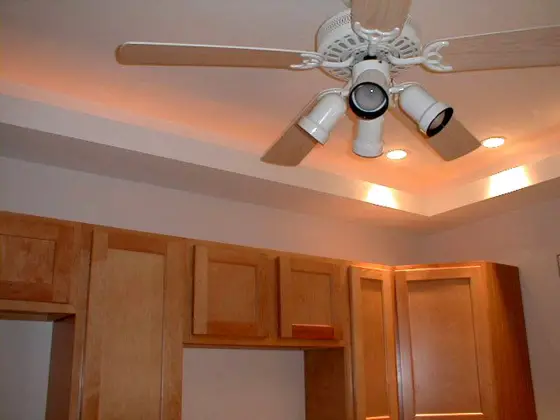
Indirect lighting adds elegance and character to any kitchen.
DEAR TIM: I want my new kitchen lighting to be dramatic, functional and different. To make it a challenge for you, I am on a tight budget. Do you have some ideas that will give me what I am looking for? Do you think a ceiling fan is a good idea in kitchen? Sally M., Bolivar, TN
DEAR SALLY: The only challenging thing about this project is the planning aspect. I am quite certain I can deliver on all of your requests. If you are lucky enough to have a nine foot tall ceiling in the kitchen area, the end result is going to take your breath away.
The importance of kitchen lighting is often overlooked. All too often a builder or remodeler will just install a series of recessed lights and/or some surface fixtures to fulfill the need for general purpose lighting. The modern kitchen is often much more than just a work area. It can be a quiet area where you relax by yourself, a space where two people casually talk and get to know one another, or it can be an anteroom that is used to support activities in an adjacent space. An assortment of lighting types will allow you to maximize the mood in your kitchen no matter what you use it for.
I feel the most dramatic look you can achieve in a kitchen is to mix indirect lighting with direct lighting. Indirect lighting is created by hiding the light source from view. The light produced by the hidden fixture bounces off a ceiling or a wall and produces a warm glow that adds enormous amounts of atmosphere if done just right. The light fixtures can be hidden on top of or under wall cabinets or they can be installed in open troughs or layered ceiling areas that surround the entire kitchen space. Open soffits can be installed in a room with an eight foot ceiling height, but they look best if the ceiling is nine or even ten feet tall.
Direct lighting is achieved by using conventional recessed lights, surface lights or light fixtures that are on a pendant or chain. Many ceiling fans can be equipped with decorative light fixtures as well. These types of lights work well to provide bright lighting for work surfaces and general purpose lighting in the kitchen area.
To maximize the power and decorative effect of all of the lights you need to wire and switch them independently. Different sets of lights need to have separate controls so that you can add or delete layers of light as you would peel layers of skin from an onion.
For example, a ribbon of rope lights concealed in an open soffit that surrounds the entire kitchen can be the sole source of indirect light. Have this single light source on its own switch. Four or six small recessed lights in the central part of the kitchen ceiling may provide the next layer of light. Additional recessed lights that wash all of the countertops can be the third stage of light. A traditional surface mount fixture in the center of the room can provide the final boost of light energy when the kitchen needs to be at its brightest.
Ceiling fans in kitchen spaces are an excellent idea. Not only can they be a functional fixture, but they also can be a highly decorative item as well. I have a fan in my kitchen and it is a workhorse. During warmer weather it produces a gentle stream of cool air that keeps the cook, my wife Kathy, very happy. I use it every time I mop the floor. The air stream dries the floor before the cats or kids track up the floor.
If you decide to install a ceiling fan, make sure that you keep recessed fixtures away from it. If a fan blade passes underneath a light fixture, it can create a very annoying stroboscopic light effect. I like to keep recessed light fixtures at least 9 inches away from the edge of any of the fan blades. If you can maintain 12 inches clearance, that is even better.
Rope lighting and small recessed lights are budget friendly. A 20 foot long rope light and eight recessed lights with attractive trims can be purchased for about $300. If anything is going to break the budget it will be the ceiling fan. In case you can't afford the one you want, go ahead and install the approved ceiling fan electrical box and cable that will power it. Place a flush cover plate over the ceiling box and start saving your money and watch for sales or rebate offers.
 If you are looking for a great book for installing simple wall lights, to running wire in new construction and in existing walls and ceilings, then Wiring a House is the book for you. With its wealth of practical know-how this book, written by a master electrician, is sure to become an indispensable reference for anyone who wants a common sense guide to residential electricity. The black and white photos and illustrations featured in this book are clear, crisp and easy to understand. You must buy a copy of Wiring a House, a great hardback book published by Taunton Press.
 If you are looking for a book with invaluable information on tools and materials, detailed instructions for how to repair or replace wiring in old buildings and bring them up to code then you need a copy of Old Electrical Wiring. This 400 plus page book tells you everything you could ever imagine about switch layouts, troubleshooting, and design change. It also has an extensive glossary of old wiring terms and slang. Packed with drawings and illustrations, including pictures of old devices, this practical book will tell you whether an old electrical system should be torn out or repaired. This book will really help you.
 Here's a complete, full-color guide to all aspects of residential wiring. Electrical Wiring Residential is another must have book. It's everything anyone could need to know, from wiring a lighting branch circuit, to installing a service entrance or installing lights in a swimming pool. It is loaded with examples, wiring diagrams, spectacular photos and illustrations explaining all the 1999 NEC requirements. This book is easy to read and understand, yet has all the instructions and details needed to perform virtually any residential wiring job properly.
Column 308

Tim built custom homes and did ultra-custom remodeling for 20+ years before launching his Ask the Builder media presence. He was selected as one of the Big 50 by Remodeling magazine in 1993. This award gave birth to Ask the Builder in October 1993. Tim also operates https://DrawPlumbingPlans.com. His @askthebuilder YouTube channel was the first home improvement channel on YouTube.