Hot Water Recirculating Pumps
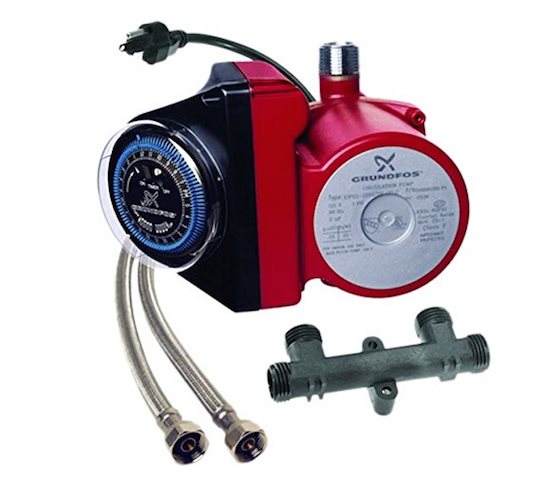
This is a reliable hot water recirculating pump you can install on top of your water heater. The weird threaded fitting goes under the sink that's farthest away from the pump. CLICK THE IMAGE NOW TO ORDER THIS PUMP.
"To get instant hot water as you often find at hotels and other institutions, you need to have a loop in the piping system that circulates hot water back to the water heater."
Hot Water Recirculating Pump TIPS
- Loop needed to get cold water back to the heater
- Can be created easily under a sink - See Below
- WATCH my Video about Recirculating Pumps BELOW
- Gravity loops work great but must be done in a new home or large remodel
- CLICK HERE to Get Tim's FREE & FUNNY Newsletter!
DEAR TIM: I believe I need a recirculating pump. It takes about 30 seconds for hot water to reach my shower each morning. It's frustrating to wait that long.
Is it possible to have hot water within a second or two after I turn on the valve? I have seen different recirculating systems that promise hot water instantly and they talk about huge energy and water savings.
Is this true? Is there a way to get hot water using simple gravity instead of a pump? Chad G., Birmingham, AL
Related Links
An Easy Hot Water Recirculating System
A Gravity Hot Water Loop - No Pump Required!
DEAR CHAD: Many people wait for hot water just as you do each morning.
What Plumbing Fixtures Waste Water?
Here's a list of plumbing fixtures that waste water waiting for hot water to show up:
- vanity sinks
- kitchen sinks
- dishwashers
- washing machines
Fortunately, this problem can be solved one of two ways depending upon how your plumbing system is designed.
Free & Fast Bids
CLICK HERE to get FREE & FAST BIDS from local plumbers to install a recirculating pump.
Can a DIYer Install a Hot Water Recirculating Pump?
A DIYer probably doesn't have the skills needed to install a hot water recirculating pump.
Keep in mind that the work to achieve your goal is not something the average do-it-yourselfer can tackle. If you've not worked with water supply lines, you could get into trouble fast with a water leak.
What's more, certain cities and states have strict regulations with respect to modifications made to water supply systems that are connected to public water systems. Be sure to call your local plumbing inspector before you cut into your piping system.
Free & Fast Bids
CLICK HERE to get FREE & FAST BIDS from local plumbers who will install a recirc pump.
Is It Okay to Waste Water?
Clean water is a valuable natural resource and it should not be wasted. The trouble is, in many localities, water might be a very cheap commodity. When prices are low, people tend to waste. The trend is for higher and higher water and sewer bills if you get water from a city or county supplier.
I grew up in Cincinnati, Ohio and the Cincinnati Water Works constantly ratchets up the cost of water. In Cincinnati, your sewer bill depends on how much water you buy, so if you water a lawn or plants, you pay more even though you're not allowing that water to go into the sewer system.
You have to add in the cost of your sewer bill when you try to calculate what water is really costing you. Don't forget to do this.
For example, a cubic foot of water used to cost me just a little over 1.6 cents. Once again, it's a moving target so you have to look at your water bill and see what you pay per cubic foot. Don't forget to take into account your sewer bill.
How Much Water is Wasted Waiting for the Hot Water?
There is a very good possibility that you waste less than a tenth of a cubic foot of water each morning. To prove this, assume that there is 25 linear feet of three quarter inch piping between your shower faucet and water heater.
Do the math and you will find out that there is just .076 cubic feet of water inside the water pipe. When I was paying just 1.6 cents per cubic foot of water, to waste one dollar's worth of water, I'd have to take over 800 showers.
How Do You Get Instant Hot Water?
You need to have a loop in the piping system that circulates hot water back to the water heater to get instant hot water as you often find at hotels and other institutions.
Most houses do not have a dedicated loop as the hot water pipe typically dead ends at the plumbing fixture that is farthest away from the heater.
Can A Recirculating Loop Be Added to an Existing Home?
It's possible to install an effective return loop in single-story houses that have a basement or crawl space where the water supply pipes are visible below the floor joists. Two-story houses make this task nearly impossible, as the piping system is typically hidden in the walls of the home.
CLICK HERE to get FREE & FAST BIDS from local plumbers to install a recirculating pump.
Is it Easy to Install the Loop in a New Home?
Yes, it's very easy and inexpensive to add the return loop leg in new construction.
If you're building a new home or doing a major remodel where you can expose the water lines going to the second floor, you can install the second half of the return loop in less than four hours in many cases.
CLICK HERE to get FREE & FAST BIDS from local plumbers who will install a recirc pump.
What is the Alternative to A Piping Loop?
The alternative to a hot-water piping loop is to use the existing cold water line to a sink as the return leg of a loop.
But, you don't have to install a return loop if you choose to use a modern recirculating pump system. These products employ a nifty temperature actuated bypass valve that connects the cold and hot water supply lines at the fixture that is farthest away from the water heater.
The bypass valve uses the cold water line as the return loop back to the water heater.
Are All Recirculating Pump Systems the Same?
Not all recirculating pump systems are the same. One system places the pump under the sink at the farthest fixture. You have to push a button to start the pump.
The trouble with this system is that you still have to wait for hot water. What's more, this pump needs high voltage electric to operate. It can be a huge challenge to install an outlet under a sink.
Another system activates a remote pump that can be near the water heater. The trouble with this system is that it pumps water through the system whenever the temperature drops at the activation valve. This system wastes energy dollars as it pumps hot water while you sleep and are away.
What Does the Best Recirculating Pump System Have?
Perhaps the best pump system is one that has a temperature controlled bypass valve under the farthest fixture sink and a timer on a pump that can be conveniently located adjacent to the water heater.
The timer can be set to go on and off at 15-minute intervals depending upon when you feel you need hot water at the fixtures. CLICK HERE to see this great pump with a timer.
The pump is equipped with a handy extension cord that can be plugged into a convenience outlet near the pump. There is no water waste with this pump and it also minimizes energy waste since it only sends hot water into the water supply lines during the programmed times.
Can I Just Install a Gravity Hot-Water Loop?
Gravity hot water recirculating loops that do not require a pump can sometimes be installed after a house is built. They will only work when the water heater is below the water supply lines in a basement or crawl space. This system requires that the hot water line return back to the heater after it services the farthest fixture.
How Much of the Piping Needs to be Insulated?
The entire hot water pipe, plus the return piping must be well insulated for the loop to work. The last 15 feet of the return line must not have insulation on it for the convection to happen.
Modern water heaters have a pesky rubber flapper on the hot water outlet pipe and sometimes the incoming cold water inlet. These must be cut out or a large hole drilled in it. If you don't do this, the hot water can't float up through the gravity loop.
The rubber flapper works well when water pressure forces it open when you call for hot water. But it will not open if water is trying to gently float up the pipe.
CLICK HERE to get FREE & FAST BIDS from local plumbers who can do this job for you.
The pump shown above was the one recommended to Cynthia in the November 25, 2008 AsktheBuilder Newsletter to solve her slow hot water.
Column 413

Tim built custom homes and did ultra-custom remodeling for 20+ years before launching his Ask the Builder media presence. He was selected as one of the Big 50 by Remodeling magazine in 1993. This award gave birth to Ask the Builder in October 1993. Tim also operates https://DrawPlumbingPlans.com. His @askthebuilder YouTube channel was the first home improvement channel on YouTube.

What is a better brand for a hot water circulating pump to my water heater. I want one that will safe me water and energy. Thank you and I will be waiting for your pront response.
Nestor, your question(s) require lots of typing and I have some questions for you. You should consider investing in a 15-Minute Consult with me. Look at my cart for that. Lot's to discuss. I just do short pithy answers here.
Can you tell me what brand that this pump is.
Bob
That is a Grundfos pump.
The best solution, in my opinion, is a loop system, a circulation pump at the water heater with a flow switch and interval timer such that if the timer senses flow to a hot water faucet for a short time (like 2 to 5 seconds, adjustable) it will activate the pump for long enough to heat the loop (adjustable time for varying conditions) and then turn off the pump because it isn't needed after the loop heats up. Turning on any hot water faucet for the minimum interval to start the pump and then turning it off until the loop heats up eliminates tricky timers and saves keeping the loop hot at all times. This system requires a complete loop in the hot water system that is preferably insulated; a backflow preventer; an expansion tank; a small circulation pump, preferably brass or stainless; timer or timers and a flow sensor. I use a differential pressure switch but a paddle type flow sensor would work. I also put a filter screen ahead of the backflow preventer to keep any debris out of the check valves. Luckily I found a perfect timer at an electronic surplus store that has a settable delay on make, settable on interval and settable re-cycle interval. I have it set for 2 seconds to start the pump, 2 minutes for the pump to run and 10 minutes null time before the pump will run again. The differential pressure switch is set so that the flow is moderate to cause it to switch so a deliberate turning on of a faucet is required to activate heating the loop.
Do you have more specifics on how what you use for the electronics? This is the best solution i have heard!
I recently installed a 80 gallon electric hot water heater and I am not getting hot water to faucets unless I turn on several faucets further from the faucet I need hot water. It is a pressure problem. Will a recirculation pump resolve this issue? .......my home is two story, 4500 square feet and I never had this problem with my previous 2- 40 gallon propane water heaters.
Are you sure ALL of the heating elements in the heater are working?
Tim, if a bypass-type valve is used between the hot and cold water supply at a fixture so a recirc pump can provide immediate hot water to the fixture, it seems to me that the cold water supply pipe then becomes filled with hot water. If I want cold water to drink immediately after using the hot water, will I not get hot water when I turn on the cold water faucet?
Not if you have a check valve in place.
Whoa. Maybe I don't understand, but if the hot water is recirculating through the cold line, the water in the cold line seems like it would be warm (maybe not hot). So wouldn't you have the inverse problem? IE you'd have to clear the "warm" water from the cold pipe before that water is cold?
Can you please point me to or provide a sketch of where the check valve would be installed? I too, am encountering this problem .....
What kind of pump can be used when the house is built on a concrete slab?
See question previously posted. Harry Joseph
Currently rented a home that has this loop is there regualtions on how long it's suppose to take for hot water to hit the faucet. OR possible quick burns to not happen example turn hot water on and takes little time to get hot to avoid burns regulations for builders to allow a time to get water hot to reach faucet
The temperature of the hot water should probably not be above 115F.
I have two hot water heaters in my attic side by side. Each supplies a different area of my house (one story). Do I need two recirculating hot water pumps or can I use one pump for both hot water heaters?
two pumps please
Not what I was hoping to hear, but thanks!
I have a rennai tankless water heater. Is there a recirculating pump designed to help reduce the water wasted waiting for hot to get to the taps?
With tankless water heaters there is not a good recirculating pump. You would be able to waste less water, but you would be running the water heater so much more than normal (since supplying *any* hot water means the tankless heater is kicking on as opposed to having 50+ gallons in reserve.)
I live in 1 story house build on a slab. Hot water to the bathrooms is not my problem. My kitchen and laundry room is at the end of the run. My dishwasher and washing machine don't run correctly because the demand water never gets "hor enough" Whirlpool refuses to acknowledge a problem because I don't meet their standard of 125 degrees within 20 seconds.
Suggestions please.
Sure.
Install one of the pumps I write about in this column. Get HOT water to the two appliances BEFORE they turn on.....
If the distance from HWH to a bathroom is large, what about using small point of use (~2-3 gallon) at the bathroom in line with the HW pipe?
You stated that you found a "perfect timer at an electronic surplus store that has a settable delay on make, settable on interval and settable re-cycle interval. I have it set for 2 seconds to start the pump, 2 minutes for the pump to run and 10 minutes null time before the pump will run again."
What is the make and model number? for I have been having a difficult time finding one.
Thanks!
Is there a recommended way to find the furthest faucet from the water heater? Thank you
is it better to have a recirc pump with a temp sensor or without. Also for a new house with 2 return lines, better for a single pump or 2 pumps.
Most if not all commercial water rates also have a sewer charge based on usage, but most residential rates bill a flat fee for sewer. Also, while waiting for hot water you are introducing cold water into the hot water heater, which must be reheated. If the hot water lines are not insulated and you utilize a recalculation pump there is also more heat loss through the pipes that stay hot for a lot longer periods of time. You will get hot water quicker, but there is also an energy cost which may be higher that the cost of the wasted water. Wouldn't' tit be nice for the consumer if the building codes required insulated hot water lines, and not allow the cheapest first cost.
Mr. Donald, actually Tim is correct about sewer and water billing, at least in the last two cities in NC where I have lived. They charge twice the amount for sewer as they do water and they factor using the pipe size at the main meter. However, we were able to write the water meter numbers down before and after tasks like topping off the pool or watering newly planted landscape.
Also, I do understand that all recirculating systems I have looked at recommend insulating the hot water pipe except for a few feet. So it's not necessarily codes that need to be changed. Perhaps it is the owner and builder reading the manual that needs to be done.
I have a PEX plumbing system, where every faucet or fixture has its own line(s) coming to it, from the manifold that is by the heater. With such a setup, wouldn't I need a seperate pump for each fixture that I want the recirculated water at?
No. You need one pump. But you'd need to create a *loop* at each fixture where you want hot water to be at a certain time. Look above at the photo of the Grunfos pump. See that funny U-shaped sort of thing? That creates a loop under a sink or at a shower or tub. There are other recirculating pump solutions out there as well for people who have systems like you do. My house is also set up like yours.
I recently installed a grundfos recirculating pump on my new home which has an expansion tank on the cold water side going into the hot water heater. I hooked the pump up properly to the hot water side and installed the bypass valve under the sink furthest away. It take 3 to 4 minutes for the water to get hot. Does it have anything to do with the expansion tank, or is the pump simply bad? I have installed this same model pump before a few times at different houses, and no problem, so I know I connected it properly. Thank you for your time.
When you talked with Grundfos Customer Service, what did they tell you?
It looks like these pumps just use a 110 outlet. Could a heavy duty plug-in digital timer be used to control it? I would rather it not run while I'm at work, but want hot water available all day during the weekends.
You answer that question matching up the wattage limits of the timer to the wattage DRAW of the pump.....