Stop Mold Growth
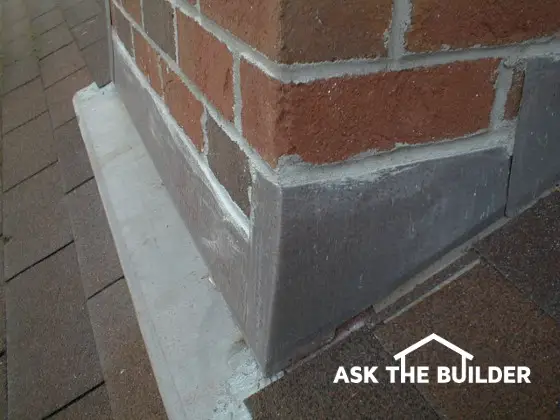
Here's an example of some excellent chimney flashing and mortar joints that prevent water from entering a home. The water would create severe mold and rot issues in the attic and roof framing. Copyright 2017 Tim Carter
Stop Mold Growth TIPS
- Water is the primary source of mold growth
- Do whatever is necessary to keep all surfaces inside dry
- WATCH mold growth video below
- Use Stain Solver oxygen bleach to clean up mold and remove spores
- CLICK HERE to Get Tim's FREE & FUNNY Newsletter
DEAR TIM: There's been so much news lately about mold that I am very concerned about what might happen to my family and myself in my new home. When I was growing up, mold was never and issue.
What is different now? Why is mold such a problem with newer homes?
Older homes seem to be somewhat immune.
How do you STOP mold growth?
Chad G., Birmingham, AL
DEAR CHAD: As much as I hate to say it, I think the mold problem is just starting to raise its ugly head.
Poor Building Practices
For many years I have witnessed building construction practices that, in my opinion, contribute to severe mold growth and subsequent structural failure from wood rot. The problems can be traced to several things.
Water Vapor & Condensation
First and foremost among them, many modern builders simply do not understand the dynamics of water vapor, condensation, ventilation and exterior moisture protection.
In the years ahead, I predict that mold discovery and mold related issues will reach epidemic proportions in recently built homes.
Free & Fast Bids
CLICK HERE to get FREE & FAST BIDS from local mold control experts.
No Old Mold
Let's discuss the older home you grew up in and the thousands of older homes that are still occupied and in excellent condition in your community and others around the USA.
Older homes simply were not built as tightly as the homes of today. The weatherstripping around doors and windows was poor or non-existent.
Many homes had little or no wall insulation. The houses were drafty.
Cheap Fuel
Inexpensive heating fuel allowed these building practices to exist. Residential central air conditioning had yet to be invented. Builders understood the importance of tar paper beneath wood siding.
Brick structures were two or often three courses thick. Indoor humidity in the winter time was very low.
Why Mold Grows
Mold and mildew require just three things to form and grow:
- mold spores
- food
- water
It's virtually impossible to eliminate the first two in the list. Mold spores are everywhere. Thousands or hundreds of thousands are in your home.
Food for mold is everywhere. Dust, sugars, dirt, wood, paper, fabric, are all food sources for mold.
But you can stop WATER. If no water is in contact with the spores and food, there's NO MOLD.
Stop Mold Video
Watch this short video. He explains what I just mentioned above.
Air Movement
Because of these factors and several more, water that triggers mold growth didn't collect inside of wall cavities, on interior wall surfaces and in attic spaces. The drafty nature of the construction allowed the water to rapidly evaporate into the atmosphere.
Mold most certainly did grow, but only in places where water leakage had become a chronic problem.
Energy Crisis Chaos
The energy crisis of the 1970s turned the residential construction industry on its ear. There was a rush to seal air leaks in houses and improve the weatherstripping on doors and windows.
But many didn't think about the secondary long-term effects of installing many of the new energy products.
Vapor Barriers Trap Water
Vapor barriers in exterior walls became a building code requirement. In many areas of the nation, forced air heating and central air conditioning with its necessary duct work replaced traditional hot water or steam radiant heating systems.
Humidifiers Add Water!
Along with the duct work came whole house humidifiers. Humidifiers are a good thing, but if not operated properly, they can become mold's best friend.
New Builders - No Training
The rapid growth in the overall population created a housing boom. This led to an influx of builders and sub-contractors into the residential housing industry that had little or no formal training.
CLICK HERE to get FREE & FAST BIDS from local mold control experts.
Doing It Wrong For Decades
These individuals, without knowing it, started a trend of poor building that was, and continues to be, unknowingly passed on to subsequent builders and sub contractors. Just because an individual has been doing something for 20 or 25 years doesn't mean it is right!
Caulk Is Not A Permanent Fix
For example, go back in time and you would never see a roofer caulk metal flashing in place. Sure, modern caulks are a far cry better than old brittle butyl caulks, but they can and do break down over time.
On the other hand, 40-pound tin flashing embedded 3/4 inch deep into a mortar joint has been known to last 70 years or more. It's hard to get tin-coated steel now, so opt for 1/32-inch-thick sheet lead.
Tar Paper Works
Old builders discovered well over 100 years ago that overlapping layers of ordinary 15 pound tar paper stopped rain water and snow melt from touching vital wall sheathing and wood framing members.
Air Infiltration Barriers
Today we have modern air and water infiltration barriers, but many houses are built without this vital secondary moisture protection. Wind-driven rain can and will get behind all types of siding.
It can also penetrate the single layer of brick veneer that so many homeowners think is waterproof.
Builder Must Understand Water
To stop mold growth, your builder must be well educated and be able to demonstrate a knowledge of how to use modern building materials in such a way that water does not condense within wall cavities and attic spaces.
Building Code = Minimum Standards
He needs to build your home to standards that exceed what the building code states. The building code is a wonderful set of guidelines but many code officials will agree that is a set of minimum standards.
If he does not agree with this point, it is time to re-open the bidding process on your new home.
Mold Removal
If you have mold growing on a surface, it can be removed by using different types of bleaches. Not all bleaches are the same.
The most common bleach that most people use is chlorine bleach. It's a liquid purchased at just about any grocery store. The chemical name for chlorine bleach is sodium hypochlorite.
CLICK HERE to get FREE & FAST BIDS from local mold control experts.
Toxic Fumes
Chlorine bleach is a very effective mildew and mold killer, but its fumes can bother some people. Mixing a 50/50 solution of chlorine bleach and water is often all you need to do to make a powerful solution.
Spray it on the mold and mildew and let it sit for several minutes. Scrub it with soap and water and then rinse.
Stain Solver is MADE in the USA with USA ingredients that are food-grade quality. CLICK THE IMAGE to order some NOW.
If you want a less toxic bleach, you may want Stain Solver Oxygen bleach. Oxygen bleach is a powder you mix with water.
Stain Solver produces no fumes and it also does a good job or removing mold and mildew, but it doesn't do it quite as fast as chlorine bleach.
The Oxygen bleach solution is also safe for any vegetation and nearby plants should you be working with it outdoors.
Message from Tim:
Years ago while researching a column about cleaning decks, I discovered the wonders of Oxygen Bleach. It is perhaps the 'greenest' cleaner I know of as it uses oxygen ions to break apart stains, dirt and odor molecules. There are no harsh chemicals, and it works on just about anything that is water washable.
I decided to create my own special blend using ingredients made in the USA. In fact, the raw materials in the active ingredient are food-grade quality registered with the FDA. I call my product Stain Solver. I urge you to use it to help with your cleaning project. You will be amazed at the results!
CLICK HERE to get FREE & FAST BIDS from local mold control experts.

Tim built custom homes and did ultra-custom remodeling for 20+ years before launching his Ask the Builder media presence. He was selected as one of the Big 50 by Remodeling magazine in 1993. This award gave birth to Ask the Builder in October 1993. Tim also operates https://DrawPlumbingPlans.com. His @askthebuilder YouTube channel was the first home improvement channel on YouTube.
The fact of bleach killing mold is absolutely incorrect. Mold that is growing on a surface with pours cannot be killed with bleach. There are roots that penetrate deep and the bleach ions are unable to pass thru to the base of these. Bleach can also serve a protective layer to mold. If you wipe a porous surface with bleach, then try to go back over it with a mold killing product, it will not penetrate the bleach layer. The entire surface must be wiped with water to help dissolve the bleach, then go back with a mold killer product. The product is sprayed on and then wiped. These often contain hydrogen peroxide and an active ingredient similar to what is in hand sanitizer. The real kicker is....mold spores can still be a toxin even dead. As long as they are there they can release toxins. Everything must be vacuumed with a hepa filter and bag in the vacume, Trust me on this...I have been there on the front lines.
Houston here..... I am helping my 80 year old Aunt with her home that flooded and had roof leaks during Hurricane Harvey. We've removed the Sheetrock from the places that had the 3 feet of water from the ground up. My question is what to do with the walls where the rainwater came in from leaks in the roof (apparently it has been caulked since the storm, metal roof.) Pictures fell off the wet walls a day or so after the storm but there aren't any water marks. Mold has started to grow or be seen on parts of the ceiling and corners of walls and ceiling. Do I remove the Sheetrock completely or only the parts with the mold? Forgive the length, I'm a novice and doing this all by myself.
The upper drywall should be okay. Here's the deal with mold and mildew. It only burps out spores that can cause health issues if ACTIVELY growing.
If you've STOPPED the water from coming in, the mold / mildew will die. You'll still see the leftover black remains, but that can be washed off and painted over.
It's the active mold growth - or disturbing old dead mold - that can cause health concerns.
Katy Texas here: After Harvey we cut out all the sheetrock. Our house was built in 1976, the builder used a rock board on the house side frame and about 12 inches high they used tar paper. When cleaning I ripped off a section of the tar paper and noticed there is black stain. I assumed this is bleed through from the tar paper against the rock board. A friend came by and saw this and says its mold. So, have you seen this in older homes? If I remove all the tar paper, and have it cleaned and treated, what materiel can I go back with? Or do I leave it alone?