Painting Floors Really Works Well
Painting Floors Ideas and TIPS
- Painting floors is easy, cheap and it's fun
- Durable finishes are easy to create - used in retail stores!
- Special floor paints and clear coatings are needed - LINKS BELOW
- Use stencils and borders for greatest flair and WOW factor
- CLICK HERE to Get Tim's FREE & FUNNY Newsletter!
DEAR TIM: We discovered a plumbing leak as we were getting ready to install a new laminate floor. The money for the flooring is now in the plumber's bank account.
Since we have no money left for new flooring, is there a way to successfully paint the exposed plywood floor? How do you fill the depressions and cracks in the floor?
Is it necessary to prime the wood before painting? Mark A., Hickory, NC
DEAR MARK: Are you sitting down?
Painting Floors Works!
The answer is, "Yes!" It is not only possible to paint floors, the paint job just might end up better looking than the original laminate floor you intended to use.
There's no real magic in painting a floor. You simply have to follow a few simple steps and use the right products to achieve durable and long-lasting results.
CLICK HERE to get FREE & FAST BIDS from local painters who can paint your floors.
Smooth Floors Look Best
Just about any flooring surface that is in good shape can be painted. Concrete, wood, ceramic tile, sheet vinyl, vinyl tile, etc. can all be painted with ease.
The only surface that may have problems would be an older basement concrete floor that is below grade or one that is in contact with a very wet soil. Water that seeps into concrete can sometimes cause a painted finish to peel.
But many modern concrete floors installed since the 1970s have a vapor barrier under the slab. This moisture barrier often stops the water vapor allowing the paint to stick tenaciously to the concrete.
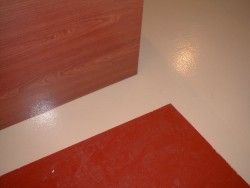
You are looking at a wood cabinet back in the upper left corner of this picture. The white and red parts of the photo are painted flooring! Look at the shine. Would you believe me if I told you this was in a retail center, not a home? Imagine how much foot traffic that floor gets in one month.
Paint in Public Places
You probably walk on painted floors all the time and don't realize it. You may even watch a sports game or two where the athletes are scuffing painted floors.
Many upscale clothing stores and restaurants have painted floors.
Basketball players run up and down painted floors. These floors take enormous abuse.
Clear Coat For Best Surface
Most paints will not yield a surface hard enough to resist years of foot traffic. That said, there are some special paints that have been made for many decades that you can walk on. If you've ever visited old mansions or homes with covered porches built in the late 1800s, you've seen these paints.
Exterior porch paints have been formulated with great success for years. Here's a fantastic one:
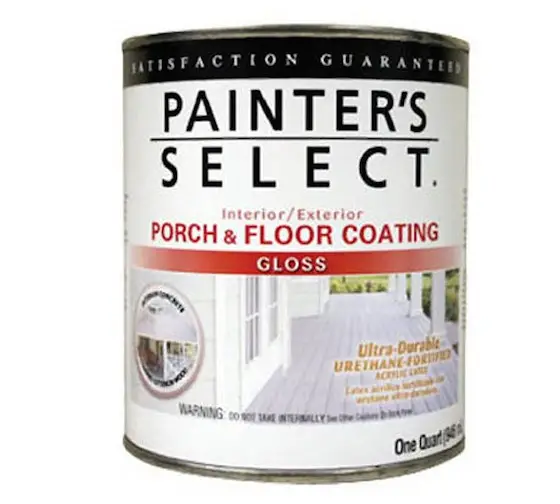
Here's a great urethane-fortified paint. That's why on the label it says it's for porches and floors! It's tough enough to walk on! CLICK THE IMAGE NOW TO ORDER IT.
Clear Water-Based Urethane
You achieve durability and long-term good looks by coating the painted surface with three coats of clear urethane. Most people take for granted the hardness and durability of clear urethanes. For example, hardwood floors that are not coated with urethane can begin to look dingy and miserable in a short amount of time.
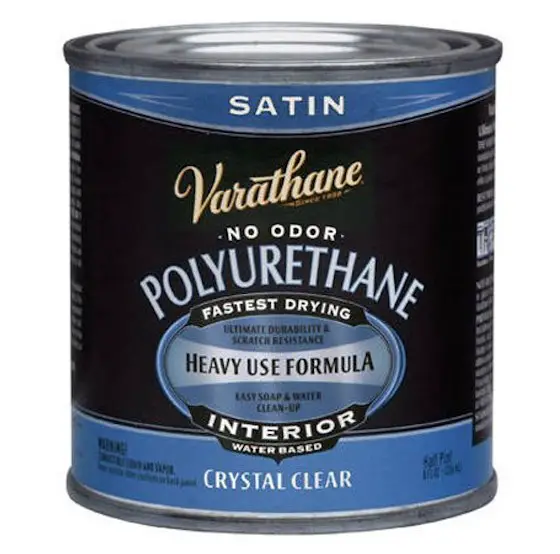
SECRET TIP is to coat the drywall BEFORE finishing with this amazing urethane product. It WILL STOP water from penetrating into the paper of the drywall. CLICK IMAGE TO ORDER IT NOW. Always be sure to order the exact sheen you want. There's a big difference between satin and high-gloss!
The thin coats of smooth urethane protect hardwood floors from dirt and other contaminants. It serves the same purpose over any painted surface. Visit any indoor basketball floor and you'll quickly become a believer. Lines, logos and all sorts of things are painted on these floors. The paint looks good because of the invisible layers of urethane that are on top of the paint.
CLICK HERE to get FREE & FAST BIDS from local painters who can paint your floors.
Deep Clean First
Stain Solver is MADE in the USA with USA ingredients that are food-grade quality. CLICK THE IMAGE to order some NOW.
Painting floors begins just as any other painting project. The surface to be painted should be clean, dry, dust-free and as smooth as possible. Consider using Stain Solver, a certified organic oxygen bleach to deep clean the floor.
Stain Solver is non-toxic, it's got no odor and it will remove grease and other stubborn stains.
Large depressions and cracks in the wood flooring need to be filled with a product that dries hard. Do not use caulk or lightweight spackling compounds as floor repair materials.
There are any number of excellent plastic-type wood fillers that dry exceptionally hard. Certain floor leveling compounds that are mixed with water often dry very hard. Test these materials by walking on them after they dry. If they survive the walk test now, they will look good once painted.
Prime If Required
Bare wood floors should be primed with special primer/sealer paints. These products work well to hide the wood grain that otherwise might show through the finish paint.
Hardwood floors that have a varnish or urethane finish must be sanded before a primer is applied. Concrete floors may need a special masonry primer. Check the label of the finish paint you choose.
Use Compatible Primer
Typically a paint manufacturer provides a list of compatible primers that work well with specific finish coat paint products. Oil paints work best for floor painting. The oil resins have a tendency to adhere better than water-based paints. They also tend to cure and harden faster.
Faux Finish For Friends
You can dazzle your friends and neighbors if you incorporate some faux finishes into the painted floor. There are an infinite amount of possibilities.
Stenciling, borders, pinstripping, etc. can all add accent touches to the floor. I've seen some gorgeous stenciling work done on steps and floors.
Look at these amazing stencils to get an idea of what's possible.

There are HUNDREDS of different stencils you can use on floors. This is one on a wall, but imagine this one in the middle of a room! CLICK THE IMAGE TO BUY IT OR LOOK AT OTHER STENCILS.
Borders Around Area Rugs
If you intend to have an area rug on top of the floor, you might consider creating a border that frames the rug equally on all sides. It is best to practice your faux finish technique on a piece of plywood. Once you feel you have the look, then begin to work on your floor.

This is just one of MANY different border stencils you can use to outline area rugs or furniture. You can create a border around the entire room. Use your imagination. CLICK THE IMAGE NOW TO BUY THIS AMAZING STENCIL OR TO SEE OTHERS.
Paint Must Cure
Once the finish paint has dried two or three days, apply three coats of water-based urethane. The water based urethanes typically do not yellow over time. Be sure to look for the words "non-yellowing" on the urethane label.
The key to keeping the floor looking good for a long period of time is to apply a single maintenance coat of urethane every two years.
CLICK HERE to get FREE & FAST BIDS from local painters who can paint your floors.
Column 431

Tim built custom homes and did ultra-custom remodeling for 20+ years before launching his Ask the Builder media presence. He was selected as one of the Big 50 by Remodeling magazine in 1993. This award gave birth to Ask the Builder in October 1993. Tim also operates https://DrawPlumbingPlans.com. His @askthebuilder YouTube channel was the first home improvement channel on YouTube.
We'd like to get the look of stained concrete over the solid-but-outdated linoleum tiles in our basement. Would need to cover the old floor with something that would obscure the fine lines between the tiles, and would like a nice coloring that permeates the material.. Ideas?
Dan, you need to do a 15-Minute Consult with me. Look at my cart for that. There's lots to discuss. Pithy answers are all I do here.
Thanks for the tip
Tim, almost all the advice I have seen everywhere says that you can't apply water-based paints over oil-based paints, yet here you propose just that - a water based polyurethane over oil-based floor paint. How does that work?
Because the new resins are very strong glues.
Hi Tim,
I live in the NW, and I have a home built in 1967. Probably by 1970, the garage (with a smooth concrete floor) was converted to a family room and unfinished storage area. I would like to put some sort of flooring in the family room. However, I believe there is a moisture problem and don't want to end up with mold growing under the carpet. What is the easiest way to deal with this? Here's the situation:
The unheated storage area was slick, particularly nearest the east wall where the downspouts were (later, I put in French drains without weep holes) and I used a slurry-type sealant that worked pretty well. I didn't do an excellent job pre-cleaning or keeping the slurry wet until it cured properly. It worked okay, but small areas chipped off and you can see the dark (assumably moist) concrete below.
The "family room" is inside and gets ambient heat from the adjoining living room in the winter. Part of the floor has linoleum tiles (that may have asbestos--color scheme/style suggests late 60's, early 70's), and part is exposed concrete-- of which a portion got painted 20 years ago and is still TACKY!
Based on this, I am making an assumption that there is no vapor barrier beneath what was the garage floor, and that there is a moisture problem in the family room, just as there was in the storage area.
To recap: I don't want to trap moisture under future flooring to create a mold problem, only have "evidence" of moisture (tacky paint) nearest the east wall, and worry about potential asbestos issues with the tile (from the halfway point to the west edge of concrete, where it meets the sill of what was the garage and steps up to the plywood floor of the house (with crawlspace below).
Do I treat/seal the exposed and painted part of the concrete with some sort of concrete sealer (any recommendations?). I'm not sure how to prep the concrete (and how--- paint remover, giant sanding machine). Do I dare try to crack off the linoleum tiles or just leave them? Do I test for moisture somehow? Cover the whole thing up and pray it's a non-issue??
I have had every sort of contractor out here, and they are mainly all clueless! The latest did concrete work, and suggested removing the concrete from just the part that seemed wet (before the asbestos), putting vapor barrier in that section and re-laying the concrete. I want to do the simplest, safest, cheapest thing to be able to lay flooring and actually use the room!!
I will take any suggestions you have!
thanks so much!
This is too much to answer in one sentence. I created a phone consult product for situations like this. I'm sure you understand why!
Hi, We painted solid oak bedroom floors with one coat of primer and 2 coats of porch and floor paint last week. Then put in some stripes 2 days later. All paint is from Sherwin Williams and all the same kind. We want to poly the floor. Paint man says to use oil based poly and wait 14 days for paint to cure before applying poly. Then wait 3 days before moving in furniture. Your thoughts?
House is kept at 65 degrees and we live in the desert.
Thank you,
I'd NEVER use oil poly..... Why not follow my instructions in the column?
Great column. Thank you. You mention using plastic-wood filler for depressions in floors. Do you think that would adhere to primed vinyl or could you recommend something similar for vinyl?
Hello, is the two to three days dry time before applying the urethane coating the same for water based paints - I'm using a Farrow and Ball floor paint
We painted our wood floor 2 coats with primer that was tinted and then two coats of porch paint both latex. Then two coats of water based minwax non ambering poly. It looks great except for whiting between some boards. do you have any idea what could cause this and what the solution is?
Had our living room floor level and stained.. The leveler was some type of thick paste..started cracking..now looks like an old cracked side walk. Can I bust that out and use self leveler,,then paint it
hi i painted my vinyl floor and want to put the urethane on how long will i have to wait to put back the furniture into that room?