Removing Moss and Algae From Roofs
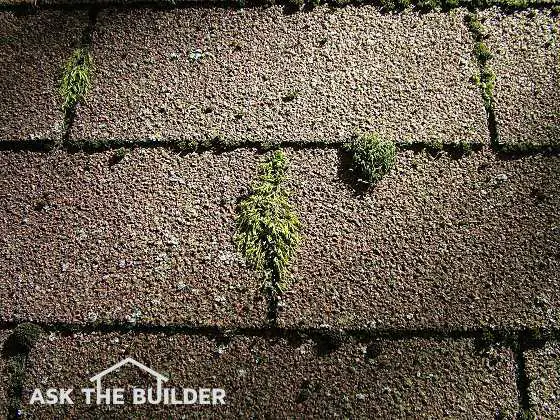
This is moss growing on my own garage roof. The large clump you see towards the top is about the size of a large grape. © 2017 Tim Carter
Roof Moss Removal and Algae TIPS
Roof moss removal usually requires a broom or heavy stream of water. Moss is a thick organic growth. Algae is just a thin film of organic growth that can be removed by washing the roof with certified organic oxygen bleach. Copper strips prevent the growth of moss and algae.
-
- Moss is thick - Algae is paper-thin
https://www.stainsolver.com/
- Use Stain Solver oxygen bleach to safely clean
- WATCH Moss Removal & Roof Cleaning Videos Below!
- Copper will prevent the growth of moss and algae
- CLICK HERE to Get Tim's FREE & FUNNY Newsletter!
DEAR TIM: Part of my roof gets very little direct sun and is shaded. Both moss and green and black algae grow on the shingles. Are these organisms causing damage to my roof?
What's the best way to remove them? I'm very hesitant to use chlorine bleach as it may damage the roofing material. Once clean, is there a way to permanently keep the roof free of the moss and algae? Scott W., Toledo, OH
DEAR SCOTT: People who live in all parts of the nation and have roofs made from all sorts of materials, wood, metal, asphalt, clay or concrete tiles, etc. can have moss and algae accumulate on their roofs.
Those places that receive more rainfall and have sustained high levels of humidity have more moss and algae growth as the moss and algae need water to grow and multiply.
CLICK HERE to get FREE & FAST BIDS from local roof-cleaning companies.
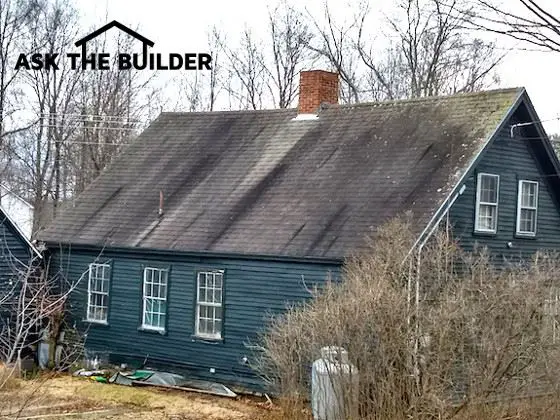
This roof is covered with different species of roof algae. You can see where the lead is helping to keep the roof clean. If there was a copper strip along the entire roof ridge, the roof would be perfectly clean.
Why Does Roof Moss Grow on the North Side?
The growth is often more pronounced on the north-facing portions of roofs since they tend to stay wetter longer and are in the shade.
Large trees that produce lots of shade on a roof can also foster the growth of moss and algae as evidenced by my own west-facing roof. It used to get covered with moss and algae. Morning dew and rainfall tend to evaporate slower on these surfaces because of the minimal amount of direct sunlight these roof surfaces receive.
Can Roof Moss Shorten a Roof's Lifespan?
Yes, roof moss can shorten the lifespan of untreated wood and asphalt roofing materials.
The thick moss growth with its shallow root system keeps the roofing materials damp for extended periods of time and this moisture promotes wood rot and can and does erode the asphalt in shingles.
Is it Dangerous Up on a Moss-Covered Roof?
Yes, it can be very dangerous standing on a moss-covered roof.
It's important to realize that a roof covered with moss or algae that is wet is as slippery as wet glare ice. You can slip without warning and tumble to the ground.
You may not feel comfortable getting up on a roof. I know many people who are terrified walking on a low-slope roof much less a steep one.
Fortunately, God gave me the no-fear factor with respect to walking on roofs. You must respect them, but it's safe if you know what you're doing.
Shingles can be loose, break loose and slide as you step on them.
Walk leaning into the roof and keep a low profile. If you start to slip, LAY FLAT trying to create as much surface area as possible to slow or stop your slide.
CLICK HERE to get FREE & FAST BIDS from local roof-cleaning companies.
How to Remove Moss From Roof?
Moss is quite easy to remove from a roof. Use a standard bristle scrub brush on a pole and push the brush down the roof to tear the moss's shallow root system from the shingles.
Do not brush up the roof as you might break the bond between shingle layers.
Note how the moss typically starts to grow at the top of the vertical slots between shingles. These areas of asphalt shingles are the last place water evaporates from a roof. Once the moss is removed, inspect these slots to ensure the colored ceramic granules are still in place. If the granules are gone and you see just the interior fiberglass mat of the shingle, your roof is well on its way to being replaced.
The green and black algae, in my opinion, are not harmful to the actual roofing material because they do not develop roots. They are more of an aesthetic issue since they make the roof look horrible. Both of these algae can be cleaned from the roof, however, the green algae is far easier to remove than the black algae.
Should I Avoid Chlorine Bleach?
It is wise to avoid chlorine bleach as a roof cleaner. Chlorine bleach can remove the natural color from wood roofing shakes.
Chlorine bleach, even diluted with water, WILL KILL vegetation on the ground if it runs onto the ground as it is rinsed from the roof. My one neighbor systematically murdered two specimen maple trees next to her patio because she used chlorine bleach to remove the algae from her patio each spring. I WARNED her to stop and she thought I was an idiot.
Chlorine bleach can accelerate corrosion of metal gutter and downspout systems. If it drips down on a wood deck below your roof, it will also cause accelerated corrosion of the joist hangers, nails, screws and any other metal structural connector.
What is the Best Certified Organic Roof Cleaner?
Stain Solver is MADE in the USA with USA ingredients that are food-grade quality. CLICK THE IMAGE to order some NOW.
The best roof cleaner, in my opinion, is non-toxic Stain Solver oxygen bleach. Stain Solver is certified organic and is a powder you mix with hot tap water.
It does a fantastic job of cleaning algae from roofs. Many customers have sent in before and after photos of it working. CLICK HERE and scroll down to see a stunning before-and-after photo set.
It's best to apply the Stain Solver solution to a cool roof surface, preferably on an overcast day. If you keep the roof surface wet with the solution for just 20 minutes, and then lightly scrub the roof surface, the algae will come off with no issues.
Severely stained roofs may require multiple applications of the Stain Solver solution. The solution also helps to loosen the grip of the shallow moss roots.
Roof-Cleaning VIDEO
Do Copper Strips Stop Moss and Algae Growth?
Yes, copper strips stop moss and algae growth. Copper is a natural biocide and it's safe. Copper is a naturally occurring element.
Once the roof is clean you can hinder moss and algae growth by introducing copper onto the roof surface.
Thicker copper can be very expensive. I discovered that copper strips that only weigh 3 ounces per square foot do an excellent job.
You MUST USE solid copper or stainless-steel nails when installing copper or you'll get a galvanic reaction and the other nails will corrode.
Copper STOPS Moss and Algae - VIDEO:
Place copper at the top of the roof. If the distance from the top of the ridge to the gutter or eave line is 25 feet or less, then just put a 12-inch-wide strip of copper over the top of the ridge.
Realize you MUST USE solid copper or stainless-steel nails or a galvanic reaction will CORRODE any other nail.
I include the 2.5-inch ring-shank copper nails you need to secure the copper.
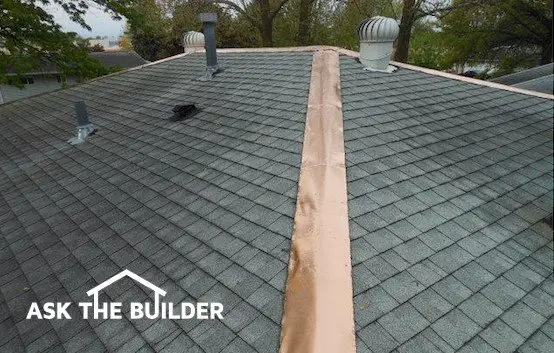
If you install copper strips like this on your ridge and hips the roof algae and moss will disappear if you get periodic rain.
How Does the Copper Work?
Each time it rains some copper ions wash down onto the roof and create a poisoned environment that both the moss and algae dislike. The ions are dislodged from the copper strip by ultraviolet light (UV). Five percent of the sun's UV light contains powerful photons that blast apart just about anything they hit.
Be patient as the copper eventually will turn a distinctive dark nut brown and then the classic green color. If you're getting ready to install a new asphalt shingle roof, you want to install this copper to extend the life of the shingles dramatically.
I was the first person in the world to discover that copper extends the life of asphalt shingles by DECADES. Look at this photo of definitive proof:
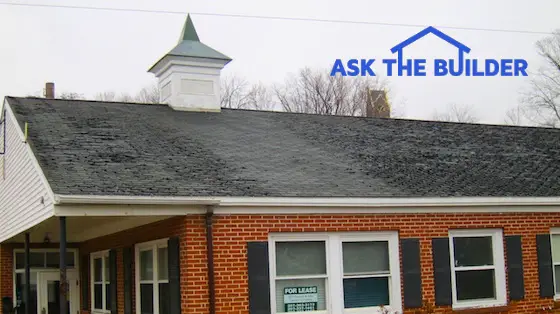
Look at how the 8-foot-wide strip of asphalt shingles look nearly perfect. The other shingles on either side have lost their granules and are curled as can be. The copper ions washing off the cupola roof STOP the oxidation of the asphalt. When asphalt oxidizes, the molecules cross link and become brittle.
I made this discovery while researching my Roofing Ripoff book. Based on the evidence I provide in the book, it appears some shingle manufacturers are pre-aging their shingles so they fail much sooner than they should. Copper will extend the useful life of asphalt shingles by decades.
This is the cover of my Roofing Ripoff book. CLICK THE IMAGE NOW TO ORDER IT.
Does Zinc Stop Moss and Algae Growth?
Zinc works as well to stop the growth of algae and moss, but it's not as effective as copper.
The copper material works far better to poison roofs than zinc. Zinc is indeed effective, but copper tends to do a better job for a longer period of time. The copper strips are easy to install and they tend to blend into the roof once the shiny copper begins to oxidize and turn the distinctive dark brown.
Should I Hire a Professional Roof Cleaner?
Yes, you should consider hiring a pro. Cleaning roofs can be dangerous work.
Remember what I said above about how algae that becomes wet is often as slippery as wet ice?
If you're going to try to do this yourself, work on dry parts of the roof and reach sideways to scrub and clean those parts of the roof that are wet with cleaning solutions. Once a roof is clean, they often are not too slippery if they are wet. Wear shoes that have excellent traction. Sitting and working on the roof instead of standing lowers your center of gravity and minimizes your chances of falling from the roof.
CLICK HERE to get FREE & FAST BIDS from local roof-cleaning companies.
Will Copper Pennies Stop Algae and Moss Growth?
No, copper pennies will not work to stop algae and moss growth. You need to put many many pennies on to get enough copper to wash onto the shingles.
I get email all the time from readers of my column and visitors to my website. Here's one from Lee:
Dear Tim,
Instead of putting copper or zinc strips on a roof to inhibit moss growth, wouldn't it be cheaper to use pennies? Use two or three per linear foot, slipped under the edge of shingles near the top or the roof, or stuck in place with a dab of silicone caulk. It's more time consuming, but easier for someone who doesn't have the cutting or bending tools. - Lee R., Portland, OR
Dear Lee,
Copper pennies would work so long as you install *enough* pennies. You need to have the square inch area similar to the exposed copper strip. However, realize that modern pennies have a small amount of copper in them. Before 1982, all pennies, except during WW II when they were made of steel, had a 95 percent copper content and 5 percent zinc. After 1982 the ratio became 97.5 percent zinc and 2.5 percent copper . The thin copper coating will wear off in no time up on the roof and zinc doesn't provide as much protection as copper.
It's better to put on a thin strip of copper. Make sure you have at least 6 inches exposed for every 25 feet of roof below the copper.
Click here to purchase copper roof strips for your roof.
Tim
| Message from Tim:
Years ago while researching a column about cleaning decks, I discovered the wonders of Oxygen Bleach. It is perhaps the 'greenest' cleaner I know of as it uses oxygen ions to break apart stains, dirt and odor molecules. There are no harsh chemicals, and it works on just about anything that is water washable. I decided to create my own special blend using ingredients made in the USA. In fact, the raw materials in the active ingredient are food-grade quality registered with the FDA. I call my product Stain Solver. I urge you to use it to help with cleaning your roof moss and algae. You will be amazed at the results! |
CLICK HERE to get FREE & FAST BIDS from local roof-cleaning companies.
Column 539

Tim built custom homes and did ultra-custom remodeling for 20+ years before launching his Ask the Builder media presence. He was selected as one of the Big 50 by Remodeling magazine in 1993. This award gave birth to Ask the Builder in October 1993. Tim also operates https://DrawPlumbingPlans.com. His @askthebuilder YouTube channel was the first home improvement channel on YouTube.

Could you tell me if any of the fungacide or bleach products used to remove moss from a tiled roof are harmful to animals once the moss has fallen to the ground?
Carolyn,
You need my Stain Solver!!! It's a fantastic oxygen bleach that gets rid of algae that's left behind after you scrub the moss off the roof. Stain Solver will not harm your plants or any animals.
Hi.
I have black algae forming on my east roof and as I have A light tan roof I would like it gone.
I have not found copper strip for sale in my area but zink strip is pushed by many sales outlets. I do not care to use zink as I understand it does not work as well as copper.
My father was an electrician for over 30 years before his retirement and upon his death I cleaned out his sheds and found several rolls of copper ground wire.I was wondering if I could use this wire instead of the copper strip? I thought 2 or 3 wires could be attached to the roof using copper plumbing straps or would this plan be A waste of time?
I would have to hire this job out as I am in my 60's and I am unable to get on roof's anymore and I would hate to waste my money doing this job twice.
Thanks for your time.
G.R. Ronan
Gary, you need to schedule a 15-Minute call with me.
Do you know if a solution of water and lemon juice would hurt/bleach the shingles? I would think the acid would help prevent more growth (and friendlier on my sewers)
Glenn, you should consider investing in a 15-Minute Consult with me. Look at my cart for that. Lot's to discuss. I just do short pithy answers here.
To clean algae off a roof, how much Stain Solver is needed?
Say moderate stains for a roof 32' x 24'
3/4 cup of Stain Solver per gallon of water. Always always go to the http://www.StainSolver.com website and look at the Use Instructions there.
Forgot to mention, I've enjoyed your specifications for new house construction that I bought a while back, it's helped with our design of the house. I'm a detail-oriented person, so I appreciate your effort to include the nitty gritty.
will the poison solution runoff created by the copper strips used for moss control damage aluminum gutters?
No. Not at all.
I have a roof covered in green moss,wil stain solver remove and or kill in short period of time?
Stain Solver WILL help you make the roof look like new. You will need to scrub the roof. To keep the roof FREE of algae, you need to install some copper strips along the ridge line of the roof.
Wonder if your stain solver would help remove black stains on an EIFS acrylic wall surface? Bleach does NOT work.
Scott, well it depends on what the black stains are! Do you have a clue? You can buy a small sample size of Stain Solver and try. At this point you have NOTHING TO LOSE.
We have a 5-year-old high-end GAF roof. It's blue. On the north side, a downspout from the top gable drains onto a lower gable, and there's black visible there, which I'm assuming is mold. Since that's the only place it's appearing, I was wondering if I couldn't put a copper strip in the mouth of that downspout, rather than at the ridge. Shouldn't this work? Any downside if it doesn't?
I have a cottage in Northern Wi near the UP of Michigan. I was informed by my roofer, the supplier and the manufacturer that I do not need to apply zinc strips to the new roof that I am installing. I am using a Landmark Pro asphalt AR shingle that carries a 15 year Algae Resistant warranty.
I am told placing a zinc strip woul be redundant since there is zinc in the material. Can you please comment on the feasibility of putting zinc or copper strips on these particular shingles. What is the benefit of using copper over zinc? Is the higher cost for copper worth it? What is effective shelf life of zinc and what is effective shelf life to protect against algae for copper?
Am I better off waiting 5 - 10 years to put on the zinc and or copper strips since new shingles have zinc and come with a 1( year AR warranty?
Please respond ASAP as I need to inform contractor working on project.
Thank You.
I'm a roof repair tech and I am thinking about using Ajax Oxygen Bleach, since it seems to be the same thing, am I correct on this?
Well, you need to ask the Ajax people these questions:
Is Ajax CERTIFIED ORGANIC?
Do the raw materials used to make Ajax come from the USA or China?
How much active ingredient is in Ajax?
My Stain Solver oxygen bleach is Certified organic, the two ingredients are Made in the USA, and we have the most amount of active ingredient as allowed by law so we can ship via any method in the USA.
I was advised to use lead strip. What are your views on lead?
what is the best way to cover a cement roof after cleaning it with algae caused by rainwater. This is most probably in India
will the copper strips eventually kill the algae without any scrubbing? My roof is not that bad but does need to be treated. About how long for the copper to work? thanks, douglas
Yes they will. It all depends on the amount of sun and rain that hits the copper. The more of each the algae will disappear faster.
How fast? As Kenny Chesney says in his hit song, "Only time will tell, but it ain't talkin'."
As any mountaineer can tell you, do not lean into the roof. You want to be as perpendicular to the roof as practical and generally that vertical, straight up.
Zepe,
If you stand perpendicular to the roof that means the axis of your body is at a 90-degree angle to the surface of the roof.
No one I know of can do that. When you stand straight up as you say, the axis of your body creates an acute angle with the surface of the roof. That's what I was talking about doing.
When you say stand straight up, you're creating this acute angle. Time for you to go back and look at your high school geometry books.
Some interesting ideas for removing moss and algae off roofs. It is always best to use environmentally friendly methods if at all possible.
Looking forward to your newsletter!
Love your newsletter!! Can you nail the copper strips on top of the ridge vent? Do you need to seal the copper nails with tar so they don't leak?
I have zinc strips on my cottage roof, and they prevented growth of moss for several years but moss is now growing. The roof is too steep to crawl on, but I could straddle the top if there is a way to re-activate the zinc (I understand it oxidizes, so is there a way to de-oxidize it)? Alternately, I could spray the edges of the shingles with a sprayer, but I can only reach the bottom five feet with a scrub brush.
Copper is so much more effective than zinc. If zinc were the BEST biocide, shipbuilders of old would have nailed sheets of it to the clipper ships and Old Ironsides instead of copper.
Go get the copper here:
http://shop.askthebuilder.com/copper-roof-strips/
If I had known that, I would have asked the roofer to use copper, but it's already installed.
I'm wondering if I could sand the oxidation off of the zinc.
I am in California and have a clay tile roof with green algae or moss. I can not scrub the roof because the roof cannot be walked on. I need a product I can spray on, not have to scrub, and for it not to be toxic to landscaping or pets... any suggestions?
You can try my Stain Solver. But understand that for ANYTHING to get really clean, there must be mechanical agitation. Clothes rub against each other in a washing machine, you rub your skin in the shower, fine pumic and water blasts against dishes in a dishwasher, etc. For you to expect amazing results just spraying something on is unrealistic.
Go to: https://www.stainsolver.com
I live in Canada. In our journal, they talked about copper roof ridge roll on top of roof against algae. They say that's effective but it will ruin the gutters. One of your readers ask you the same question, but is it safe for all sorts of gutters. Thank you. I will certainly order your Stain solver and surely the copper roof ridge if you say it's OK for all sorts of gutters. Thank you so much