Low Shower Head Water Pressure
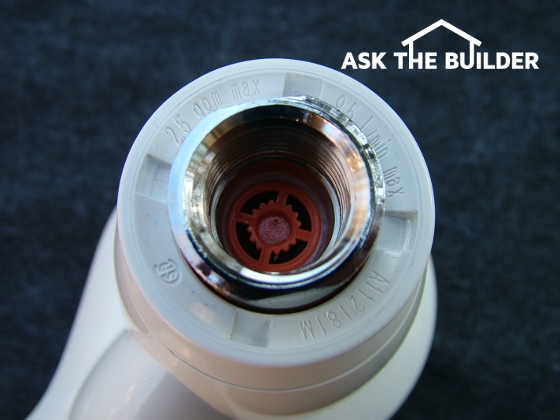
Low water pressure in shower head: See that orange disc with the slits in it? That's blocking water flow. It has small holes that can readily clog with sediment. When this happens, the water flow can be reduced to a trickle. Copyright 2018 Tim Carter
"If the shower head worked fine and the flow became reduced over time, pieces of sediment or debris from the city water system or your well could have clogged the restrictor."
Low Water Pressure in Shower TIPS
- Debris clogs flow restrictor in the shower head
- Remove flow restrictor and clean
- People with own water source don't need flow restrictors
- Unequal water flow in shower head points to the clogged valve cartridge
- CLICK HERE to Get Tim's FREE & FUNNY Newsletter!
DEAR TIM: I have a low water pressure shower head. The flow of water that comes from my shower is miserable. It's so weak it takes forever to wash my hair.
The water flow out of the tub spout is fine as is the flow at the bathroom sink. I've been told there is a flow restrictor in the shower head that's the culprit.
Can I remove it or modify it so I can take a reasonable shower? Is there another possible problem? Pamela F., Lakeland, FL
Related Links
Low Water Pressure in Faucets - Easy to Fix
Low Water Pressure in My Entire House - Help!
DEAR PAMELA: If there is not a flow restrictor in the shower head itself, there may be one in the body of the shower faucet.
Does a Flow Restrictor Cause a Low Pressure Shower Head?
Yes, a flow restrictor is the most common root cause of low water pressure in a shower.
A small disc in the shower head blocks the full flow of water from the shower faucet. There are strict laws in place that force manufacturers to limit the amount of water that a faucet and/or showerhead can deliver in a given amount of time.
I don't feel these laws should affect everyone.
Here's why. For starters, I'm a college-trained geologist and studied hydrogeology - the study of groundwater.
I live in a rural area and get my water from a well. I'm also on a septic system. For each gallon of water, I extract from my well another equal gallon of water goes back into the soil via my septic system.
But if you live in a city or area that gets its water from reservoirs that may not be filled every wet season, then it might be a good law for you in that it helps to conserve precious natural resources.
Free & Fast Bids
How Can I Save Water Without a Flow Restrictor?
Even if you do live in an area where you don't have abundant fresh water like I do, you can simply take a US Navy shower in that you only have the water on to get wet and rinse off. As you clean your body with soap and shampoo, leave the water OFF to save water.
But most people are LAZY and won't do this simple thing to conserve water.
How Fast Can I Fix My Low Pressure Shower Head?
It's possible that within 30 minutes you can make this shower head perform like a champion.
I'm quite certain that with a little work the shower head will perform as designed and give you the desired strong stream of water you deserve and so desperately desire.
What Causes Low Water Pressure in a Shower?
Small pieces of solder, copper shavings, wood dust, wood chips, globs of soldering flux, pieces of plastic, etc. can get into the water lines when they're installed by plumbers. This small debris clogs the flow restrictors and spray outlets on the shower head.
If this is a new home and the problem has been a chronic one since the day you moved in, there's a good chance the problem can be traced to a workmanship error.
Small sediment from rural water wells, city water mains, and your own plumbing pipes can clog the small holes in the flow restrictors.
Who Should Flush Lines BEFORE Connecting Shower Heads?
It's the responsibility of the plumber to flush out the water supply lines before any shower heads are installed.
Flushing the water lines can happen at most fixtures just after the water shut-off valves have been installed but before the flexible supply lines have been connected from these valves to the faucets or fixtures.
But the shower and tub valves are just a little more challenging. These valves are almost always installed before the interior of the house is finished and often before the water service from the street or pump has been connected to the interior plumbing lines.
How Do You Flush a Water Line?
You just need to have a few empty buckets, a wrench, and ten minutes to flush a water line.
The plumber just needs to have a helper to turn on and off the main water supply valve as he has the shower valve cartridge removed. This allows the water supply pipes to be flushed so the valve cartridge doesn't get clogged.
He then attaches an extended nipple or the actual shower arm to the threaded lug inside the wall where the shower water comes from. He leaves the shower head OFF the end of the shower arm.
When water is then turned on through the valve, any debris in the riser pipe is flushed out. The shower head can be installed once the water runs clear.
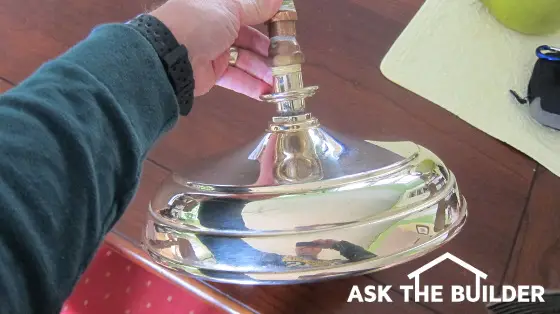
An expensive decorative rain-head shower head can get clogged to. (C) Copyright 2018 Tim Carter
What Flushes the Water Line?
The rapid flow of water carries a mixture of water and debris into the shower head. This large volume of fresh water flushes the water line and puts the debris into the buckets. The extremely small holes in the flow restrictor can become clogged or partially clogged in an instant.
Can City Water Mains Cause Low Water Pressure in a Shower?
Pieces of sediment or debris from the city water system or your well can cause low water pressure in a shower.
This is a very common occurrence, especially if you live in an area with older city water mains. If a city water main is serviced, pieces of sediment are often dislodged in the main water main as the water flows through the giant mains toward your house.
How Do You Check For Flow Restrictor Clogs?
Remove the shower head from the angled pipe that projects out from the wall to check the flow restrictor for clogs. Once the shower head is off, turn on the shower faucet to see if you get a respectable amount of water flowing from the one-half inch diameter pipe that connected to the shower head.
If lots of water comes out of the bent shower arm pipe, the problem must be in the shower head.
Where is the Shower Head Flow Restrictor?
The shower head flow restrictor is at the base of the female threads where you connect it to the water line. Look inside the end of the shower head where the water line connected to it. You should be able to see a small plastic disk.
Use a very thin pointed piece of metal to get a purchase under one edge of the disk. Try to pry the disk out of the shower head.
Work slowly and pay attention to which side of the small disk faces out towards the water supply pipe. When you go to reinstall the disk, it must be installed the same way it was at the factory.
How Do you Unclog a Shower Head Flow Restrictor?
Use a small straight pin or another object to clean out the small holes in a showerhead flow restrictor.
Use plenty of fresh water to help rinse away any debris. Place the disk near a bright light so you can ensure each of the holes is perfectly clean.
Be sure you rinse the shower head at the same time to ensure no debris made it past the flow restrictor.
How Do You Dissolve Hard Water Deposits?
Allow the shower head soak in some warm white vinegar for twenty-four hours to remove hard water deposits. The vinegar will often remove or soften the hard water deposits.
After soaking, use a toothbrush to remove any residual deposits and rinse with clear water. Install the small plastic flow restrictor disk and reattach the shower head to the water pipe.
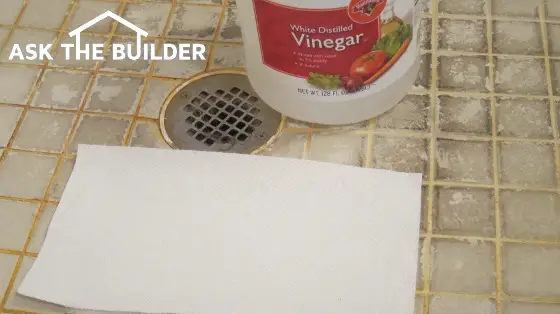
White vinegar will dissolve hard water deposits from showerheads and tile! © 2018 Tim Carter Builder
Should I Buy A New Shower Head?
You may have to buy a new shower head. Not all showerheads are designed the same and after removing one from the water supply pipe at the wall you may not see a plastic disk. If this happens and the flow of water from the supply pipe is adequate, just go buy a new shower head.
Shower heads are readily accessible and they are a common replacement part. In fact, you may find one that produces a better stream of water than what you had before.
Remember to use pipe thread compound on the water supply pipe that connects to the shower head. This prevents leaks where the shower head connects to the water supply pipe.
What Does Unequal Pressure at the Shower Head Mean?
Unequal pressure between hot and cold water at the showerhead means the clog is in the valve, not the shower head.
If your shower water delivers great pressure when you have the valve handle turned to all hot or all cold and then you turn it the other way and the volume decreases, this tells you the issue is in the VALVE.
One of the small ports or openings in the valve is clogged with a piece of sediment that's blocking the flow of the hot or cold water.
Clean out the cartridge or install a new one to get full flow again.
Companion Articles: Low Water Pressure in Faucets, Tub Faucets

Tim built custom homes and did ultra-custom remodeling for 20+ years before launching his Ask the Builder media presence. He was selected as one of the Big 50 by Remodeling magazine in 1993. This award gave birth to Ask the Builder in October 1993. Tim also operates https://DrawPlumbingPlans.com. His @askthebuilder YouTube channel was the first home improvement channel on YouTube.

I had my bathroom remodeled. I now have a handheld shower head and a fixed shower head in the same shower. The pressure in the handheld shower head is fine but the fixed shower head's water pressure is low. I am not happy. Did the contractor do something wrong? Can the problem be fixed? Prior to having my bathroom remodeled the water pressure in the shower was fine.
Victoria,
You're here at the right place at this column. Just read it again and follow the advice. I'm sure you have to take apart the shower head.
Installing a new bath faucet (Pfister one handle,same as I already had) made shower lose terrible pressure, which was fine before. I removed shower head, soaked it and the filter in vinegar for 3 hrs.,scrubbed it with brush and it's still the same. Restrictor was removed when I first bought it and shower was fine until now.
I'm at my wits end, because I love my showers.
Plumber did flush the pipe before replacing shower head, so that's ruled out.
Help. Thank you.
Hi Tim, the water pressure is low in our shower head and tub but the rest of the house is fine. Also, the problem is only intermittent. We took apart th shower head and cleaned it. But no change. It happens once or twice a day and no other appliances are on at these times. Any ideas?
What about installing a new cartridge in the valve? Maybe you have sediment that's blocking water flow inside the valve. What's the water flow like when you have the shower head off and just the neck arm there?
Just get rid of all the flow restrictors, they are annoying full stop.
My shower has good pressurensometimes and sometimes not, I can turn it on and off back and forth and itnwill be strong, I recently changed the diverter valve, the water pressure out the spout in the tube is great and probably more than it should be. Any ideas on what the problem might be?
All of a sudden the water pressure for the hot water is extremely low to the point that it trickles in all faucets including the shower. The cold water is fine. What do we do?
There is a blockage in the cold water side of the cartridge. Clean it out.
Hi Tim,
I'm having water pressure issues in both the bath faucet and the shower head, though pressure in the adjacent sink and elsewhere in the house is fine. I'm thinking mineral build up, as my hot water tank also makes a weird vibratey/rattle noise like a drill sometimes. Any suggestions or advice?
Hi Tim, after changing diverter valve in compression style tub to shower my shower head water pressure is only fair. Water pressure to tub spout is fine. Any ideas? Thanks
Hi Tim,
Our shower in our guest house has terrible water pressure. We bought the house last year & it is a new build. I changed the shower head. We also had a plumber replace the regulator but it is still terrible. The other faucets seem fine. Any advice?
Thank you so much!!! Took 15 seconds and has made a massive difference!
First stepp worked fine for me cheers
I have barely a trickle of water from my shower pipe neck. I already removed the shower head and even made the mistake of taking off the faucet handle with the faucet on. Plenty of pressure there, Also no other fixtures-2 sinks and 1 tub are having any low flow problems. Any ideas??
If/then assumes that the showerhead is the culprit. What if it's not?
Here's the scenario. We installed and ran new line direct from the water source to the newly installed shower stall. Brand new valve-set (simple 2-knob set from Lowes). Brand new basic showerhead.
Terrible flow.
Take off the showerhead, still terrible flow.
Disconnect source from the valve-set, AWESOME flow, pointed at a 5-gal bucket, it flows so fast it splashes out of the 5-gallon bucket.
The sink right next to the shower flows so hard it's like the above bucket...it splashes out of the sink.
Thoughts?
Thanks!
Are you in America? I don't know what a valve-set is, but am having same shower problems (onset about two weeks ago) as you. We have instantaneous hot water heater too, so what trickle is coming out is freezing cold. When I take off the shower head, the cold water pressure is fine, but hot water pitiful. We're in a rental in Australia that owner won't fix, and winter is coming on.
My shower is fine when cold... ...but after about 3 mins the flow becomes much weaker. What could the cause be?
Hello,
I have the same problem with low water pressure, but when I went to remove the shower head it looks like there is some caulking on the threading. Is it still ok to remove the shower head? Thank you.
V/R,
Danelle
You were spot on, sediment from the line had clogged the flow restrictor screen in the shower pipe and once removed and cleaned, the water pressure not only returned but was better than before. Thanks so much for the help!!!
Hi good info and I love the quiz, keep me on your list Thanks Gerald Feist Rock Creek BC.ca
Thank you so very much for this information. I have looked at several different sites and got the same unhelpful info until this one, this was exactly the problem and now I have great water pressure. Thank you again
Hello my water pressure is not good to the shower head fine for a bath but when I turn the knob to focus the water on the shower head it only stops half the water flow and the bathtub and makes for a really bad water pressure in the shower how can I fix it what could it be
I had low hot water pressure in guest bath/shower, so I moved to the master bath. Then the guest bath started working but the master bath lost hot water pressure. Sinks are okay. I spent $500 for the plumber to replace value and faucet in master and rerouted water line through the ceiling. That works, but now the guest bath has low hot water again. Plumber doesn't know what happened. Help!
Did you do all I say to do in the column above????? I'm a master plumber. The issue, I'm 98% sure, is sediment dislodged during all the work. I do phone consulting to walk you through the process:
http://shop.askthebuilder.com/products/15-Minute-Phone-Conversation-with-Tim.html
Hi there. We had good (not the best but still good) hot water pressure in the shower up until the last 3 weeks. It is now down to a dribble if that!
The cold works fine, its just the hot.
Any suggestions? ??
Thanks.
Justin,
I just REVISED the column to answer your question! Your possibility was overlooked when I wrote the original column.
Go back up and re-read the column and you'll soon have GREAT water pressure both hot and cold!
I have 3 bathrooms all with Moen single lever tub and shower combinations. In one of the shower s the water runs very slow. in both the tub and shower. I took out the cartridge and turned the water back on and had good pressure and water volume with no cartridge. I put in a new cartridge and it still runs slow. No improvement from tub spout or shower.
What do I do next
Easy. Re-read the above column. Do all I say in the column. You've skipped a step!!!
Thank you very much. Small piece of plastic stuck in the flow restrictor. Easy fix once you know where to look.
Hi there, we've just had a new bathroom put in downstairs. The water pressure used to be fine all around the house, including the shower, but the shower was so weak, as were the taps in the sink upstairs. The contractor said it was just because of the gravity-fed system and we needed a pump (another £100). This is now installed and is very loud, incredibly annoying and we are unhappy with it as a solution. How can we go from good pressure to such bad pressure? Is there anything I should be saying to advising the contractor? I feel he may not know the answers!!! He is a friend, which makes it more of a tricky situation.
In reply #6, I think you meant the hot side of the cartridge.
Gloria's description is also a bit foggy. When she stated "all faucets", did she mean just in the shower/tub or also the sink in the bathroom.
If the latter, it is not a problem in the shower/tub.
I read your article and my hand held shower head has low pressure that gets worse by the day however, when you first start the water, a big blast of pressure comes out and then we have the low pressure. Changed the cartridge but it didn't change. Any ideas?
Yes. Soak the head of the hand-held unit in hot white vinegar for hours.
If you still have issues, this is an option:
http://shop.askthebuilder.com/products/15-Minute-Phone-Conversation-with-Tim.html
hi tim,
there is water in all of the sinks and toilets in the house but the two showers are not working at all.. we've recently went through a polar vortex in the midwest that dropped temps to -20 and beyond. its still odd to me that i have running water everywhere else but the shower heads...any suggestions?
Not surprising. Cold air is dropping into the wall around the space between the vent pipe and the top wall plate.
No solution other than to wait for the temperatures to rise. If you have access to the top plate from the attic, you may be able to caulk it in the spring.
Thanks Tim, following your excellent advice I have solved my shower temperature and flow problems. Goodbye flow restrictor and hello shower bliss! (no water restrictions in Tasmania)
Hi Tim. I've lost water pressure in shower. I have pressure in rest of home. I decided to check outside garden hose and lost pressure there as well. Had umber come out he checked shower and under house at pipes. Says I had a little leak around where the valves where behind shower plate is but not enough to cause shower to have water pressure is low. He said as long as he had been a plumber in many years he had been stumped that he had to get back to me. So my question to Tim is what could all of a sudden cause low water pressure and also my hot water only lasts 8minutes now. Could my hot water tank have any correlation?? Thank you!
Highpressureshowerheads.com
I went through 3 different shower heads from major manufacturers, before stumbling onto this company. Solid brass in several different styles. I initially removed the flow restrictor, but had to reinstall, because the needle-like spray was uncomfortable to my wife. No fancy multispray options, just a great old fashioned shower.
I tried all the fancy new shower heads from several of the premier brands, but ended up with a piddling shower, no matter what I did. Then I found the company highpressureshowerheads.com
I got a no-frills all brass shower head that I had to install the flow restrictor, because the spray hurt my wife's skin when used without it.
Thank you for this timely article.