Sewer Gas Smell – There are Many Sources
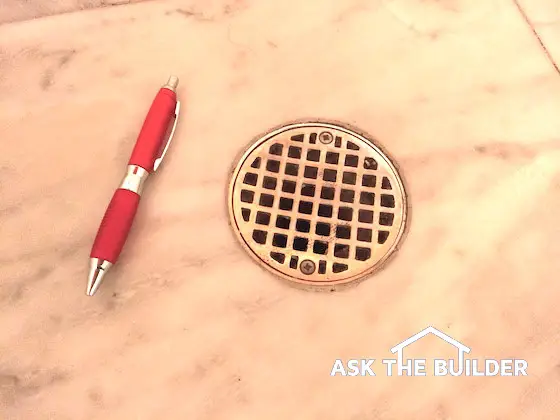
Sewer gas smell often comes from a floor drain like this one. Sewer gas smell can also come from a rooftop vent pipe and I show HOW TO SOLVE the problem on this page. This is a floor drain inside a Men's Room at a hotel. Under the metal grate is a water seal you can't see. Water evaporates allowing the gas to enter the room. Custodians and cleaning personnel need to pour a gallon of water into floor drains like this at least once a week. Copyright 2018 Tim Carter
Sewer gas smell is caused by invisible gas that enters your home from your plumbing pipes. The most common source is dry floor drains. The second-most common source is a bad wax seal under a toilet.
Sewer Gas Smell Tips
- Source of the odor is usually where it's strongest
- What happened just before you started smelling the odor?
- Did you get a new washing machine or have a drain cleaned?
- Does something happen just before you smell the odor?
- CLICK HERE to Get Tim's FREE & FUNNY Newsletter!
DEAR TIM: My daughter's house has a chronic sewer gas smell problem. The odor is strong when it rains and the furnace or air conditioner is operating.
The odor gets so bad my daughter and her family evacuate the house. Three plumbers have not been able to solve the problem and we have checked all plumbing fixture traps, caulked where the basement floor meets the foundation, etc.
My daughter is ready to sell the house for a loss. Can you help? Dave S., Shelby Township., MI
DEAR DAVE: Sewer gas can be a vexing problem to solve, but it is by no means impossible. As much as I hate to say it, the three plumbers that were consulted are either inexperienced or they do not keep up with technology.
The good news is I doubt your daughter has to move and take a loss. It is my guess the source of the odor can be found and repaired for less than what a moving company would charge just to move your daughter and her family.

Before you read more of my answer, I can SOLVE your sewer gas problem on the phone in less than 15 minutes. I've been a master plumber since age 29 and have solved hundreds and hundreds of sewer gas problems.

I've helped HUNDREDS of suffering homeowners just like you and the odor goes away in hours.
CLICK or TAP HERE to order a phone consult from me now.
Tim Carter, Master Plumber and Founder of AsktheBuilder.com
Free & Fast Bids
CLICK HERE to get FREE & FAST BIDS from local plumbers to stop sewer gas.
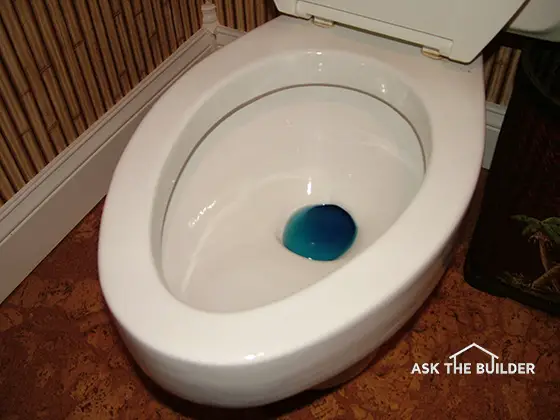
Sewer gas smell can enter a room if the water level in a toilet bowl drops this low. Always keep the toilet bowl filled with water to its normal level. Read Sewer Gas Smell in the January 4, 2011 Newsletter. © 2017 Tim Carter
What Causes Sewer Gas?
Sewer gas is created by the decomposition of waste materials that are found in public and private sewer systems and private septic systems. The characteristic odor can be overpowering and it is toxic. To add further insult to injury, the gas is explosive as it often has a methane component.
Are Plumbing Pipes Designed to Prevent Smell?
Plumbing drainage systems are designed to keep this sewer gas inside the pipes and any that does exit to the atmosphere happens outside the home through the vent pipes that poke up through the roofs of houses.
Are Roof Vent Pipes Sewer Gas Exhaust Pipes?
No. Vent pipes on the roof are intake vents, not exhaust vents as most people believe.
When a large volume of water enters a plumbing drain pipe it pushes air in front of it towards the sewer or septic tank. This air must be replaced and it is sucked into the plumbing system through the roof vents.
Can a Dry Trap Cause Sewer Gas Smell?
Yes, a p trap under a fixture that has dried out and lost its water seal will cause sewer gas to enter your home.
The source of the sewer gas can be plumbing fixtures whose traps have gone dry or have lost enough water that the water seal within the trap has broken.
How Fast Can Water Evaporate From A Trap?
Water can evaporate very fast from a trap depending on the temperature and humidity in the house. In the arid Southwest, a trap could dry out in less than a week.
You'd be surprised to discover that water can rapidly evaporate from toilets and the traps below tubs, floor drains and just about any fixture within a few weeks or months in most cases. In fact, when my daughter is away at college I have to flush the toilet in her bathroom every three weeks to keep the bowl filled with water.
If I don't keep the toilet seat down, I have to flush the toilet weekly as some household pets seem to love to drink water from clean toilet bowls.
Is the Wax Gasket Under Toilets a Source of Sewer Gas Smell?
A common source of sewer gas smell is a failed wax gasket seal under a toilet. The wax gasket, when installed correctly, forms both a water and gas-tight seal between the toilet and the plumbing drainpipe system.
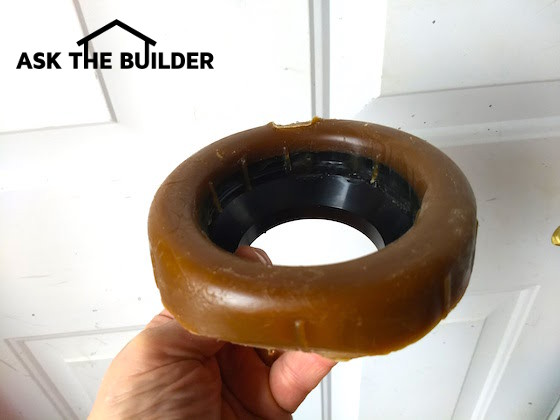
Sewer gas smell can leak into your home if this wax gasket has detached from the underside of your toilet. Copyright 2018 Tim Carter
A toilet that rocks back and forth as you sit on it is a clue the sewer gas is leaking past a failed wax gasket. Toilets should never move and should have tile grout between them and the floor. Caulk is an inferior sealant because it's flexible.
Can Cracks in Pipes Cause Sewer Gas Odor?
Cracks in either plumbing drain lines or vents pipes are the other source of sewer gas leaks. If the crack is in a drain line, you often see an associated water leak.
But vent pipe cracks are far more elusive. They can leak vast amounts of sewer gas and you might not be able to locate the source easily without a special machine.
Can an AC Drain Pipe Cause Sewer Gas Smell?
Yes, an AC condensate drain pipe can create a foul sewer gas smell. A rancid biofilm can form on the inside of the pipe.
The furnace and air conditioner clue tell me the leak might be in a vent pipe that is close to a return air duct. The leaking sewer gas is being sucked into the return air system and then broadcast throughout the entire house by the air handler in the furnace.
STOP!
Before you read more of my answer, understand now I can SOLVE your sewer gas problem on the phone in less than 15 minutes.
I've helped HUNDREDS of suffering homeowners just like you and the odor goes away in hours.
CLICK HERE to order a phone consult from me now.
Tim Carter, Master Plumber and Founder of AsktheBuilder.com
Can a Smoke Test Find the Sewer Gas Leak?
Yes, sewer gas leaks can be quickly discovered by a plumber who owns a very cool machine that generates artificial smoke. The smoke is simply visual and does not create a lasting odor nor does it stain any surfaces in a house.
The plumber connects the smoke generation machine to the plumbing drain system and then blocks off the drain pipe leading to the sewer and caps off all roof vent pipes.
Once the smoke machine starts, it begins to slightly pressurize the plumbing system. If there is a cracked pipe or a fitting joint that is loose, the smoke readily exits at that point before it would bubble up through a fixture trap filled with water. Usually, the source of the sewer gas leak can be discovered in less than one hour.
CLICK HERE to get FREE & FAST BIDS from local plumbers to stop sewer gas.
Can Vent Pipe Clogs Cause Sewer Gas Smell?
Yes, sewer gas problems can also be caused by plumbing vent pipes that are clogged. This can happen in old homes where a cast iron vent pipe gets clogged by years of rust scale that falls off the inside of the pipe and clogs a 90-degree bend in the pipe.
Tennis balls, leaves, and all sorts of other debris can clog plumbing vent pipes. When a vent pipe is clogged, the replacement air needed by the system will get sucked into the pipes through a fixture inside the house.
When a large amount of water is placed into the drain pipes by a toilet or a powerful washing machine pump, it can readily suck the water out of a nearby bathtub trap or even a kitchen sink trap. Once this happens, sewer gas immediately enters the room through the dry fixture trap.
What Can Be Used to Slow Evaporation in a Trap?
Mineral oil can be used to slow evaporation in traps.
Fill them with water and then slowly pour four ounces of mineral oil into the fixture or floor drain. This mineral oil will evaporate far more slowly than water and the trap will remain wet for many months.
CLICK HERE to get FREE & FAST BIDS from local plumbers to stop sewer gas.
Author's Notes:
I received these emails after my column was printed.
"Tim:
In regard to the sewer odor problem in Shelby township Michigan: If they have a sump pump in the basement and have a french drain around the perimeter of the house, there could very easily be a broken sewer pipe right outside the basement wall. When it rains, tainted water gets in the drain, goes to the sump, odor is in basement, return air to the furnace distributes odor throughout house.
Enjoy your column in the Telegraph Herald."
Dave B., Dyersville
"Hi Tim:
My name is Gary Whiteman of Whiteman Land Service, Curtice, OH. We do pond construction and new home site development.
I read your article in the Toledo Blade, Dec. 18 and noticed that there was no mention of possible sewer gas from homes that have a leach field system. We have had many people complain of sewer gases from their basements. We have found that the cause was due to other contractors who did not remove previous farm drainage tile from under the leach field area and to the home foundation or basement.
Thus, the waste water travels through the farm tile under the leach bed to the drainage tile around the footer and into the sump crock inside the basement. To solve this would be to remove the farm tile between the leachfield and home.
Contractors excavating for the basement or foundation, and also the leach field, should remove these tiles at least twenty-five to thirty feet away from the home area. I hope this info will be helpful.
Regards,"
Gary
"Dear Tim,
We had a perplexing sewer gas odor in our home. After spending over $3,000 in fees with plumbers, locators and other experts, we still had no answer.
Finally a very knowledgeable plumber discovered an illegal connection in our drain system. The person who installed the condensate drain line from our air conditioner installed it without a vent line. Each time our washing machine would pump water into the drain system, the rush of water would siphon out the water in the small trap of the condensate line.
The sewer gas from the main sewer line would then travel up through the condensate line and into the actual air conditioning air handler. When the air conditioner would run, the moving air would suck vast amounts of sewer gas into the ducts and broadcast it through all of the air vents in our home.
Once the condensate line was disconnected from the drain line and piped directly outdoors, our sewer odor disappeared immediately."
Sandra Farmer, Paradise Valley, AZ
Column 599

Tim built custom homes and did ultra-custom remodeling for 20+ years before launching his Ask the Builder media presence. He was selected as one of the Big 50 by Remodeling magazine in 1993. This award gave birth to Ask the Builder in October 1993. Tim also operates https://DrawPlumbingPlans.com. His @askthebuilder YouTube channel was the first home improvement channel on YouTube.

Hi,
4 years ago we had a new septic field put in, the tank was not replaced, 3 business advised the tank was fine. We have noticed a terrible septic gas smell outside of our home. Water drains fine, no back ups and no smell inside the house, just outside. So who do I call? Do I call a plumber or septic company?
Thank you
Jamie
Jamie, did you ever resolve this situation? Sounds just like mine, only the whole system was replaced. The installing company just says to add more rid-x. The old system did not stink, but was condemned by the county. Nothing changed with the inside plumbing. thanks, I'm going crazy.
Charlene
I have read the problems about sewer gas and have a unique situation. We moved into a new home and when we leave the doors open to the back screened in porch we get what smells like a sewer gas odor in the house. there is a sewer pump station within about 50 yards behind the home but the is downwind of the house. I sit on the back porch frequently at different hours of the day and there never seems to be a smell outside. The smell is only inside after the doors have been opened for awhile. Research to date has been for naught.
Any suggestions would be appreciated
Richard,
Lots to discuss. This is why I have my 15-Minute Phone Call.
This may not be your problem, but my sunroom had a terrible sewer smell when I left the doors open. Seems as though pet urine was the problem. Even after it was cleaned, it remained in the grout. I have since covered the tile with linoleum and the problem is gone. You may check to see if the former owners had pets.
I just came across this while I was searching for an answer to the same exact problem. We recently had extensive plumbing work done due to a flood in the house and since we have moved back in are dealing with this. Ive had a couple of plumbers come by and they all seem to think I'm crazy and have not been able to help at all. I would love any advice you can give
An sewage odor occurs in the bathroom faucet after I flush the toilet. Can you tell me what the problem is?
Angela,
Clogged vent pipe or inferior plumbing installed.
To talk about it, consider my 15-Minute Phone Call.
I live in a Condo and called the association to report the sewer gas in by unit. All they did was to tell me to call a plumber. I am retaired and can not spend a lot of money on a plumber. It has been almost two weeks now and it effects my eyes.
What should I do? I live in Aurora, Colorado, at Foxdale.
Carolyn
Carolyn,
Talking with me for 15 minutes may be far cheaper than calling a plumber.
Hello;
I had a sewer smell in bath tub until I had trap replaced. now I have sewer smell in wall where vent pipes are located. The smell only comes when the temperature outside in 85 degrees or greater.
Bob, you need to schedule a 15-Minute call with me.
I have this same problem with a sewer smell in the master bathroom only when the temperature outside in 85 degrees or greater and the A/C is turned off. (It is not noticeable when A/C is on.) I have an unfinished basement with bathroom pipes exposed, and I put a pvc sealant on every visible pipe fitting and connector. Also checked the caps on the clean-out and it was tight. House was finished 11/19/07. While house was still under warranty, the builder had his foreman come by to check it, and they found nothing wrong. The master bath wall has never been finished (the builder dropped the ball and didn't tile it. Could the problem be a leak in a pipe inside the wall? They seem to have used a lot of scrap pipes on my house and there are connector fittings every 4' to 7' from basement floor to roofline.
Melissa is the problem in your house fixed now?
We have noticed a septic smell from our septic system had it pumped out still from time to time we would smell it outdoors, have added enzymes for the bacteria, still have the problem not all the time, found a place in the yard where the smell is on the ground but the ground is not soggy. The only drain we have an issue with is the washing machine will back up into the kitchen sink when it spins out, but it drains on down. Really need help on this.
Thank you
Dena
Dena, your question requires lots of typing, plus I have some questions for you so I can give you the correct answer(s). I only do pithy answers here in the comment section. If you want to protect the investment you have in your house and not waste time or money *hoping* you make the right decision, you should talk to me on the phone for just 15 minutes. It'll be the best investment you've ever made in your home!
When I run my washer, sewer gases come up from the bathroom, so I guess the traps are running dry? how easy and expensive is this fix?
Kim, your question requires lots of typing, plus I have some questions for you so I can give you the correct answer(s). I only do pithy answers here in the comment section. If you want to protect the investment you have in your house and not waste time or money *hoping* you make the right decision, you should talk to me on the phone for just 15 minutes. It'll be the best investment you've ever made in your home!
I am a new City Maintenance personnel. I have inherited a problem with one of our buildings that has a sewer gas smell ONLY when there is a northwest wind. It is a flat roof building that slopes from east to west, shares walls with two other buildings and it is actually shorter than both adjacent buildings by about 10 feet on the north side and about 30 feet on the side south. The sewer piping is new with no cracks. The vent pipe has a frost-free cap which is about 2 feet from the top of the roof. The closest shared wall to the pipe rises about 2 feet above the pipe about 8 foot away to the south.
David, your question requires lots of typing, plus I have some questions for you so I can give you the correct answer(s). I only do pithy answers here in the comment section. If you want to protect the investment you have in your house and not waste time or money *hoping* you make the right decision, you should talk to me on the phone for just 15 minutes. It'll be the best investment you've ever made in your home!
The toilet in the master bedroom appears to not have been flushed when we return home from work and has a strong odor. It looks as if the sewer is backing up but the plumber could not find any blockage. Any ideas?
Lynn, your question require lots of typing and I have some questions for you. You should consider investing in a 15-Minute Consult with me. Look at my cart for that. Lot's to discuss. I just do short pithy answers here.
I also have a sewer gas smell, have investigated the p-traps, poured bleach, it does seem to be when the blower kicks in on the furnace so I'm thinking it's the vent pipe. I also have arranged to have my septic tank pumped just in case that is too full and not working properly. Any other thoughts?
Traci, your question(s) require lots of typing and I have some questions for you. You should consider investing in a 15-Minute Consult with me. Look at my cart for that. Lot's to discuss. I just do short pithy answers here.
Our home is built on a slab. We are experiencing heavy sewer gas odors. We have had two plumbers check it. The first one replaced a drain the second one repaired a toilet seal. The odor is still very bad . It is worse in cold weather. What else do you recommend ?
Linda, you need to do a 15-Minute Consult with me. Look at my cart for that. Lot's to discuss. I just do short pithy answers here.
My problem is sewer gas outside my home. We have city hookup. My general contractor did his own plumbing? Anyway when it was time to hook up to the city sewer line he discovered that one of the supports for my deck was directly in the way. Instead of a nice straight outlet from our house it's crooked and I'm thinking that it does not drain our home correctly. I think that this creates an usually strong oder from a slow moving system. So I think a lot of gas is coming of the roof? Any comments.
David, I have questions. This is really a consult that can't be done with a two-sentence reply. You can talk with me for 15 minutes.
Hello,
My family and I live in a 1949 Cape Cod style home that has a horrible sewer gas issue. Not every time but when you flush our toilet upstairs the sink and tub gurgle and then put out sewer gas smells. We have had a local company come to our home. They checked all the traps in tub, sinks, basement, and also checked the roof vent and outside municipal tank. The cleaned the traps and checked the flow into the tank outside. They were at a loss to what was exactly the problem. The man told me it could be that the house isn't properly vented or that the older pipes could need to be replaced. We have no clue and I would like to have an idea of what it might be so we can try to remedy this.
Jennifer, Walter, this is what my 500-Second Consult is all about. Click the Shop icon at the top of the page!
We have a suspected sewer smell, however none of the P traps are dry. From the sink the waste pipe flows almost horizontal to the right and then vertically straight down through a spare room one floor underneath, then into the floor of the spare room and turning horizontal and exiting with the rest of the plumbing. We have had the waste pipe inspected with a camera and a smoke machine. There are no visible defects. There is no ventilation for this waste pipe. However each plumber who looked said that there should be a vent, but if it was a ventilation problem the smell should be coming from the sink upstairs through the trap. Is it possible for the smell to seep through the PVC pipe and into the room? This pipe is waterproof and the smoke machine found no leaks. It's a bit perplexing. The smell is only noticeable when the window and door are closed for more than 2 days.
I have been gettn a wif of rotten eggs in & around my home for 6mnths both me my neighbor have been complaining to my landlord since i moved in 6mnths ago he dint smell what i was talkn bout so hasnt taken it seriously...mean time over the past 6mnths ive gone 2the hospital & drs complaining of headaches dizzyness neuseu & major fatigue without any help frm them cuz every1 wrote it off as my disability so i thot mayb i was losing it....but i was gone 1day for a long time & came home & my house smelt worse not rotten eggs this time like human increments i called over my neighors & we sniffed tell we located the source its a pipe in my food pantry thats suppose 2go up 2my ceiling but its missing a whole piece of pipe so sewege gas has been leaking in my house for 6mnths im calling my landlord now & sure he'll fix it promptly but is this sumthn i should go see a dr for or is 1s fixed no longer somthn i have 2worry about im just concerned since ive been sick a long time
I had this problem in my new house - it ended up being because of my high speed Bosch washing machine. The spinner was set on 1200, and it dried out the nearby traps, letting up sewer gas, which was spread around the whole house when we had the furnace going. I was almost ready to move out, but after spending days doing research online, I reset the spinning down to 600-800. The smell was gone, and the clothes were spun just fine. Such a simple solution.
help I have a house that is now 4 years old when I bought it there was a terrible sewage smell everytime it rain I have tried filling all traps wth water and bleach with no difference it is a three level house with a grinder pump in the basement and the smell seems to be worst on the ground level floor my drain field is down hill of my house approximate 100 ft
Hi,
We are in an apartment and something is wrong with the central air conditioning unit or the sewer pipe that it drains into. Maitainance (sp) have been over to clean the drain pan, coils, and pipes that go into the sewer, but when the air conditioner has ran for a while and stops intermittently the smell starts. No smell really coming from the air ducts, just around the unit when it intermittently shuts off. It is hard to decipher where the smell is coming from, except maybe the drain pan, drain lines. The furnace does not smell in the winter, when the air conditioner is not running, so this seems to rule out a dry sewer trap. Actually, maitainence came over today and ran water down the sewer drain, it was better, but now the smell is back. Any suggestions?
What if the smell is coming out of the fawcett itself. About 2 years ago I had a rotten smell when I flushed my bedroom toliet. Not all the time, just enough to know when it stunk. Then it went away until about a month ago. Now it happens in my shower and bathroom sink. If I let it run for a couple of minutes it will happen until it "runs out" of stink. Then water is normal again. Is this the same as sewer gasses when it comes out of the spigots and shower heads? And what should I do?
we have a leech bed. the washer waste collects there. it is two 50 gallon drums with drilled holes. it has filled up over the four years. it smells when we wash. what can we do?
Dear Tim,
We recently demolished an upstairs bathroom. I now detect a sewer odor in only certain areas of our home (especially the adjoining room which has the return vents in it). The demo'd bathroom has no odor and toilet drain has a rag in it so we wouldn't have that problem. We are waiting for our contractor to begin the remodel, but in the meantime, how do we figure out where the odor is coming from? Is there a chance that a pipe was cracked during the removal of the tub? Thank you in advance for your help/advice.
I get a terrible sewer smell in my house when I do anything that requires running water such as the shower or washing machine. This only seems to be a problem when the temperature drops below 40 degrees. I have had the sewer tank pumped and the sump pump replaced but it still happens. HELP
Where do you live- can you come TX to help us?! We own a property that was built in the 40's and cannot seem to find the solution, we've been told by tenants that the former owner did a smoke test but never found anything- i brought in the people that did the smoke test and "he can't remember" we had a plumber we trust cap off any open lines, foam any open areas replace a broken toilet all in the properties basement. I get calls nonstop from tenants and although we want to help, no one seems to find the solution!
Hi, I have a brand new trailer on a gravel pad only. However someone did have a different trailer on this lot before. I get a horrible egg smell coming from the heat vents(in winter) and also from under the deck year round. From naked eye inspection, I have no busted pipes. I share a septic with other trailers in the park. I have a low water level in the toilets but otherwise no drainage issues. Please help!
After owning our home for 2 years we started smelling sewer gas in our bed room and our office the smell was very over whelming. All the these rooms are next too the second floor bathroom. I did a lot of reading and performed all the suggestions. I changed the toilets wax ring and all the drains had water. But after this the smell was still there. I took off the toilet bowl again and opened up the wall next to the toilet to take a look at the plumbing. The house is old but the plumbing was all up dated with PVC. I flushed the vent with a hose. The smell has decreased but we still catch wiffs of gas here and there. I was wondering if the piping under the sink was my culprit? It's not leaking water but can gas escape through poor seals?
Thanks
Michael
Michael,
It's tough to go back and forth here in the comments section in situations like this. Consider investing in a phone call so I can solve the problem.
We seem to have sewer gas in the whole middle level of our house. It does not really smell in the basement or upstairs. My bathroom had a strong sewer smell under the sink without a plumber my husband duct taped the fittings the smell is better but not gone and a vent pipe is located in the wall behind this sink. Also on the opposite side of the house quite some distance it also smells like sewer gas in our laundry room. I've been so ill since the gas smell. I called in sick for work for a week I didn't know these gases could get you sick.
Do you do house calls? We live near chicago,Ilinois
Yes, I do make house calls. It's pretty expensive to get me to come from New Hampshire. Click the SHOP icon at the top of the page and then look for the Consult Tim text link.
The sewer gas smell went away. We had a plumber check the pipes with smoke bombs and he said none came out anywhere. We also had our tank pumped out. Now after losing electric for 24 hours after a storm( we are all electric) first the basement was terrible with a strong sewer gas smell and now after the power came back on the sewer gas is smelling in the same places as it was before. We have our washing machine in the basement and it drain in our sumo pump. Can you think of any reading this is happening? Please help
By the way the smell now is gone from the basement. It's just in the middle section in our house. In certain areas you can smell the odor. The smell isn't in one side of the house it is separated quite a distance
Sewer gas smell when blower comes on for heat or AC .
Only smells in master bath and adjoining dressing area.
Had a couple of plumbers who could not find the problem.
Any suggestions?
This is a doublewide mobile home (2 years old) and I am on an aerated sewer system.
Type BIOFILM into my search engine here at AsktheBuilder.com. Assuming the plumbers VERIFIED your toilet gasket is fine, the odor could be coming from your sink and shower drain tailpieces.
Hi, hoping you can help. We bought a house in May and still can not move in due to a terrible smell in the master bedroom and bath. We have had the septic tank cleaned and the pipes are clear plus traps. But every time we run water in the bathroom this smell comes into the bedroom, the wall the smell is the worst there is no plumbing per the crawl space. So we are stumped please help!
cindy
Hi, appreciate your expertise and knowledge for plumming problem....washed a load of clothes (medium size), laundry room or kitchen sink no back up of water. But, the back to back bathroom tubs and toilets backed up and won't drain. I have plunshed but to no avail.
Nothing overflowed, but I have noticed water behind and around toilet and baseboards in the first bathroom. and water is much much lower in masterbath toilet and tub adjacent to first bath...being back to back i am assuming pipes are connected to each other and septic tank is in front yard. reading other answers...I'm thinking maybe something is clogged ...can you help?
You have a clog..... Hire a pro to clear it. BEFORE he leaves the house, have a helper TEST that the clog is gone. Have two five-gallon buckets of water in both bathrooms. At the SAME TIME pour as fast as you can both buckets of water into the toilet bowls. See what happens. If there is NO CLOG, the drain line will handle that much water without the toilets overflowing.
Hi Tim, we moved into a 30 year old home a couple months ago. We have since discovered all kinds of plumbing issues and have had most all the plumbing under the house replaced. What lead to the discovery of all the cracks and leaks was the horrible odor coming from the bathroom. After replacing all the pipes the odor started to go away. We are adding a bathroom at the other side of the house. They completed it this week and set the new toilet. When they opened the flap to set the new toilet, the odor came back. Even after setting the new toilet the odor is horrific and now it is back in the old bathroom where it started. Any ideas Tim?
My idea is that I'd want to know if the seal under both toilets IS really sealed......
I'm about to do a comprehensive video showing how critical the placement of the toilet flange is to the finished floor surface. There's VERY LITTLE margin of error.
What's more, if the toilet was NOT INSTALLED correctly as they were setting it, that can RUIN the seal. Setting a toilet is an art. It's not as easy as it looks on all those HGTV shows. I've been a master plumber for 35 years and know a thing or two about toilets.
We have this septic smell after rain and our plumber supposedly done this modern sewer with no vent to the roof, someone told me that there is a thing that you can put on the outside drain to prevent has from coming back in, pls help
I've decided to produce a product that will show you how to figure out where the odor is coming from and HOW to fix the problem. Sign up for my FREE newsletter to be alerted when this is complete.
I have subscribed to your newsletter but I have not seen this product. Have you produced it yet?
Mark,
Not yet. It's on my To Do list VERY NEAR the top. Open each issue of the newsletter. When it's complete, I'll announce it there. Thanks!
Hello wanted to ask my home was built in 1980 it has 4 vents on top that have been leaking for some time when it rains. I'm getting ready to place metal on my roof can the vents be routed to the open ridge cap or end gables to prevent possible leaking in years to come
Plumbing vent pipes can't be relocated to the inside of the attic. The leaks are probably from cracked rubber in the flashing. When the roof is redone, new flashing will be installed that will solve the leaks.
Can the sump pump odors make you sick? The basement I'm in has it 20 inches from my bed, only separation is a closet door.
The room smells everyday is like sewer gas/rotten odor
Been feeling sick since I'm sleeping here. Have headaches,nausea, dizziness...
They called a plumber and said he didn't smell gas but smell bad.
I guess he should bring a machine to detect different gases?
I feel like the guy didn't take it too seriously but I'm concerned as my health is been really bad since I'm here, I've been talking to some doctors but seems that they don't have an explanation.
Mary, YES! The odors can make you sick!!!!! Did you tell the doctors that you're breathing sewer gas?
Dear Tim.
We are miserable and need help. We purchased and moved into our home a year ago. Our home was a foreclosure that was renovated by a construction company, apparently without permits, and we have had numerous issues particularly with plumbing. We have spent almost $30,000 already on investigating our sewer gas leaks.
We initially had odors from 3 of our bathrooms. We found a leak in the vent in the master bath which was repaired. This room smells much better but still occasionally will have a mild odor and sometimes one of the sinks will smell like rotten eggs when the water starts running.
Our big problem though is in our children's bathroom. We often do not use this restroom at high capacity (though the shower is used 2-3 times a week and toilet almost daily), but whenever my family visits they stay in a connecting room and as usage increases the odor becomes horrendous. We have tried every possible investigation including cameras and gas detectors but the odor typically only occurs evening and middle of the night/early am so it is almost never present when plumber comes to the house.
We have so many holes in our walls and ceilings from the investigations but still no solution. Toilets have been reset and sealed, vent pipes have been cleaned, septic tanks drained, p-traps have water...please help as my daughter and son have developed chronic coughs and in general it is ruining our lives and our pocketbooks.
Alisa, I recommend you do just one last thing. You get me on the phone. Last week I helped an oral surgeon who lives in Defiance, Ohio solve his sewer gas problem. It only took me seven minutes. I've been a master plumber for 35 years. I know a thing or two about what causes sewer gas. Go ahead, schedule a phone consult with me. It comes with a FULL MONEY-BACK GUARANTEE.
We have an older mobile home that seems to give off a sewer-like smell. An old septic tank was removed from my lot this past summer...thinking the smell was coming from it and the pipe that was capped off underneath the home. Both of these items were removed. Now, (5 months later) the smell is back. The only correlation we have to go on is that one of our neighbors had a sewer back-up. The plumber removed the clog at the sewer clean out and his issue was resolved. This home is about three homes away and it is about 150 yards down the street.
The previous smell occurred mostly when it rained that is why the old, unused septic tank and pipe were removed. We thought that the rain filled the tank ever so slightly and this caused a smell going through the old connective pipe underneath the house. This seemed to help, but there have been periodic episodes since then and now (since my neighbor had his sewer back issue) it is back. Any one have an idea that might help me?
Thank you,
Dan
We have a pipe that seems to have the cap broken off to contain the sewer smell. It looks to be sawed off for some reason?
Do you just get someone to put a cap over the open pipe that occasional sends smells into our house.
We were smelling things that were not right and then I noticed the pipe opening is exposed and not capped. My gut says cap the pipe but would appreciate anyone's point of view here. And if the pipe has been sawed off is there a universal cap that we can fix to the opening?
Thanks for any advice,
Jon
Cap any open sewer pipe.
We have sewer has issues quite frequently when we flush the toilet unless my husband pours a little bleach in the back of the toilet in the tube thing sticking up. Which drives me crazy because we have our own septic I'm worried it's killing all the good bacteria...but it does stop the sewer has smell when he does it. Any advice would be great.
I am not sure if the odor coming from all my faucets, two bath tubs, and washing machine is "sewer odor." It is a chemical odor, irritating to eyes and sometimes respiration. I am on town water. My neighbors water does not smell foul like mine does. I just paid over 200 dollars to have my water tested. But now I'm wondering if it is a drain or pipe issue. I don't know who to call, who can identify the source. A drain company? Plummer? Sewer company?
Kelly, I solve sewer gas problems on the phone each week for folks like you. It's impossible to do in comments. You can order a phone consult by clicking here.
Ok Tim. Thanks very much! I appreciate you getting back to me.
Tim,
I have a mobile home on concrete slab. Sewer drain pipe goes into ground under house. I have a really bad sewer smell under the house and it is seeping into the house and doesn't smell like it's coming in through floor vents. One of my bathrooms is being redone but all the drain pipe lines are covered with guerilla tape. Can you help me find the issue?
I have an odor coming from my bathroom and it's from the shower. It's an addition so you cannot see the p trap and a stuck a 3foot cleaning wire down to try and clean the pipe a nd it came out clean on the brush. I flush the toilet and it seems to go away also. There's also a pipe coming out of my floor by the sink about 6to8 inches in length. Curves from the wall into the floor. I just want the smell to go away
I have the same smell and I have county water. I had inspection and they said feces and ecoli in my sump pump water. County came out and did dye test in street and in my house and found nothing. I also have a running stream under my house. The smell git worse when we had a sump pump and french drain put in which is how we found out we had a running stream under our house.
Many many years ago after we bought the house we were replacing carpet in the basement and found a hole in the floor with bricks in it. when we took out the bricks there was a hole in the main drain pipe for which you could smell and see when you flushed the toilet.
We were told by neighbors they did that so they wouldn't have to pay for the sump pump install Etc.
So we fixed the hole then years later noticed mold growing on the walls in the basement so we had the French drain put in and the sump pump. Now the smell is worse and that when we had the inspection done to find out what it was. Now we don't know where it is coming from.
The dye test didn't show up in the sump pump and we would fill the tub with color and water for. Week and couldn't smell that in the sump pump pit either
it is really bad now and I don't know what to do.
They said we will have to break up our basement floor and replace the whole pipe but if that isn't it then what.
could it be from my neighbors since there is a run ing stream under my house.
SOLUTION FOUND!! If you have sewer smell when you run your washer or in a nearby bathroom that happens randomly, mine was caused BY A WORKING SUMP PUMP THAT WAS GETTING BACKFLOW.
How did I figure it out? I had the sump pump replaced & had the guy get a nice and quiet check valve from the plumbing supply store. Then one day I realized that the smell was gone! We had this smell for YEARS after changing out the wax seal on toilet and doing other useless things, I prayed to bind up the sewer smell and loose a clean smelling house in Jesus' name so God gets all the praise.
Help please. My sewer exit pipe that is located in my basement in a closet size room. I don't know what the gases smell like but I can smell something coming from that room now that I have removed the door. It's not a horrible smell like a sewer but a smell that needs to go. I found the pipe gas vent and there is no odor coming from that at all. Is there a way I can check to see if this vent is clogged? When I smell near the pipe located in basement it seems to be stronger near ceiling then floor. Hope I explained this right and maybe get some advice please I would be really grateful. Thank you
We had the house re-roofed in September 2014. Shortly after there was a sewer smell in our bedroom. We called the plumber and he said there was a cracked vent on the roof. They replaced that. The odor persisted and we called him again. He could not find the cause. The odor went away until a couple of days ago. It is now September and the odor is back. It seems to be coming from the bedroom, not the attached bathroom. Opening the patio door in the room and running both the whole house a/c fan and bathroom fan seems to get rid of the odor. It was not a problem in the winter even though the whole house fan was not running. Thank you for any insight you can give me.
The last few years we have been experiencing a sewer smell in our bedroom. This smell occurs this time of year when the days are warm but the nights are significantly cooler. Such as 70 degree or warmer in the day and 55 or lower over night. The once the days don't get so warm any more, we don't notice the smell. We've had two different plumbers look into it without any findings. Any thoughts?
I would like to follow Mike's comment as we have a similar problem. It's in our master and only when the weather changes.
Hi Tim! We have a house build in the 50s. Since we've moved about three years ago we've noticed a sewer smell intermittently. It has recently gotten much more frequent. We noticed it when we take a shower in the master bathroom on the second floor. When someone is in that shower you can also smell it on the first floor. Occasionally you get it in the basement as well. It seems to be on all 3 floors in the same location. There is a sewer vent that exits the roof in the walls in that area. I've asked several plumbers who have come for other things what their thoughts are and Several have suggested needing to knock out walls. Thoughts? Thanks!!!
Tim I live in FL and have city water/sewer. We purchased house which was empty for over year. we hooked up washer, but have not used it. As I walked into utility room I noticed an odor. Got near washer drain pipe and noticed strong urine odor emanating from drain pipe. Any ideas? Thanks
We have a sewer smell in our house. We only get it in the cooler months when the air us cooler. Have had a couple of plumbers look at it and have found nothing. Not to sure they knew what they were doing. Any suggestions?
We live in Virginia.
I live in Wilmington, MA. The sewer vent pipe is in my front lawn and my neighbors and I share a leching field. The smell from the pipe is awful. I also occasionally get a sewer smell from the kitchen sink. I had my tank emptied with no improvement. All the plumbing in the house is new except the kitchen. Who do I call for assistance, a plumber? I only moved in the house 6 months ago!
Linda,
I'd start by talking to me first. Go to the top of this page in the column and CLICK the link for the Phone Consult service.
Does anyone have experience using vent pipe filters? If so, what brand and how did it work?
Hi, we recently moved into an older house and when we flush the main bathrooms toilet there is a horrible smell. We have a half bath in the hallway and it doesnt have that smell but also that toilet keeps clogging up. I will be fine for a day but then its clogged again, even withno toilet paper being put in there. Also, when you flush the main bathrooms toilet, you can either hear the hallways bathroom/bathroom sink or kitchen making a horrible gargling noise. The sewage smell only comes from the main bathroom(so I believe), we also have storage behind where the pipes are for the bath tub and you can smell it in there. What could be the problem for this?
First, this is a list of some of the issues that I have been experiencing for several months. An horrible onion smell that makes my head hurt and burns my eyes. I suddenly comes from the back wall of toilet, the floor through out the apartment, the drain in the tub, the walls in the house and the garbage disposal in the kitchen. I air out the unit, clean with cleaners and use scented air sprays. The manager claims that this is my imagination. What is your professional opinion?
We get a sewer smell in our four season room every time it rains heavy as soon as it stops raining within hours it goes away . We have had so many issues in this house we want to move but not leave this problem to others as it was done to us. We found a cracked deer like leading to the septic tank from our basement which is directly over the septic tank - yep they actually built the room over the septic tank however it never smells by the outside access to the tank ?? After we fixed that cracked pipe ( tearing off floor to the four season room breaking up old concrete patio to get to that pipe ) we thought the smell would go away ? We are told our neighborhood is on a high water table we had our boxes outside checked and they did some procedure to break up the dirt around the leach field pipes after 3,900 it still smells when it rains! It does not smell in our crawl space but the smell comes from the electric fireplace in the four season addition that is built on a deck basically . This is at the exact place it meets the foundation at crawl and after we fixed that pipe it never smells in crawl just the addition ? We use to have to evacuate a few hours after the rain stopped we could come back . I have no way to close this room off as it is all open to the kitchen and it's horrible to be near that . There is also a gas pipe running under that fire place and I can't hear the room up if it's cold because I'm afraid of the sewer gas causing an explosion . Could it be that the contaminated dirt from broken pipe is smelling when it gets wet? Can we install an shay st fan under this room does that remove the sewer smell? Appreciate any help !
Sorry for typo
Correction deer like was sewer pipe
Cracked sewer pipe from basement to septic tank which was directly under our four season room
There is also heating and cooling vents running under there coming out the crawl to heat and cool four season room but the smell ic ours even if the heat or sir has not been running for days .
Would Exhaust fan help under room? so sorry for typos hope u can fix them to create one entry ?
Heat and air vents are under fireplace
My mom and stepdad live in a home with public sewer, and they have a raw sewage smell, plus musty mold like smell. My mom is always complaining how her clothes never smell as good as mine do when removing them from her dryer. However, if you see the laundry room, the washer looks like it's about to fall through the floor, including the hot water heater. The Landlords do not seem to think there is a problem. I have never seen such nice yet poorly conducted land lords. The go to for the AC to continue to fail to push cold air out is to put stop leak, fill with Freon every time you turn around, at least 3-4 times in the last couple weeks. Yet, they blame the heat and the ac just can keep up. Then talk about their AC in their home is 30 years old and is still working. Back to the smell, my mom and step dad can no longer smell it. Yet, there has been 4 of us that smell raw sewage. My son, even told them the whole wall between the kitchen and built on back room was saturated in water, yet people still believe there are no issues. My sister and I now fear the healthy living our mom used to once live. Are we crazy? Does anyone else see there are major issues here? And the landlords don't see a problem either!!
Hello. Just today we noticed a sewer gas at the top of staircase in colonial style house. No odors any where else. There is a bathroom at the top of stairs but no odor in there. Have not had any plumbing work done. Any ideas?
The city wants to build a waste sewer disposal in the back of my home. I have the option of staying or selling. This is a old neighborhood and the homes are not valued very high.
What is the percentage of smell that come from such a waste station.
The state is Ohio.
SELL NOW!!!!! The value of your home will be LOWER after the plant is built. Few will want to buy it.
1995 Double Wide mobile home. Started smelling sewer gas in small bath. which was used regularly. Pumped tank. Situation unresolved. . Checked and cleaned P traps no probs with draining. no loose connections. Toilets and seals good, Smell has escalated from just that bath to whenever you run a shower in the bath at the far end of the house or when the heat or air is on. Can now smell sewer gas outdoors near in ground tank when heavy water usage in house. Outdoor temps doesn't make a diff. Checked under the house for leaks, nothing. Am at my wits end, any suggestions?
Bought a new house that is an attached to one other unit infill. It is three stories high with a basement and has five bathrooms. It is the master bedroom bathroom on the top floor that has a problem. We moved in five months ago but didn't notice any unusual sewage odors until the other side was purchased and occupied. When you go towards the master bathroom, there is a sewage odor coming from the drain in the sink. Could this smell of sewage be coming from our neighbor's unit? I'm perplexed as the odor is the strongest after the sink hasn't been used overnight or after we get home from work. Not properly vented or a dry trap would be my guess. Any thoughts on this before we spend more money on plumbers than Neurosurgeons make in an entire year?
we are purchasing a home that was built in the 50s and every once in a while it will smell like sewage in all the rooms that have AC. it also has an open sewer line in the basement. We thought maybe because we took the cover off the hole (we had a lot of rain this summer and the basement was wet so we were running dehumidifier hoses to the hole.) We covered the hole with the wood and mat that was there before and hadn't smelled the smell in about a month. Its back now and the hole has remained covered. Now we aren't sure what it could be and where to start. (Note the basement doesn't smell and neither do the bathrooms) at first it was the back porch which is right over the open sewer line, now its the upstairs bedrooms and the master & guest bedroom on the main floor. The house hasn't been lived in in 3 years but has had regular visitors (used as a guest house) who flush the toilets roughly weekly and showers when guest come (every few months). Were wondering if once we get in and start living there if it will go away or if it will make us all sick. (We have 3 small children and I am pregnant) The house is in the city and its on city water / sewer and we are in Ohio if that helps. Any advice or help would be great! Thank you!
Ashley,
I solve all sewer gas problems over the phone.
http://shop.askthebuilder.com/products/15-Minute-Phone-Conversation-with-Tim.html
I just solved one yesterday for Josh and Jodi in N. California.
Our city utility company does smoke testing on its sewer lines about once a year. They usually warn everyone in advance, which is good when you see smoke coming out of the ground. Last year they were smoke testing in the area where I have commercial property.
One of the buildings had been empty for a while, but I would try to make sure the toilets were flushed regularly to keep water in them (flush valve toilets don't have seats so they evaporate fast). It just so happened that I was there that morning for our annual smoke detector system test. Fortunately the techs had already taken the system offline so it wouldn't call to 911. Suddenly smoke is pouring out of the six toilets like a row of barbeque smokers at a cookoff.
Even though there were two other toilets and sinks between those six and the sewer line, the smoke found a way past the water in the line.
Moral to the story is: set up a scheduled day of the week or month and make sure there is water in all your drains. Watch unused bathrooms, floor drains, unused soaking and jetted tubs, outdoor kitchens, etc. And if you have a vacation home that is unused for months, close drains in sinks and cover toilet bowls with a layer of plastic to prevent evaporation.
I have an "intermitten" sewer smell in my master bath. It seems to be on a timer which right now is from 9:00 p.m. to 10:30 pm.... No smell all day long. I've put my nose in toilet and shower drain....no smells. It does seem to come from outside as worse when window is open and window & blind have "that" odor. It has not been noticeable in 3-4 mos...then started. City sewers with sewer lifts in area....could I be getting a "back-draft" when lifts are running? I've talked to a few people but they just think I'm a crazy ole lady. Last nite it was fine until during the nite....woke me up.....had to cover my nose....
Jo,
I'm a master plumber. I solve these sewer gas problems over the phone. There's a small charge - much less than what you'd pay a plumber to show up. And if you're not happy with the call, it's FREE.
Go here to purchase and schedule the call:
http://shop.askthebuilder.com/products/15-Minute-Phone-Conversation-with-Tim.html
My house was built in 1956. It's a brick colonial. I have been smelling sewer gas for 3yrs.A plumber recently told me to mix hot bvb water, bleach & pine sol in a five gallon bucket, pour it down floor drains & wash sink and cover them with towels. Well it had not rained hard so I had not smell anything. Today it has bc even raining all day, sewer gas smell has returned & all drains are still covered. What could it be? This is driving me nuts.
Centa,
I solve all these problems on the phone. I have too many questions to ask you. Doing it via email or here in comments is not a prudent use of time and resources. Go here to set up the call. I'm a master plumber and have solved thousands of sewer gas problems.
http://shop.askthebuilder.com/products/15-Minute-Phone-Conversation-with-Tim.html
Tim,
I have a strange problem. There is a strong sewer gas smell coming from the AC vents all over the house every time I use my master bath sink at night. It does not happen when the heater is on during cool months. It does not happen when my wife uses her sink which is 6' away or the shower or tub. I cleaned out my sink's trap and there was gunk and a strong odor from the material. The toilet was recently re-seated properly. The house was built in 2004. The HVAC unit is in the basement and it has a floor condensation pump whose drain goes up and over a wall and drips into the floor drain. There is a P trap "shape" in the drain line before it enters a PVC pipe in the final section. We have poured water and chlorox into the floor drain repeatedly. I will add some mineral water when I get the chance. I do not hear any siphoning noises from any fixtures during flushes, etc. Could this be mold in the condensation line? If so, why does my sink trigger the smell? It smells fine all other times. Bewildered.
Dan,
I solve all these issues on the phone for a host of reasons.
I've been a master plumber since age 29 and always track down the source of the odor:
http://shop.askthebuilder.com/products/15-Minute-Phone-Conversation-with-Tim.html
I have an oil furnace and when I turn it on the bathroom smells horrible. It's kind of a mix between something dead and sewage yet slightly fishy. Plumbers have been out and can't figure it out. Landlord says if I can't take it move. I just moved in and don't have the means to move again. It's the middle of Nov so I will be needing that heat without vomiting every time I need to shower or use restroom. Please help.
Are you sure there's water in all the fixture traps? The sink and the shower/tub?
Be SURE there's water in the traps before the furnace comes on and JUST AFTER it comes on, add more. See if there's no odor then.
Hello. I have the same problem in my apartment. The smell is bad n the landlord says that other residents don't have this problem. I asked him to install a p-trap on the outside drain pipe downstairs, but he told me that it probably was rainwater pipe coming from the roof, which isn't the case. What should I do?
Well, follow my advice in the above column or think about doing a fast phone consult call with me:
http://shop.askthebuilder.com/products/15-Minute-Phone-Conversation-with-Tim.html
Sewer gas contains methane which is flammable so there is also an explosion hazard possibility.
Hi! My husband and I replaced our septic system, tank and lines, going into our house. Ever since then, we have a sewage smell in the house, worse when it rains! How can I get rid of this?
I solve all sewer gas problems over the phone. Far too much to type. Here's how to set up the call:
https://shop.askthebuilder.com/products/15-Minute-Phone-Conversation-with-Tim.html
Hi, quick question. I have. finished basement. only when it rains hard I noticed my carpet raises in one spot. i noticed it's where there is a floor drain under the carpet. I put my ear to the floor and I can hear water flowing and there is a strong sewer small. Any advise how to solve the smell? It's only when it rains hard. Thanks
Uh, the trap in the floor drain is probably dry! Fill it with water.
Recently began having a “rotten egg” smell. When ever we run the shower, wash dishes in the kitchen, flush the toilet... the more water we run down the drain the more the sewar gas smell is present. The smell is in the basement. I have looked everywhere and can’t find it. The stink pipe on top of the house has a rubber cover with a 3/8 hole drilled in the center... please help
I solve all sewer gas issues over the phone. There's just too much to ask and answer.
https://shop.askthebuilder.com/15-minute-phone-or-video-conversation-with-tim/
We have a sewer smell that is coming out of the various air "return" vents throughout the house. It happens this time every year when we start using our furnace, but not when we run the ac.
The ac drain pipe empties into a floor drain in our basement. I installed a trap in case it was sucking sewer gas from the drain but I don't beleive that is the issue because there is no sewer smell coming from the floor drain.
You would be a hero if you could solve this mystery! Thank you.
I’m having a problem with sewer gas wafting from one of my roof vents, and it settles right near my front door. At times, it’s so bad it makes its way into my garage from outside, which is where my air handler sits. Sometimes, my toilet will accumulate a film and “bubbles” in the bowl… there seems to be a considerable amount of gas that likes to come out of the vent pipe for that bathroom. I am on city sewer and water, but very near the lift station. The only thing that works is when they have the charcoal canister and exhaust fan running at the lift station, but I’m told that makes it smell for the homes closest to the lift station. My home is both the lowest in elevation and shortest in height, so I seem to bear the brunt of this issue. They promised a solution by a chemical they’re injecting into the sewer system, and consequently, turned-off the charcoal fan as they say it’s no longer needed. I’m getting nowhere quick with the city… is there anything I can do on my end to solve this problem? I’ve been told that raising the vent or installing a charcoal filter may make the situation worse. The same would be true for a check valve as well… I’ve been told it will make me all but certain to experience main clogs.
Good day, we're trying to figure out the source of a smell in our up stairs closet. It's a brand new build April 2021. There is a pipe in the closet with a vent covering it. When closet is opened it is horrible. Any ideas of what is wrong? Thank you.
Bonnie K.