Plywood
DEAR TIM: Hurricane Katrina destroyed my house and my husband and I are in the process of rebuilding. We are going to build a wood-framed home and wonder what is the best material to use to minimize damage to the structure when the next hurricane hits. Does it make a difference if we use oriented strand board (OSB) vs. traditional plywood? Which material will offer the best performance for both strength and water resistance? Pam R., Gulfport, MS
DEAR PAM: The effects of Hurricane Katrina are going to be felt by many for years to come. I suspect vast changes in the building code will result and more new products will be developed to better resist the wicked winds hurricanes fling at the structures we mere mortals erect. Massive building code modifications happened after Hurricane Andrew had his way with south Florida in the 1990's.
I have no issues with wood-framed construction if you are building at an elevation where you negate the effects of the destructive storm surge. The pounding of tons of water against wood framed homes often produces flotsam that ends up in a beach-side fire fueled with driftwood. If your home has the chance of being inundated with water, you may want to rethink your plans and give serious consideration to poured concrete cast within insulated concrete forms and/or reinforced concrete block construction.
When you look at the technical test data for both plywood and OSB, I am convinced you will buy plywood for your floor, wall and roof sheathing. OSB is a very good product, but the technical data I reviewed indicates plywood has greater screw and nail holding ability when you compare products of equal thickness.
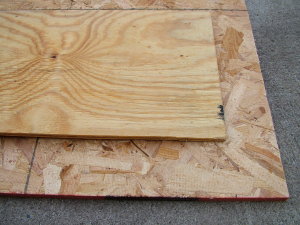
Plywood looks completely different from OSB even though they are made from the same wood products. Their performance characteristics are almost as different as their appearance. PHOTO CREDIT: Tim Carter
Plywood used on the exterior walls of your new home can also make it very resistant to wind-load damage if you nail the edges of the plywood to the studs every 3 inches on center vs. the normal 6-inch on center spacing. This 3-inch on center nail spacing increases the strength of the holding power of the nails and the plywood. With this nailing pattern and using 8-penny nails and 15/32"-inch thick plywood, it would require 490 pounds per square foot of pressure to pull the plywood from the wood wall studs.
Plywood also seems to perform better when hit by flying debris. In testing mandated by the South Florida Building Code, a 19/32"-thick piece of OSB was penetrated by a 9-pound 2x4 shot out of a cannon. The same projectile was not able to penetrate a piece of plywood that was 5/8" thick.
Hurricanes produce vast amounts of wind-driven rain. This water can and does penetrate the structure. It can get under roofing, into walls and soaks wood subfloors. Plywood that is rated for exterior exposure will resist damage from water, even if it gets saturated. Plywood can and does swell, but typically once it dries, it returns to its original size and shape. The same can't be said for OSB panels.
OSB panels are created under enormous pressure as the wood strands and resins are compacted. When OSB gets wet, the strands of wood swell and they release some of the compression stress. This expansion is often greater along the edges of OSB than in the center of the panel. When the OSB dries, it rarely returns to its original thickness and you often can see and feel the puffiness of the panels.
Plywood panels are also smoother than OSB. This characteristic is important when it comes to installing flooring materials. Certain flooring materials require the subflooring to be extremely smooth and plywood meets this requirement.
Plywood and OSB are friendly competitors. OSB is a great engineered wood product that helps make the most of our natural resources. But as with many different things, one product can't serve all masters or meet all needs.
I have used plywood for years on many of my projects and have never had a failure. If you use the right product for the job and install it the way you are supposed to, you will get years of trouble-free performance. OSB has also been on my material list for jobs and I have even built things where I use both plywood and OSB on the same job. When making decisions about strength and performance, always trust the test numbers, not necessarily what a salesmen says.
Column 607

Tim built custom homes and did ultra-custom remodeling for 20+ years before launching his Ask the Builder media presence. He was selected as one of the Big 50 by Remodeling magazine in 1993. This award gave birth to Ask the Builder in October 1993. Tim also operates https://DrawPlumbingPlans.com. His @askthebuilder YouTube channel was the first home improvement channel on YouTube.