Cabinet Knobs
Cabinet Knobs Secrets and Tips
- Function more important than form
- Knob location must be comfortable
- Best location 2.5 to 3 inches from door corner to center of knob
- Templates can create errors if not used properly - SEE BELOW
- CLICK HERE to subscribe to Tim's FREE Newsletter
DEAR TIM: I am struggling with cabinet knobs on my new kitchen cabinets. The cabinet knob placement has me scratching my head. How do you know where to place kitchen cabinet knobs and pulls? Should I use cabinet knob backplates? Can you tell me the proper way how to position cabinet knobs? Lois M., Canton, GA
DEAR LOIS: You are by no means the first person to struggle with cabinet knobs. I have seen knobs placed in all sort of places on cabinet doors, but there is a standard many carpenters seem to follow that has worked well for me and many of my customers over the years.
CLICK HERE to get FREE & FAST BIDS from finish carpenters to install cabinet knobs for you.
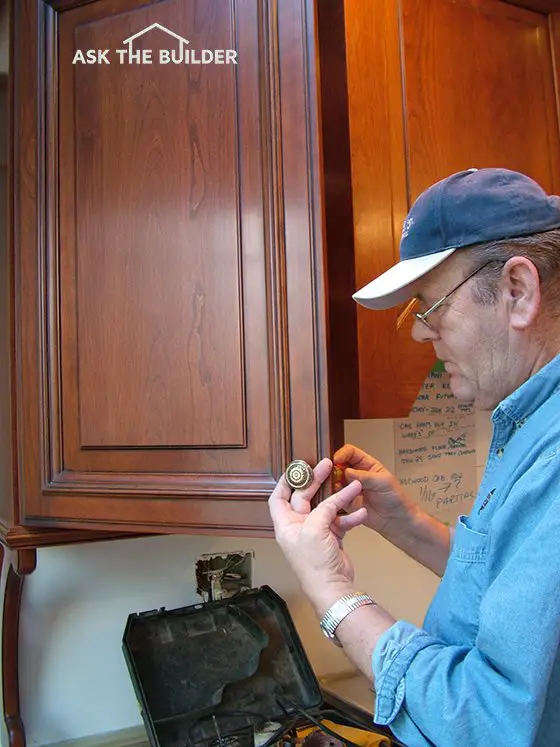
Function First
Cabinet knobs are a great example of a utilitarian item found in just about every home that is a crossover between function and form. The knob performs a very important job by allowing you to easily open a cabinet door. But at the same time, the knob needs to look good , and more importantly, its placement on the door must look right.
I am a huge proponent of function being more important than form. When you think about cabinet knob placement, you want the knobs at a height where they are comfortable to reach, and they provide the greatest amount of physical advantage or leverage when opening the door.
Easy Open
The farther away the knob is from the hinge, the less effort you need to open the door. You can prove this easily by placing a knob on an old cabinet door. Put the knob in the center of the door and you will quickly see it takes far more effort to open the door than if the knob is on the outer edge of the cabinet door frame away from the hinge.
Small Target
The cabinet knobs for kitchen wall cabinets seem to work very well when they are placed somewhere between 2.5 and 3 inches up from the lower corner of the cabinet door opposite the hinge side of the door. Since many cabinet doors have frames that surround a raised decorative panel, center the knob on the frame or flat area of the frame. Many cabinet door designs are different, so carefully look at the knob on the door before you make the final decision.
The cabinet knobs for kitchen base cabinets are placed somewhere between 2.5 and 3 inches down from the upper corner opposite the hinge side of the door. When knobs are placed in these locations, you will discover that your hand comfortably can grab them without your arm stretching.
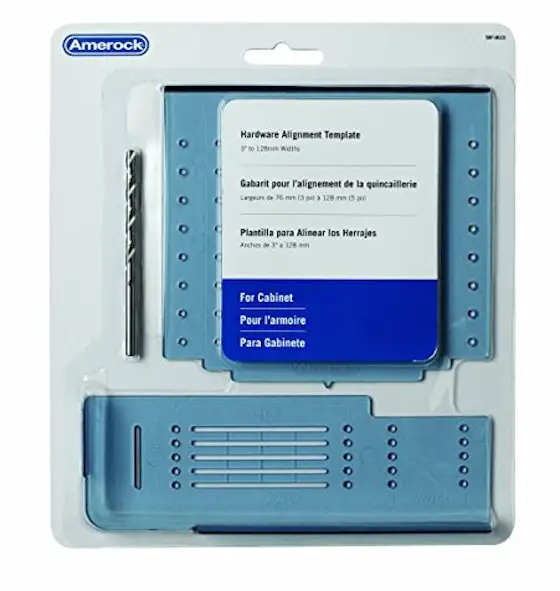
This is a set for both doors and drawers. CLICK THE IMAGE to BUY IT NOW.
Backplates
Cabinet knob backplates can be very useful. They often prevent dirt and grease from fouling the cabinet door finish. Some people do not like the look of backplates, as they can make the cabinet door look hardware heavy. I would suggest testing one to see how it looks on your cabinet door. Install a knob with a backplate on one door and then a knob on another door nearby and see which one makes you feel better.
You can use a tape measure and a pencil to make a mark on the cabinet door showing you where to drill the hole for the screw that holds the knob in place. But let my voice of experience tell you that this can be dangerous.
Templates
If you are tired, distracted or just make a mistake, a knob will end up in the wrong place. It is better to use a template that fits over the corner of the door. The face of the template has a hole in it at the precise location where the knob will be. You then trace the outline of the hole with a pencil and drill a perfectly-located hole each time.
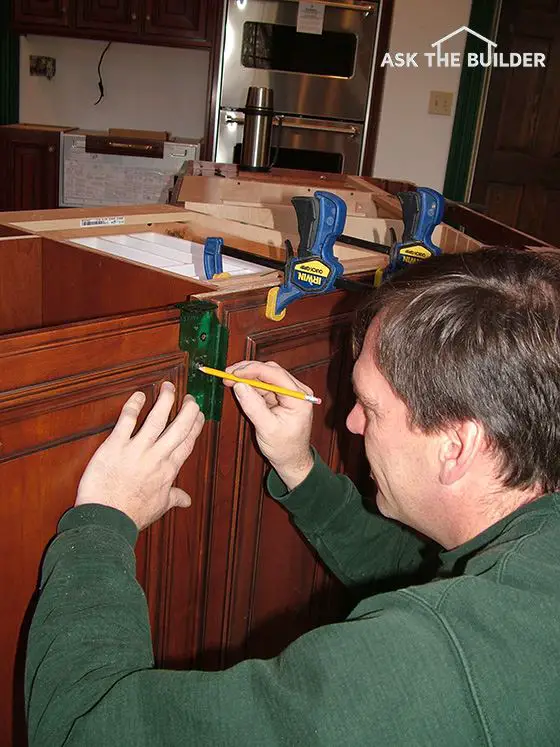
Plastic templates can be purchased at many hardware stores, home centers or fine hardware stores where you can buy premium cabinet knobs. The plastic templates are inexpensive and allow you to drill holes in the template for different locations to match your final decision on cabinet knob placement. I prefer to place masking tape over any extra holes so that only the hole I want to use is open. This prevents errors.
CLICK HERE to get FREE & FAST BIDS from finish carpenters to install cabinet knobs for you.
Right Screw Length
Be sure to use the proper length screws for cabinet knobs. The fastener must penetrate into the knob a minimum of 1/4 inch. Be careful when tightening the screws. Use screwdrivers that fit into the screw slot tightly. If the screw driver slips as you twist that final partial turn, the screwdriver can slip off the screw and scratch the inside of the cabinet door.
IMPORTANT TIP: Drilling the hole for the knob should be done very carefully. The drill bit should be the same diameter of the screw or possibly larger by only 1/64th an inch.
Drill from the front of the cabinet door to the back, but apply minimal pressure as you complete the hole. If you push too hard as you drill, the drill bit will explode out the back of the cabinet door leaving an ugly mess of splinters and chips of wood. Often the screw head will not cover the damage.
CLICK HERE to get FREE & FAST BIDS from finish carpenters to install cabinet knobs for you.
Column 658

Tim built custom homes and did ultra-custom remodeling for 20+ years before launching his Ask the Builder media presence. He was selected as one of the Big 50 by Remodeling magazine in 1993. This award gave birth to Ask the Builder in October 1993. Tim also operates https://DrawPlumbingPlans.com. His @askthebuilder YouTube channel was the first home improvement channel on YouTube.
how do you install a cabinet knob on a cabinet that has curved panel where the knob needs to go -- not a flat surface for the knob/screw
The same way as on a flat surface. Knob must have small contact point where it touches.
I have a five foot pantry tall cabinet door that I would like to install a pull on.
it looks odd placing the pull 2.5 inches from top, please help
Hope you have it sorted
I have installed pulls on my cabinets. The doors have a curved surface, so the knobs turn inward a bit--towards the center line between the doors. It looks a bit weird to me. I thought I can make them straight by loosening them a bit, and putting wood putty under them to adjust the slant. Is it normal for knobs to turn inward? I'm trying to sell, so I don't want anything to stand out.
Wood putty is a mistake. Grind the base of the pulls at an angle to match the curve to make them look right.
Good idea,
Thanks!
We are almost through a kitchen renovation. We bought brand new alpine white cabinets. Our contractor put knobs on without asking me where I wanted them placed. He did not use a template, some are uneven. He's attempting to move hole without replacing doors. Is this possible? Could something happen with wear/use and the hole become visible again? What should I do? I love my cabinets, we paid a lot for them and I do like my contractor, but he should of asked me where I wanted them and used a template. Should I insist faces be replaced or is it possible you will never notice where old knob holes were? Any advice would be greatly appreciated.
Contractor is in the WRONG. Do NOT pay him for the job until you're SATISFIED.
I have a similar issue as Kathleen. Our trim carpenter also happens to be the construction foreman of our custom home. He insists that we are getting too upset about cabinet knobs that are uneven (at first some were a 1/4", others are at 1/8"), at different heights and having screws creating chips and splinters in our cabinetry. He has used wood filler for the larger discrepancies, but is there any sort of professional guideline we can point to?
YES!!!! You should have purchased my New Construction Home Specifications. All you had to say in the specs are what you want. You state the acceptable TOLERANCE. You would say, "All cabinet knobs must be positioned as seen in the Detail drawing on page XX of the plans. No chips, scratches, or damage to either side of the cabinet finish will be acceptable. Damaged cabinetry doors or drawers must be replaced with new ones that match perfectly."
Finish carpentry is an art...craft and the tolerance and margins of error for me come down the 32nds and 64ths of an inch.
It's a real shame that some out there that claim to do " fine finishing " are in the buis...stick with banging 2x4's together.
Homeowners please do your research on specific contracting.
Though I agree with you on finish carpentry being an art and that professionals are going to deliver quality work... your response would be more reliable and credible if you spelled your words correctly. The lack of detail in your post makes me think you could potentially "cut corners" on fine details in your work.
Just saying...
Thanks!
I am installing a tilt out bin just under my sink. The panel is 16 inches wide. I am having a terrible time finding knob placement information.
I want to install knobs on my cabinets but there is a diagonal seam where the wood comes together in the center. Is it safe to drill on the seam to put a knob there? We wanted them in the lower corner and not a few inches up.
I had my contractor center the knob in the imaginary square that is in the lower corner of cabinet ( the top part and the side part of the square is formed by the seams that attach the stiles and outer edges of cabinet form the other 2 sides of square......was this wrong? On pantry with top and bottom cabinet I have 4 knobs close together forming a square.....looks ok.
I gave a single pantry that is 15" wide and 90" tall. The top door is 30" tall. Doors open left to right. I have installed a handle on the upper door at the lower left hand corner but am not sure if I should place the bottom door handle at the upper left hand corner or mid way down on the left side. Any suggestions will be appreciated.
Gloria,
You put the handle where it's MOST CONVENIENT to grab it.
I want to mix knobs and pulls in my bathroom. I have one 90"tallx18"wide cabinet, 2 under the sink doors, and 3 15" drawers. Does it matter which gets the pulls and which gets the knobs?
We're planning to transition from knobs to handles on our kitchen cabinets. It looks like if I use the existing knob hole for one of the handle ends then that end may be too close to the edge of the cabinet. Is there a way to make this transition without having to re-face the cabinets?
We are replacing existing knobs and pulls with the new pulls on all doors and drawers. Does it matter if the new pulls come a little below the doors? I'm not sure if this is proper. It is approximately 1/8" below.
Thank you.
Hi Tim,
Personally we don't like knobs, they stick out and has a change to catch on our clothes and such. Since the doors and drawers are always 3/4", very simple to reach under and pull them all open with no issues and nothing that sticks out.
Hi - I have Amerock candler pulls to install but they have a pin that sticks out a little further than the screw hole. How do you get the pulls to mount flush on the door? The pin doesn’t seem to seed into the door as I tighten the screw. BP29368G10
Simple. You create a small hole for the pin to fit into.
Would adding a backplate help an oval door knob not loosen & turn?
Doubtful. Why not just apply thread adhesive to the screw that goes into the door knob? Here's one I use and LOVE LOVE LOVE it: https://amzn.to/2W8QyiO