Shed Ramps
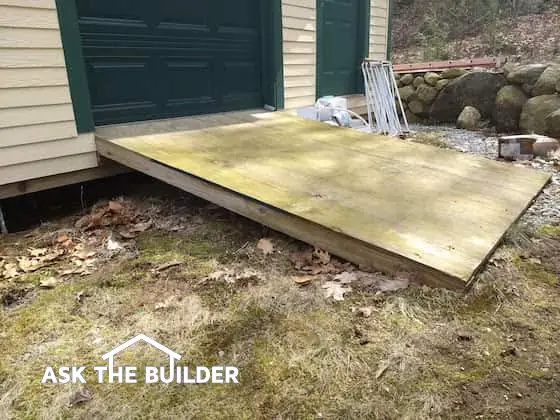
This shed ramp is made with treated plywood and treated 4x4 supports. It's very strong. IMPORTANT NOTE: See the door at the top of the ramp? That's a traditional overhead garage door, but it's only 6-feet wide! Yes, you can get small garage doors. Swinging shed doors don't seal well and are DANGEROUS on windy days. Copyright 2018 Tim Carter
"The shed ramp project is not very difficult, however, it will require some unusual cuts with a circular saw. On a scale of one to ten, with ten being the toughest job, I would rate this project a 2.5."
How To Build A Ramp For a Shed in Hours
DEAR TIM: I'm convinced you know a great deal about shed ramps. I need to know how to build a ramp for a shed because the ground around my shed slopes. It doesn't seem that shed ramp construction would be that difficult, but I don't want to start until I have an outdoor shed ramp plan.
What is the maximum slope you can have on a shed ramp? Do you know how to build a shed ramp with wood? I want the ramp to be safe and very sturdy because my riding lawn mower is quite heavy. Jerry McG., Lees Summit, MO
Related Links
How To Build A Ramp - Basic Carpentry
Treated Lumber Can Rot - Prevent It Doing This
DEAR JERRY: Although I have built my fair share of shed ramps, I don't know if you could say I am a shed-ramp guru. But I can give you some tips that will allow you to construct a woodshed ramp that with not shudder or snap as you drive your lawn tractor up and into the shed. I suggest we copy the way I built my own shed ramp.
The shed ramp project is not very difficult, however, it will require some unusual cuts with a circular saw. On a scale of one to ten with ten being the toughest job, I would rate this project a 2.5.
Quick Start Guide For Building a Shed Ramp:
- design so slope is no greater than 3 inches of rise per foot of run
- purchase treated lumber plywood and treated 4x4s and 2x4s
- attach a treated 2x4 to the shed that 4x4s rest on
- use hot-dipped galvanized or stainless-steel screws to fasten plywood to 4x4s
Free & Fast Bids
CLICK HERE to get FREE & FAST BIDS from local shed building contractors.
How Steep Can A Shed Ramp Be?
I feel the maximum slope should be no more than 3 inches of vertical rise per horizontal foot of run. My shed ramp has this slope and it rises 24 inches from the ground to the shed floor.
The total length of my ramp is 8 feet. Try to make your ramp as long as possible so the slope is less than 3 inches for every foot of run.
If a ramp is steeper than this, you might also have a problem when the lawn tractor pulls into the shed. My lawn tractor has a belly mower. The belly mower can scrape the top of the ramp and prevent the tractor from entering the shed.
Lawn tractors with snow plows might also have an issue with a steep ramp. The blade may dig into the ramp if you try to drive the lawn tractor up into the shed.
How Do You Prevent A Ramp From Being Slippery?
The best way to keep a ramp from being slippery is to keep it clean and free of slimy algae. You can also install pure rubber mats. You must keep the rubber clean.
Rubber is excellent because it's not slippery when wet.
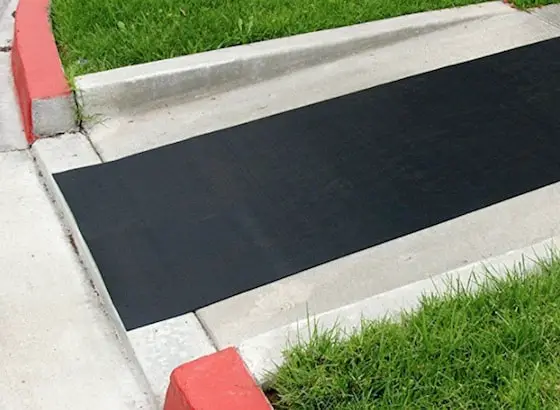
This is a perfect rubber mat for a shed ramp. It's 3-feet wide and 7-feet long. Place two of them side-by-side. CLICK THE IMAGE NOW to have them delivered to your home in days.
Let's discuss the slope issue. The steepness of the ramp can be a safety issue when you are both on and off the lawn tractor. If the ramp is steep and you have not cleaned it for a year or so, it might develop a slippery algae covering.
When this algae gets wet, it is more slippery than a wet bar of soap. Just walking down the ramp may have you on your posterior faster than you can say "Whooops!". If you try to drive a lawn tractor up a slippery ramp, it is possible for the tractor to slide sideways and tip over the ramp. You can get severely injured if this happens.
Stain Solver is MADE in the USA with USA ingredients that are food-grade quality. CLICK THE IMAGE to order some NOW.
Clean shed ramps with certified organic Stain Solver as soon as you see a hint of green algae or black mildew. Both can be very slippery.
The cost of cleaning the ramp is far less than what the ER bill will be. The last thing you need is a broken wrist or tailbone.
What's the Best Shed Ramp Material?
The best shed ramp materials are treated lumber 4x4's, a treated 2x4 and treated three-quarter-inch-thick plywood. You can find treated plywood at traditional lumber yards. Don't count on a big box store to carry this specialty item.
I spaced the 4x4's two feet on center as they project away from the shed. Since my ramp is 6-feet wide, I needed four 4x4s.
The ends of the 4x4s are notched using a circular saw. This notch allows them to rest on the 2x4 which is through bolted to the end joist of the shed. The notch is only one and one-half inches deep and perhaps an inch high. The two cuts that make up the notch are 90 degrees to one another, but the one cut is not parallel with the end of the 4x4.
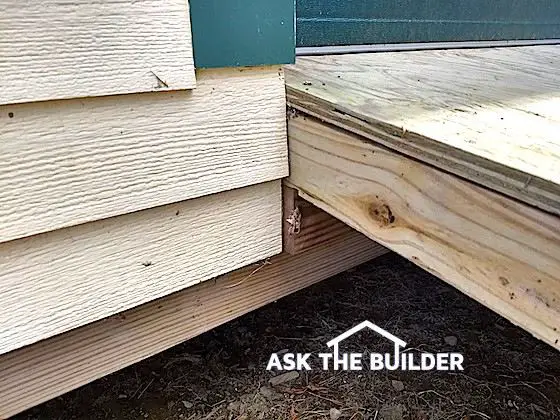
You can just barely see the treated 2x4 that's bolted to the side of the shed. The 4x4s are notched to sit flat on the edge of the 2x4. Copyright 2018 Tim Carter
The 2x4 is bolted to the side of the shed joist so the top of the 2x4 is 2.5 inches down from the top of the shed floor joists. If the shed floor has three-quarter inch flooring, this will allow the treated plywood of the ramp to line up nearly perfectly with the top of the shed flooring.
Once the small notches are made on the ends of the 4x4s, you can set them on top of the 2x4 and toenail them into the side of the shed joist. Use special hot-dipped galvanized nails that are 3.5 inches long.
CLICK HERE to get FREE& FAST BIDS from local shed building contractors.
How Do You Fasten the Plywood To The 4x4s?
After all of the 4x4s have been secured to the 2x4 ledger board, you cut the plywood to length and nail or screw it to the 4x4s. Use hot-dipped galvanized nails or screws for this task, but they only need to be 2.5 inches long. Recess the screw heads. Your lawn-tractor tires and bare-foot children will love you for this.
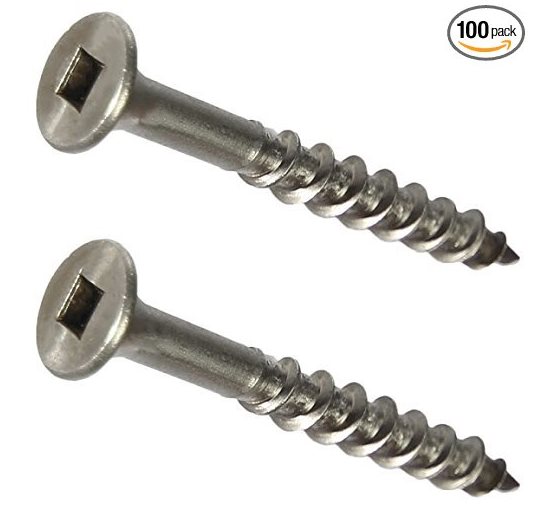
These are great screws to use for a shed ramp. CLICK THE PHOTO to have them delivered to your home.
Are There Other Shed Ramp Materials?
Shed ramps can also be made from aluminum or other metal. There are any number of companies that make ramps that can be placed permanently or used only when you need access in and out of the shed. Some ramps are slightly wider than the width of the lawn tractor tires. These must be placed very precisely so the tractor does not flip over.
If you build a solid-wood ramp like mine, you can use real rubber mats to make pathways for yourself and the lawn-tractor tires. Real rubber, when wet, is not slippery. Get rubber mats that have some bumps on them that will give you superb traction. Clean the ramp and rubber mats on a regular basis to remove any dirt, algae or moss.
CLICK HERE to get FREE& FAST BIDS from local shed building contractors.
Column 671

Tim built custom homes and did ultra-custom remodeling for 20+ years before launching his Ask the Builder media presence. He was selected as one of the Big 50 by Remodeling magazine in 1993. This award gave birth to Ask the Builder in October 1993. Tim also operates https://DrawPlumbingPlans.com. His @askthebuilder YouTube channel was the first home improvement channel on YouTube.

Great information. Qa sketch may be helpful. For end pre of the 4x4's. Do you secure the end of the 4x4 with spikes?
I need a ramp for a wet area, anything wood always rots. Any ideas?
How about adding some 1x6's along the edges to prevent something sliding off?
I have made non-skid by mixing paint ( oil base is best ) with sand. put it on thick & let it dry. I ordered a rollup door, similar to what they use on those storage unit places. works great & sure beats swinging doors.
I had a plywood ramp for years and it finally rotted out and was very slippery from algae. I rebuilt my deck last summer using composite material and used the old deck 2x6s to build a new ramp to the shed. Put down four 2x6s out 5 feet buried in gravel and screwed shorter 2x6s across all joists. Slathered on some old shellac and tossed sand on them. It won't win any rewards but I got a big thank you from the wife who was afraid for her life every time she stepped on the old ramp. It will rot out in time but not while I'm still around.
I'm wanting to build a ramp that folds up for the door to my shed. Using weights to help so it's not so heavy. Have you ever thought about that type of ramp?
Nope. I've not done the engineering. Good luck!