Roof Cleaning
DEAR TIM: Roof cleaning needs to be done at my home. I have a newer asphalt shingle roof, but parts of it are getting covered with moss, lichens and algae. It is really distressing, as it makes my house look like it is being neglected. Is a pressure washer a great tool for cleaning roof shingles? Will it remove all of this growth? A neighbor told me a pressure washer will ruin my shingles. Are there other cleaning alternatives? Once the roof is clean, how do I prevent the stuff from coming back? Tom B., Whittier, NC
DEAR TOM: Welcome to the world of organic chemistry. I'll bet the north, northwest and possibly west-facing sections of your roof are the ones that look bad, while the remaining parts of the roof look like new. What's more, my guess is the parts of your roof that are the worst get shade from some large trees. I know this, because I have the exact same problem as you do. Parts of my roof look like the Amazon rain forest.
Wind broadcasts spores, they can drop from trees and birds can deliver them to a roof surface. The abundant water you get from periodic rainfall fuels the growth of the moss, lichens and algae. Since the north, northwest and west sections of your roof stay in the shade during the early part of each day, the dew that develops on the roof at night does not evaporate quickly. This morning moisture quenches the thirst of the mini-vegetable garden up on your roof. The other sections of your roof dry too quickly and the moss, lichens and algae die of thirst.
 Discover how Tim pressure washed his roof.
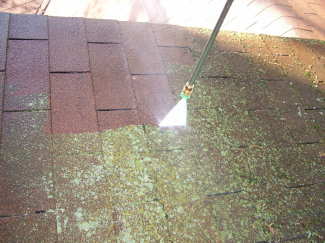
You can use a pressure washer to clean moss, lichens and algae from asphalt shingle roofs. But, you must be careful! PHOTO CREDIT: Brent Walker
I have also heard urban legends about pressure washers causing permanent damage to asphalt roof shingles. I know for a fact that pressure washers can damage concrete, so it would seem likely they might harm shingles.
BEGIN AUTHOR UPDATE - November 2015:
This column was written in 2007. At that time all of the asphalt shingle companies and the Asphalt Roofing Manufacturers Association said to NOT use a pressure washer to clean roofs. They still tell you NOT TO USE A PRESSURE WASHER as it can and will VOID the warranty.
The primary reason, in my opinion, is because they knew the shingles currently being made were not as good as the shingles I used on my home when it was built in 1986.
Secondly, I'm convinced they realize that not all homeowners and contractors would do the job correctly. They'd use the wrong tip on the pressure washer, hold the wand too close and or use too much pressure.
There's NO DOUBT that you can damage an asphalt shingle with a pressure washer, but the photos and VIDEO footage on this page is clear proof that you can use the tool to clean asphalt shingles that are MADE CORRECTLY so the ceramic granules are well adhered to the fiberglass mat.
I'm currently collecting data from hundreds / thousands of homeowners who are suffering PREMATURE shingle failure. I was one of them.
CLICK HERE if your home is suffering from premature shingle failure to take my survey.
Soon I'll be issuing a full report of my findings. You'll be stunned to discover the Asphalt Roofing Manufacturers Association is refusing to cooperate with my investigation.
Tim Carter - Founder - AsktheBuilder.com
END AUTHOR UPDATE # # #
But since I know how to quickly and easily replace one or more roof shingles, I decided to do a test of my own.
What's more, I felt my roof would be a good one to test since it is now twenty-years old, and at the end of its useful life. If I damaged my roof, then no harm no foul as I'd be installing a new one.
I also decided to test some new shingles to see if the pressure washer blasted away many or all of the colored granules.
The roof-shingle-cleaning test started with a gasoline-powered pressure washer that develops 2,500 pounds per square inch of pressure while delivering 2.4 gallons of water per minute. I equipped the pressure washer spray wand with a 25-degree tip. This tip is used for general-purpose cleaning.
The results of the test were astonishing. I was able to remove all of the moss, lichens, algae and twenty years of dirt with the pressure washer.
No damage was done to the asphalt shingles whatsoever.
I started with the spray wand tip about twelve inches from the surface of the shingles and aimed the wand down the roof. I didn't get any noticeable cleaning results at this distance. But once I slowly lowered the wand to within 6 inches of the shingles, the organic growth started to disappear.
My suggestion to you is to carefully clean just one shingle and stop working. Inspect the shingle for damage.
Walk to another part of your roof where the shingles look great to see if the clean shingle looks just like the freshly-cleaned shingle. Rest assured you will readily spot damage. If you see small or large patches of solid black or fiberglass mesh, you are ruining your roof.
You can use a regular garden hose and a scrub brush to clean your roof. It will be an enormous amount of work to say the least. Always point the garden hose or pressure washer wand down the roof. Never point it up the roof, as water can be driven up under the shingles creating massive leaks inside your home.
 Tim Carter shares an easy way to keep your roof shingles free from moss, algae and mildew. Click to watch the video.
You can keep the roof looking like new once cleaned, by installing strips of copper at the top of the roof. You need about two to three inches of copper exposed along the ridge line. If your roofer had installed shingles that contained invisible copper-coated granules, you would not have to do any of this work. The slow release of copper on the roof surface prevents the growth of moss, lichens and algae.
Be extremely careful working on a roof with water. The water makes the moss, lichens and algae as slippery as if you had spread oil on the roof. Try to always work on a dry section of the roof. Work in ribbons that are maybe two-feet wide going from the ridge line down to the gutter line. The hoses also are dangerous slip hazards. Use fall-protection harnesses to ensure you will not get hurt if you slip.
When you get to within ten feet of the edge of the roof, stop working and let the freshly-cleaned roof dry. Once the roof is dry, then reverse the direction of cleaning so you are walking forward towards the end of the roof, not backwards and falling off!
Column 672

Tim built custom homes and did ultra-custom remodeling for 20+ years before launching his Ask the Builder media presence. He was selected as one of the Big 50 by Remodeling magazine in 1993. This award gave birth to Ask the Builder in October 1993. Tim also operates https://DrawPlumbingPlans.com. His @askthebuilder YouTube channel was the first home improvement channel on YouTube.
The assumption that Pressure-washing damages concrete is completely false! A pressure-washer does not have enough power to tear apart concrete. I can run a pr. washer tip across my hand while it is running... I can remove dried paint or gum from concrete without damaging it. Concrete has many variations in quality of formula, and has improved a lot over 50 years. The thing that most damages concrete is Mother Nature, meaning age, moss, freezing & thawing cycles, de-icer, traffic, etc.
Concrete can be made to last longer by applying a sealer to it every few years. Or, cleaning it annually.
The breakdown of concrete is not due to washing it, but rather to many other factors, and washing it is necessary and can prolong its lifespan.
I hate to say it but you're completely wrong. All you have to do to see the power of water flowing across GRANITE at just 14.2 pounds per square inch (PSI) is hike to the bottom of the Grand Canyon on the Kaibab Trail. You'll then instantly understand that water squirting out of a pressure washer at 2400 PSI can and will erode the cement paste at the surface of concrete. If you want further proof, go to Chicago. Look at the sidewalk in front of the Chicago Tribune building. See all that exposed aggregate? That's because it gets PRESSURE WASHED at least once a week.
Industrial pressure washers are used all the time to cut through concrete and metal. Do us all a favor and STOP posting false information here at my website. Your comment about your pressure washer not hurting your hand is ludicrous. Just talk to any ER doctor and she'll tell you all about the people that come in with severe injuries from pressure washers.
I just read the comment from Stan dated 2/22/15. My eyes just about popped out of my head.
I work for an orthopaedic hand doctor. Hey Stan, do a google search on high pressure injection injuries then get back to me. Pressure washer and airless paint sprayer injuries are about the worst we come across. Even the ER doc sometimes fails to appreciate the severity when all they are seeing is a tiny puncture wound.
My boss, Dr Douglas Carlan, was interviewed in Construction Equipment magazine, 2/2012, https://www.constructionequipment.com/injection.
Do yourself a favor and listen to Mr. Tim Carter.
Hi Tim,
I would have to disagree with your advice on cleaning asphalt shingle roofs with a pressure washer. You can not effectively clean your roof without causing damage. In fact the Asphalt Roofing Manufactures Association (ARMA) along with every asphalt roofing manufacturer will tell you not to use a pressure washer on your roof. It will damage your roof even if you think it does not and it will void your roof warranty.
The accepted method to clean your roof is a method called softwashing. It is a low pressure system (less than 100 psi) using chemicals to clean your roof.
I hope you will retract your advice on cleaning a roof with a pressure washer and steer the people to the correct way to clean their roofs.
Shannon,
Thanks for your comment. I went up and added new content to the column that should take care of your concern. It's in red. You should read it. I'm in the beginning stages of gathering all sorts of evidence about what may be a serious misbehavior within the asphalt shingle industry. Stay tuned. You should subscribe to my newsletter to be informed when I publish my findings early in 2016.
Hey Tim, leaving a comment to say thank you for sharing your knowledge and expertise. I recently started working with a family owned pressure cleaning business in Miami and did not see how big of a learning curve there is.
I've subscribed to your page and will share your posts on Facebook.
thank you again for sharing this information!
It’s really informative post. Pressure washing is the best way of cleaning roof. Thanks for sharing this information. Keep posting and keep sharing like this.
A homeowner needs to be very careful about roof washing especially if they’re going to use a pressure washer. The kickback is often stronger than they realize and the pressure can strip granules easily. Great info, thanks for sharing!