Pouring Concrete
DEAR TIM: Right at the top of my honey-do list is pouring concrete for a 15 by 25 feet patio at my home. The patio will be 5-inches thick. My calculations indicate this is almost six cubic yards of concrete. How many people will I need to help me pour this concrete slab. The closest I can get the concrete truck is 100 feet to the patio. What challenges do you see? Jay W., Green Bay, WI
DEAR JAY: Looking into the pouring-a-concrete-pad crystal ball, I see many challenges for you. This is a very big slab for a concrete rookie and his band of groupies. Without the proper number of people who have the right equipment and skills, I see nothing but problems. Lots of problems.
First, there are all sorts of ways to unload the concrete from the delivery truck into the forms for your concrete patio. I assume you are on a tight budget and can't afford the cost of a concrete pump that would make this job as easy as possible. You may be able to rent any number of motorized vehicles made to transport concrete. A skid-steer loader with a large bucket does a superb job as does a motorized hopper made specifically for moving concrete from a ready-mix truck to the patio.
If you are unable to get this equipment and must use traditional man-powered wheelbarrows, you must make sure your 100-foot travel distance is accurate. If this distance assumes the concrete truck is going to back onto your driveway, I sure hope your driveway was built to handle the load. A truck that carries that six-cubic yards of concrete in one load can weigh as much as 20 or 30 tons. You can order the concrete from some ready-mix concrete plants in small trucks that may only carry one or two cubic yards at a time. Large concrete trucks that carry 10 cubic yards of concrete can weigh in at a staggering 35 to 40 tons!
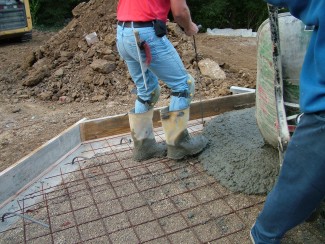
Pouring concrete can be hard work. Each wheelbarrow load can weigh hundreds of pounds. PHOTO CREDIT: Tim Carter
The topography of your yard is also important. If the yard is level, then moving the concrete from the truck to the patio forms will be somewhat easy. If a slope is involved, then the work will be very hard. A construction wheelbarrow full of concrete can weigh nearly four hundred pounds. Trying to push that up a slight grade is grueling work. Trying to hold back that weight going down a hill is a recipe for spilled loads. If you do have a sloped yard, then you will be transporting small loads in each wheelbarrow.
I estimate you will need a minimum of five people wheeling concrete. It only takes ten or fifteen seconds to fill a wheelbarrow with a full or partial load of concrete. The trip from the truck to the patio and back will be at least two minutes. Remember, concrete trucks only allow so much time to unload without charging you for extra truck time.
Once the concrete is dumped, you will need a minimum of three people, possibly four, to spread the concrete and screed it off. A screed is a 10-foot long aluminum or wood straightedge that is pulled across the wet concrete. The screed acts like a man-powered bulldozer by removing excess concrete. It also shows where the concrete is low.
Two people are needed to efficiently and accurately screed the concrete. The third person is spotting the deliveries of the concrete and using a concrete rake to puddle the concrete to the right height. This job requires great skill so the two people working the screed do not have to pull too much concrete with the screeding tool.
Prepare for hot or wet weather. High temperatures can accelerate the chemical reaction that causes the concrete to transform from a plastic mixture to man-made stone. You can have the concrete company add chemicals that will slow this reaction. Do not add water to the concrete mix to make it more plastic. This additional water dilutes the Portland cement making the concrete weaker than the original design strength.
All sorts of things can go wrong that will cause stress and problems as you pour the concrete. Wheelbarrows and other hand tools can break. Low pressure in the wheelbarrow tires can make wheeling nearly impossible. The concrete form boards can fail or bow because they were installed poorly.
You should place reinforcing steel in a concrete slab like this. A fourth person working inside the forms will be necessary to ensure the reinforcing steel is pulled up into the wet concrete. Steel mesh is often laid on the grade, and it must be pulled up with a large hook to get the steel into the center of the slab. If steel rods are used as the reinforcement, these must also be suspended above the grade so concrete flows under and over the steel.
Be very careful about getting wet concrete on your skin. The concrete is extremely alkaline, and can cause sever second and third-degree burns. I know this for a fact as it happened to me on a hot summer day pouring a large basement slab. I had two massive burns on my upper and lower leg that kept me from working for two weeks.
Column 680

Tim built custom homes and did ultra-custom remodeling for 20+ years before launching his Ask the Builder media presence. He was selected as one of the Big 50 by Remodeling magazine in 1993. This award gave birth to Ask the Builder in October 1993. Tim also operates https://DrawPlumbingPlans.com. His @askthebuilder YouTube channel was the first home improvement channel on YouTube.
i would like to know how much it would be to have you lay concrete down. for a 46 x 30 with a foot deep?
Simple. Just calculate the cubic yards you need and call your local ready mix concrete plant for a delivered price. Be sure to order the correct PSI. The more cement in the mix, the more it costs. You were taught in school how to do this math, right? If not, you better get up to speed quickly to survive.
The fact that you say I will need about five people to help me pour my concrete patio makes this project a bit more than I thought it was going to be. My patio will be about ten feet by ten feet. I was anticipating being able to just wheel barrow a few loads of concrete into the form and then spread it out myself. Is this not something I can do for myself?
Bryan,
I think you already know the answer. Are you a driver for R. Pepin & Sons? Or do you do their SEO? 😉
Hello Tim. My question is....Why would anyone even consider a project such as this a "DIY" project? I'm pretty handy with a set of tools but the best tool I own is my brain and I know where my skills start and where they stop. A project this size is one for the pros. If it were my deck, I'd let the pros handle the job and I'd stick to buying the beer and steaks for the barbeque for when the deck is done. Just a thought.
IRC 2012 does not allow the "pulling" of steel. (found to be totally ineffective) So on a six inch slab with #4 rebar 12" oc how do you wheel barrow to the unreachable portions? Is building a ramp the only way? No pumper truck is available.
Hi Tim. I was wondering how to support and anchor a concrete form for two entry stairs The width of double front entry doors. Currently there is one step but we are raising the door to meet the height of new interior floor that will also be raised to meet the level of the main floor. The foyer was “sunken” from rest of first floor. The step that is there will be removed and I will calculate the stairs, I’m just stumped on how to keep form in place on top of the concrete pad that is currently there. There is nowhere to put stakes into the ground like I see normally done. I don’t want it to move or have concrete ooze out from underneath. Thanks Tim
Julie,
There's far too much to type. This requires one of my short paid phone consults. Best $$$ you'll spend on the job. The call is FREE if you feel I didn't help you:
https://shop.askthebuilder.com/products/15-Minute-Phone-Conversation-with-Tim.html
what options do I have if I need concrete poured 25 feet in distance across water to fill a pipe in a lake. We can't afford a boom truck. Do you have any suggestions. The regular arm of a concrete truck don't go 25 feet in distance.. Thanks
I learned from an old concrete finisher that you can work it or it can work you. Anticipate everything will go wrong, be ready for it and think about what you are doing before you do it. He poured concrete by himself here in Boise over 40 years. 10- 15 yd slabs were his normal size job. He even water cured his concrete for a week. Phenomenal tradesman. I thank him every day for the things he taught me. Don't move the slump farther than the hump he would laugh and say. Meaning only knock down the hump where it was placed. He didn't rake or shovel Mud all over the place. He used a 14ft. Mag screed. Actually a level checker. He made a hook on one end to go over a stake and pulled on handle he made for the other. His strikes were perfect, bull floating was simple along with the rest. As far as finishing goes, toss one rock out of the slump. If it sticks, too soon if it bounces you better hurry! If you want to know more just msg me. Thanks Shane S2K.