Paperless Drywall
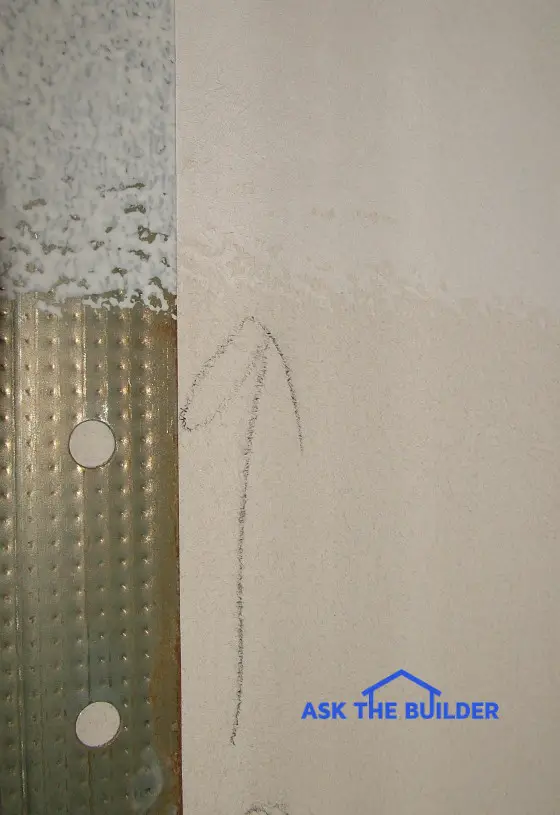
It is really hard to see, but the paperless drywall in this photo has a texture like ultra-fine steel wool. PHOTO CREDIT: Tim Carter
Paperless Drywall TIPS
- Many different types of drywall some with no paper
- Inner gypsum core is different and more resistant to water damage
- Slightly rougher texture easily made smooth by skim coating
- Use in high-humidity locations of home
- CLICK HERE to Get Tim's FREE & FUNNY Newsletter!
DEAR TIM: Paperless drywall is causing me some consternation. Is it as easy to cut, install and finish as traditional drywall that has a paper facing?
Why would I want to use paperless drywall? The texture of the paperless drywall is definitely rougher, and I am worried the walls and ceilings in my house will not be smooth.
Would you use this paperless product in your own home? Joy B., Olive Branch, MS
DEAR JOY: The paperless drywall is a fascinating product.
Great For Wet Locations
To me it is one of those, why-didn't-I-think-of-that products. While traditional drywall with paper facing is fine in many instances and I have it on virtually every surface of my own home, the paperless drywall solves a few pesky problems the paper-faced drywall has had for years.
Paper Sandwich
Traditional drywall has a firm gypsum core that is wrapped with special paper both front and back. Not all drywall has the same paper facing.
Some drywall products have colored paper facing (blue or green) that inhibits the absorption of water that might otherwise soften the gypsum core.
Free & Fast Bids
Fiberglass Is Immune To Water
The paperless drywall is covered both front and back with fiberglass which is naturally highly water resistant. It also comes with a moisture-resistant gypsum core. Not all traditional drywall has this type of core.
Slows Mold
First and foremost, the paperless drywall was created to help minimize the spread of mold in homes.
Is it mold-proof? Absolutely not. It's mold resistant simply because the fiberglass mat that replaces the paper is not a known food source for many common molds.
Some molds actually feed on the paper facing of traditional drywall if the drywall becomes wet or damp and stays moist.
I Loved It
I have used this paperless drywall on two recent projects in my own home. Aside from the slightly rougher surface when handling it, I could tell no other difference when cutting the paperless drywall with a traditional razor knife.
Drywall screws and nails penetrate the paperless drywall just like traditional drywall.
View From A Distance
When viewed in daylight at a distance over six feet away, the surface of the paperless drywall appears nearly identical to that of traditional paper-faced drywall. But when you get closer and look at the surface of the paperless drywall, you can see and feel the fine fiberglass matting.
At night when light washes down a wall from above at a low angle, the texture of the fiberglass matting is very apparent.
Finishing Fills Texture
If a rookie drywall finisher and painter work on the paperless drywall, you might see smooth polka dots where the screws and nails are covered with finishing compound in the drywall.
Smooth racing strips might also be visible at corners and flat seams where joint compound and tape was used to finish the unsightly seams where two pieces of drywall touch one another.
The smooth areas are created when the creamy joint compound fills the small voids in the fiberglass matting. The filled glass matt has a very different texture than unfinished paperless drywall.
Simple Skim Solution
This problem is easily solved if the entire surface of the paperless drywall is skim coated with drywall topping compound. There are many different methods of skim coating as well as large tools to make the job go faster.
One method, that has worked well for me, is to add some water to drywall topping compound transforming it into a thick paint. Apply the topping compound to the paperless drywall with a thick-napped paint roller, and then immediately remove it with a wide flat knife. If the humidity is low, the skim coat dries very rapidly.
Skimming Last Step
It's best to skim coat the paperless drywall after it has been sanded. The skim coat offers a secondary benefit of fixing minor imperfections that might appear in the drywall finish.
Use In High Humidity Locations
The paperless drywall can be used in bathroom areas where you might expect high humidity, but not necessarily water contact. An example of this would be exposed wall surfaces above ceramic tile in tubs and showers, around vanities and toilets, etc.
The paperless drywall can be used in any other part of the home where you might otherwise use traditional drywall. It has one slight disadvantage. The drying time of finishing compounds is slightly slower.
This stems from the fact that the fiberglass matt facing allows little or no water to penetrate in towards the gypsum core. When using traditional paper-faced drywall, the water found in finishing compounds can soak into the paper allowing for more-rapid drying times.
Column 688

Tim built custom homes and did ultra-custom remodeling for 20+ years before launching his Ask the Builder media presence. He was selected as one of the Big 50 by Remodeling magazine in 1993. This award gave birth to Ask the Builder in October 1993. Tim also operates https://DrawPlumbingPlans.com. His @askthebuilder YouTube channel was the first home improvement channel on YouTube.
wait, you would sand the fiberglass surface before skim coating it? wouldn't that release all the pesky little glass shards that make up the fiberglass? how itchy is paperless drywall to work with? sounds great otherwise.
You should consider investing in a 15-Minute Consult with me. Look at my cart for that. Lot's to discuss. I just do short pithy answers here.
Can fiberglass coated surfaces of ceiling billboard be compromised and deteriorate after being flooded from above several times? I've been finding a white powdery looking substance covering my countertop and worry that I'm exposed to fiberglass residue. How can I know for sure?
Cat, I just do short pithy answers here. Think one sentence. Your question requires a boatload of typing and I have questions for you. What you need is my 15-Minute Consult!
I can't locate paperless drywall board at Lowe's or Home Depot. Where can it be purchased?
I'm on the board of a FL condo that is attempting to address proper building practices. The first order of business is to establish the mandatory requirements for licensing, insurance and permits; now we are addressing the issue of best practices & products. I previously used the fiberglass coated drywall in commercial construction applications such as utility areas, baths and kitchens but haven't been able to find a local source of supply for these products in the SE Florida area (Ft Lauderdale area). Any resources you cn recommend?
P.D.,
You may want to do a few of my phone consults for this project. For a host of reasons.
As for drywall sources, I found about 15 in ten seconds:
https://www.google.com/maps/search/drywall+suppliers+ft+lauderdale+FL/@26.0967335,-80.499277,10z/data=!3m1!4b1
Here's the link for my phone consult service:
http://shop.askthebuilder.com/products/15-Minute-Phone-Conversation-with-Tim.html
Does paperless drywall have any VOC's, or toxic chemicals?
Easy answer.
Get the MSDS sheet from the manufacturer and do your due diligence.
Do you know how it reacts in a fire?
Yes. It disintegrates from the extreme temperatures. Just go look at photos of houses destroyed by wildfires to see what happens when a severe fire consumes a house.
What happens to blue board if you peel the paper off and texture it for a bathroom?
Once installed, are there any health risks to occupants from the fiberglass itself (for example, in earthquake country, if it cracks, or if there are temperature changes in a skylight, will fiberglass in this drywall pose any respiratory risk, or is it too inert to become airborne in those types of scenarios)?
Irina,
Minimal, or no, risk, especially if you paint it.
Does paperless drywall need to be primed before painting? My parents have a bathroom wall where the paint is peeling. So I scrapped off chunks of painted where it was not sticking, and I did a light sand, and then applied paint and the remaining paint started lifting around d the areas where I scraped. The house is 10yrs old. So this is the original paint..and I am not sure if the builder used a primer.. does paperless drywall need a primer?