Attic Fan Installation
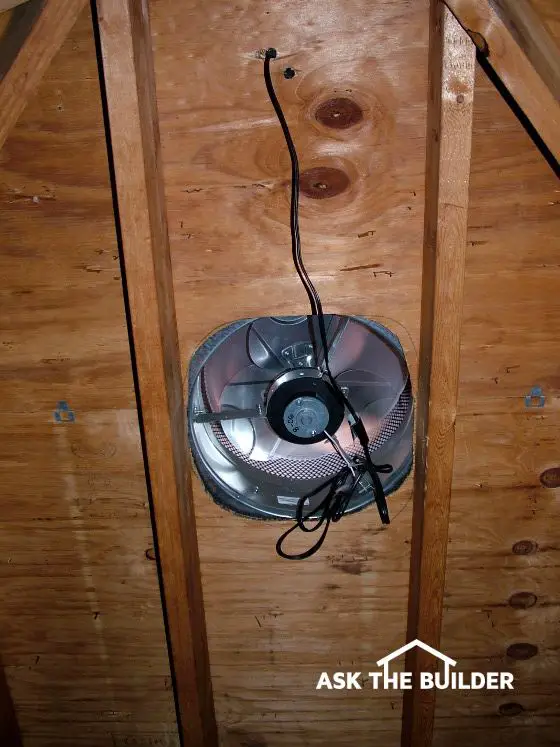
This attic fan looks impressive, but it moves less than 1,000 cubic feet of air per minute. It's a solar-powered fan. See the cable poking through the roof? It's connected to the solar panel you can't see. That small amount of air has not lowered my attic temperature. PHOTO CREDIT: Tim Carter
CLICK THE PHOTO TO HAVE TWO OR MORE POWERED ATTIC FANS DELIVERED TO YOUR HOME NEXT WEEK. THE FANS YOU NEED ARE POWERED BY 120 VOLTS AND RUN WHEN YOUR ROOF IS IN THE SHADE AND CONTINUE TO RUN UNTIL THE ATTIC IS COOLED. THEY MOVE FAR MORE AIR THAN A SILLY SOLAR FAN.
Attic Fan Installation Tips
- Many fans needed to cool an attic space
- Put fans high up on a roof to create pull-through ventilation
- Excellent soffit vents are required
- Solar-powered attics fans are USELESS - see below
- CLICK HERE to Get Tim's FREE & FUNNY Newsletter!
DEAR TIM: I know I need an attic fan to cool my hot attic. But there are many different types of attic fans.
Should I consider a solar attic fan or some other attic exhaust fans? What type of attic fan do you use?
How much air do I need to move through my attic to make a significant difference in the temperature? How important are soffit vents in this system? Pam W., Green Bay, WI
DEAR PAM: Attic fans are an effective tool to use to help lower excessive attic temperatures. As you might imagine, I have used many different types of fans, and have formulated opinions based upon experience and some accurate data I have collected over the years.
Tens Of Thousands Of Feet Of Air
I believe the first thing to realize is that it takes massive amounts of air moving through an attic to create significant cooling. Farmers who raise chickens can attest to this as the buildings and barns that house chickens are usually equipped with massive fans that move tens of thousands of cubic feet per minute (CFM) of air.
Even then, it is almost impossible to drop the temperature to that of the air temperature outdoors.
Free & Fast Bids
CLICK HERE to get FREE & FAST BIDS from local contractors that specialize in installing attic fans.
Intense Infrared Rays
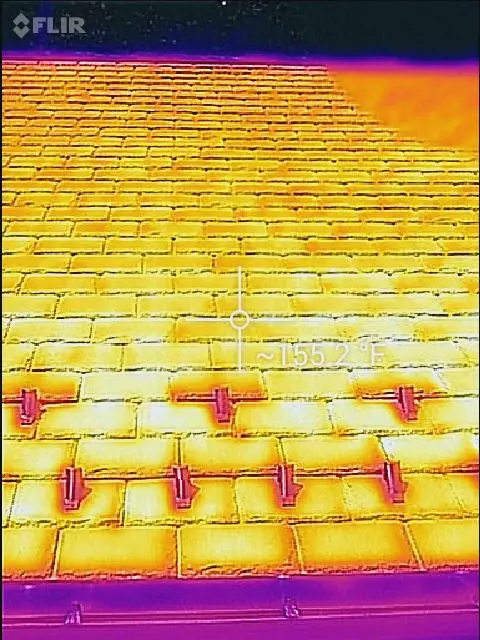
Here's an infrared camera photo I snapped of my own roof in July. The temperature was 155 F. That's blistering hot. Copyright 2018 Tim Carter
Think of the dynamics of what is happening on a blazing summer day when the sun is pounding relentlessly on your roof. The temperature of the shingles soars.
They can easily approach a temperature of 150 F or possibly more. This heat then transfers to the roof-framing materials.
The trusses, rafters and roof sheathing get very hot. All of these things radiate heat much like the coals of a fire or a hot radiator.
Stored Heat
This stored heat in the roof rafters, trusses, roof sheathing and shingles is released as infrared energy that passes through air and starts to heat up solid objects like the insulation and anything stored in the attic.
To cool these things down, the heat needs to be transferred to something else that can store the heat. The only thing available is the water in the air that is moving through the attic.
Solar Fans Are Useless
I'm currently testing a specific solar attic fan. I have two identical units installed in my attic. The solar panels get sunlight until mid-afternoon. After that point my entire roof is in the shade created by two massive trees.
IMPORTANT TIP: Unfortunately these two fans have not done anything to reduce the attic temperature. The day before I installed them it was a cloudless day and the attic temperature at Noon was 129 F.
When both fans are operating at Noon, the temperature has never been below 128 F. Each fan claims to move 800 CFM of air. The fan blades do spin rapidly, and I have good soffit intakes as well as windows in my attic that allow air to freely enter the attic space.
The fans are NOT MOVING ENOUGH AIR to make a difference.
No Sun = No Movement
The trouble with solar attic fans is they stop working as soon as a cloud blocks the sunlight. On partly-cloudy days, the temperature can be beastly hot, and the fan blades simply stand still for much of the time.
After the sun goes down, the attic can still be stifling hot from all the stored solar energy in the wood of your attic., and there's no hope of air movement since the sun is not powering the fans.
Regular Electricity Is Better
Powered attic fans that get a constant supply of household electric will move lots of air. But you need to have quite a few operating to feel a difference.
Many of these fans are equipped with thermostats so they will turn on and off automatically. This is a handy feature that saves energy.
CLICK HERE to get FREE & FAST BIDS from local contractors that specialize in installing attic fans.
Wind-Powered Turbine Vents
You can install wind-powered turbine vents as well. When the wind blows hard, these fans can exhaust lots of air. But since the performance is tied to the wind speed, you can't count on these to work at peak performance in the hottest part of the day.
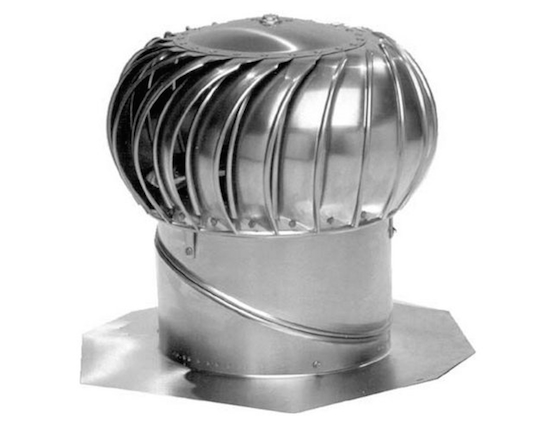
This is a standard turbine vent. They come in different colors. Some have external braces. This one you see is Made in the USA. CLICK THE IMAGE TO ORDER ONE OF THESE GREAT TURBINE VENTS.
Great Soffit Vents
You need great soffit vents to supply the attic with all of the replacement air. Powerful fans that are exhausting air from your attic work best when they can get ample amounts of makeup or replacement air from outdoors.
The lack of soffit vents may cause the fans to draw air up from the inside of your home. If you're running air conditioning, this can cost you dearly as your air conditioner will work harder to keep your home comfortable.
Can't Have Too Much
I have come to the conclusion that it is impossible to have too much attic ventilation. But achieving this can be a challenge aesthetically. Many people do not want the surface of their roofs cluttered with fan housings, or twirling vents.
Those people who have experienced hurricanes will be the first to tell you that any hole in a roof is very problematic when the wind starts to howl relentlessly for hours.
No Silver Bullet
There is no silver-bullet solution when it comes to attic fans. There are models that work best in certain parts of the nation and this same fan may do a poor job in another geographic area. Your house may not be sited well for solar or wind-powered solutions.
Those fans that are powered by household electricity probably hold the best promise as they will move tremendous amounts of air and do so until the attic temperature has dropped significantly. Your challenge will be installing enough of them to keep your attic temperature just above the outdoor temperature on the hottest day of the season.
CLICK HERE to get FREE & FAST BIDS from local contractors that specialize in installing attic fans.
Column 734

Tim built custom homes and did ultra-custom remodeling for 20+ years before launching his Ask the Builder media presence. He was selected as one of the Big 50 by Remodeling magazine in 1993. This award gave birth to Ask the Builder in October 1993. Tim also operates https://DrawPlumbingPlans.com. His @askthebuilder YouTube channel was the first home improvement channel on YouTube.
Very nice article. I certainly appreciate this site.
Thanks!
New roof dilemma - Need your help again, Tim!
You help so well with my oven exhaust fan question, I'm going to ask for your mercy again with a new roof dilemma. We need to replace the 20+ year old roof on our home. Building construction has changed a lot in these years. We live in Raleigh, NC, and are getting a 50-year architectural roof (TimberlineHD) installed. We have had 2 different roofers tell us 2 different things about our two roof fans (one is solar, one is electric). One roofer said he wanted to replace both of the fans (for an extra cost, of course), and one said that since we're having soffit vents and new ridge vents installed (we don't have soffit vents now), we actually don't need the fans, and they could possibly even draw outside air back into the attic. I've read your articles, and other than knowing you're a big fan of ventilation, I can't seem to figure out for myself if fan make sense in our situation. I am concerned about drawing air back into the attic, particularly in the humid summer months. We have a story-and-a-half house with a shaded back yard and some shade in the front.
My husband is a schoolteacher, so we need to not spend any more on this than we have to, but we want to do the right thing, as well. We could really use your expertise again! Thanks so much.
Maggie,
Please go read all my past columns on Turbine Vents. You know, the whirlybirds. READ ALL OF THEM.
Your answer lies there!
Hi there...
I have an attic fan that wired to a timer. As to the most beneficial times of the day for it to turn on & off, is the question I have.
Appreciate the help!
When the attic temperature hits 100 F it should come on. Have it go off at 4 am in the morning.
What is the life span of a powered roof-top attic fan? I had the fan installed 20 years ago, here in Maryland, which has hot & humid summers, but the fan doesn’t run year round. Should it be replaced? What is the fire danger from an older attic fan?