Roof Vent
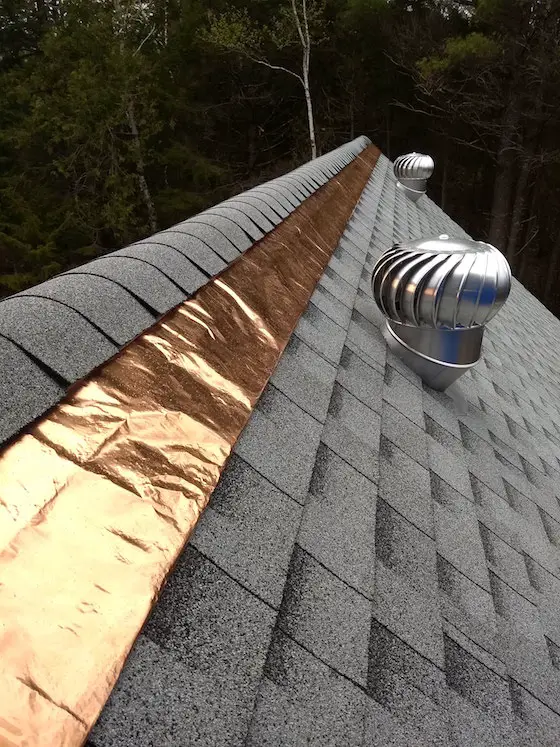
There is no ridge vent here. Why? The turbine vents, or whirlybirds, do a far better job. Add to that, I was the first person in the world to identify that copper prevents the oxidation of asphalt molecules on asphalt shingles. See how easy it is to install this copper in a new-roof installation? CLICK the photo or TAP HERE to order the copper strips.
Ridge Vent Hot Outside - They Don't Work - I Proved It
DEAR TIM: I need to know which roof vent to install on my home as it is time for a new roof. I am considering a continuous ridge vent, but once hot air reaches the peak of the roof it has to go down several inches to escape the attic. This defies physics and doesn't seem logical. What are the roof-venting options I should be considering as many online resources seem to want to sell something? I would also like a green or responsible choice. Leo K., Concord Township, OH
DEAR LEO: You are not the first person to contact me about the mystery of a typical ridge roof vent. Roof-vent installation was a standard practice for all the years I built, and I routinely installed continuous ridge vent on my jobs. Never did I stop to test the manufacturers' claims, thinking they were accurate.
Several years ago, a friend of mine made the same observation you did. He couldn't understand how hot air could go down through a ridge vent to exit a roof. It seems these vents would work well as the carpenters cut away the top roof sheathing leaving a 3 or 4-inch opening at the highest point in a roof. But then the roofers install the continuous ridge vent and cover that with shingles. The shingles lap down onto the roof to provide the water seal from falling rain.
This means hot air needs to go up to the vent and then somehow go down past the shingles before it can escape the attic. Anyone who paid attention in their high-school physics class knows that hot air rises and absolutely doesn't want to go down. Look in the sky on a cool evening and you can see hot air balloons drift as the contained bubble of hot air transports the gondola and passengers up. The balloon comes down when the air cools or the pilot releases hot air from a vent at the top of the balloon.
The same principle, I believe, works with helium balloons. Let one go in a room with a cathedral ceiling, and it will quickly get trapped at the peak of the roof. It takes effort to pull the balloon away from the ceiling.
Test Using Incense
This got me to thinking, so I tested the principle at my own home with a stick of incense. On a blistering-hot day with no wind outdoors, I went into my attic and lit the stick of incense carefully, not to set my house on fire. With a flashlight illuminating the wafting smoke, I set the incense stick a few inches below the peak of the roof where the continuous ridge vent was. Instead of seeing the smoke get pulled out of the open pathway, it just collected at the peak of the roof. Barely any of the smoke was pulled outdoors.
For air to exit a ridge vent, it MUST GO DOWN. Hot air rises and wants to rise, not go down. This is why the incense smoke didn't exit the attic. If it doesn't go out, then neither does the stifling, hot air.
This experiment of mine was not completely scientific, but it proved to me the roof vent was not working as I thought it would. I am sure some hot air escapes the vent, but my feeling was that there would be a reverse waterfall of hot air readily and continuously moving through the vent. Such was not the case.
You have numerous roof-venting options. There are traditional mushroom or pot vents, powered roof vent fans, a solar-powered roof vent, a turbine vent, etc. There are all sorts of possibilities as well as mixing and matching different types.
On my own home, I have several types. The static pot vent just covers a 12-inch-diameter hole in the roof. Hot air just floats out of these vents. I also have two solar-powered roof vents. When the sun shines on the solar collectors, a low-voltage fan spins pulling out hot air. I then have a sleek turbine vent that has excellent ball bearings. The slightest breeze sets the turbine in motion sucking hot air from the attic.
Keep in mind that a roof vent is just as important in the winter. In fact, roof ventilation is critical all year. You need a continuous, or nearly continuous flow of air moving through your attic space. This air movement can help to keep your attic cooler if tremendous amounts of air are moving, and the air movement will exhaust humid air that otherwise might condense on cool or cold surfaces in your attic.
I prefer the turbine roof vent because it can work day or night with just the slightest amount of wind. You can't say that about a solar-powered roof vent. Plus, a turbine vent uses no electricity. It's a really green and environmental choice.
The common mistake many people make is to put in too little roof ventilation. It is impossible to have too much ventilation in your attic. The companies that sell roof turbines have sizing guidelines, but for every 1,000 square feet of attic space I would install two 14-inch-diameter turbine vents.
When you shop for turbine vents, let price be your barometer for quality. The more expensive turbines generally are better made and have better parts. You want the ball bearings to be sealed if possible, and you want the vent to be sturdy.
If you live in an area that may be struck by a hurricane, you will probably have to remove the turbine vent if a monster storm is forecast. Sustained winds can rip a turbine vent from a roof leaving a gapping hole in your roof. Talk with professional roofers who have weathered a hurricane or two. They possibly can tell you the best way to install a temporary patch in the roof that will not be blown off during the storm.
Column 745

Tim built custom homes and did ultra-custom remodeling for 20+ years before launching his Ask the Builder media presence. He was selected as one of the Big 50 by Remodeling magazine in 1993. This award gave birth to Ask the Builder in October 1993. Tim also operates https://DrawPlumbingPlans.com. His @askthebuilder YouTube channel was the first home improvement channel on YouTube.
Thank you for this very helpful article on roof vents. I will have a new roof installed in the near future and I'm in a quandary as to the type of roof venting I should have. So, just a clarification question: are you saying that ridge vents do not actually work? I have one contractor who wants to install can vents because he says the ridge vents do not work. I have another contractor who says the ridge vent is by far the best method. I'm left in a state of confusion. After reading your article I think the biggest selling point of the ridge vent is probably that it is most pleasing to the eye. Am I correct? Thank you, Tim, in advance for your response.
Dianah, you need to schedule a 15-Minute call with me. There's simply too much to talk about and type.
Just had a ridge vent installed, and the roofer only cut one side of the roof for venting. He did not cut the recomended 1 3/4 inch on either side of the ridge beam. Will this be a problem, and should I have him re-work it to the requirement?
David, your question requires lots of typing, plus I have some questions for you so I can give you the correct answer(s). I only do pithy answers here in the comment section. If you want to protect the investment you have in your house and not waste time or money *hoping* you make the right decision, you should talk to me on the phone for just 15 minutes. It'll be the best investment you've ever made in your home!
Previously my house used two louvered vents one at either end of the main "gable" (for lack of knowing what to call it) (each side of the house under the main part of the roof). These are just openings with screen wire attached to the back of a metal insert with louvers. It's a small house. When I had my house re-roofed, the roofer installed a ridge vent all the way across the top of the roof. I read somewhere that if there is a ridge vent, these other vents should be closed off so the ridge vent will work and pull the hot air out. Now I read where the ridge vent doesn't do the job, so should I leave things as they are...with the side louvered vents and the ridge vent?
You need to do a 500-Second Consult with me. Too much to type. http://shop.askthebuilder.com/500-second-consult/
Saying that heat will not rise out of a ridge vent because the shingles force air down a bit is like saying the physics of a siphon won't work because some water has to go uphill. Most of the heat is rising as most of the water has to fall.
Hi Tim: How far from the peak of a roof should vents be placed?
Thank you.
Gary
The higher the better.
I just had my pole barn garage rebuilt because of a roof collapse. The builders put a vented roof on so I could use a wood stove. Leaves are now coming in should this be? It is an insurance job and need to know I don't want to sign that I am happy with it, if it isn't right.
Thank You
Leaves should not be entering through the roof. No way no how.
You are asking about the roof which could resist weather, water and heat. My experience is about a roof repair which is having all these qualities that is RV Roof Sealent as far as roof material concerned metal is better and long lasting.
I need a new roof, and I presently have a ridge vent the whole length - 38'. The roofer wants to close up the ridge vent and instead install 7 roof vents. Is this a good idea? The pitch of the roof is 4 1/2 - 12. Thank you.
Why does your roofer want to close the ridge vent?
Tim,
Interesting article. When you tested your ridge vent on your home, please answer yes or no to the following questions:
1. Did you have soffit vents?
2. Did you have baffles in place?
3. If yes to #1, Was the amount of soffits equal to the amount of ridge vent opening?
And were the soffits unobstructed (such as not having blown-in insulation on top of them)?
4. If yes to #2, Were the baffles in every accessible attic bay?
This response is absolutely on target. In order for a ridge vent to work, you have to calculate the NFVA (Net Free Ventilation Area) of the ridge vent and have at least the same NFVA for the intake (soffit) vents. In fact, it's better if the NFVA for the intake vents is greater than the ridge because it creates an upward air flow, pushing the hot air out, otherwise the hot air will just sit at the ridge. Also, if there are any other high-level vents (e.g., gable vents) they should be closed off so as not to interfere with the upward air flow you're trying to create.
i am in the process of installing a barrel tile roof on my house, where i previously had wood shingles. Th old roof had fans to pump the hot air out of the attic, where as now the opening is much smaller and they are installing the goose neck vents to the house. I do not feel as comfortable with this idea because the air can not escape fast enough to keep the home cool.
Please advise on what to install properly for best results, i live in Miami Florida.
I had 25' of ridge vent installed several years ago at the peak of a section of flat roof (back) to front angled roof (front). It seems when it rains really hard, I get water coming down between the walls in one section. Now I have a mold problem. What would you suggest? I need to get up on the roof to make sure branches and leaves are not preventing drainage away from the ridge. Is ridge roofing along a flat roof section, a good idea?
Hello,
Next Step insulated our attic in March and they installed four mushroom vents on the back side of the roof. When they said four vents, we thought they would be small vents on the lower side, not big Mushroom vents. Had we known their intentions, we would not have had it done. Now, we are doing a new roof and want architectural shingles and a ridge roof. The roofer will remove the mushroom vents for an additional $1,000. Should we replace the mushroom cover with a better looking cover or go with the ridge roof?