Backer Board
DEAR TIM: I’m getting ready to buy backer board for a ceramic-tile project. There are different types of tile backer board leaving me confused. What backer boards would you use and which would you avoid? I know you’ve favored cement backer board in your past work, so tell me if you still feel that it’s the best product. If you can share any backer board installation tips, I’d appreciate that. Dennis D., Waynesville, OH
DEAR DENNIS: To be more precise, I’ve installed lots of concrete backer board for years, all with good results. The concrete is unaffected by any water that might somehow get behind the ceramic tile. But these concrete products are heavy, problematic to cut and can wick water causing wood rot.
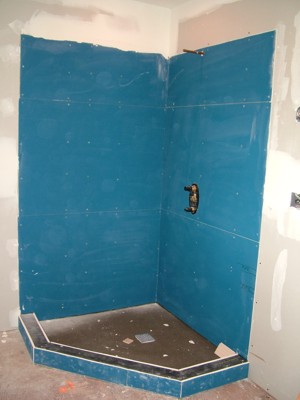
This coated backer board is easy to install and works well on walls and floors. PHOTO CREDIT: Tim Carter
Recently I’ve been experimenting with some of the alternative backer boards. The most recent one I’ve worked with has a water resistant gypsum core with a fiberglass mat backing and a handsome blue waterproof coating on the side that the tile adheres to. This material is code approved and recommended by a leading ceramic-tile association. I have to admit it far easier to work with than the cement back boards. I don’t miss the small pieces of sand and grit that scratch tub finishes!
Using this particular product also saves a step in the building process. If you do decide to use cement backer board, you must install a separate moisture barrier between the board and any wood that the board is attached to. Since the concrete can absorb and wick moisture, the barrier prevents wood rot should the backer board get saturated with water. I discovered first hand this can happen just a month ago when I demolished a 25-year-old bathroom that had waterlogged cement board in the shower. Because no water barrier was installed years ago, the bottoms of some of the wall studs were beginning to show water damage.
When I first got into the construction business nearly 35 years ago, a moisture-resistant drywall was the backer board of choice. It had a green paper so you could distinguish it easily from traditional drywall. Millions of square feet of this was installed in bathrooms, some by me, only to discover it didn’t do too well. Water passed through grout joints and eventually caused the green paper to fall apart. Virtually every building code now shuns this product for use in wet areas. I would never install this product behind tiles that were subject to water splashing on them.
As you prepare to install your ceramic backer board, the first thing to do is stop and read all the written instructions that deal with installing backer board. The product that I used with the bright blue coating had the instructions attached to each sheet. This is very helpful, and it can save you time and money so you don’t have a failure at a later point down the road.
Don’t underestimate the importance of using the correct fasteners when installing the backer board on walls. The combined weight of the board and the tiles you’ll attach to it is very high. I would absolutely use screws instead of nails, and not just drywall screws. You can usually find special backer board screws that have an oversized bugle-shaped head that securely fasten the board to wood or metal studs. Be sure the screws are coated so they will not rust. It’s also important to drive the screws flush with the surface of the board. Don’t allow them to tear the coated facing of the board.
If you’re installing your backer board in a shower or tub, don’t allow the board to come into contact with the concrete shower pan or the tub ledge. I prefer to hold up the backer board one-quarter inch off tub ledges and one-half inch off a concrete substrate in a poured shower. Holding the board up prevents the edge from sitting in any water.
Cutting backer board, especially if it’s a gypsum-core backer board, is done with a simple razor knife. The surface is scored with the razor, and you then snap the board creating a clean line. The razor is then used to cut the fiberglass backing. It’s the same procedure used to cut regular drywall.
Take your time to make sure that wall studs are plumb and in the same plane before you install backer board. These products conform exactly to what you fasten them to. If you want your tile to go in easily, the backer board itself must be plumb and flat.
Make sure the tile backer board that’s used on floors is attached to a sound subfloor. Screw down the wood subfloor to the floor joists before installing the backer board. If the floor seems springy or bouncy, you’ll likely deal with cracked tile. Be sure to install the backer board in a bed of cement thinset mortar to ensure there are no hollow spots or voids in between the backer board and the wood subfloor.
Column 789

Tim built custom homes and did ultra-custom remodeling for 20+ years before launching his Ask the Builder media presence. He was selected as one of the Big 50 by Remodeling magazine in 1993. This award gave birth to Ask the Builder in October 1993. Tim also operates https://DrawPlumbingPlans.com. His @askthebuilder YouTube channel was the first home improvement channel on YouTube.
Where can I buy that "water resistant gypsum core with a fiberglass mat backing and a handsome blue waterproof coating on the side that the tile adheres to"? Thanks.
Robert, your question requires lots of typing, plus I have some questions for you so I can give you the correct answer(s). I only do pithy answers here in the comment section. If you want to protect the investment you have in your house and not waste time or money *hoping* you make the right decision, you should talk to me on the phone for just 15 minutes. It'll be the best investment you've ever made in your home!
Our cement front porch has outdoor carpet glued to it. With the weather and sun we are always having to replace it TOO often.
What other means could I cover the porch that would last longer?
Thanks,
Jamie Woolley
TM,
Thank you for such a detailed reply regarding the use of gypsum backer board. My question is: do we have to apply a 'waterproof coating' on this blue backer board?? My husband used the exact type you spoke about, the gypsum backer board with the blue on the tiling side. He's thinking we have to apply a waterproof coating before we can begin tiling.
We appreciate your professional opinion and advice.
Thank you,
Margaret Stieber