Foundation Footer
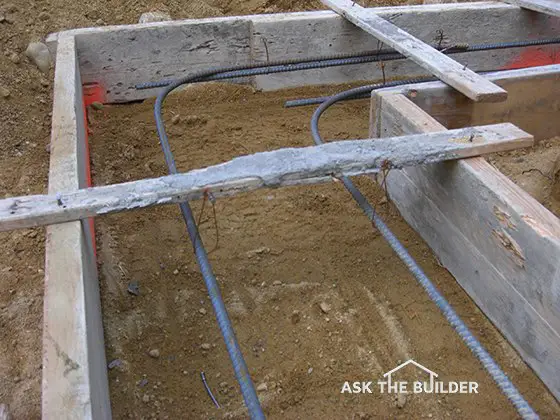
These wooden form boards will soon be adjusted and filled with concrete to create a strong foundation footer. ©2017 Tim Carter
Foundation Footing TIPS
- Make them 24 inches wide
- 8 inches thick minimum
- WATCH videos below
- Steel is a must
- CLICK HERE to Get Tim's FREE & FUNNY Newsletter!
DEAR TIM: I’m thinking of a career in new home construction and know very little. One of the things I don’t fully understand is the foundation footer, or footing. I’m also stumped about piers.
What’s the real purpose of these things? Can you install a foundation without concrete footings?
What tips can you share about pouring concrete footings? I’m sure you’ve sloshed around in wet concrete down in more excavations than you care to remember. Brad T., Topeka, KS
DEAR BRAD: You bet I can tell stories about concrete footers.
Big Footing - Perfect Conditions
Several jobs come to mind, but perhaps the one that stands out the most is the time I had to pour a massive footer for a commercial building in Blue Ash, Ohio with just one helper.
CLICK HERE to get FREE & FAST BIDS from local foundation contractors to pour your footings.
Fortunately for me, the job site allowed the concrete trucks access to all sides of the excavation hole, the weather was cool, and my helper that day was lucid.
You can’t afford mistakes to happen when you have expensive concrete tumbling in the drums of several 10-yard ready-mix concrete trucks!
Mother Earth Contact
Structural engineers, building inspectors and other builders may have more to say about this topic than me, but suffice it to say that a foundation footing is perhaps one of the most critical aspects of the house.
It’s almost always the first building element that makes intimate contact with Mother Earth or soil that the house rests upon. In rare cases, a footing may be supported by piers of one type or another that are placed in the soil under a footer.
Spread Footing
The term spread footing was used years ago and it's with good reason.
The primary purpose of the footer is to spread out the weight of the structure across a larger footprint than the foundation would if it was in direct contact with the earth.
Frequently a concrete footer is 20, 24 or even 30 inches wide and at least 8-inches thick. More often than not you’ll see them 10-inches thick. The average foundation wall is usually only 8-inches thick (wide).
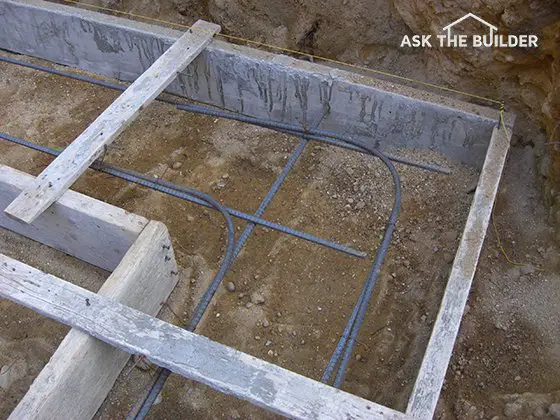
You're looking at the wood forms that will restrain the wet concrete used to create the footing. Those are 1/2-inch steel rebar that's suspended down about four inches from the horizontal spreader boards that hold the forms parallel. The steel needs to overlap at least 18-24 inches at splice points. ©2017 Tim Carter
Enormous Weight
When you calculate the total weight of a completed house plus everything in it, you’d be stunned by the total tonnage. Just the interior furnishings and possessions in an average home can weigh tens of thousands of pounds.
Add this to the many tons of weight of the building materials and you end up with enormous concentrated loads. Without a footer under a foundation wall, the foundation wall may actually start to slice into soil much like a knife cuts into a stick of butter.
Footing Videos
Watch these three videos showing a footing being poured at a house next to mine in New Hampshire. This was NOT my job. I'm just an inquisitive neighbor!
Foundation Form Aid
But a footer, because it’s wider than the foundation wall, displaces this weight over a much larger area. A footer also creates a nice, level surface for the foundation contractor to set his forms.
CLICK HERE to get FREE & FAST BIDS from local foundation contractors to pour your footings.
Piers
Piers are used to provide a solid foundation in weak soils. Think of piers as table legs for a moment.
Some piers that you pour yourself come with an ingenious design that incorporates a footing into the pier. The bottom of the pier is fatter than the top of the pier. CLICK HERE TO ORDER THESE FORMS.
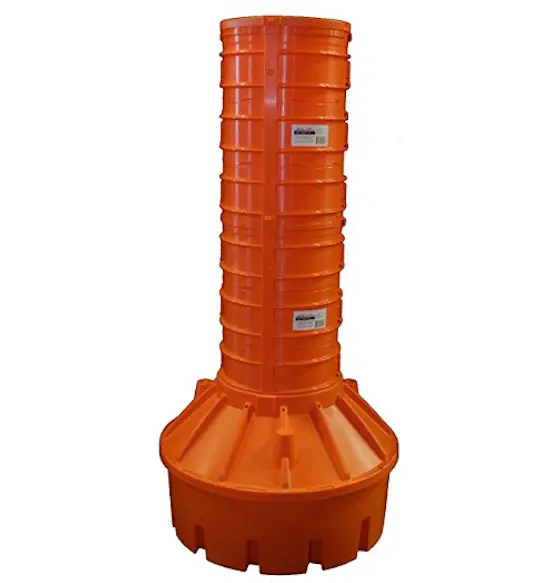
This is a great pier form I've used to build my shed and for my large deck. It's got a built-in footing at the bottom. No tools required for assembly and the steel comes with it PRE-CUT! It's amazing. CLICK THE IMAGE NOW TO ORDER AS MANY AS YOU NEED.
The top of the table represents the actual footer. The table legs are the piers that extend below the footer until they reach solid soil below. Some piers are designed to have enough sidewall friction where the piers touch the soil along the entire length of the drilled shaft.
DIY Pier Form Video
Here's a quick video that shows you a DIY pier form. It should make sense.
I have MANY MORE pier videos here on the website. Just use my search engine on each page to locate them.
Pre-Cast On Stone
Some pre-cast concrete foundation systems are routinely installed without a poured concrete footer. They rest on compacted gravel that acts as a footer. Be sure this type of footer is approved for your area and the gravel used is crushed and angular.
Rounded gravel might not be a good choice because it can move with ease. Think about how ball bearings roll around.
Steel A Must
Reinforcing steel is a must in concrete footings. Concrete has great compressive strength, but little when subjected to tension.
If the ground moves under the footing, concrete can come under tension, bend, crack and go down.
100X Stronger
The presence of steel dramatically increases the tensile strength of the footer. Average concrete only has about 400 pounds per square inch (PSI) of strength to resist tension failure. The steel rebar you buy at the lumber yard has no less than 40,000 PSI of tensile strength. You can get it with 60,000 PSI or more if you special order it.
Steel Overlap
When overlapping the steel bars, make sure they overlap at least 18 - 24 inches. Structural engineers will specify the best location of the steel inside the concrete footer. They'll often mention in the specifications the minimum overlap distance. It's sometimes referred to as a minimum multiple of the diameter of the steel called for.
You may see a specification say, "Overlap steel bars no less than 20 bar diameters."
Keyways
I like to place a keyway in my foundation footers. This is a channel or groove that’s created after the concrete is smoothed over in the forms. You can slide a 2x4 in the concrete to create this feature.
When you then pour the concrete foundation, that concrete flows into the groove in the footer. This mechanical connection between the two elements helps keep the foundation wall from sliding across the footer if the foundation wall is subjected to horizontal pressure.
Level The Footing
Take the time to ensure the footing is as level as possible. This will make the job of setting the foundation forms much easier. It’s also mission critical that the footing be square so the foundation is centered on the footer. Sigh, so much more to say but there’s just not room!
Nails & Rods
If you’re pouring a trench footing, be sure to place nails, if possible, in the sides of the trench that tell you how deep to pour the footer. You can also drive steel rods in the center of the trench to help you establish the correct depth of the concrete. Take your time to get the concrete level as it will make it so much easier to pour the foundation or lay concrete blocks that may form the foundation walls.
Form Boards
Concrete footing forms should be made from sturdy 2x8’s or 2x10’s. Many foundation contractors prefer to use 2x8’s and stake them up off the ground several inches.
This technique makes it easier to level the form boards in case the excavator was not able to dig a level hole. That’s not as easy to do as you might think.
CLICK HERE to get FREE & FAST BIDS from local foundation contractors to pour your footings.
Column 848

Tim built custom homes and did ultra-custom remodeling for 20+ years before launching his Ask the Builder media presence. He was selected as one of the Big 50 by Remodeling magazine in 1993. This award gave birth to Ask the Builder in October 1993. Tim also operates https://DrawPlumbingPlans.com. His @askthebuilder YouTube channel was the first home improvement channel on YouTube.
I would like to build a 1100 sq ft house in the country. One floor about 700sf ft with a loft (400 sq ft) I have a limited budget I wonder if it will be less expensive to do a foundation of concrete or concrete blocks with steel reinforcing bars full of cement. How much it will cost per sq ft one way or the other?
Gabriela, your question requires lots of typing, plus I have some questions for you so I can give you the correct answer(s). I only do pithy answers here in the comment section. If you want to protect the investment you have in your house and not waste time or money *hoping* you make the right decision, you should talk to me on the phone for just 15 minutes. It'll be the best investment you've ever made in your home!
DEAR TIM: I’m thinking of a career in new home construction and know nothing about construction. What tips can you give me.
Easy. Read everything here at my website.
I own a home 13 years old which I bought new from the builder. the Real Estate market was insane and this home was built very fast. I kept an eye on its construction as much as I could. But I did not watch them pour the foundation.
My question has always been this: " why the foundation has inbedded 2"x2" of what it seams like treated wood? They were covered with a coat of cement, but that has now peeled off and the wood is exposed. At my initial inquire, I was told that that the foundation is within State code, but everyone who sees this, questions it.
Please provide me with an opinion, is this normal? the soil in my area is very "rocky".
I
@ maggie. I assume these 2x2 are about 4' apart. If so this is a quick way to set your wooden stakes for your form boards on the slab to be poured over the footer. They set a string line where the form will be and drive the stakes into the wet footer saving them extra steps after the footer hardens.
I have questions about footers, is there a way to contact you
Ronnie,
Yes. You can talk to me on the phone. I have to charge for this service as you might expect.
We have a walkout basement and want to do a stamped concrete patio. When the contractor started the job he dug down and exposed the footer. How thick does the concrete have to be over the footer so it doesn't crack? Should the patio be attached to the foundation?
Hi, I want to build a natural stone outdoor kitchen on top of an existing flagstone patio. The patio is built on a 4-5" concrete footer. HOw can I calculate if the flagstone patio will support the weight of the kitchen? Also, how close to the edge of the patio can I build? Thanks!
Michael
I am planning to build a two story house and I will dig a 3' footer around it. Any suggestions from anyone? So I can make some changes. Thanks
I am building a 20•48 foot house 8 foot walls with a 16 foot peaked roof I want it on footers with concrete or pole pillars the concrete pillars will be round fiber tube filled with cement 8 in in diameter 2 1/2 foot tall . Or should I pour a footer and insert a treated telephone pole in the mix some where what's the best easier option I'm doing this for my first time all by my self but am confident in my will to own my very own house
Hi I live in western PA I am looking to build a 3ft high wall about 8ft long with concrete block mortared together. The frost line is 36 inches do I really have to dig 36 inches deep for a footer
Thanks
@dave
Bottom of footer must be below frost, so 36". You could potentially only do 28" of concrete but then would require an extra layer of block. The bottom block would be covered.
I would like to brick seven post but the concrete was poured without a footer. The posts sit in about 2 feet of concrete. Can these posts be bricked?
I am putting a block wall up in a basement and the floor is not straight one side of the footer is 5 inches the other side is even with the slab on a basement floor the other wall for the footer to be level it is four and a half inches but where my Corners meet it goes from nothing to four and a half inches what do I do with the corner
The foundation footer is the bottom building block on which your house rests. This is the perfect blog for anyone who wants to know about this topic.
i just need a definition of this plz
Can you use redie mix cement on a footer!!!
I am having my patio enclosed to make a Florida room the contractor put an additional 6 inch footer on top of the original footer, I think it is to pad the bill because when the inspector came out he said he was surprised to see a footer on top of a footer
My husband and I are building a footer and crawl space for a 50X28 modular home.. We are using ICF blocks with 6 inch concrete center and 2 1/2 inch foam on each side of block.. How wide should our footer be, do we include foam in figuring out size of footer. Are we better off going with 8 inch concrete ICF block instead..Modular has 6 inch walls.. Thank You