Solving Pocket Door Problems
"A high-quality pocket door frame and hardware kit will operate flawlessly for many years if installed properly."
Pocket Door Problem Checklist
- Install the best pocket door frame - CLICK HERE
- Follow Installation instructions making sure studs are plumb
- Trolleys must have three wheels
- Paint doors on all sides/edges BEFORE put in pocket
- CLICK HERE to Get Tim's FREE & FUNNY Newsletter!
When Did Pocket Doors Become Popular?
Pocket doors became very popular a few decades after the US Civil War. The popularity peaked between the late 1890s and the 1920s.
Who hasn't been inside one of those magnificent Victorian homes built 100 years ago that has dual-acting pocket doors between the living room and dining room? Those disappearing doors can instantly create privacy. If you want to watch a video about pocket door privacy, it would do you well to click or tap here.
The beauty of the pocket door system was known by our grandparents and their parents. They saw how the doors saved space. The pocket door concept freed up both floor and wall space. I don't know about you but I'd sure like to shake the hand of the inventor of pocket doors!
Can I Install Heavy Items on a Pocket Door Wall?
Yes, you can install heavy pictures and items on the pocket wall if you use pocket door plywood clips. These simple and affordable clips allow you to put pieces of 5/8-inch plywood in between the narrow pocket-door studs.
CLICK HERE to get FREE & FAST BIDS from local finish carpenters that specialize in pocket doors.
Related Links
Quick Start Guide to Installing Pocket Doors
How to Attach Shelves to a Pocket Door Wall - Interesting Challenge!
Why Do Some People Dislike Pocket Doors?
A certain number of people complain how the pocket doors rub going into and out of the pocket. The doors jump off the track.
CLICK or TAP HERE if you need me to HELP YOU over the phone to solve your pocket door problems.
It's tough or impossible to adjust the doors once they are trimmed out. Old pocket doors may be hard to operate or don't work at all.
All of these pocket door problems can cause a person or a friend to avoid using pocket doors. This distrust can often be blamed on poor hardware quality or poor installation practices.
Are There Problem-Free Pocket Doors?
Yes, a high-quality pocket door frame and hardware kit will be problem-free for many years if installed properly. I know. I've installed countless ones over the decades, even in my own home.
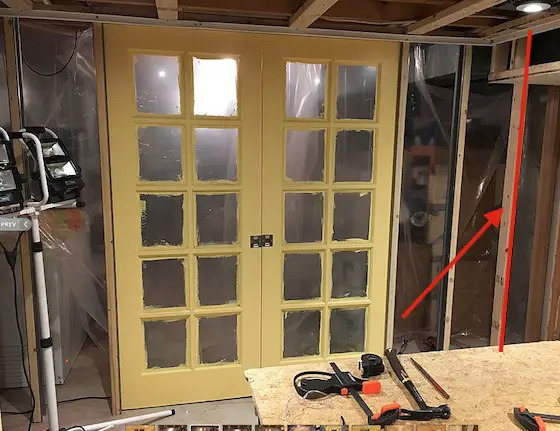
This is a unique photo showing two converging pockets doors being installed. The frames are in and for some reason, the homeowner put in the doors at this stage. It's not necessary to do this. Look to the right and the vertical red line is on the edge of the first full wall stud at the end of the pocket on the right. The bottom and the middle of the red arrow cross over the two thin studs capped with steel. These create the pocket and you use short drywall screws to attach the drywall. Copyright 2017 LE Johnson Hardware, Inc.
What are the Best Pocket Doors?
The best pocket doors start with the best frames, track and trolleys. You don't see any of this once the pocket door is installed and the walls are finished.
Here's the only brand I'd ever install. They're simply that good. I've had LE Johnson pocket door frames/hardware on all my jobs and in my own home for years.
Note below in the photo how the trolleys have three wheels. This type of trolley ensures they never jump off the track.
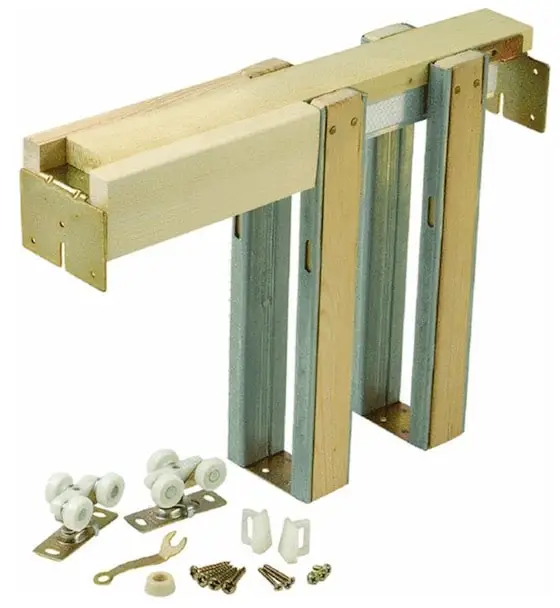
This is a miniature version of a LE Johnson pocket door. The vertical legs create the pocket. The track is hidden in the horizontal top member. The three-wheel trolleys are in the lower left. Copyright 2018 Tim Carter
Is it Hard to Get Old Pocket Doors to Work?
It can be very hard to get old pocket doors to operate smoothly. The design of the hardware is flawed and it's almost impossible to get parts.
Do you have an old set of pocket doors that you wish to revive? It may be tough to do it if you are looking for used parts.
If you're a purist and must stay with old parts, you can try to find them online. Many small independent hardware stores ply their wares on Amazon.com. CLICK HERE and start hunting!
Can I Install New Pocket Door Track and Trolleys with Old Doors?
Yes, you can restore old pocket doors and install new trouble-free hardware and trolleys.
If you can't find parts, don't get discouraged. The heart and soul of a pocket door system are actually the track above the doors and the rollers, or trolleys, that attach the door to this track. There is absolutely no reason whatsoever why you can't put a new track system in an old door pocket.
How Do You Install the New Track and Trolleys?
You have to remove the old track and trolleys to install the new ones. It's somewhat painful to tear into the wall, but it's worth it.
Getting it in will be a challenge and may require surgery on the wall, but this can be easily repaired. I urge you tackle this project with a positive attitude. It will be tough at first, but the outcome will be dramatic.
CLICK HERE to get FREE & FAST BIDS from local finish carpenters that specialize in pocket doors.
How Do I Solve Common Pocket Door Problems?
There are a few things you can try to solve common pocket door problems.
Problem: Does your door jump off the track and get stuck in the pocket?
Solution: Look at the wheels or rollers. If they're single-wheeled rollers, you have an inferior system. The best pocket door hardware has 3 or 4 wheel hangers that fit into a box-shaped track. It is impossible for this type of roller to jump off the track.
Problem: Can you easily remove the door after one side of the top split jamb is removed? If not, you can have big problems.
Solution: You can buy a pocket door hardware system that allows you to easily disconnect the door from the 3 or 4 wheeled hangers. Within moments the door will be in your hands, not in the pocket!
Problem: What happens if the track gets damaged? Can you easily remove it?
Solution: If your track does not have keyhole shaped slotted screw holes, you will be in for a treat. I guarantee you will be tearing into the wall to get at the track screws deep in the pocket. A track with keyhole-shaped screw holes eliminates this problem.
Problem: Does your door rub the split jamb when it is pulled in and out of the pocket?
Solution: Check to see if there is 3/16th-inch clearance between each side of the door and each jamb.
If you have this clearance and the door still rubs, the door may be warped and/or the entire pocket door assembly may be twisted. If this is the case, it will require major reconstructive surgery to solve the problem.
The problem with rubbing doors can sometimes be traced to the bottom door guides. An inexperienced carpenter may install these on the wrong side of the split jambs! They are supposed to be on the face of the jamb. This allows you to adjust them easily.
Do Pocket Doors Need to be Painted Before Installation?
Yes, you need to paint the pocket door on all sides, top, bottom, and edges before it's hung on the track.
Pocket doors require some tender loving care from the painter as they are being installed. Once installed you can't get to the top, bottom, or back vertical edge. These surfaces MUST be sealed to prevent warping. This can only be accomplished as the door is being worked on by the carpenter.
If you paint the door, it is simple. Just apply a primer coat to the entire door as soon as it arrives at the job site. Then have the painter apply a finish coat to the edges of the door before he hands it over to the carpenter.
If the door is to be stained, it will be a little more difficult. The painter will have to carefully apply a sealer to the top, bottom, and hidden vertical edge. If you get sealer on the face of the door, the stain will not penetrate properly. It will really look horrible. Coordinate this carefully!
CLICK HERE to get FREE & FAST BIDS from local finish carpenters that specialize in pocket doors.
Column B190

Tim built custom homes and did ultra-custom remodeling for 20+ years before launching his Ask the Builder media presence. He was selected as one of the Big 50 by Remodeling magazine in 1993. This award gave birth to Ask the Builder in October 1993. Tim also operates https://DrawPlumbingPlans.com. His @askthebuilder YouTube channel was the first home improvement channel on YouTube.

Do pocket doors ever require lubrication? I am at my brother's home and noticed that a door that used to slide just fine, is tougher to slide than I remember last year. This bathroom door has about 6 years of service and is the busiest door of the 3 pocket doors he had "professionally" installed. The other 2 doors slide great, this 1 I'd like to fix for him and am wondering how to approach the situation.
Ray, you need to schedule a 15-Minute call with me. There's simply too much to talk about and type.
I have an old house with 2 sets of double pocket doors. I can't adjust them because they do NOT have rollers. They are on some kind of pantograph system in their walls with heavy cast iron mounting plates. Where can I get info on these old doors that won't close correctly?
Stan ; Jermyn PA 18433
Stan, your question requires lots of typing, plus I have some questions for you so I can give you the correct answer(s). I only do pithy answers here in the comment section. If you want to protect the investment you have in your house and not waste time or money *hoping* you make the right decision, you should talk to me on the phone for just 15 minutes. It'll be the best investment you've ever made in your home!
Tim you said that a single wheeled rollers are inferior systems. I agree. Would it help to put 3 or 4 single wheeled rollers spaced evenly across the top of the door, rather than the 2 single wheeled rollers I have now?
Yes. But good luck doing that.
We have several pocket doors we installed but when the door opens it goes all the way into the wall making it hard to grab to pullit out to close. Is there anything we can do to keep the door out of the pocket a little?
Stacy,
Walter, this is what my 500-Second Consult is all about. Click the Shop icon at the top of the page!
We have a pocket door that just sways in the breeze. At the bottom of the door aren't there supposed to be support wheels that guide the door straight? Or am I just missing something, thanks for your help.
Russell, Walter, this is what my 500-Second Consult is all about. Click the Shop icon at the top of the page!
Hi,
We have the same issue - a pocket door that sways in the breeze with no bottom guide or fixture. The paint is scratched on the door because it rubs against the side of the wall. Could I sign up for a consultation on how to fix this? Thanks!
Here's how to set up the consult call: https://shop.askthebuilder.com/products/15-Minute-Phone-Conversation-with-Tim.html
Hi Tim- My builder just finished installing double pocket doors in my home and he is now on to another job. My problem is that I just realized the doors, if not pulled out together to meet in the middle, will come out of the pocket completely and past the center point. Is there anything you can do to make sure each door stops at the midpoint?
thx
e
I am desperate to find a way to make my pocket doors stop in the center too! I'm told it is called a door post but multiple visits to hardware/home improvement stores and online searches have yielded nothing! I see that something was up there in the center of the top tracks (plate marks and two holes for nails/screws) but no idea what it's called or what it looks like, HELP!
Did you find a solution? My 110 year old house has old double pocket doors that work great...but if you're not careful, you can pull one out too far and one not far enough. They do not meet necessarily exactly in the center all the time. Is there a double door stop I can find that goes in the middle to keep one from overextending?
the back set of wheels came off the track,how do you get to them to put back o track.
With great difficulty. They'll come off again.....
When we walk across our bedroom floor, the wall that hold a pocket door creaks. Any ideas to get rid of the creaks?
Yes. Read my past columns on floor squeaks!
My wife and I purchased a home a couple years back. The deed says it was built in 1890. She removed the trim from our pocket doors after I asked her not too while I was working. One side works just fine but the other will not close no . Its stuck open. The roller system is cast iron with 4 rollers for each hange . Each door has two hangers. I can see what looks like set screws I'm assuming to adjust the heigth. But what im confused about is how the rollers attachvto the door. They look to be slotted but I am unable to get them to stay. Any advice would be greatly appreciated.
I'd have to be there Larry..... Usually it's a common sense thing. Study it and study the way the parts interact. You'll figure it out.
My contractor hung a bathroom pocket door with a 1 1/2" clearance between the bottom of the door and the floor. Short of pulling off all the trim to remove the door is there any other way a piece can be added to the bottom of the door. Would like to keep noise inside the bathroom
I have a pocket door, about 10 years old, that naturally slides shut all the time without being pulled. Am I correct in thinking that the only real solution is to remove the door and remount the track so that it is level, or has a slight negative cant to help the door stay in the pocket?
How do you adjust the slide on a pocket door? When I slide the door closed the door rubs the frame on scrapes the paint off one side of the door.
I am having a house built and wanted to know if there is something I could do in the building stage to insure the smooth operation of pocket doors. I read about priming as soon as possible. Is there anything that could be added to the interior frame surface to make door glide smoothly in & out? We live in a humid location. Should frame be sealed?
Theresa,
The FIRST thing is to put in the BEST pocket door frame on the planet. This is the ONLY one I'd use:
http://amzn.to/2j6Jr2Q
Then you absolutely need to paint all the doors on all sides and edges BEFORE the doors are installed in the pocket.
I have been a contractor for more than thirty years. I hate it when people - especially people like you - claim that pocket doors save space. Fact is that pocket doors don't save not even one square inch of space. They may be more CONVENIENT, but they don't save any space. Walk up to any door. You must stand in front of the door to open it and pass to the other side. There is a minimum 30 inch square area the door clears to allow for your presence before you pass thru. Then, on the other side there exists the SAME exact square space that allows you to exist after you've passed thru. Do the same for a pocket door. There does not exist a pocket door that adds to that space! Not only that but you can't hang a robe hook or sign, a picture or anything else that lot's of people do, to a pocket door.It's time everyone starts using valid logic.
Dear A.,
The space the PR people and manufacturers talk about is the quarter circle of floor space once the door starts to swing past 90 degrees as you open it. Some people like to put a door all the way back against a wall making a 180-degree arc.
We propose that you come up with a new term to describe this wonderful characteristic of the magic pocket doors. With a pocket door, one can now place a piece of furniture in that otherwise wasted space.
Let us know when you have coined a new descriptor. I'll then forward it to LE Johnson for their review.
P.S. There are many more things to get your blood pressure up rather than this. How about focusing that energy on getting some of your peers to do quality work rather than sub-standard quality I get so many complaints about.
Prior planning and request for pocket doors before you start building are a must. You can't change your mind once the door is framed. We installed four pocket doors 27 years ago in our new house. Never have had a bit of trouble. They work fine and love the convenience of not having a door in the way. Don't know what kind or how many rollers but the builder must have known what he was doing. I requested them and they have been great.
So you can have good luck with them. I suggest you don't let kids play around with opening and shuting them for the fun of it though!
Does somebody know if there is a stop or catch on an old pocket door? I just started rehabbing a house and found a pocket door that had been covered up. It worked fine for a few days and then all of a sudden it stopped halfway on the track as if there is a couch or something holding it. The rail is clear so there has to be a stop somewhere? Please advise. Thanks
I have a pocket that door slides halfway open on it's own. It didn't used to do this. Is there any way to adjust it so that it doesn't slide open anymore?
If a pocket door open or closes on its own, it is because the top track is no longer level. Here in California it is not unusual for a house to shift a bit after an earthquake.
On an LE Johnson pocket door, you might try snugging up the LE Johnson "1550 Door Guides" located at the bottom of the pocket's jam to rub a bit on the door to prevent it from opening or closing on its own. If your door DOESN'T have door guides you can add them. They only cost a couple of dollars.
Our pocket door has worked perfectly for the 17 yrs. we've lived in our home. A pantry abuts one side of the pocket door wall. Recently, a shelf support in that pantry pulled loose and made a big hole in the sheet rock. We repaired the hole and shelf support, but a couple weeks later, I was opening the pocket door and heard something fall inside the wall. It may have been a piece of the damaged sheet rock. But, now the door won't close all the way. About 3" of the door remain in the doorway. Is there any way to remove the obstacle so the door goes back in the wall all the way again? (Please respond in my email as I don't know if I'll get back to this site again any time soon.)
Help! I've just had a tiny house built. Have 4 pocket doors. Builder is telling me it is code not to have the door open flush. I have a motorized wheelchair to fit into the door space. the 1/4" makes a big difference. Is this true it is code? This palm beach county FL
Beverly,
Well, there's only one way to find out, wouldn't you say? You get a copy of that section of the building code and you see what it says.
The easier way is to pick up the phone and call the building inspector for your town. Talk to him.
If I were a betting man, and I do occasionally bet at the Bellagio black jack table, I'd say your builder sits on a throne of LIES.
My pocket door track has no screw holes that I can see. Not sure how it is supported. Suggestions on it removal.
I have a sliding interior pocket door which sags at one end because the screws that attach the metal plate to the top and are part of the suspension are loose. I can partially and temporarily tighten them with a some curved needle nose pliers. Is it possible to actually remove the door and tighten the wood screws properly?
Yes. Just read the column above. Remove the trim and jambs around the door so you can get the door off the track.
If we’re remodeling our master bedroom before our master bath and we’re installing a pocket door as the bathroom door in place of the old door, will it effect the new laminate floor we’re putting in the bedroom?
Not if you have a top-notch contractor on the job that can look ahead at what's happening with respect to the finished floors and how they interact with one another and the door.
Hi Tim! Our RV came with a pocket door. My problem is, how do you clean the pocket? There's a ton of cat fur and dust that has collected there that I disturbingly found last night, but my broom or vacuum attachment won't fit in the space. Any advice?
Get a piece of clear plastic pipe from a hardware store that WILL fit in the groove. Fashion it to fit to the end of your vacuum hose with an adapter or two. Get it long enough to reach. Tape a dowel rod to it to keep it rigid.
How do I frame a pocket if there is a perpendicular wall to the wall where the pocket is. Can that be done?
Kevin,
Simple! Please watch the second video from the top of this page. The one where I show a pocket door framed up. Just mimic this in your situation.
Hi Tim:
I had a pocket door made to order (wood and glass). My contractor installed it (we built the wall to house it), but realized after that the door was not prepped for any hardware. Are there alternative ways to have a way to open and close and retrieve the door from the wall without cutting into the door to mount standard options
Jessica,
I'd have to see photos and complex situations that are beyond a "Yes, No or one-sentence" answers I shuttle off to one of my paid consults. Here's how to set up that call. I think I've got the perfect solution, but I'd need to see photos of the setup.
http://shop.askthebuilder.com/products/15-Minute-Phone-Conversation-with-Tim.html
Hi Tim,
We are about two weeks away from moving into our newly (completely renovated) home. The pocket door we installed for our powder room slides too fast for comfort. Is there any way to slow it down without having to take off the trim, drywall etc?
A builder has installed two big pocket doors at our house however they have a lower track that I didn’t want. They are 2.8 metres wide and the other one is 2 metres. Both in a 2.35m ceiling. It means our wooden floor will not run smoothly between rooms.
Is it possible to remove the lower track, or will that be problematic?
Thanks in advance!
It's impossible for me to give you the BEST answer without seeing them. Sorry! Apply some critical thinking skills to the issue and see what options you come up with.
I have a lot of warm humid air coming in by pocket door. Is there anyway to close off the opening around the door?
I have doors that are 38” wide being used as converging pocket doors. Should I use Two 36” frames and space them apart a bit, or get a 42” frame and cut it?
Hi, I have pocket door that stops half way and sounds like it bangs against something. We have to push it forward some in order for it to close. Any fixes?
Yes. Remove the top and side split jambs and investigate what is causing the problem. If you need detailed step-by-step help, I offer you my protection: https://shop.askthebuilder.com/15-minute-phone-or-video-conversation-with-tim/
My pocket door seems to be on the tracks but about 4 ft from the floor we can see a screw from the inside wall and it is keeping the door from opening. Maybe they didn't want it to move? Anyway, any clue about how to cut the screw without having to take the entire track and door out?
I installed new trolleys on an old track. Once I got the door back on and opened it all the way, it became lodges in the pocket. It's totally jammed now and I'm really not sure what to do next. Any advice on what I should try next?
Yes. Bite the bullet. Put in the pocket door I link to.
Have a pocket door that knocks/ bangs every to you slide to open the door. Every thing looks square and plumb, but when closed, the door appears to be angled. Top of door faces one direction, botyom if door faces opposite and the door lock does not align with the door lock strike plate. How do you adjust this ?
My pocket door keeps going out of alignment. I move the screw but it keeps loosening over a couple week period. Is there a way to keep the door level? Thanks.
New Construction: the pocket door installed is extremely wobbly when opening and closing. It moves back and forth a lot . Is this normal?