Extension Ladder Sizing

Follow Me on Twitter.

By Tim Carter
©1993-2010 Tim Carter

Summary: An extension ladder needs to be the right height for your job to be done safely. Extension ladders should be purchased with more length than the highest point you will need to reach. Check out this extension ladder sizing table to determine the safest sizes for your needs.


Extension Ladder Sizing

If you are getting ready to buy an extension ladder, you want the right height ladder to do the job. If you have a multiple story house - say one that is 2 and one half stories, a single extension ladder will not do all jobs. If you buy a ladder to reach to highest point on your house, it will be too long for the short jobs. Buy your short ladder first and see if you can't rent or borrow a tall ladder for the once-in-a-great-while tall jobs.

Extension ladders are usually sold in even foot increments, such as a 16, 20 , 24, etc. A 16 foot ladder consists of two 8 foot sections that are mated together. Because an extension ladder needs to overlap, its maximum length when extended is less than the length you thought you bought! The following table should help you see what I mean.

Extension Ladder Sizing Tables

Extension ladders should be 7 to 10 feet longer than the highest support or contact point, which may be the wall or roof line. This will allow enough length for proper setup, overlap of ladder sections, height restrictions of the highest standing level, and where appropriate, the extension of the ladder above the roof line. The highest standing level is four rungs down from the top.

The highest permitted standing level on a stepladder is two steps down from the top. A person standing higher may lose their balance and fall. A person’s maximum safe reaching height is approximately 4' higher than the height of the ladder. For example, a typical person can safely reach an 8' ceiling on a 4' ladder.
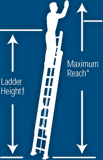
Ladder Height Maximum Reach* Highest Point the Ladder will touch ++
16' 15' 9' max.
20' 19' 9' to 13'
24' 23' 13' to 17'
28' 27' 17' to 21'
32' 31' 21' to 25'
36' 34' 25' to 28'
40' 37' 28' to 31'
* Assumes a 5'6" person with a vertical 12" reach.
++ Support points for extension ladders reflect section overlap, ladder angle, or 3' extension above roof line.

Sizing Guide table and graphic courtesy of Werner Ladder Company


Comments:

Elaine Perkins
30 Nov 2008, 17:36
If you have an extension ladder that measures 16 ft. not extended,
how long will it be extended to max extension?
remlo
12 Dec 2008, 22:09
it is very nice idea
John Cable
21 Jun 2009, 04:55
Crazy, but making a 20 foot extention ladder 10 feet longer. If I Overlap two fully extended ladders making it 10 feet longer,and being very careful to spice the two together. I was going to was good wire and rope. I want to trim a few branches that are 28' high. I don't have a vehicle to rent a longer one. Please help I want to be safe and I feel pretty good on ladders.
Joseph
11 Oct 2009, 16:13
Ladders are strange creatures. You cannot merely say to yourself that the item you need to work on is this height, so you need an equally tall ladder.

Oh no! Remember, for safety reasons, it is recommended that your ladder be 1' foot away from the building wall for every 4 feet you intend to climb up.

(I would not want to be up 20+ feet with my ladder only a mere 3 feet away from my house wall).

It would be nice if ladder manufacturers and hardware companies would provide a ladder size value based on all the factors.

i.e. My 20 foot extension ladder can only really extend to a maximum length of 16-17 feet. After that, it runs out of rungs to lock against. Then factor that at 16 feet up, you need to have the bottom out 4 feet. This means, my maximum touch point is well under 16 feet for my "20 foot extension ladder"

I'm certainly wishing now that I bought a 32 foot extension ladder. I have a peak roof and I wanted to set up Christmas and Halloween lights this season from under the roomline, but I need a ladder that will extend and touch the wall at least 20' up the bottom while being back about 5 feet from the wall.

Is there a chart somewhere that shows various extension ladder lengths, factoring in how far the base needs to be out at various length settings and how far the touching point will be at each setting?

I don't want to buy the wrong length ladder again. I estimate the underside of the peak of my room to be about 20 feet up.

Roger
13 Oct 2009, 07:13
Joseph,

Tim has that chart in the article above.

     View all comments
*Name:
Email:
Notify me about new comments on this page
Hide my email
*Text:
Security Image:

Visual CAPTCHA


Contact us to Advertise on this site.
Have a Suggestion?
Do it right, not over!

Ask the Builder Comment Help

Thanks for stopping by! The Comments Section of my AsktheBuilder.com website are a place for you to share stories about how you've solved a similar problem at your home or carry on a conversation with other visitors. I tried, at the beginning, to be part of the conversation, but there were too many questions being asked and it was impossible for me to keep up and get my regular work finished each day.

If you want to ask me a direct question, you should go to the Ask Tim page of this website.

Helpful Comment Tips: If you need help with a problem, please try these things now before you type in a comment. You could discover your answer in just minutes.
  • Read ALL Comments Before Submitting One: If there are lots of comments that are already part of this column, there is a very good chance your question has already been answered by me or someone else.
  • Read Similar-Titled Columns First: The column above is almost always part of a two-or-three-part series. The answer to a question you may have is probably in a related column or in comments that are part of that column.
  • Read Columns in a Category: Take the time to read many columns in a category. The amount of information you will discover will amaze you.
  • SHARE a Story: Please share any tips or amusing tales of glory! Tell others what has worked for you. Maybe you have a disaster you want to discuss. Let's collaborate so we all learn together.
Don't show this alert again.