Attic Trusses – Room Size
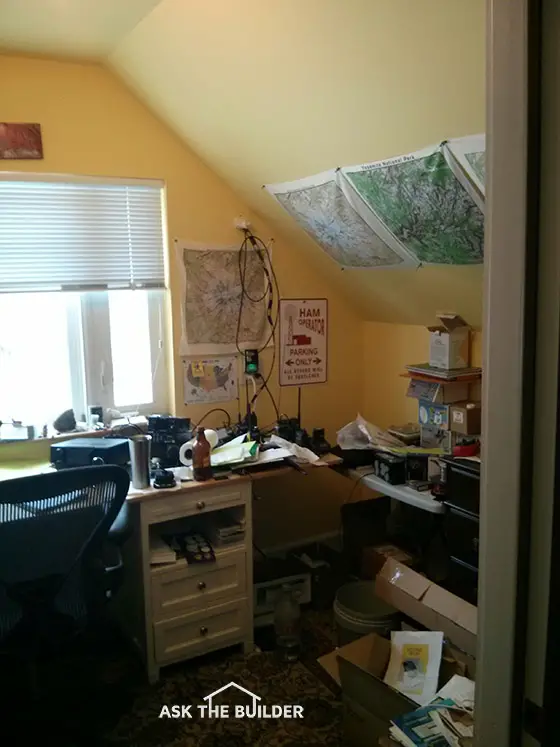
Attic trusses created this room. This is my cluttered man cave and ham-radio shack. This room is over the garage of my New Hampshire home and it was created using attic trusses. The room is 12-feet wide, the vertical wall to the right is 4-feet tall, the ceiling above is 8-feet tall. The wider the structure is, the BIGGER the room can be. The steeper the roof pitch, the HIGHER the ceiling can be in the room - within certain limits! - © 2018 Tim Carter
Attic Trusses Checklist
- Attic trusses create a room inside the truss!
- Very small extra cost for the added room
- Steeper-pitch roofs create bigger rooms
- Order taller heel height for more insulation space
- CLICK HERE to Get Tim's FREE & FUNNY Newsletter!
Best Way To Frame - The SBCA - The Authority on All Things Trusses
You can get the best information about attic trusses, and all other structural building components, by visiting the Structural Building Components website that was built just for you.
Attic Trusses - Create a Free Room or Rooms
My friend, Loren Power, will be the first to tell you that I made a mistake on his house. He trusted me to build his home and it was one of the first I had ever done.
He was the one who pointed up into the vast attic space of his home and said, "What a huge waste of space. Why didn't we make some sort of room up there?" Of course this was after the entire roof was constructed and it was too late to turn back.
CLICK HERE to get FREE & FAST BIDS from local carpenters who can install any trusses for you.
Loren's comments years ago quickly put me in my place. It was obvious that I still had lots to learn about offering options to homeowners.
Do Steeper Trusses Create Bigger Rooms?
The steeper the roof pitch, the bigger the rooms will be. My daughter's house has attic trusses. The house is only 28 feet wide with a 10/12 pitch and she has a giant room that's 18-feet wide with a ceiling height of 9 feet eight inches!
If your new house will have a steeply pitched roof - say 10 inches of rise for every 12 inches of run (10/12 pitch) or more - then you can gain some very serious room if you upgrade to an attic truss.
For example, if your house is a 50-foot-long by 38-feet-wide structure, you can get an attic truss that will allow you to create a full height room (8 foot ceiling) that is 16 feet wide by 50 feet long!
That's 800 extra square feet. Think of how you could slice and dice up that space into different rooms.
How Much Extra Money Do Attic Trusses Cost?
My guess is that the national average for an attic truss that will create the space we just described will cost you about $100 more than a regular common truss. These prices change with the demand for lumber.
For the 50-foot-long room, you'll need about 24 trusses. This is $2,400 plus the cost of the plywood subfloor. Let's say plywood costs $20 per sheet for 3/4 inch tongue-and-groove yellow pine. We'll need 25 sheets to cover our 800 square foot space. This will add an additional $500 to our material cost. We are now at $2,900 plus tax. Let's just say it will be $3,100.
Get out the calculator. $3,100 divided by 800 square feet equals just $3.88 per square foot rough construction cost!
That's a HUGE bargain, especially when you compare that to the overall cost of your house.
Not only that, this cost is almost purely material cost. The labor to set the trusses is no different than had you not included the room. You would be a fool not to create this space or at least a partial space up in the trusses.
Can You Store Things in Regular Trusses?
No, regular trusses are not designed to act as storage or attic trusses.
I received an e-mail from an individual. He had discovered a hidden storage space up in his attic.
His dilemma was whether or not the floor of the space could support the weight of storage boxes. Had the builder installed attic trusses or their step-sister storage trusses, I doubt I would have received the e-mail.
My advice was him to get a FREE & FAST BID from a local structural engineer who'd come out and tell him what he can store up there. NEVER take a chance. Get a bid.
Can You Create a DIY Truss?
Yes, you can build your own truss or trusses. The issue is how you make your connections and if you've done all your calculations correctly.
How well did you do in high school geometry? If you did fairly well, then cutting roof rafters will be a piece of cake.
All you have to keep in mind is the fact that there are primarily two cuts in rafters. The ones that are straight up and down (plumb cuts) just like a plumb line and level cuts (heel cuts). Rafters simply have a series of cuts in them, all of which are either parallel with one another or oriented at 90 degrees to one another.
Watch my Framing Square VIDEOS to see how this is done:
How Do You Make Angled Rafter Cuts?
To cut a rafter you need to know the pitch of the roof. This is the rise and the run relationship. By convention, we call it out as the number of inches a roof slope climbs as you proceed 12 inches horizontally across the roof. An example would be a 4/12 pitch roof. The roof "rises" 4 inches in height for every 12 inches it "runs" horizontally.
A framing square will create the series of parallel lines and perpendicular lines if you simply slide it along one of the edges of the rafter. Note that a framing square has two legs. The narrow one that is 16-inches long is the tongue.
The fatter one that is 2-feet long is the body. The are oriented at 90 degrees to one another.....now isn't that a coincidence.....?
Note that there are markings - in inches - on both the inside and outside edges of the square. The starting point of the markings is at the corner where the two legs meet. This is important. You must decide to use either the markings on the outside edges or inside. I happen to like using the outside edges of the framing square.
Get some scrap pieces of 2 x 4 and practice making these two cuts.
CLICK HERE to get FREE & FAST BIDS from local carpenters who can install any trusses for you.
How Do You Make 4/12 Rafter Cuts?
Let's say we are doing a 4/12 pitch roof. Find the 4 inch mark on the outside edge of the tongue. Locate the 12 inch mark on the outside edge of the body. Position the square so these two marks are touching the same edge of the rafter your are going to mark.
Watch the videos above to see this done.
Note how the square is oriented at an angle across the rafter. The tongue of the square is creating your plumb cut where the rafter will rest against the ridge board. The body is creating the heel cut where the rafter will sit on top of the wall. We could mark and cut right now if our span was just one foot. But we aren't building a cat house!
How Do You Calculate Rafter Length?
Let's go back to geometry. The rafter square makes two sides of a right triangle. The sloping rafter makes the third component - that being the hypotenuse.
The length of the hypotenuse is what goofs everyone up. How do you figure out the length of the rafter? It is simple mathematics. It has already been done for you if you buy a quality framing square. There are tables on the body of the square that tell you how long the rafter is for the different pitches for each foot of horizontal run.
You can also purchase books, booklets, or fancy construction calculators that will instantly tell you the rafter length as long as you plug in the rise, run and span values. Once you grasp how to orient the square, this is your only other challenge.
How Do You Do Ridge, Tail, and Seat Cuts?
If you do the pure math to figure out rafter length, you will always be a little long. Why? Just about everyone uses a ridge board.
You need to shorten the rafter for half the thickness of the ridge. This often means slicing off an extra 3/4 inch off the plumb cut at the one end.
The seat cut is the notch where the rafter sits on the wall. Don't make this too deep. Never cut out more than 1/3 the plumb cut distance into the rafter.
The rafter tail cuts where the roof ends are best made - in my opinion - after the roof is framed. If your wall is not perfectly straight - most aren't - your gutter board will mimic the curved line of the wall if you cut the tails at the same time you make all your other cuts. It is more work to do it in the air, but it is well worth it.
How Do You Install Trusses?
Trusses can be installed using just man or woman power or you can get help from a crane or any other machine that can safely lift the truss and set it into position.
Every year many construction workers get killed or seriously injured from truss assemblies that collapse suddenly during construction. The most common problem is that the trusses were not braced properly and sufficiently during the erection process.
Attic trusses almost always need to be set by a crane. They're extremely heavy.
All truss manufacturers will gladly supply you with a booklet showing how to brace trusses as you set them on top of the walls. A simple 2x4 or series of parallel 2x4's providing the 16 or 24-inch spacing isn't enough! You need additional diagonal braces that make X's on the top chord of the trusses.
Larger trusses often need similar diagonal bracing on the vertical center post web member too. the larger the truss (both height and span) the more complicated the bracing. Gravity, wind, the motion of workers, and an unexpected bump by the crane can easily topple a truss roof during construction.
Don't try to ever set attic trusses if you've never done it before. Have a seasoned crew of carpenters there to assist you.
CLICK HERE to get FREE & FAST BIDS from local carpenters who can install any trusses for you.
How Do You Install Complicated Trusses?
If you're setting a hip roof made from trusses, you will probably have girder trusses, special hips, etc. There's a certain order in which the components must be set. Not only that, you work from the two long ends of the roof towards the middle.
The truss manufacturer will almost always provide you with a set of erection instructions to help you. If you're a rookie, I wouldn't think of trying this without some experienced help.
CLICK HERE to get FREE & FAST BIDS from local carpenters who can install hip trusses for you.
Column B203

Tim built custom homes and did ultra-custom remodeling for 20+ years before launching his Ask the Builder media presence. He was selected as one of the Big 50 by Remodeling magazine in 1993. This award gave birth to Ask the Builder in October 1993. Tim also operates https://DrawPlumbingPlans.com. His @askthebuilder YouTube channel was the first home improvement channel on YouTube.

Hello,
My husband and I are embarking on a new build/renovation to an existing 24' by 36' story and a half cape cod with knee walls. We are planning on our addition to be 24' wide by 26' in length, to add a larger living room in the main floor and an extra bedroom and bathroom in the top floor. My question is; How do you calculate what the actual "living space' will be for the top-floor area? We are going to be building storage space into the kneewall part, but are having a heck of a time figuring out the top-floor area for bedroom/bathroom sizing. Any suggestions or help would be greatly appreciated...Many thanks, Heather
Heather,
I developed this product just for questions like this. Way too involved to type and would take far too much time. I'm sure you understand the value of time! Take a look at my 15-Minute Phone Consult.
i need help designing an attic room on new construction. house will be 60 feet long by 28 feet wide. I need to knoww what size the room will be at what pitch roof
Carol, your question requires lots of typing, plus I have some questions for you so I can give you the correct answer(s). I only do pithy answers here in the comment section. If you want to protect the investment you have in your house and not waste time or money *hoping* you make the right decision, you should talk to me on the phone for just 15 minutes. It'll be the best investment you've ever made in your home!
I just installed 28' wide attic trusses over my garage, and the attic room was 15'-11" with 5' knee walls and 8' ceiling at the center. roof pitch was 12/12. hope this helps.
Im building a 22 ft wide room do I use 2x4 0r 2x6 trusses Thanks Dan
2x4s will work just fine for the trusses - assuming you use the right lumber species, connector plates AND the trusses are designed by a registered engineer!
Hi my new house is going to be 50 long by 48 feet wide Are you saying in the first paragraph it would be better to use trusses rather then rafters? I am wondering bc we are having a loft Area in the top of our house going down the middle? Thanks!
Correct. Those would be massive compound rafters with a house width of 48 feet! You'd have to have two interior bearing walls for regular rafters.
Using attic trusses, you'll have an ENORMOUS room if you go with a pitch of 8/12 or greater. You'll need a crane and experienced crew to set them!
I'm building a garage 24' x 24' and I want to constuct my own Attic Trusses. Using a 10/12 pitch, I plan to use 2 x 10 for joists and 2 x 4 for rafters and web supports. Can I put the trusses on 2' centers? The walls will be constructed of 2 x 6 modern framing on 2' centers.
We're looking to have a bonus room over the 30'x40' garage in our new house to be built. I'm okay having 6' walls that then pitch up to an 8' ceiling. We're not looking for an aggressively steep pitch so can you give me some ideas on size of the room we might be able to get?
Just go visit a local lumberyard that sells trusses. They'll draw it up for you.
Is it possible to build an attic room out of trusses right on the ground? wouldn't that just be an A-frame?
I currently have space above my garage I would like to make into a walk in closet. It has attic trusses with rectangle opening of 65 wide by 108 tall. In each rectangle they have a diagonal from the top right corner into the bottom left. If I take a 2 by 10 and bolt into the left and right top corners where the cross member meets the roof line can I get rid of the diagonal
NO NO NO NO NO NO!!!
CLICK THE FOLLOWING LINK and get FREE BIDS from local structural engineers who can give you the PROPER WAY to do this:
http://www.homeadvisor.com/ext/32182231
Tim,
Why didn't you consider LP Smart side instead of
Hardie Board for you daughters exterior.
Uh, I'm confused, Shirley! Neither of those products is being used for the exterior. They're going with a dramatic cedar shake-look vinyl siding. Why did you think the house was going to have Hardie Board?
Hi, I’m confused. I thought the whole idea of having an empty attic space above the second floor was so the air in there would be as cold as the outside and prevent ice dams like on the new house we had. The old house we live in now, the bedrooms are literally in the attic space and we have ice damming problems all the time.
Tom
I can clear up that confusion!!! Please use the search engine here at my website and locate ALL of my columns and videos - there are MANY - about ice dams and what causes them. I explain in them how to STOP the leaks and how to PREVENT ice dams. Get back if you have any questions.
Generally I would think that the bottom chord of the Attic Truss and the Rafters themselves would be a wider dimension like a 2x6 or 2x8 to span and carry a load spec of say 55psf? I want to build a garage with attic space (possible living space) with dormers for light and extra room space. The garage width for the roof attic trusses will be 26'-0" wide. Can you comment on the chord sizes and if dormers will be an issue here?
Hi On new construction if the house is 26'wide what is the minimum roof pitch I need for a habitable room with 7' ceiling? Also do I need bigger footings or more expensive foundation work for a habitable attic room?
do you by chance have plans/prints for a 24ft attic truss
what would be the room width with a 32' wide truss on a 12/12 pitch vs a 7/12 pitch
Thanks
Dale