Sizing Air Conditioning
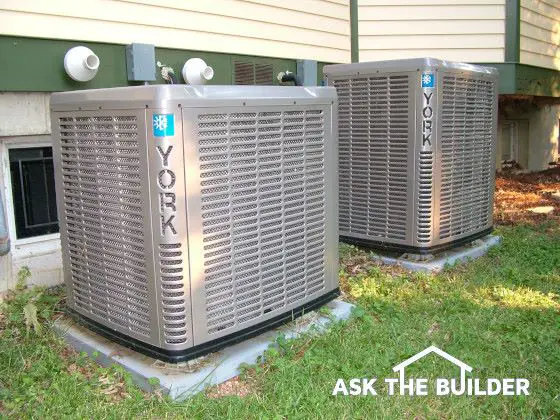
Sizing air conditioner - These are two AC units outside my own home. I have two separate systems in my home, one for the first floor and one for the second floor. The one on the right is a monster 5-ton unit. Richard Anderson did the heat gain calculations to ensure it was the right size. Should you cover AC unit in winter? Copyright 2021 Tim Carter
Sizing an Air Conditioner Checklist
- Do the required Manual J calculations
- Follow all ACCA guidelines
- AC units come in different sizes like shoes and clothes
- Heat Gain calculations provide data so each room is cool
Sizing an Air Conditioner - Do It and You'll Be Cool!
Related Links
Return Air Ducts - Key To Keeping Cool - SECRET INFO - Don't Share!
AC Sizing Problems - Does This Sound Like Your Home?
Why Doesn't My House Get Cool?
Your house may not get cool because it was built like the Gibson's house in Cincinnati, OH. Sizing an air conditioner is very important.
My friends - the Gibson's - purchased a tract home about 15 years ago. It was actually the sub-division model home.
The front of the house has no less than ten windows if I'm not mistaken. One month ago their AC unit gave up the ghost.
My HVAC man, Richard Anderson, installed a new AC unit for them. The Gibsons had always complained about being uncomfortable. They thought the AC unit was low on Freon. It turns out the AC unit was never sized right from the get go. It was 1.5 tons too small!
Do I Need Return Air Ducts?
Yes, you need return air vents and ducts in just about every room of your home. These vacuum hot air from the room and return it to the air handler to get cooled.
To add insult to injury, the Gibson's had no return air ducts from the second-floor rooms. There was just one central return duct in the second-floor hallway. Richard cut a hole in the wall above each bedroom door to allow hot room air to get to the return duct in the hallway.
What is Heat Gain?
Heat gain is a scientific measurement of how many BTUs per hour of heat is generated inside your home.
My HVAC man did a heat gain calculation to make sure that the properly sized unit was installed. He has a neat computer program that allows him to do this.
You can do the same thing by hand - I have done it numerous times - and arrive at the same results.
Does One Size AC Unit Work in the Same House?
No, one size AC unit will not work in all houses even if they're the same. There are many factors that determine the size of an air conditioner.
Tract houses often have similar sized AC units. The builder or HVAC person simply does one calculation and often applies it to all houses that are similar in size. Guess what? This doesn't work!
In the case of my friends, the glass on the front of their house happens to face west-south-west, the WORST possible direction! The blazing sun late in the afternoon cooks the inside of their house. I'll bet that a number of you reading this bulletin have similar situations.
Can Square Feet be Used when Sizing Air Conditioner?
You can size an air conditioner using square feet, but it's not the best way. I'd only do this to just get in the ballpark with respect to the actual size.
Some HVAC contractors try to size AC units by doing a simple square foot analysis. They use a gross multiplier that ranges from 400 (older homes) to 1,000 (newer homes) sq. ft. of floor space per ton to arrive at total BTU heat gain or total tonnage.
This method is unacceptable. If your HVAC person proposes this, find a qualified technician who understands heat gain and knows how to use Manual J.
What is Manual J?
Manual J is a publication created by the Air Conditioning Contractors of America (ACCA)
This manual is used to calculate heat gain and heat loss.
Calculating heat gain is really complex. You must use a booklet called Manual J. This booklet takes you step-by-step through the process making you account for each and every source of heat.
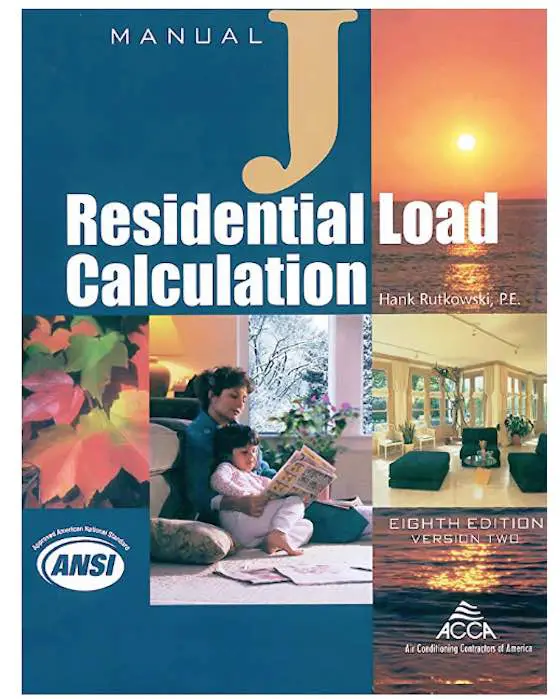
This is the only manual to use to calculate heat gain and heat loss for your home. CLICK THE IMAGE to order it now.
Many scientists have worked over the years to formulate the tables, formulas, and values that combine to form this bible of the air conditioning industry.
You can purchase a copy of Manual J - and I URGE you to do so - if you want to really understand how air conditioning works. The ordering instructions can be found if you keep on reading.
The manual is actually a rather technical booklet, but if you follow instructions well, you can easily work out a heat gain computation of your own. You will at least get close. Don't get bogged down in all of the technical mumbo-jumbo within the manual. Simply take your measurements and crunch some numbers.
How Do I Find a Professional Who Will Use Manual J?
It's best to use a nationally recognized HVAC contractor. CLICK HERE to locate one.
Should I Install a Larger AC Unit to get Cooler?
No, do not install a larger AC unit. It will short cycle.
Some people want to oversize their equipment so they are assured of being cool on those hot days. This can be a big mistake. You actually want to undersize your equipment ever so slightly.
Researchers at Texas A & M found that air conditioners that were undersized by 10 to 20 percent are more efficient and more effective at removing water vapor (humidity) from your indoor air.
Now I will agree with them to a point, but I don't know if I would undersize my own equipment to the 20 percent benchmark! I would go 5 percent at the most....a totally unscientific approach since I have always sized the equipment on my jobs to match or slightly exceed the calculated heat gain.
Oversizing a unit causes problems because the unit doesn't run long enough. You want your air conditioner to run for 15 - 20 minutes at a time. This allows the recirculating air to come into contact with the cold coil inside the air handler.
This is how humidity is removed from the air. You will feel most comfortable when as much moisture is squeezed from the interior air as is possible. Short cycling air conditioners don't remove humidity well at all.
How Do You Calculate Heat Gain?
The first thing you need to do to calculate the heat gain of your house is to purchase a copy of Manual J. This booklet is very likely at your local library and/or you may be able to borrow a copy from a local air conditioning distributor.
The point I am trying to make is that it contains 116 pages of tables, examples, and other valuable information that is physically impossible for me to include in this tiny Bulletin.
My copy of Manual J has an awesome example computation. You can see the floor plan of the house and the computation sheet. This allows you to see how they arrived at all of the individual heat gain BTU's. The example computation will allow you to easily compute your own house's heat gain.
The following instructions are meant to HELP you make sense of the rather technical Manual J. Without the following notes, I'm afraid that you might give up in frustration.
Who is the ACCA?
Air Conditioning Contractors of America (ACCA)
2800 Shirlington Road
Suite 300
Arlington, VA 22206
www.acca.org
Call Toll Free - 888-290-2220
How Do You Calculate Temperature Difference?
OK, it gets much hotter on average in Las Vegas or Dallas than it does in Chicago. This is important as you need to keep in mind the heat intensity when sizing AC. Manual J has extensive tables that will list your city or town or one very near you.
There is a temperature listed that will usually only be exceeded 2.5% of the time. In other words, it can get hotter than that temperature but only for short periods of time. You don't want to design your system for worst case scenarios. If you do this, it will be oversized.
75 to 78 degrees is the recommend interior temperature. You subtract 75 degrees from the temperature listed for your city. This is your design temperature. You will have to round this value to some factor of 5 for all subsequent calculations. In other words, if you arrive at 23 degrees, call it 25.
What About Heat Gain Through Windows and Glass Surfaces?
The largest and most direct source of heat gain is glass. You know this anytime you have stood in front of a window on a hot sunny day. You feel like an egg in a skillet.
Heat gain through glass is affected by the compass direction the glass faces, whether or not the glass is shaded by an awning or trees, the layers of glass, and the total surface area of the glass. This aspect of your calculations is critical. If you make a mistake here, it can be big. Take accurate measurements and be sure of your compass directions.
Your BTU heat gain calculations start once you have measured all of your windows and noted all of the other data. I prefer to add up all of the square footages of the glass that face a certain compass direction. I then only have to go through the calculation one time.
Locate the proper table(s). You will need to know your design temperature, the compass direction, type of shading, and glass thickness. Once you zero in and find the right values, you will cross reference these to a number that is called the "Heat Transfer Multiplier" (HTM).
You take this number and multiply it times the square footage of glass surface for that particular compass setting and shading requirements. The resulting number is the number of BTU's that you are "gaining" through your glass. Write this number down as you will be adding up ALL of the BTU's to get to your total Heat Gain. Note the vast difference in the numbers between similar windows that face West and ones that face North.
What About the Heat Gain of Exterior Doors?
You now proceed through the same exercise for your exterior doors. You will be asked to select a door type and then find your design temperature and cross-reference once again. Use this HTM and multiply it times the total square footage of exterior door types. Once again the resulting total will be BTU's of heat gain from the doors.
How Do I Calculate the Heat Gain Through Walls, Ceilings, and Floors?
You will need to follow the same steps you did in the above exercises to get the BTU heat gain from all other surfaces that are in contact with the hot, humid outdoor air. This simply requires accurate measurements on your part and an investment of time. Do it on a step by step basis following all of the steps in Manual J.
Is Air Infiltration Important?
All houses leak air. Old houses tend to leak more air than newer ones that are of moderate to high quality. There is a special calculation that you must do to find out the BTU's of heat gain your house experiences from air infiltration.
You basically have to calculate the total cubic foot area of your house multiply this times .40 and divide the result by 60. This gives you the cubic feet per minute (CFM) of air infiltration. You multiply this final CFM value time the HTM value on the Air Infiltration table. Having fun yet?
What About Latent Heat Gain Sources?
Manual J will then walk you through a process of determining some hidden heat gain sources. The occupants of the building create heat as do appliances and light fixtures. All of this - even though it is not great - must be accounted for.
The net result of all of this effort is a total heat gain which should be somewhere in the neighborhood of tens of thousands of BTU's. My own home has a total heat gain of about 68,000 BTU's. Remember, you divide the total BTU's by 12,000 to reduce the BTU heat gain into tons of AC. Take your time with the calculations and you will be rewarded. The entire process should not take you over 3 hours.
Read how Tim kept warm in his house in the January 9, 2015 Newsletter.
Column B231

Tim built custom homes and did ultra-custom remodeling for 20+ years before launching his Ask the Builder media presence. He was selected as one of the Big 50 by Remodeling magazine in 1993. This award gave birth to Ask the Builder in October 1993. Tim also operates https://DrawPlumbingPlans.com. His @askthebuilder YouTube channel was the first home improvement channel on YouTube.
I had a Heatmor outdoor wood burner installed about 8 years ago. It is an open loop boiler system that shuts down when the water temp. reaches 180 Deg.. I heat my home water, my detached garage as needed, and my house with this unit. It saves me thousands of dollars since installed. I have more wood blown down each year than I can burn, so I probably will never have to worry about the fuel supply - unless uncle Sam decides to make me stop. Keep up the great articles, I re-post many of them to Facebook or email.
I would like to insulate my basement walls with rigid Styrofoam boards. The boards I see are covered both sides with aluminum foil. I do not want my basement to look like a spaceship. Do you know of any PAINTABLE at least on one side board for this purpose. All the home improvement articles seem to show putting up studs and spray foam and finish with drywall. This is what I would do if I want to create living space but I just want to do something simple for storage space. Do you have any tips on what to do?
1. Don't post questions that are not relevant to the topic being discussed.
2. Go to the search box and enter your questions to see a list of the many columns Tim has written on your subject.
Tim,
Will the Manual J work for heating as well as air conditioning?
We are planning on moving to northern Indiana, which will require both.
Thanks,
Craig
I am torn in what tonnage my new A/C should be. Please help! My house is a 1,496 sq ft one-story bungalow in the Southeast and was built in 1947. It has the original 19 wooden divided light windows and one big picture window, so they are just thick glass and not double-walled or glazed. The house never had a central A/C. I have received unit tonnage estimates from 3 contractors: 3, 3.5, and 4 tons. I worry getting a 4 ton unit would be way too much, but this estimate is from an independent contractor is a family referral that has worked on at least 3 family members' houses for 30 years and highly approved by all.
Is higher tonnage needed for old drafty houses with a lot of old windows bringing in more heat? Should I just shut up and trust this contractor's judgement or try to contest it for smaller tonnage?
Thanks,
Roz