Understanding House Settling Cracks
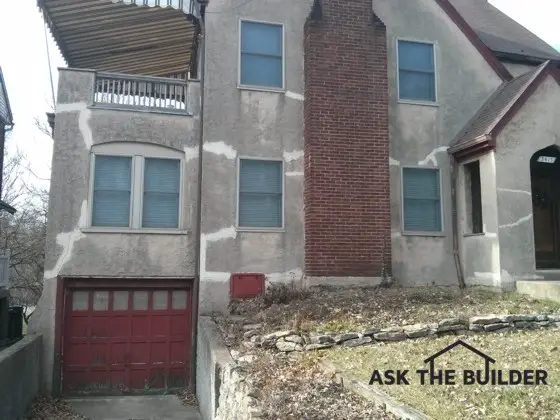
House settling cracks were patched here. See all the white lines? The person who repaired the cracks made several critical mistakes. The stucco should have been washed first. The patching material should have been tested on the side or rear of the home for a perfect match. Copyright 2018 Tim Carter
House settling cracks come in all types and sizes. Settling cracks can often just be lumber shrinkage cracks in new homes. True settlement cracks tend to get larger over time.
Revised February 2018
House Settling Cracks TIPS
- Settlement or shrinkage?
- Poor soil causes settlement
- Great Videos BELOW
- Growing cracks = settlement
- CLICK HERE to Get Tim's FREE & FUNNY Newsletter!
Shrinkage Cracks Most Likely Instead Of House Settling Cracks
Cracks happen for all sorts of reasons. But all too often people name every crack in their house as a settlement crack.
New homes are plagued with shrinkage cracks because the wood framing is shrinking as it looses water. If you feel you have a true settlement crack, the best person to call to get an opinion is a structural engineer.
CLICK HERE to get FREE & FAST BIDS from local structural engineers.
Related Links - VERY IMPORTANT!
Settlement or Shrinkage? Most Likely Shrinkage
How to Match Stucco Patches Perfectly
How To Match Mortar / Grout Colors In Minutes
Concrete Shrinks!
Shrinkage cracks can happen in concrete. For every ten feet of concrete that are poured, be it a wall or a slab, it will shrink 1/16th of an inch in about a year's time.
But people see a crack in a concrete wall and immediately think it's a settlement crack.
Different construction materials have different expansion and contraction coefficients.
House Settling Cracks Video
Watch this short video to see some common house settling cracks.
Some materials change shape and size as they absorb water and water vapor while materials immediately adjacent to them do not budge. An example of this is hardwood flooring. Wood is hygroscopic. That means it changes shape and size as it soaks up water and then releases it.
Mother Earth is a dynamic too, meaning soils can move. But this is somewhat rare unless you live on a steep hillside.
There are all sorts of soil-movement problems in parts of Greater Cincinnati, Ohio because of an unstable soil. It's found wherever you have the Kope or Lower Fairview formation.
You can use geologic maps like the one below to identify bad soils.

This is a copy of a United States Geologic Survey (USGS) geologic topographic map of the East End of Cincinnati, OH. The downtown area would be just to the left of what you see. The Kope and Lower Fairview formations are the light pink rock just above the magenta alluvium that's north of the Ohio River. (C) Copyright 2017 USGS and every US taxpayer that owns the maps. CLICK THE IMAGE TO BUY GEOLOGIC MAPS FOR YOUR AREA.
Understanding House Settling Cracks
If you have an understanding as to why cracks happen, then you can often work to make permanent repairs. There are some cracks that can't be easily repaired.
What's more, it is hard to totally disguise some cracks.
CLICK HERE to get FREE & FAST BIDS from local structural engineers.
Houses Have Hips And Knees
Large houses have joints within them.
These are places where the house relieves movement, just like the joints in our fingers, arms and legs. I often see cracks in modern homes where columns support beams. You can see cracks right where the contact point between these two structural members meet.
Hardwood floors often develop cracks. There are all sorts of reasons for that to happen, and almost always they can be traced to a humidity or moisture problem.
Soil Problems Cause House Settling Cracks
I routinely act as an expert witness in court cases involving poor quality construction. Recently, I finished a case that involved a house built on poor soil.
The builder built a house that was constructed over the top of a ravine that was filled in. Believe it or not, the excavation contractors bulldozed trees, limbs, and other vegetation into a small valley.
Then they placed soil on top of this. They rolled over the soil making it look like a great place to build.
Two years after the house was built, problems started to happen.
The foundation actually dropped several inches in numerous places and caused all sorts of havoc within the home and in its outside walls.
There were huge vertical cracks in the brickwork, the basement floor looked like an earthquake had struck and interior steel I-beams were twisted and compressed so much that they were crushing 2x4 plates. I was amazed at what can really happen when houses are built on poor soil.
Foundation Settlement Repair Video
Watch this short video to see one method to repair foundation settlement cracks.
Insurance Claims
The insurance company needs to be sent a copy of the letter to put them on notice of a possible claim. These letters need to be sent to both companies via certified mail with a return receipt being sent to you. Keep these very valuable receipts.
CLICK HERE to get FREE & FAST BIDS from local structural engineers.
Column B288

Tim built custom homes and did ultra-custom remodeling for 20+ years before launching his Ask the Builder media presence. He was selected as one of the Big 50 by Remodeling magazine in 1993. This award gave birth to Ask the Builder in October 1993. Tim also operates https://DrawPlumbingPlans.com. His @askthebuilder YouTube channel was the first home improvement channel on YouTube.
My house is forever cracking since I renovated and this has really become costly over the past 5 years. The cracks are on the walls and floor especially where the new and old structures are joint together. I need to mention that the area is on a clay soil which looks like the building is "moving" all the times. How can I stop this from going on?
Search instead for My house is forever cracking since I renovated and this has really become costly over the past 5 years. The cracks are on the walls and floor especially where the new and old strucures are joint together. I need to mention that the area is on a clay soil which looks like the building is "moving" all the times. How can I stop this from going on?
.
We need to talk. Far too much to type. http://shop.askthebuilder.com/categories/Consult-Tim/
My wife and I are looking at purchasing our first home. It is a townhouse with beautiful granite counters and wood rails. We were also impressed with the tiled floors, however, there is a crack from the front door to the back along the nicely layed tile. The only other settlement evidence is in the top right hand corner of the door frame. This TH is only 6.5 years old and on the market for 73k. The big question is will the settlement problems stop there or should we let this great deal pass and look for something else.
Tim, I have a new construction home, 3500sqft plus walkout basement. Every night I hear *very* loud popping noises, sounds like possibly in attic. Additional details - live in Michigan, soil seems sandy around home, no cracks in drywall, 1-2 nailpops, and if I had to guess I'd say my house is pretty dry even though I have a humidifier. Any suggestions on what I might do to make sure this is nothing major before my warranty runs out shortly? Thanks for your feedback I really appreciate it.
I cover these questions in past columns here at the website. Use my search engine to discover your answers!
Me and my partner live in a rented 1st floor flat with our 2 children and have been here 2 years. The longer I stay here the worse the cracks in the ceiling are getting the run the length of the house from one room to the next and even through light fittings. The frontroom one has a huge crack through the light fitting and you can clearly see its a deep crack. The bedroom has had wallpaper put up on the ceiling which wasnt noticed till we had been here a few months and the wallpaper is starting to bow in areas. How dangerous is this and can it be easily fixed?
I have avertical crack in my 1930s semi from upstairs window to my window below, it goes right through to inside, I am sooo worried, is this something to worry about, is it serious or easily fixed. I do have a surveyor coming tomorrow but cannot sleep
I'm a disabled vet and I just moved into my newly constructed home in September 2014. A few days after moving in, I noticed two long cracks in the garage foundation and three days later, two more. Took photos and informed builder, was assured it was only the house settling and not to worry.
Last week, I noticed a foot long jagged crack running along the ceiling in my living room (have recessed ceilings) and the start of cracking on all four corners. Builder says same thing, the house is settling.
I admit not being construction saavy, but that didn't reassure me. Should I be worried and should I be looking for a Home Inspector since I haven't been in the home two months?
What else should I be looking for?
I urge you to READ all my columns about: Settlement cracks, concrete shrinkage and ALL columns in my Structural category. Your answers are there. Bottom Line: Your builder is very likely B * * * S * * * ing you.
Hey Tim, I have an issue with an upstairs front bonus room that faces the street and the electric and cable is connected to the front right side of the house. I am tracking forward movement of the front right side of bonus room evidenced by shearing of the drywall tape and separation of the connecting wall. I drew a straight line down and across the sheared tape a month ago and have noticed separation of the line by 2 centimeters. There are no unusual cracks in the foundation on that side of the house because my first suspicion was soil washout and settling issues. Do you have any thoughts regarding this issue? My second suspicion is the electric and cable lines that are connected to a pole across the street and the pole is bending away from my house.
If I understand what you're surmising, the electric and cable lines are not creating the crack in your home. It's very COMMON for utility poles to lean one way or another to counteract the weight of the lines they support, especially at points where the lines change direction such as a curve in the road.
Tim, we remodeled our master bathroom about a year and a half ago. Out went the stick down floor and the built in tub and shower and in went ceramic tile, a stand alone tub (light weight at 145 lbs.) and a separate shower stall. All is well except in the last month below the bathroom (our kitchen) has what I would call settling cracks. Some to he drywall nails have pooped, one of the drywall seems has cracked and in a doorway there is a very small crack running at a forty-five degree angle. If the house was not almost 30 years old I would call all of this settling as all of these things other than the 45 degree angle crack have occurred in other parts of the house throughout the years. Nothing has seemingly moved in the bathroom or in the walls on the first floor.
During remodeling we had the home looked at by a builder to verify that the floor and structure could support the remodel and we were told that the home "was very overbuilt" with 2x8 joists that were 12 - 14 inches on center and there was a triple 2x8 running down the middle of the floor all claims that I verified when the floor was opened up for plumbing work and insulation.
To me these cracks are extremely minor and I think that they should be expected but could you let me know what you think please?
I'd monitor them. See if they get bigger. 2 x 8's joists are not overbuilt in my opinion if the span of the joists is greater than 9 feet! They are the MINIMUM-SIZED floor joists typically allowed in construction. You better go to my website pages and READ all my past columns about span tables. Pay attention to the 1 / 480 standard I talk about.
We moved into a new build in sept it is a raised ranch built in 2014 we have recently noticed cracks in the paint along the stair wells and separation from the ceiling in a few rooms should this be happening already and is it normal
It could be normal. Re-read my column and ANY others that talk about lumber shrinkage.
hi. I've recently got a newly built house and have had several quotes on flooring for my lounge. The flooring people have said the concrete floor needs skimming first as there's cracks and it's uneven and will risk the vinyl cracking after being laid. they've told me to get onto the builders to do it but the builders have said that's how new build floors are and if I want it skimmed then i'll have to get it done myself. is it the builders responsibility to leave me with a floor that's ready for flooring to be laid or is it for me to pay for? thanks
Hi,
My husband is a disabled vet and we bought a brand new construction. We have gone through 3 sups from the builder and our punch list was never fully completed and we are still dealing with the issues 6 months in. Our biggest problem is the second floor slopes. The loft is the flattest point and the two rooms one on each side slope. An engineer came through that the builder sent and it showed a slope of .6" the standard should be .25". But the sup told us that there's no structural issues per the report. They keep on telling us that the trust needs to settle and that's the reason. No cracks that we can see but I know several other houses in our area had cracks due to a trust issue and the settling but they were not the same model house as ours. Is that really true that the trusts are the reason for this slope? Also on my first floor the floor slopes in the master and the guest. They floated the master to fix it and it's better but in the guest they raised it an inch and it still has a slope. They said we just have to live with it that's the best they could do.
Hello 😉 we moved into a brand new Villa in FL about 1 year ago. Noticed a long crack about 1/8" from ground up to below roof line on the side of the building. Other new Villas also have settling problems. Villas were built with cement blocks as per new hurricane code. Should we be concerned?
Hi, REALLY need help. Been in house 12 years. We remodeled an old slaughterhouse, about 4,500 sq ft block bldg. About 8 yrs ago we had our pipes leak under foundation so ran all new PVC in attic. 1.5 yrs ago put new roof on (was tin now OSB with shingles). About 1 yr ago put in pool. On side where pool put in, there's a LOT of block cracking vertically and hotizontally. But, there's cracks other places too. I've tried calling a couple foundation jack companies for eval but they dont call back. We are very rural. Any ideas?
Sandra,
Sounds like you need one of my phone consults. I just hung up with Ron up in Chicago about an issue he has with a squeaking floor. I solved his problem in just minutes.
Go here:
http://shop.askthebuilder.com/products/15-Minute-Phone-Conversation-with-Tim.html
Hi Tim,
We live in large 3 story, 3000+ sq ft Victorian in New England w/ 2 chimneys.
Recently, We started finishing the basement- removed old concrete floor and dug down 18 inches.
Door frames are now out of wack 1/16- 1/8. All door bolts no longer function properly as they dont fit.
Why did this happen, and now that digging is done will it get any or much worse?
How to correct it?
You removed the support from the foundation walls. You've potentially caused tens of thousands of dollars of damage - perhaps $50,000 or more.
You MUST CALL IN a structural engineer NOW - IMMEDIATELY - before the house collapses.
My guess is a house-moving company is going to have to be called in to re-support the home while a new foundation is installed under your home.
I can't believe anyone thought it was a good idea to dig that far down next to the foundation walls..... CLICK THE FOLLOWING URL NOW AND GET BIDS:
http://www.homeadvisor.com/ext/32182231
Tim, House was built in 2006. Nail pops all over. Tile has long crack in it. Now the crack is widening. House is built on sand and I'm on a huge hill. My back yard is sunk down. Trees in the area look like they are falling or lean ingredient. Do you think there is a foundation issue. I'm renting this home. Just had a baby I don't want to live in something unsafe. Thanks
Leah,
If you have a drunken forest around you, it's usually a clear sign of landslide movement. Without being there to see it, I'm at a disadvantage. But from what you're describing with all the defects, something is happening and it's not good.
It's time to start looking for a new place to live.
My house is 2 yrs. old and we heard what sounded like loud gun shots under the livingroom floors.. We have ceramic floors.. Do you know what this could be?
Hi, I am Lee and I am trying to buy this house in Laguna Beach Area. And there is one concern. There is an area in the kitchen close to a door way to garage. And the area is not even with about 1-inch sagging. Owner says it's been no further changes for last 11 years he's living there.--- the house was built on 1973. Otherwise I don't see other cracks. All the doors and windows are working well.
The door to the garage closes OK without jamming but you can notice minlmum slope. Is this anything to be worried? Do I need eval per Structual Engenier as Inspector says? Or is this just stablized settlment?
Confused soul.
Thank you.
Please please please for your financial security go back up to the column and CLICK the text links I provide for Structural Engineers.
See them? Here it is again:
CLICK THIS: http://www.homeadvisor.com/ext/32182231
We moved into a newly built house 16 years ago. It is a three story house. The side of the house that all three floors are above ground has a crack down the wall. I believe the crack is growing in length and wider. My husband says that the house will always settle but I believe that after three years it should be done settling and a bigger issue is at hand. What is normal and where do I go to get information to back up either view? If it could be a bigger issue, what are some possibilities?
Renee,
I'd go back up and re-read my column. When you see the links to get FREE & FAST BIDS from local structural engineers, click one.....
Start keeping a log and MEASURE the crack to see if it's actually growing. That data will be needed for the engineer. Measure at the EXACT same location each time. Make a mark on the crack so you know where you measured.
Hello,
We are first time homebuyers. Bought back in March. Had a home inspection and everything was good. The house was built in the 80s. I am finding several 45 degree angle cracks from a door frame (no door but more of an opening to another room) corner. The cracks are all on the interior walls. The house has a crawl space but no basement. Do I need to be really concerned? I can not find your columns of what you have already addressed. Hope you can answer my question. Thank you,
Alexis Jacobson
Hello Tim. We bought a house last Jan 2017, and now cracks are appearing in many of the door casings. Looks like the previous owners tried to hide settling. I had the builder assess the cracking - they said normal. all night the popping sound can be heard and I'm seeing more "settling". What can I do or read to see if problem is bad? Tried to search for other articles you wrote but cannot find them On your site. Thanks.
Justin,
The reason you couldn't find them is I'm doing a bad job of cross-promoting my content.
I just went up and created a RELATED LINKS section in this column that would have given you your answer.
Read this column:
https://www.askthebuilder.com/settlement-cracks-or-shrinkage/