Understanding House Settling Cracks
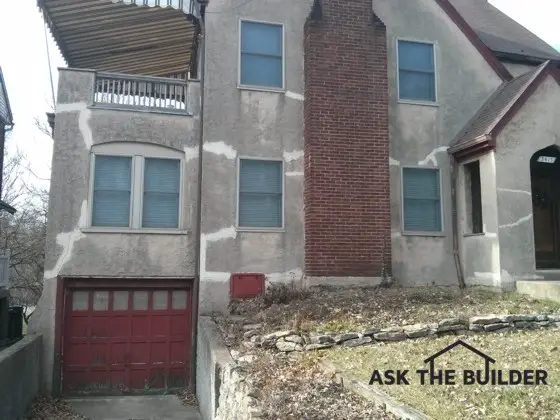
House settling cracks were patched here. See all the white lines? The person who repaired the cracks made several critical mistakes. The stucco should have been washed first. The patching material should have been tested on the side or rear of the home for a perfect match. Copyright 2018 Tim Carter
House settling cracks come in all types and sizes. Settling cracks can often just be lumber shrinkage cracks in new homes. True settlement cracks tend to get larger over time.
Revised February 2018
House Settling Cracks TIPS
- Settlement or shrinkage?
- Poor soil causes settlement
- Great Videos BELOW
- Growing cracks = settlement
- CLICK HERE to Get Tim's FREE & FUNNY Newsletter!
Shrinkage Cracks Most Likely Instead Of House Settling Cracks
Cracks happen for all sorts of reasons. But all too often people name every crack in their house as a settlement crack.
New homes are plagued with shrinkage cracks because the wood framing is shrinking as it looses water. If you feel you have a true settlement crack, the best person to call to get an opinion is a structural engineer.
CLICK HERE to get FREE & FAST BIDS from local structural engineers.
Related Links - VERY IMPORTANT!
Settlement or Shrinkage? Most Likely Shrinkage
How to Match Stucco Patches Perfectly
How To Match Mortar / Grout Colors In Minutes
Concrete Shrinks!
Shrinkage cracks can happen in concrete. For every ten feet of concrete that are poured, be it a wall or a slab, it will shrink 1/16th of an inch in about a year's time.
But people see a crack in a concrete wall and immediately think it's a settlement crack.
Different construction materials have different expansion and contraction coefficients.
House Settling Cracks Video
Watch this short video to see some common house settling cracks.
Some materials change shape and size as they absorb water and water vapor while materials immediately adjacent to them do not budge. An example of this is hardwood flooring. Wood is hygroscopic. That means it changes shape and size as it soaks up water and then releases it.
Mother Earth is a dynamic too, meaning soils can move. But this is somewhat rare unless you live on a steep hillside.
There are all sorts of soil-movement problems in parts of Greater Cincinnati, Ohio because of an unstable soil. It's found wherever you have the Kope or Lower Fairview formation.
You can use geologic maps like the one below to identify bad soils.
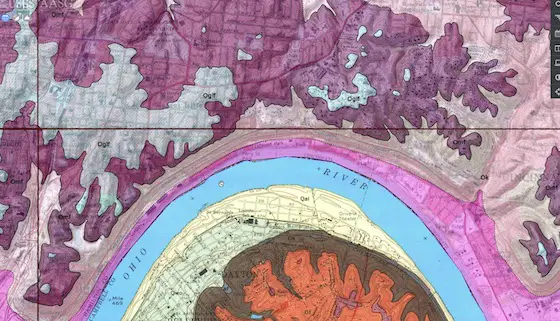
This is a copy of a United States Geologic Survey (USGS) geologic topographic map of the East End of Cincinnati, OH. The downtown area would be just to the left of what you see. The Kope and Lower Fairview formations are the light pink rock just above the magenta alluvium that's north of the Ohio River. (C) Copyright 2017 USGS and every US taxpayer that owns the maps. CLICK THE IMAGE TO BUY GEOLOGIC MAPS FOR YOUR AREA.
Understanding House Settling Cracks
If you have an understanding as to why cracks happen, then you can often work to make permanent repairs. There are some cracks that can't be easily repaired.
What's more, it is hard to totally disguise some cracks.
CLICK HERE to get FREE & FAST BIDS from local structural engineers.
Houses Have Hips And Knees
Large houses have joints within them.
These are places where the house relieves movement, just like the joints in our fingers, arms and legs. I often see cracks in modern homes where columns support beams. You can see cracks right where the contact point between these two structural members meet.
Hardwood floors often develop cracks. There are all sorts of reasons for that to happen, and almost always they can be traced to a humidity or moisture problem.
Soil Problems Cause House Settling Cracks
I routinely act as an expert witness in court cases involving poor quality construction. Recently, I finished a case that involved a house built on poor soil.
The builder built a house that was constructed over the top of a ravine that was filled in. Believe it or not, the excavation contractors bulldozed trees, limbs, and other vegetation into a small valley.
Then they placed soil on top of this. They rolled over the soil making it look like a great place to build.
Two years after the house was built, problems started to happen.
The foundation actually dropped several inches in numerous places and caused all sorts of havoc within the home and in its outside walls.
There were huge vertical cracks in the brickwork, the basement floor looked like an earthquake had struck and interior steel I-beams were twisted and compressed so much that they were crushing 2x4 plates. I was amazed at what can really happen when houses are built on poor soil.
Foundation Settlement Repair Video
Watch this short video to see one method to repair foundation settlement cracks.
Insurance Claims
The insurance company needs to be sent a copy of the letter to put them on notice of a possible claim. These letters need to be sent to both companies via certified mail with a return receipt being sent to you. Keep these very valuable receipts.
CLICK HERE to get FREE & FAST BIDS from local structural engineers.
Column B288
32 Responses to Understanding House Settling Cracks