Blacktop and Asphalt Facts
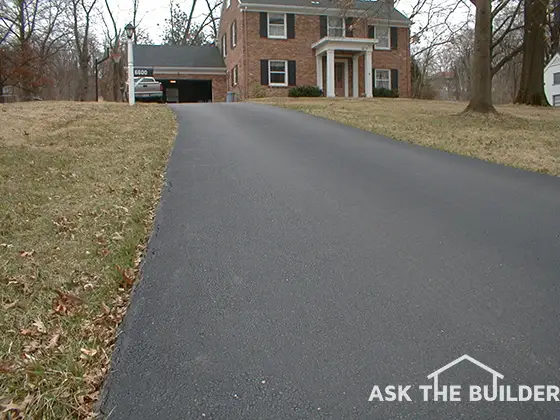
This is a blacktop driveway near my last home. it's in great shape and you know it's got a solid gravel base under it. Copyright 2017 Tim Carter
Working with blacktop is like working with many construction materials. It takes skill, knowledge, well maintained equipment, high quality asphalt paving and base materials, and favorable working conditions. If any one of these is compromised, you will, in all likelihood, get a poor quality job. If two or more of these are compromised, there is no doubt that you will experience inferior results.
As with anything, the more you know, the better your chances of success. Here are some tips which will enable you to ask some intelligent questions as you talk to asphalt contractors.
Drainage
Make sure that your finished pavement will slope at least 1/4 inch per foot. You must have positive drainage on top of the blacktop. Water must not be allowed to puddle on top of blacktop. If your driveway is virtually level this is not a problem. Simply have the contractor install a crown in the driveway. The middle of the driveway will be higher than the edges. That way water will run from the middle to each edge.
SubGrade
The subgrade is the soil beneath your driveway. Different soils have widely different strength characteristics. If your soil is a plastic type clay, it can be very weak. It will deform easily when heavy concentrated loads are placed upon it. Check with your local agricultural extension service to see what type of soil you have. Often they have soil maps which tell you the strength characteristics of your soil. If building a new driveway, you must remove all topsoil.
Get the best-looking asphalt driveway around! Learn what to ask your contractor in my Asphalt/Blacktop/Tar & Chip Installation & Repair Checklist. I offer a 100% Money Back Guarantee.
Remove any roots or other material which can decay. Be sure to compact the soil if it was disturbed while digging. If you have utility trenches which will cross the driveway (water, gas, sewer, electric lines), make sure that your builder fills these trenches with gravel all the way to the top! Do not allow the builder to backfill these trenches with soil!!!!! The soil will eventually settle and your driveway will have a depression.
If you have soil which is poorly drained when wet, you should give serious consideration to installing drain tile beneath the base. This drain tile will help to keep water from softening the soil and spoiling the base. Consider installing a geo-tech fabric in these conditions as well. These fabrics help to keep the mud from getting mixed with gravel. If you have an area with heavy vegetation, you can sterilize the soil to inhibit plant growth. However, use these chemicals sparingly so as not to harm the environment!
Base - The Foundation
The base, or foundation of an asphalt driveway is the key to a crack resistant surface. The base and the soil beneath it do all the work in supporting the loads which will be placed on the driveway. There are two types of bases. One is the standard crushed gravel base. This base is placed upon high quality, strong, compacted soils. It often is a minimum of 6 inches thick. It can be up to 8 to10 inches in thickness, depending upon the strength of the soil and what type of vehicles will be on the driveway. You should always build the driveway for the heaviest vehicle which will be placed upon it. For example, suppose you intend to have a fully loaded concrete truck on your driveway. Many of these trucks weigh 36 tons when fully loaded. Each wheel of the truck could have a 6 to 8 ton load on it!! The footprint of each tire is less than 1 square foot!! The little bit of extra money you spend on the thicker base will be worth it. You can also install an asphalt base. This type of base is similar to standard blacktop except for one thing. The aggregate (rocks) in the mixture are larger than normal. This larger aggregate gives the asphalt base great strength characteristics. This type of base does not usually have to be installed as thick as a gravel base. It also is a better base to use if your soil is poorly drained or your soil is a heavy clay.
CLICK or TAP HERE to get FREE QUOTES from local blacktop companies that can install or seal your driveway.
Asphalt - Blacktop
There are different types of mixes of asphalt paving materials. The type and quality of asphalt cement and the size of the aggregate (rocks) account for the differences. The smaller the aggregate, the weaker the finished product will be. Most people want a very smooth finished surface. This requires the mixture to have smaller aggregate. If this is what you want, your installer may have to install two layers of paving material. The first layer will be slightly thicker and have slightly larger rocks. The finish layer will be thinner (1 to 1 1/4") and have smaller stones and coarse sand. Always make sure that a tack coat of asphalt is used between layers. This acts as a glue to bond the layers together. A tack coat is not necessary if the second layer is applied shortly after the first layer.
If you are repaving an existing driveway, beware of reflection cracks! Reflection cracks are cracks that develop in the new pavement directly above existing cracks in the old pavement. This is a big problem if you install asphalt paving over concrete. The latest technology suggests that a few days after the blacktop is installed, you should consider saw-cutting slots in the new blacktop directly above the existing cracks. These saw-cuts will be straight and can be filled with a flexible crack sealer.
If repaving, absolutely make sure that all dust and dirt is removed from the old surface. Remove all vegetation from cracks and the edge of the driveway as well. Be sure to fill any low spots with patching material prior to applying the finish layer of blacktop.
Sealing - Maintenance
Many associations recommend that you seal your new driveway one year after it is installed. Be sure to use a high quality commercial bituminous water emulsion sealer. If your drive is on a hill, consider using a sealer which contains sand.
Do not seal your driveway every year!!! Sealers are coatings, just like paint. You can easily apply too much and the coatings will begin to crack and peel. Only reseal the driveway after you can clearly see that the old sealer is wearing. When the color of the aggregate (rocks) begins to show, it is time to reseal. Because the sealer will wear off faster in the areas where there is foot and car traffic, apply sealer to the non- traffic areas a little thinner. Otherwise, you will begin to get a buildup of sealer which may begin to crack and peel.
Column B415

Tim built custom homes and did ultra-custom remodeling for 20+ years before launching his Ask the Builder media presence. He was selected as one of the Big 50 by Remodeling magazine in 1993. This award gave birth to Ask the Builder in October 1993. Tim also operates https://DrawPlumbingPlans.com. His @askthebuilder YouTube channel was the first home improvement channel on YouTube.
is lime used as a base beneath asphalt?
limestone is!
I recently received a quote for installation of an asphalt driveway. The quote was for $2,980.00 for a driveway just shy of 1200 sqft. I am concerned as the contractor doesn't intend to add a gravel base as the existing driveway is already a gravel drive. Is this typical? I am concerned as I see that anywhere from 6-8" of gravel sub-base is recommended. My drive, though well-established does not have 6-8" of gravel left to it. Should I be concerned? It doesn't seem as though the gravel should be laid directly on top of the existing drive (which is pretty much hard, compacted soil/sand at this point.
You should be concerned. You should read ALL of my columns about how to install Blacktop. And finally, you SHOULD buy my Asphalt / Blacktop Contractor Hiring Guide!