Treated Wood Foundation Problems
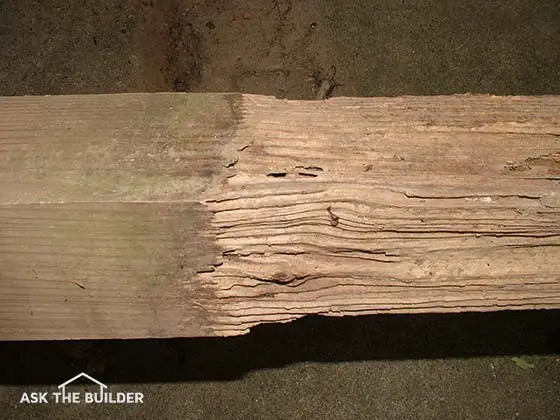
Lookie lookie, Can you see the extensive termite damage on the right side of the post? Imagine my reaction when I pulled this treated lumber post out of the ground. I was told it wouldn't rot and that termites couldn't eat it. How would you like to have your foundation built out of this wood???? You'd have to be NUTS to take that chance. ©2017 Tim Carter
Treated Wood Foundation TIPS
- Treated wood rots
- Concrete can last hundreds of years
- QC at lumber treatment plant suspect
- My treated lumber rotted
- CLICK HERE to Get Tim's FREE & FUNNY Newsletter!
DEAR TIM: Several years ago, there was a movement toward the use of wood foundations due to the rising cost of labor and concrete. I toured a couple of newly constructed homes in the Toledo, Ohio area at the time that had used this technique.
My question is "How have these structures fared over time?" Are they still considered sound and what has become of the idea of wood frame foundations?
Are there any contractors using this method actively today? At the time I thought it a good idea, but being the skeptic I am I thought it was better left to someone else to prove the concept.
I've built several homes over the years (for my own use) and have given thought to another project. Your thoughts and insight are always appreciated as I am an avid reader of your column in the Toledo Blade. Roger Puppos, Toledo, OH
DEAR ROGER: I absolutely remember that movement promoting wood over masonry for foundations. The thought back then that rushed through my head was the fable about the Three Little Pigs. As many of us know, the big bad wolf ate two of the three little pigs - the ones that used straw and wood to build their homes. The pig that used masonry was not harmed by the wolf.
CLICK HERE to get FREE & FAST BIDS from local foundation contractors.
Castle Clues
Have you ever seen photos of ancient castles in Europe? Often the walls are still standing, but the roof is long gone.

Here's an old castle in Germany. The masonry walls are still standing, but the wood roof structure is long gone. Wood never wins against water, insects and fungi. Copyright 2017 Kathy Ziprik
The roofs were made from wood. The walls were made from stone. They didn't have treated lumber a thousand years ago, but believe me the timbers they used to construct those castle roofs were the densest and most rot-resistant lumber available at the time. Water always wins with lumber if there's oxygen around.
Cast, or poured, concrete is artificial rock or stone. You can order it with more Portland cement and make it incredibly strong so it lasts hundreds of years if that's the legacy you want to create.
Wood Is Strong
My problem with the wood foundations was never one concerning engineering. I was convinced a properly constructed wood foundation could easily act as a retaining wall against all soil pressures that were trying to push it over. Wood shoring has been used for years to protect workmen who install piping in deep trenches and those who work in mines.
I have no doubt that the treated wood manufacturers still promote wood as a viable material for foundations. I also believe there are builders who still use wood for foundation work.
Insects & Rot
My real concern was long-term degradation caused by water and insects. The thought that kept playing in my head like an endless loop of video tape was an image of a workman at a plant that makes treated lumber. There were two episodes in this short documentary.
Human Error
The first one was of the workman coming to work with a very bad head cold or the flu. In this episode, he starts to blend the chemicals that are used to preserve the wood, but because of his lack of concentration he makes a serious mistake and that batch of lumber does not receive enough chemical treatment.
Hoping
The wood certified for wood foundations is supposed to contain a higher amount of the preservatives. That's a given. But how do you know if it does?
Do you want to hope your treated lumber foundation has enough preservatives? Hope is the emotion of last resort. You hope for things you can't control.
You can control your foundation. You can make your foundation wall last as long, or longer, than castle walls.
CLICK HERE to get FREE & FAST BIDS from local foundation contractors.
Anger Issues
Episode two is a little different but the result is the same. The workman who mixes the chemicals goes and asks his boss for a raise. The plant manager tells the worker that he is not deserving of a pay increase. The disgruntled worker goes back to the work station and decides to take his anger out on the next load of pressure treated lumber.
Quality Control?
I don't doubt for a moment that plants that make pressure treated lumber have quality control measures in place and follow them making sure mistakes don't happen. That's just good business. But mistakes do happen and I have proof.
How many food recalls or other product recalls can you remember in the past year or two?
How did those mistakes happen? Who was in charge of the quality control that day at the factory?
Impossible Test
The questions you have to ask yourself, since you can't easily test the lumber at your job site, might be:
- Is the treatment in this lumber the correct mixture and will it LAST?
- Was the lumber mislabeled?
- Was the correct amount of preservative used and was the pressure high enough in the vessel?
Tim's Failure
In the early 1990's when CCA treated lumber was still being produced, I built a large play structure for my daughter. The main supports were 4x4 posts that I placed directly into the ground and backfilled with the soil.
These posts were approved for direct ground burial. The treated lumber came with a lifetime warranty against rot or decay.
Fifteen years later, I took the play structure apart so I could build a large Queen Anne Victorian garden shed for my wife. To my amazement, two of the six 4x4 posts had significant termite damage to that portion that was buried in the ground.
To say the least, I felt vindicated about my suspicion that treated lumber was not to be trusted 100 percent of the time.
Great Wonders Of The World
When it comes to building for a lifetime, I have a tendency to lean on my college degree in geology. Look at the great temples, tombs and castles that are still standing in the world today. One thing they all have in common is they all are made from rock.
The Great Pyramids are still standing after thousands of years as are temples in Central and South America. Europe has castles that are hundreds of years old that are still in excellent condition. Remember, concrete is nothing more than artificial rock.
Build your foundation from concrete and sleep well at night.
CLICK HERE to get FREE & FAST BIDS from local foundation contractors.
This column was mentioned in the May 12, 2015 AsktheBuilder Newsletter.
Column EM0013

Tim built custom homes and did ultra-custom remodeling for 20+ years before launching his Ask the Builder media presence. He was selected as one of the Big 50 by Remodeling magazine in 1993. This award gave birth to Ask the Builder in October 1993. Tim also operates https://DrawPlumbingPlans.com. His @askthebuilder YouTube channel was the first home improvement channel on YouTube.
Dear Tim. I just read your reply back to roger and it answered most of my questions. I'm am currently looking at purchasing a house with PWF and it was built in 1977. I guess a couple Of questions would be how hard/expensive is it to replace a PWF and what is the life expectancy is on a PWF
We need to talk. Far too much to type. http://shop.askthebuilder.com/categories/Consult-Tim/
sounds like Tim might be a masonery contractor. I built a 7 bed room log housr 30 years ago and its still as new. a 30 year block or concreat basement will have cracks, dampness, musty, etc.
Totally agree....I love our permanent wood foundation, 22 years later and never had any issues, termites, rot, or leaks...no musty smell. The basement of our house is just as nice as our other floors. I grew up with a cinder block type basement and it was a nightmare and i didn't even want a basement but our lot was conducive to it so we researched this type in 1995 and LOVE IT!!!
I am the Building Official for the City of Hutchinson, Hutchinson MN.
I have been on the job for 15 years and have never seen a wood foundation constructed. However I live in a home with a wood foundation.
I have been asked by a builder how to insulate a wood foundation for a slab on grad home. Our area requires 42 inch frost protection.Can you help us with insulating the foundation wall?
Thanks, Lenny
I'm so confused. Why / how can a slab-on-grade home have a wood foundation? I would think they would do a turned-down concrete slab or pour a footer / foundation, backfill and then pour the slab on this. Lenny, what am I missing?
check out the following site for publication on permanent wood foundation. It has a section on insulation: http://www.southernpine.com/applications/permanent-wood-foundations/
also check out AWC-PWF 2015. this is the 2016 building code adopted offical building code reference for proper design/spec for permanent wood structure.
Tim,
I am looking at a home with a wood foundation, I can see that the walls are bowed in and several studs have moved in 1/2-3/4" in along the slab do to freeze/ thaugh in Michigan. Where basement windows were framed studs are pushing in under window where there is a break in the top plate. Is there any way to stop it, is this a sign of failure.
Thanks for your input,
Ralph,
RUN AWAY from this house. You never EVER want to purchase a home that has significant STRUCTURAL issues. On a scale of 1 to 10, with 10 the worst, I'd rate what you say about a 8.5.
You couldn't GIVE me a house that has an issue like this. To fix it, you'll be calling up the companies that move houses to lift yours up. Then you'll RIP OUT the crappy wood foundation and pour a proper poured concrete foundation.
Now, if you've got a rich auntie or have won the Powerball lottery, then have at it!
I am a builder and have put in 12 homes with PWF's. I've lived in one of them for the past 18 years. I am planning a new home with a PWF and would never live in anything else. A PWF must be designed by a Engineer and installed properly or it could have problems. The post on your "Queen Anne Victorian garden shed" was a post from the Depot not foundation grade wood, any wood from Depot is not rated for ground contact and will fail. You can do a PWF with a slab on grade.
Mark,
The lumber from my Queen Anne shed was not purchased from a big box. It was purchased from the top lumber company in Cincinnati that sells the MOST and highest-quality treated lumber. It's the best you can buy.
The photo in this column tells the tale. Treated lumber APPROVED for ground contact EATEN by termites.
You can't argue the fact that quality control can slip one day and the wood you THINK is okay is not. Since you don't have a field testing lab, you HOPE the wood you're using WILL last.
But as Kenny Chesney said in his hit song, "Only time will tell, but it ain't talkin'."
Tim,
I'd suggest that the question isn't whether or not a wood foundation can fail due to a manufacturing defect, but rather what is the frequency of failure due to material and/or installation problems vs. a typical masonry foundation, and what is the cost to repair the foundation if it does fail? Your thoughts?
Mark is correct. Permanent wood foundations use FDN treated lumber. Pressure treated wood rated for ground contact is not to be used for foundations. The preservative chemical retention for ground contact wood is less than that of FDN treated wood. In addition the wood used in PWF does not contact the ground. There must be a water barrier between the dirt and the wood. Check your codes. Also check out the Scandinavian Countries. They have been using PWF for many decades.
Carl,
I know. I believe you missed the point of the column. How do you know for certain the wood has the correct amount of preservatives, even if it's stamped FDN?. You can't test it in the field. Maybe a batch was STAMPED wrong? It wouldn't be the first time mislabeled goods entered the marketplace.
Finally. I read for twenty minutes until the subject of a vapor barrier came up. Gravel footer that will run water, caulk, nails and lumber to spec and it's the best basement possible.
...or misbatched concrete or improperly mixed mortar or...
Usually the failure of pressure treated wood is bad design, improper materials, and/or inappropriate fasteners.
You can raise the same issues with concrete as with wood. How do you know that your concrete is mixed correctly? I have a friend who is a mason he has had numerous problems with bad concrete mix from several suppliers that have had to be torn out and redone.
That's true. But you can fairly easily have two test cylinders taken of the concrete and have them tested within a week. That one-week test will tell you if the concrete will achieve its design strength.
The entire point of my above column is to simply show that wood is not a permanent material and that I have proof of a failure of the preservative.
It's a simple statement of fact and I do that so that others can make an informed decision.
Here's the other way to look at it. If wood was such a good idea for foundations, why is it you don't see it more often? Why isn't it the industry standard?
These are simply rhetorical questions and the marketplace usually makes the decision.
I am a residential remodeler/builder in northeast KY. I will add a few facts I've learned over the years to this conversation. That being said I would not have the confidence to use a wood foundation myself. Even when we build a deck or sun room that has a patio underneath I pour concrete footing with concrete piers up to grade and then attach posts with proper hardware.
1. You said 2 of the 4 posts had the termite damage shown in the pic. I wonder if they were cut ends. They sell the preservative at most lumber yards to treat the ends of a post if you are putting the cut end in a ground contact situation because the center of a thick post doesn't get treated very well at the plant where it's produced.
2. I had a conversation with a man that sells for one of the largest "Pole barn style" metal building companies in the nation and asked about problems with post rot and was surprised to find out they still use CCA treated lumber. It does seem to be better preserved than the more common ACQ and MCQ products we buy today. Apparently since they're work is deemed commercial they can still use it. It was only banned from residential work. I wonder if it can still be used for foundations?
Hi,
I'm doing a addition to a existing house. The general contract built on the top of the foundation a frame (PT) to fix the height of the foundation. He used am various frames sizes, 2x6, 2x10, now he is adding a concrete slab and it will touch the frame that he built. My question is. Can the concrete touch the pressure treat (PT) wood?
I really appreciate your answer.
Thank you,
Heraldo
Pressure treated wood can be in contact with concrete.
I am thinking of a wood foundation and my question is, would it be acceptable to treat the outside with a tar base like they do with concrete or block, beofre you put on the plastic barrier?
People looking for more I do should go to the southern pine council website and search for wood foundations, they have a nice pdf download for free that includes details for free.
hello,
can you spray foam the floor instead of using a vapor barrier? we had a sewer backup in the basement and had to remove existing vapor barrier.
thank you,
the 6 mil vapor barrier is minimum require by building code. spray foam is not a equivalent.
How unfortunate for you Tim that you are unwilling to acknowledge a different building practice. You re entitled to your opinion about wood foundations but anyone can take worst case scenarios and say it is fact. I have seen block and poured foundations fail frequently but I won't say that they are all bad.
If they are built properly, just like any foundation they will last and stay very dry. My father and I built a WF home 37 yrs ago and it has held up beautifully, no moisture at all, but you have to follow a set of procedures that are different than building with stone. I live there now and watch my neighbors get out pumps in the spring to drain their basements. The inspectors for my area had to be schooled by us when we were building it, they were set against it because of their lack of knowledge of building this type of foundation. There isn't much of a history of this type of WF because it is new to the industry, just as poured wall were at one time.
There are at least 5 homes in my area that have WF, but I am not sure how they are holding up.
Pat,
Your comment is a CLASSIC case of someone who only hears / comprehends what they *want* to hear / comprehend.
The entire point of the above column is that the proof is undeniable that treated wood ROTS. The wood you buy to build your foundation may not have been treated properly. You can't control that.
Yes poured concrete and block can fail. I have many columns here at the website that talk about WHY and how to prevent it.
A foundation is the most important part of a house. I'm not going to HOPE my foundation is going to last and that the proper amount of copper was injected into it.
If you want to do that, so be it.
Tim, Can the chemicals used in TW conflict with the chemicals used in TW screws? I have a very lrg deck that I built 10 years ago and the floor boards are starting to loosen. When I pulled the board up where the screws were the wood looked like it had rotted, the screws no longer had thread and in the area where the screws were it was black, but the rest of the wood looked fine. Is there anyway I can send you some pictures?
You are asking TW question in a website that highly discourage use of TW. See Tim answer above to see the kind of discouragement you will soon get from Tim.
I am a structural engineer design structure with different construction material. TW is not a bad material consider its cheap to get by and its less labor intensive to install/repair. However, I think this is not the kind of material that people wish to use for their DIY project because the building code design requirement for spec/design/installation takes an engineer with many field inspections to ensure proper installation by most contractors.
Back to your question, galvanized hardware generally does not perform well when in contact with pressure treated material. It is recommended to use stainless steel connectors from a structural engineer perspective to allow maximized connector life span.
For the rotted connectors, if the remaining wood has enough space to install additional connectors, you should be able to install the replacement connectors using stainless steel material. The exposed wood holes/cut needs to be field treated follow AWPA M4 standard. This is requirement per building code for wood design standard under AWC-PWF 2015 edition chapter 2.3.3.
Correct. I highly discourage the use of treated wood (TW) for a foundation because the empirical evidence is crystal clear.
TW can and will ROT. To increase your chances that it doesn't rot, you have to do several things.
By the time you do all those things, you might have installed a foundation that will NEVER rot for a small amount of additional money.
It's all about peace of mind at the end of the day. Do you want to have that nagging thought day and night if everything was done right????
I purchased a place with a PWC foundation and want to know if the floor was installed correctly.
In the spring water came up between the PWC floor and wall. The floor seems to be a frame of PWC 2"x12" filled with large gravel, covered by 1" PWC plywood. The outside is covered with DMX foundation wrap and 2 sets of so no tubes and large gravel for drainage all around.
Comments are welcome.
Thanks.
Sorry, meant PWF and not PWC.
Hello: 25 years ago, I purchased a house with a wooden basement. It appears to be holding up, but I'm concerned. Can I hire a professional to run some tests: if so what qualifications should he have?
You don't need a professional. You need an ice pick. Click this link to get one:
http://amzn.to/2yn9ED7
Go around and start testing to see if you discover any softness where the ice pick penetrates the wood with ease.
I donno, you may be right but you present no real evidence. Your credibility suffers in that the masonry structures you cite that have stood for thousands of years were usually built atop wood piles driven deep into the soil. In other words, permanent wood foundations.
Doug,
You don't think I'm letting your comment go unchallenged do you? Please offer up the authoritative proof of these magical wood piles under the Great Pyramids or any other of the stone Wonders of the World. I showed you my proof that treated wood is eaten by termites. Anxiously awaiting your citations.
That "old castle", is in Heidelberg, Germany. It's roof, on that particular tower, burned from being hit by lighting in 1764, igniting a rather large cache of black powder. Missing woodwork on castles is almost exclusively from fires, not termites or rot. Many old structures with original wood components still exist and function, owing to the builders ability to protect the wood from the elements, and not having the kitchen (think open fire places) attached to the main building.
Hi Tim,
Agreed, concrete is great stuff, until you add rebar. Panthenon dome is in great shape while bridges made of reinforced concrete 40 years ago are falling apart. You really have no clue what you're talking about.
John, I don't know what to say, but you started it. The bridges you're talking about are all ones that get saturated with salt brine each winter.
Look at 100-year-old railroad bridges made from steel-reinforced concrete. No issues.
If I were you, I'd stop making comments at websites when you don't have a clue about the subject matter.
Also, spend a couple of weeks reading all about steel-reinforced concrete and brine attack here:
http://www.cement.org/
I HAVE BUILD THREE HOUSE IN CALIF. ALL WITH WOOD BASEMENTS AND GUESS WHAT THEY HAVE ALL BEEN IN EARTH QUAKE AND NOTHING AT ALL HAPPEN TO THEM I BUILD THEM TODAY UNDER LOG HOMES AND MY OWN I HAVE BUILD 6 OF THEM AND I HAVE EVER HAD ANY PROBLEMS WITH THEM SO I WILL GO TO THE ROCK IND BUILD ON IT BUT SOME I WILL DO A STRAIGHT FORWARD FOOTING AND BUILD ON TOP OF IT ON YA I HAVE BEEN DOING OR BUILDING HOUSE SINCE 1958 STARTED TO DO THE WOOD BASEMENT IN 1970 AND THEM HOUSE ARE STILL THERE WITH NO PROBLEMS AND BACK THEM WE DIDINT HAVE THE MORE MODERN PRODUCT TO USE ON THEM BUT THEY HAVE SOME GOOD STUFF NOW AND NOW IM ABOUT TO START ME A NEW HOUSE IN IDAHO SO I THINK THEY ARE THE BEST AND THE EASYES TO DO AND COST WISE CHEAPER SINCE I DO THEM ALL MY SELF IN FACT I BUILD WHAT I DO ALL MY SELF FROM THE GROUND UP TO A FINISH HOUSE
Maybe we got off on the wrong foot but every single piece of standard steel rebar in any piece of concrete is failing as we speak. It is not only salt brine but a basic fact of chemistry. I am a chemist, a biochemist, and an electrical engineer. I do a LOT of work on cathodic protection of rebar in concrete. Concrete is porous. Porosity means if it is porous to air it is porous to water. When you mix oxygen in the air with water you generate small areas of pitting. No steel is immune to small amounts of galvanic current as the steel is an imperfect non-homogenous mixture. Pitting ends up rusting the rebar, end of story. We have spent trillions of dollars on reinforced concrete structures because of uninformed people like yourself. Our entire infrastructure of failing. Reinforced concrete structures such as bridges are failing nationwide. The only way around it is to either use stainless steel rebar or fiberglass/carbon fiber rebar. Both are almost a magnitude greater in price than standard rebar. Even so, the bridges made with 316 rebar, or even 304, last for hundreds of years before any maintenance is required. Go ahead and kid yourself that corrosion is not happening in every single piece of reinforced concrete if you wish, you are mistaken.
Thanks John for your pretentious comment. We all know steel rusts.
But you failed to respond to my reply above about railroad bridges and countless other concrete structures that contain uncoated reinforcing steel in them.
Many are still in great shape after 100 years and they get rained on all the time.
No one is disputing your claim about what happens when you introduce a salt brine into the equation. All bets are off then.
Please try to focus on why cast concrete railroad bridges all over the USA are still in great shape after 100 years or so. They get wet, they've got uncoated steel in them.
Venice is of course built on wood pilings and has stood for centuries. This is also true of many cities that were developed on reclaimed marshland. Wood pilings were driven into the soft sedimentary soil and being completely submerged are not as vulnerable to wood destroying insects i.e. termites as timbers that are located in close proximity to surface water since most insects need respiration. These fully submerged timbers can deteriorate from other oxidative decay at varying rates depending on complex environmental factors including water chemistry and temperature to name a couple.
Tim is right wood can rot and if used for any purpose appropriate construction methods must be employed to prevent deterioration especially in a foundation but also above grade as well. While masonry can resist water it can be deteriorated by freeze thaw. Wood can burn, rot and be eaten none of these readily apply to concrete although a fire can be catastrophic to almost any structural material.
Many Builders prefer wood since it can be constructed in cold temperatures more easily than poured in place concrete and often by carpenters who are going to frame the upper stories and not masons simplifying contracting schedules.
If properly engineered and constructed both wood and masonry foundations can and do perform for decades if not centuries. No material is or can be the magic solution to every problem.
1) What about using a one-piece post-protection vinyl sleeve (60" long) on the the pressure treated timber (6x6) that will support a 16x24 vacation house ? Such products are closed at the bottom facing the 12"-18" diameter cement pad (6"thick) at 34" below grade (frost depth). Pad rests on top of 4-6" crushed stone.
sleeve is at least 24" above grade to rim board of house so no exposure to weather at all and I will use acoustic caulk to seal the sleeve space between sleeve where it ends on exposed above grade post it is protecting. Your thoughts ... (anyone)? Costs make any other foundation alternative un-affordable.