Properly Size Your Water Lines
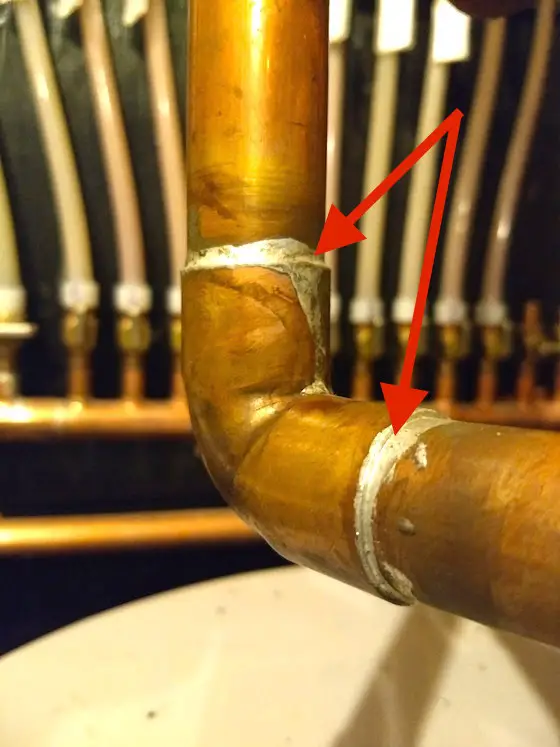
Size water line - The red arrows point to a large-diameter 1-inch feed line for all the hot water in a home. Behind it on the wall are smaller-diameter 5/8-inch supply lines to each fixture. Copyright 2021 Tim Carter
"Waterline size determines the amount of water flowing from a pipe. Bigger is better if you want lots of water in a short time."
Revised February 2021
Size Water Line TIPS
- Larger diameter water lines create less friction
- 1-inch pipe less than 100 feet to a house is good
- Size Water Line Videos BELOW
- 8-inch-diameter water main supplies hundreds of homes
- CLICK HERE to get Tim's FREE AsktheBuilder Newsletter - He's a master plumber!
My guess is that most people don't think twice about the water that will flow from the faucets in their new homes. You may not even give a second thought to the noise water makes when rushing through water lines.
Because you are moving into a new home, my guess is you might assume a waterfall of water will cascade from each faucet and hose bib.
Don't count on it. Your builder or plumber may have made a few mistakes that can restrict the amount of water that flows from faucets. These same mistakes can also cause significant water pipe noise that drowns out conversation and other pleasant sounds around your home.
Related Links
Low Water Pressure Common Causes
Old Water Pipes Create Water Flow Problems
Free & Fast Bids
CLICK HERE to get FREE & FAST BIDS from plumbers in your city or town to help increase your water pressure.
Bigger is Absolutely Better
If you are in the planning stages of building, you can correct these problems before they happen. A water supply pipe of a given size can only supply a given quantity of water at a given pressure and a given hydrostatic head. Hydrostatic head commonly refers to the vertical distance a water line extends.
Size Water Line Video
This short video is fantastic. Pay attention to the first two numbers he quotes!!! HUGE difference in volume for just a tiny increase in pipe diameter!
If you live near a water tower, you want to be as far downhill from it as possible. Usually, these towers are placed at high points in the landscape. To have the best water pressure, you want to be in a valley with as much vertical distance as possible between you and the bottom of the tank. The greater this distance, the greater the hydrostatic pressure.
High Water Pressure From Elevation
In Cincinnati, Ohio for example, if you have a home in the Mill Creek valley below all the hills above you where the water tanks are, your water pressure could easily be in excess of 200 pounds per square inch (PSI). The land above the valley is 400 feet higher in elevation. The weight of the water in the pipes between the valley and the hills above presses down and creates very high pressure.
If you are trying to push water up a pipe from a basement to a second floor, gravity is doing its best to exert an opposite force against the water pressure. Gravity becomes your friend and increases water pressure if you store your water up on your roof, but how many people do you know have 5,000-gallon storage tanks in their attics?
This is what you'll find in large office towers, hotels, hospitals and other buildings where lots of people could be using the plumbing system at the same time.
3/4 Inch Is Okay | 1 Inch Is Better
You need to have lots of water capacity coming into your home, even if you don't need it all the time. For most homes in most cities, a 3/4-inch line might be sufficient, but if you have the opportunity to specify the pipe size, put in a 1-inch line. I'm a master plumber and believe me, you'll never regret doing it.
Plumbers and builders know that people rarely turn on more than three or four plumbing faucets at the same time. But it can happen.
If you want a plentiful supply of water to flow from each faucet, you must be certain that the main water line entering the house and the main feed line within the house is at least three-quarter inch in diameter or possibly one-inch in diameter. This larger sized pipe can carry a significant amount of water.
Size Water Line Software
Watch this short video to see computer software that will help you SIZE your water lines. It's from Australia, but the principals are the same all over the world.
CLICK HERE to get FREE & FAST BIDS from plumbers in your city or town to help increase your water pressure.
Rural Well Water Pipes
Be sure your well digger puts in a 1 and 1/4-inch plastic line from the well to the inside of your home. Usually, it's a short distance and you'll never regret the larger pipe. Remember, it's easy to put in the right size pipe when the trench is open. If you try to do it later, it's an enormous, expensive, job.
If your home is far away from the water main, up a hill and it's a monster job to install a water line, you can't make a mistake. It's well worth a $500 fee, even $750, to pay a mechanical engineer to size the water line you need. It's very possible you may need a 2 or 2.5-inch diameter water line if your home is 500, or 1,000, feet from the city water main. Do NOT GUESS. You'll regret it.
Install Large Pipes to ALL Bathrooms!
All too often, a rookie plumber might start to prematurely reduce the size of the water lines in a home. If you see one-half inch diameter water lines that serve two or more fixtures, trouble may be just around the corner. If your new home has three or more bathrooms, consider keeping the cold water pipe size one inch until it has served the water heater, the first bathroom group and possibly one or two outdoor hose bibs.
The main water line can then be reduced to three-quarter inch diameter to serve the remaining bathrooms, laundry room, hose bibs, etc. One-half inch diameter pipes can branch off the three-quarter inch line to serve individual fixtures. Extend the three-quarter inch line until you get to the final two or three fixtures in the house.
This is very important if you want great pressure and volume in all bathrooms.
Large-Diameter Pipes are Quieter
Pipe noise is also a function of pipe size. Larger diameter pipes create less noise because the velocity of the water moving through the pipe towards the fixture is lower. You can also minimize pipe noise by specifying a thicker pipe size.
If you are using copper tubing in your new home, it is very likely that type M copper will be used indoors. This is the thinnest pipe allowed by most plumbing codes. Thin pipes transmit noise more readily than thicker-walled pipes.
Use Thicker Pipes Too
The next thicker pipe type is L copper. Look at a piece of L vs. M copper and you will not see any difference. But pick up a 10-foot long piece of each and you will immediately realize the type L copper weighs more. This extra copper absorbs sound.
The fantastic news is that the cost upgrade for type L copper in a typical residential home is less than $275.00. (2017 prices) This is a one-time fee that allows you to have quiet water supply piping for the life of the home. It is a very small price to pay for peace and quiet.
Drill Large Pass-Through Holes
Finally, be sure the pipes are not in a bind as they pass through wall studs, wall plates and floor joists. The holes need to be slightly oversized so the water pipes can expand and contract freely.
Pieces of rubber that absorb vibration can also be installed between the pipes and any wood framing. Installing the strips of rubber can be a hassle, but any acoustical engineer will tell you it helps to stop noise transmission.
CLICK HERE to get FREE & FAST BIDS from plumbers in your city or town to help increase your water pressure.
Bulletin NH007

Tim built custom homes and did ultra-custom remodeling for 20+ years before launching his Ask the Builder media presence. He was selected as one of the Big 50 by Remodeling magazine in 1993. This award gave birth to Ask the Builder in October 1993. Tim also operates https://DrawPlumbingPlans.com. His @askthebuilder YouTube channel was the first home improvement channel on YouTube.
I have a new house and my water comes from a well. The builder
had young plumber to do the plumbing but he plumb my riannis
wrong so I just got done replacing the pipe. My question is
the pipe from the well is two inch then he put a three inch piece of
one inch to a shutof then ran three quater to half thru the house.
I am in the process of fixing it. I would like to know if I should replace
the pipe with one inch to half inch to my fixtures. Thank you
Richard
Richard,
I've been a master plumber since age 29. Sizing water lines inside a home is not as easy as you're making it seem. I believe my column above is crystal clear with what you should do. If you're still confused, it really requires a conversation. There's simply too much to type. Or, you can have a local plumber come to your house and help you. I'm sure he'll charge at least $125 (2013 prices) for the visit. If you want to talk to me, go here:
http://shop.askthebuilder.com/categories/Consult-Tim/
I'm replacing a water line supplying a three bedroom two full bath home. Distance from meter box to house is 400 feet, water diameter line do I need? PVC vs PEC?
You won't go wrong with an 1.5-inch diameter line. What plastic is approved by your water company?????? Do your research online for FAILED stories about either material in your area.
Many thanks
I just read your article and appreciate the information. Above our water meter on the house side is a pressure gauge that reads about 55-60 psi. When more than one tap is opened, the psi drops to about 20. The main is 3/4 inch and connects to the meter which is 5/8ths. Do you have any suggestions on how to maintain a 50-60 psi with more than one tap open? Thanks.
Yes. Install an in-line pressure pump like I have at my home!
We had water coming in to the house gushing in becaseu the metal piping separated from the water line fcoming into the house, so the shut off valve would do no good!!!! The plumber came out and recommended we replace the water oline coming in, because due to settling, the line is pulling out most likely causing what happened last night. Is this accurate>
Well, settling probably did cause the problem, but it doesn't mean you need a new line from the street to the house!
I'm building NEW house requiring 400+' run going UP about 100 feet. We going from a well with pump capacity of 20 GPM and currently running at 78 psi.
Our pump is constant pressure 3 phase type (love it!!!).
I expect to install an in-line pressure pump up there although I got good flow in test up there with a hose.
What would you recommend for line running from the well up to the house? I was planning on PEX but probably need to run it inside larger PVC to protect it in this crushed sharp shale environment.
Thanks
Bigger is better.
I need to find a way to size the water service for buildings from the city main to the meter in Hoboken N J city pressure is 90 psi
After 2 polybutelene leaks in the same week, I am re-piping my house with PEX in NW FL. I have a 3/4" main supply line from the street to the 2100 square foot, 3 bath, house with irrigation sprinklers and pool. Pressure at one of the external faucets is 55 psi. House to street is approximately 100'. Distribution of the supply via manifold to the farthest faucet in the house won't be much more than 100'.
Is there any harm if I increase the size of the supply line entering the house from 3/4" to 1", allowing for the potential to re-pipe the supply line from the structure to the street if I ever feel that the water flow is no longer adequate?
In other words, I'll have 1" diameter pipe at the street, reduced to 3/4" pipe from the street to the house, then expanded back to 1" before entering the house. I figured since I have to open the walls to route the new PEX, I might as well maximize the pipe size now with the walls open, thinking that in the future, if I do have flow problems or install additional plumbing fixtures, all I would have to do at that point is re-pipe from the house to the street. Is there an issue with the reduction and subsequent expansion, with no definite plans to eliminate the reduction in the future?
We are running water line from meter to new house - about 4000 feet. What size and psi line would you recommend? Thank you.
I have 1\2 inch PVC water lines in my house and a 1\2 feed line coming from the water main.Will my water pressure increase if I increase the outside feed pipe to 1 inch?
How can I determine the size of the branch line of my piping if I have main pipe size of 4 inch. I am planning to have 3 branches, these three will flow going to the main and this these should not be overflow when they are simultaneously open at full flow. Please help. thanks
i have a parking garage complaing on not enough pressure to use power washer on the 10 thru 14 floor. they have used 1/2" pvc to feed this. can this work with a booster pump
We're running a service line 1,100' from a 3/4" meter. The pressure at the main is around 100psi and the elevation increases 10' to my house. Should we install a 1.5" or 2" pvc service line for our single family home?
Hello, I am changing the old steel pipe water lines it is a small house with 1 bathroom, a kitchen, should I go with 3/4 for the cold water and 1/2 in. Hot or 3/4 in. For the hot water line also? I am changing to pex
We have a surface well at the cottage - the pump is constantly losing prime, I've checked all the line clamps for loss of pressure and there does not appear to be any issues. The water line runs about 80 feet to a surface well. I've replaced the foot valve and the problem persists. The water line into the cottage is 11/4 inch.The only thing I can see is that there is a leak in the burried line. The only solution I can think of given that it's winter in Canada and that the line is 4 feet deep in the ground is to run a second smaller diameter line (3/4 inch) through the existing one as a short term fix - until spring comes. I would also install the appropriate foot valve. I would appreciate any advice you can provide. Does this seem like a reasonable solution for the short term?
I just moved into a ten year old House and the pipes from the well to the home is 3/4". If I wanted to change the size to 1 1/2" pvc piping would I have to go into the home as well or just the main line?
Loosing prime has nothing to do a leak, if anything the pump runs more when there is a leak.
Finding the cause of loosing prime can be difficult, if you have not started a log when it happens then do so. I suggest that you need to open and reseal ALL of the line and pump connections. If you have a bladder tank verify that it is not water logged.
Developing a rural property and selecting poly ips now. Planning on 1.5" diameter pipe for the 555' total run.
spring fed 1000 gallon tank delivers to homesite 350' away via 67' elev drop. (28.8 psi) line tee's to house and will be 3/4" main lines 1/2 risers to 15 fixtures.
The line continues from Tee another 200' and a drop of 43' (110' total) (43PSI) to a 2 bedroom cabin. Lines under cabin are 3/4" with 1/2 risers to 5 fixtures.
I'm trying to determine if the flow and volume of 1.5" pipe (minus head loss) will adequately service the house and cabin or if pumps would be required. 2" pipe is the easy answer, but availablity and cost of 1.5 is becoming a major advantage. However, it is no substitute for lazy faucets. Just trying to get educated.
Thank you
My home is 1150 feet from the community water line, with15’ rise. My home instalation is 1”. What size pipe should I use to hook into community water line?
Am I going to have issue with flow or ? by adding a second water inlet to my home. The home has 1" copper entering in the back of the house. The 1" line is reduced to 3/4". The 3/4" line is reduced to 1/2" as it enters into each room that needs water. (ie: bathrooms, kitchen, utility room, and front hose bib. The hot water tank is the only location that maintains the 3/4" going to the tank and 3/4" going back to the above rooms needing water. The hose bib to the front of the house is 1/2" from the center of the house 30 ft. out to the hose bib.
Would adding a second 1" supply line at the front 1/2" hose bib improve the volume of water throughout the house.
This would give the under size pipes running in the attic more volume to each of the rooms needing water.
Will this help in the delivery of water volume ? I understand that my PSI will not increase.
hoiw far can i run 1in pipe poly for irrigation lines?
can i go from 1 to 2in or whold that not help? would running 2in main line to manifold help with flow and pressure in the heads
I have a question. I have to replace my line from pump to house. I have to run 200 / 225 ft to house. I have a 3/4 jet pump that sits on top of casing. Which size line should I use and should I put a bigger ho motor on oump?
Very informative
I was telling someone the same thing, They wanted to use q 5/8 " meter on a 2" main line
Hello Mr. Carter, If the main line from the meter is 3/4 inch, would installing 1-inch pipes in the house make a difference in the water pressure? This is an old house and I have changed the pressure valve.
I need a bit of advice for a correction I'm currently making to my water line, built by the previous owner. The house is a 3 full bath with 6 people who shower at the same time on many occasions. The water line from the spring and well sources is 1 and 1/4 but then it's stepped down to 3/4 at the pump house and then 1/2 upon entering the foundation wall of house. So, the digging would be too much right now, and I have to leave the 3/4 to the house. I'm of course going to step up to 3/4 from 1/2 in the house, but finally my question is, would it benefit me, with 40-50' of run to the water heater and other fixtures, to step the 3/4 supply to the house UP to 1" once inside? Would that increase before decreasing again prior to fixtures and water heater allow for so much less friction that my pressure and volume will be benefited? I realize that Bernoulli's principal will of course be in effect and that run of 3/4 to the house would have an increase in water flow (velocity) to meet the new larger volume "demand" on the step-up end. The pump has a 1" output that steps down to 3/4 when exiting the pump house and then that would step back up to 1" in the house, so about a 50' run of 3/4 between 1" on either end. Plus, if I did ever dig the outside line up and replace with 1", the inside would already be all set.
Bought a new bathtub faucet and the supply tubes are the size of drinking straws. Never saw anything like it. Who would think that was a good idea?
I am 875 ft from my 3/4" water main to my home building site. I have about a 10 foot rise in terrain from the meter to the house location. I had a 1" set up, then a friend suggested a 1.5" set up, but I have exchanged it all for a 2" set up wi h cost me twice what I thought. I am confused. Do I need a 2"? or would a 1.5 work. 2500 sq ft house. 3BRM 2.5 Bath. Mostly 2 people with guest up to 12 often.