Roof Ventilation with Turbine Vents
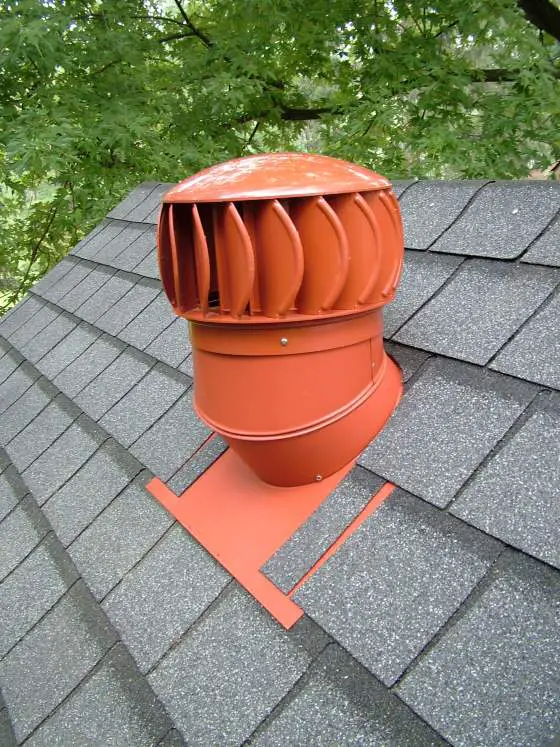
Roof Ventilation with Turbine Vent | This turbine vent spins with just the slightest breeze. It is but one tool to use when you want superior attic ventilation. The top part of this vent was made from durable plastic. The vent was manufactured in Australia. It was on my Queen Anne Victorian garden shed in Cincinnati. PHOTO CREDIT: Tim Carter
Roof Ventilation With Turbine Vent TIPS
- Ridge vents are inferior
- Hot air rises but doesn't go down
- WATCH install videos below
- Turbine vents suck lots of air from attics
- CLICK HERE to Get Tim's FREE & FUNNY Newsletter!
Is Roof Ventilation Important?
Yes, roof ventilation is very important. The more you can get the better.
The roof-ventilation rage over the past fifteen years has been continuous ridge and soffit ventilation. These systems are nearly invisible and they create a system through which air enters your attic space and then gently floats through the attic space.
But I've discovered over the years there's a much better product to use to ventilate an attic.
Do Ridge Vents Work All the Time?
Ridge vents do not work all the time. In hot weather with no wind, no air floats out of your attic space.
The companies that make the ridge ventilation products claim that no matter what the time of year, the air exits the attic space through small gaps at the peak of the roof. I've tested this claim, or hypothesis, and it doesn't work in the summertime.
IMPORTANT TIP: I'll explain more in a moment, but realize that hot air rises, it doesn't go down.
At the peak of your roof there's a gap in the wood sheathing.
This gap is covered with any number of different products that allow air to pass, but prohibit rain, snow and insects from entering your attic area. You can't see these vents as they are almost always covered by the roofing shingles at the peak.
Ridge Vent Gap Video
Watch the video just below to see this gap. You'll see it about 1:40 into the video. If you want to advance to that point, just do so. Realize this gap you see is where the air comes out of the underside of the roof.
What is the Physics of Hot Air?
The mechanics of the air movement are quite simple. During warm weather, the air inside your attic heats up. Since warm air rises, it tends to float out of the highest ventilation spaces. As air leaves your attic, more air has to replace it.
The conventional wisdom is to put in soffit vents down at the bottom of the roof so the replacement air can enter here and flow up under all the roof sheathing. This convection movement naturally draws in cooler outside air to replace the air that just exited.
Does Wind Suck Air From Attics?
Yes, wind does suck air from attics. It's called the venturi effect.
Wind that blows across the roof anytime of year also acts to vacuum air from the attic space. The wind blowing across a roof can create a partial vacuum on the leeward side of a roof. When the wind blows and at the right angle a significant amount of air can be pulled through the attic space by the vacuum created as wind blows across the peak of the roof covered with a ridge vent.
Can You Test Ridge Vents With Incense?
I loved taking physics in high school and college. There I discovered that hot air rises and cold air falls down.
For a ridge vent to work, the hot air has to rise up to the peak under the shingles, then it needs to go down several inches in altitude to get out of the ridge vent.
That seemed impossible to me. I decided to test it.
I went up into my attic on a blistering hot day around 1 pm. The sun had been beating on my roof for hours and it was probably 145 F up there.
I made sure there was no wind outdoors. It was a calm humid Cincinnati summer day.
I lit a stick of incense and held the stick about 10 inches down from the underside of my continuous ridge vent.
Smoke from the incense floated lazily up but it was NOT drawn out of the ridge vent. It just sat up near the peak of the roof.
Are Turbine Vents The Best Ventilation?
In my opinion, turbine vents are the best ventilation. They work with just the slightest breeze.
Turbine vents can vacuum vast quantities of air from an attic space on a windy day. It's the common turbine vent. Some people call them whirlybirds or whirlybirds.
These balance ventilators have a dome that spins on high-quality ball bearings. Just hot air rising out of one will make it spin.
If the wind is blowing and catches the fins, then the turbines act like giant vacuum pumps sucking hundreds of cubic feet of hot air out of an attic per minute.
The faster the wind speed, the faster the turbine rotates.
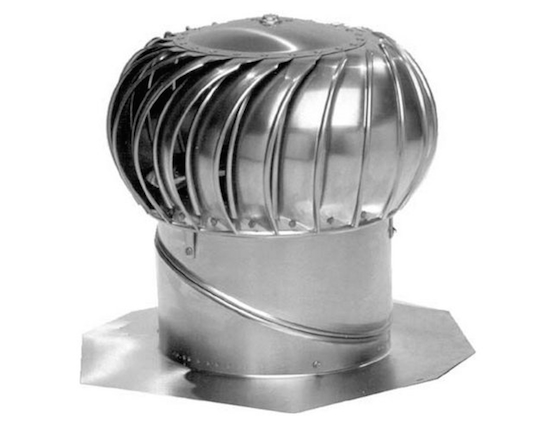
This is a standard turbine vent. They come in different colors. Some have external braces. This one you see is Made in the USA. CLICK THE IMAGE TO ORDER ONE OF THESE GREAT TURBINE VENTS.
Turbine Vents are Time Tested
Turbine vents have been used for many years in both residential, commercial, agricultural and industrial buildings. The vents are very affordable, easy to install, and they pump vast amounts of air from attic spaces.
CLICK HERE to see an assortment of turbine vents that I've used on my jobs. Made in the USA!
A Small Turbine = Lots Of Air
A small 12-inch diameter turbine vent with a constant wind speed of 5 miles per hour (mph) can remove 347 cubic feet of air per minute (cfm) from the attic space.
A single 14-inch diameter turbine vent that is subjected to 15 mph winds can expel up to 1,342 cfm of air! If the winds are still, the vents still allow air to drift up and out of the attic space, although not nearly as much.
How Much Attic Air Change is Required?
Those amounts of air might not mean much to you at first blush. But consider a moderately sized home whose attic space is 36 feet deep, 50 feet long and 10 feet high at the peak. This attic space contains 18,000 cubic feet of air.
A single 12 inch diameter turbine vent could provide a complete change of air in the attic space every 52 minutes if the outside breeze was just 5 mph.
The 14 inch diameter unit could provide a complete air change in the attic every 14 minutes at 15 mph. Imagine what happens if you install two or three of these simplistic turbine vents on the back side of your roof out of view!
Can You Achieve a Leak-Proof Installation with Turbine Vents?
It's easy to install a turbine vent and have no roof leaks.
The roofer your builder hires can install a turbine vent in less than 15 minutes. The average cost of a high quality turbine vent is just $50. The best ones provide years of maintenance-free service since they have permanently sealed ball bearings.
Roof Flashing Video
Watch this video of me installing a bathroom vent fan hood. It's the EXACT SAME process for a roof turbine vent. Nothing about the install is different.
If your roof is not too steep and you have asphalt shingles, this is a DIY project. Once again, watch this video and imagine I'm installing a turbine vent. The base flashing of the turbine vent is IDENTICAL to the bath fan flashing you'll see.
No Leaks
Many people look at the vents and think they will leak during a rainstorm. The wind that almost always accompanies a rain shower or storm actually causes the turbine to spin and blow rain drops away from the vent. The same is true for snow.
If you want the strongest turbine vent, be sure to buy one that has external braces. These are simple metal braces that extend out beyond the spinning turbine. These visible braces do a fantastic job of stabilizing the turbine when the winds are really blowing.
Column NH039

Tim built custom homes and did ultra-custom remodeling for 20+ years before launching his Ask the Builder media presence. He was selected as one of the Big 50 by Remodeling magazine in 1993. This award gave birth to Ask the Builder in October 1993. Tim also operates https://DrawPlumbingPlans.com. His @askthebuilder YouTube channel was the first home improvement channel on YouTube.
have a tublar vent in the shed of the home I just moved into, inside there is water stains on the floor under the vent, prior occupant said it leaked everytime it rained. Is there something I can purchase to put on the inside to stop the rain from leaking into the storage unit thru this
Charlene, you need to schedule a 15-Minute call with me.
My turbine ventilator blew off. How do I reattach it? The shaft that it connects to does not have any threads so how was it previously attached? I looked on a ton of other websites and I have seen the internally attached and the externally attached. I do not think mine was externally attached because I don't remember seeing the metal brackets holding it up there. I am not sure if it was internally attached because the top of mine is has a small 1 inch opening with two little holes one either side. I am confused as to how it was attached previous to the giant wind storm we had. How can I fix this?
You use screws. It's a male / female set up once you get on the roof.
...sorry cant help.
..there is a new to me static vent to replace noisy turbine vents. WheaterPro Turbo for 12"&14" base. Superior Air flow, no Maintenance.
Made by Duraflow.
Hase anyone used this type of static vent?
Just had to replace a turbine vent that was blown off roof during high winds. Cost paid to roofing company was $599.
I have a handyman install one, however the roof has quite a pitch and the vent is slanted at about 20-30 degree, not horizontal.
Is that a problem?
Thank you
Yes, that's a problem.
The spinning BASE of the turbine vent should be level.
What are the causes of these vent air turbines to slow down in their spinning during windy days? Out of 3 vents mounted on my roof, one spins normally while the other two are slow and sometimes don't spin at all. I have put WD-40 on the shaft and bearings and it spins fine, but after mounting it, it seems to behave as before, slow spin. Does mounting these vent fans exactly perpindicular to a horizontal plane make a difference?
Gilbert,
I'd say the bearings are worn. Turbines are CHEAP. Look above and CLICK that image of one. Those are the BEST ONES Made in the USA. Just get a new one or two.
Hi Tim
I recently had 2 Whirlybird turbines installed on my newly shingled roof. One closer to the front and the other closer to the back of the roof. There are still 5 or 6 static vents in the roof as well.
I've heard that the turbines might disrupt the natural flow of the attic air because once they start spinning they will start to draw air in from the nearby static roof top vents rather than the air moving in naturally from the soffit vents.
Should I be concerned?
No. If you want the best ventilation, remove the static vents and replace with more turbine vents.
We just installed wind turbines and looking at them, I am wondering if we just created a bat problem. Can and do they enter those turbines ?
We had a metal turbine vent installed on a steel shipping container that we are using as storage. The vent is leaking water on to the floor. My husband wants to remove it because of the leak and I want to keep it because of the great air flow. Can you give suggestions as to why it would be leaking? Your help is very much appreciated!
Hi Tim,
Two questions I have
1) How do we calculate the size of turbine vent we needed for the a particular size of the attic based on certain wind speed. You gave two example of 5mph and 15mph but no formula.
2) Could you please explain in a more simplerer manner on this comment " The spinning BASE of the turbine vent should be level."
Any youtube clip you have or pictorial diagram stating the mechanics?
Am setting a new room in my house but the area was a vacant area where you can see the ground floor to second floor now after closing the area, the up stairs is much warmer and darker.
So am goign to put a vent fan (condenser motor based) with 295cfm in the "enterance " of my second house floor and another inside the new no opening room.
My thought is if you bring the hot/warm air inside the house esp on the second floor to the attic and use two 14" turbine to suck out the air then house will be cooler.
my house is 22*75 feet.
Kindly share your thought... am new to this so am picking up the terminologies and advices from various sources.
thank you
Wignesh
1) The turbine vent will have this information printed on its box. You can always have more, as long as you have adequate intake, e.g. soffit vents.
2) The actual turbine (the part that spins) should be level. The part that attaches to the roof has an adjustment to make this possible.
Personally, I think these vents are of little value. They do not have enough draw under usual circumstances to expel heat except between the two roof joists which they straddle.
Turbine vents will ventilate an attic if the proper amount of them are used and they are installed properly but in most cases a "good quality" ridge vent product that is properly baffled will out perform them every time. On the 36'X50' attic example you gave it would take 4 - 12" turbines or 3 - 14" turbines to meet the minimum spec for exhaust ventilation. (1 sq. ft. of net free area per 300 sq. ft. of attic space. 50% of that intake and 50% exhaust.) 4 - 12" turbines equals 452 sq inches. 3 - 14" turbines equals 462 sq. inches. 432 sq. inches was the minimum spec for the above mentioned roof. A good quality ridge vent will give 900 sq. inches and will keep the attic much cooler unless you want to use 6 or 8 turbines.
Another important side note is if you go way over on roof exhaust ventilation you need to have equal (or a little more) intake or you could create a low pressure situation in the attic which could pull air in through exhaust vents in certain situations.
What was the answer to: "We just installed wind turbines and looking at them, I am wondering if we just created a bat problem. Can and do they enter those turbines ?"
What precautions can you take to prevent rain or snow from leaking though the turbine?
Keep the bearings oiled! The curved blades are designed to spit rain and snow OUT when they spin. A high-quality turbine - CLICK THE IMAGES ABOVE IN THE POST TO GET ONE - spin with the slightest puff of wind if you install them level as they should be.
Hi, this is Linda, I live in a townhouse and am on the condo board. There are 10 units left to re-roof, one of them is mine. We still have the wirlybirds but the Management has asked for these not be put back on the new roofs. My question, do we actually need these on the roofs?
Yes. I feel you need them. They're the best system.
Good Day, I live in an area where wind does not normally accompany rain and so it looks like the turbine fan is leaking rainwater into the ceiling. Is there anyway to mitigate this issue? The turbine fan is on a 12x15 building. Should i just remove the fan and not bother with ventilation?
I LIVE IN NORTHERN CALIFORNIA. PARADISE/95969. WE RECENTLY HAD 4 ROOF TUBINS INSTALLED. DO WE NEED TO COVER THEM IN THE WINTER TIME OR ARE WE OK NOT TO. WE'VE HEARD PRO'S AND CONS ON WHAT TO DO. CAN YOU GIVE ME ADVISE ON THIS. WERE ABOUT 100 MILES ABOVE SACRAMENTO.THANKS DICK
I'm considering purchasing a wind turbine but I live in The Bahamas where we can experience hurricanes category 3 and above. Would a wind turbine withstand high wind speeds as are associated with hurricanes.
I have a one story house. It's about 2450 SF. My roof had to be replaced after hail damage, I got a contractor to do the job. My old turbines was removed and replaced with some areas of ridge vent. I only found out after the work was done. I live in north TX , I was not sure the ridge vents are enough for the extreme weather here. We had lots above 100's temp every summer. I was told by the roofer once I have ridge vent I don't need turbines . The two does not work together. Really? What should I do ? I really can not have both? please advise !
I have a question about the positioning and location of the turbine ventilators. I noticed that my turbine ventilators were position west of the ridge of my house while my neighbor's whirlybirds were located on the east of the ridge of their house. Notice that strong storms and winds come mostly from west-to-east direction. Does it matter whether to put the whirly birds west or east of the ridge?
For aesthetic reasons they are usually positioned so they are not visible from the front (street side) of the house.
Good day
Please tell me if whirlybirds can be fitted with a no-ceiling thatched roof?
I am in Gaborone, BotswanA
Hi Tim,
Great video, about that funky transition joint that you had to seal.
I have 2 questions:
1) why would you not chalk around the finished shingle & facher molding?
2) why are you not using whirlery bird vents, that you say vent better than ridge vents?
Enjoy your columns,
Terry
Tim,
Any thought or comments on the Aura style vents? I have to replace my roof and have the whirlybirds now. I like the esthetic of the Aura vents better, but ultimately I want the best ventilation.
I think the Aura vent is a hoax. It's a STATIC vent. Here's what it says at their website:
"The Aura Ventilator performs like a turbine vent with no moving parts ensuring long life and no maintenance."
Rhetorical question of the day: How does a vent with no moving parts move hundreds of CFM per minute?
There's no discussion of this at all on their website. These appear to be nothing more than fancy-looking pot vents.
They would work under the same principal as an airplane wing. According to a principle of aerodynamics called Bernoulli's law, fast-moving air is at lower pressure than slow-moving air, so the pressure above the wing is lower than the pressure below, and this creates the lift that powers the plane upward. It will also create a vacuum that causes the hot air to be pulled out of the attic. 😉
Jason,
Thanks for the explanation. I understand your explanation on the wings of airplanes, but the shape and placement of the no-moving parts roof vents are different from the wings of airplanes.
Could you explain the aerodynamics of the no-moving parts vents?
Thanks,
Charles
do roof turbines prevent embers from entering attic space as opposed to ordinary roof vents?
Tim, you talk about your incense test where u saw no smoke being sewn up thru ridge vent. But correct me if j am wrong. Ridge vents aren't meant to vent an attic space. They are meant to be connected via a channel created between the underside of the plywood and the insulation, if any, down to the soffi vents to allow cool air to ebter the channel thru the lower soffit and rise up to the higher warmer ridge and out. The goal being to keep the roof cooler to extend shingle life.
Now, I personally disagree with that idea as newer shingles can handle the heat but when I built my SIP home with EPS foam panels, they would only warranty them 20 yrs if I built a second plywood layer roof ON TOP of the sips with 2x4 spacers. They said this space would cool the roof but more importantly would allow moisture transmission from the conditioned space to go thru the semi permeable foam, thru the osb plywood and escape thru that space. Otherwise a hotroof would almost ALWAYS result in a mushy ness of the osb ply in 10 short yrs! Just an FYI. So maybe that's why code doesn't allow osb under shingled roofing in a hot roof set up as in a cathedral with foam???
Ridge vents are meant to vent whatever space they are connected to. In a traditional situation with a flat ceiling and an attic, that is the attic. In a situation with a cathedral ceiling and no attic, they vent the the space you describe that is between the first roof deck and the second deck that has been built on top of the 2x4 (or other) spacers.
A limb fell on my roof and damaged a Roof Turbine. I need to replace. How do I find out if the Turbine is a 12 or 14 inch? Where do I measure? Thanks.