Waterproofing Foundations
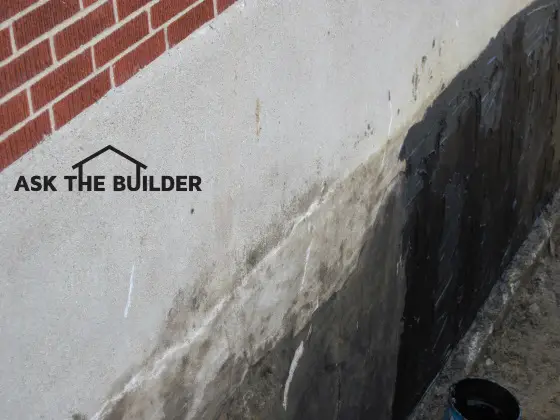
Foundation Sealer
You really can't be too careful when you start to build a new home. There are so many time-delay booby traps that can spring on you months or years after you move in. One that tends to shock many people is the simple task of waterproofing a foundation system. I can hear you now, "Tim, my builder did waterproof my foundation." Well, believe it or not in many cases that is not true.
What's the difference between damproofing and waterproofing?
Yes, your builder has already or plans to spray a black liquid on your foundation. He may even call it waterproofing. But the fact is this product may be just damproofing. There is a significant difference between damproofing and waterproofing. Because the buzzword mold is now as loud as the steel-against-steel clash of wheels on the rails of the L, you need to make sure the moisture from the soil can't possibly invade your new basement walls.
What causes that moldy smell in an old basement?
Perhaps the best way to start is to go back in time to a basement in an old home. Surely you can recall that smell, that dank moldy smell of an old basement. You were smelling mold and its growth was fueled by the constant stream of moisture from the soil through both the unprotected walls and through the concrete slab you walked across. Years ago, builders didn't regularly apply even a simple tar coating to foundations. They did not have access to large sheets of plastic that help retard the transfer of water vapor from soil through concrete slabs.
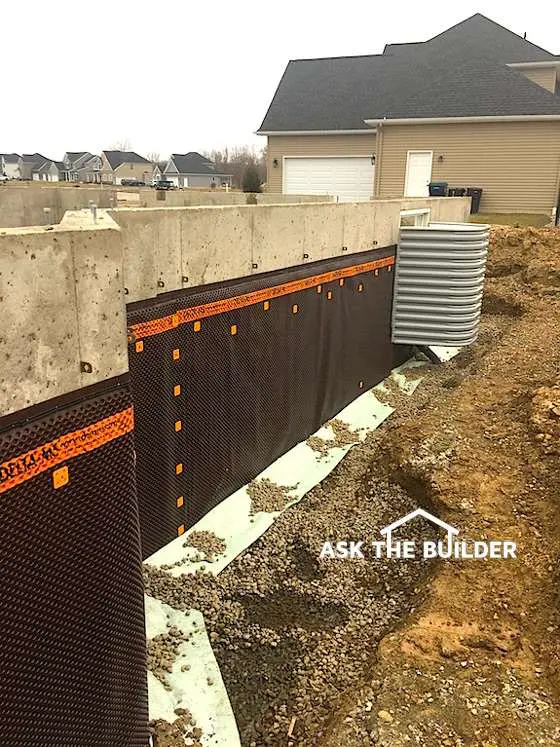
This system connects to the drain tile. It's a great waterproofing solution. I'd add more gravel and no matter what the MS Delta people say, I'd cover the gravel with a foot, or more, of straw. Copyright 2018 Tim Carter
And believe me, water vapor readily passes through concrete. Granted, it does not transfer at the same rate as perhaps paper or cloth, but it does move to an environment of lower vapor pressure. Liquid water can soak into concrete. Surely you have seen damp patches of concrete before. Proof of this is easy as efflorescence is a prime example of water movement. The water enters the concrete, dissolves salts and then moves towards your basement. Once at the surface of the concrete wall, the liquid water evaporates and leaves the salt deposits behind.
Prevent a wet basements by using this Basement Waterproofing Checklist to hire a great professional. I offer a 100% Money Back Guarantee.
To permanently stop water and water vapor from entering your foundation walls, you need to waterproof them. There are any number of systems that do this, but I prefer the spray-on systems that seal the pores of the concrete. But don't confuse waterproofing with damproofing, not for a moment.
Damproofing is an inexpensive way to meet the lowest minimum standard of the building code. The usual weapon of choice for damprooofing is simple hot liquid asphalt sprayed on the concrete. Liquid asphalt is an excellent damproofing material, but alone it is not a waterproofing system.
Do you need to check local building codes?
And while we are speaking of the code, here is one of the traps. Every local building code can be different, but most state that unfinished basement living spaces just have to be damproofed. But what happens if you know you are going to finish your basement a year or so after you move in? The answer is to waterproof the foundation now for that possibility and to ensure your basement will indeed stay dry even if it remains unfinished.
What is a good waterproofing method?
The waterproofing method I used on my own home is still available.
It was called Tuff-n-Dri at the time and it was pioneered by Owens-Corning. They subsequently sold off this business segment to Tremco.
It's a mixture of hot asphalt and rubber. The coating ends up being about one eighth inch thick or even thicker. A special insulating panel is placed in the hot liquid that helps protect the coating from damage during backfilling and it acts as both an insulator and a drainage plane. The rubber in the mixture imparts elasticity to the coating so if the foundation cracks, the coating stretches over the crack to provide protection.
If you’re interested in learning more about the cost of foundation waterproofing I have an article here.
Damproofing compounds can't do this. If the foundation wall cracks, and most develop tiny shrinkage cracks over time, water can readily pass through to your basement. It is also better to waterproof from the outside rather than try to stop water once it is already into your basement space. Spend the money now and waterproof before the builder backfills.
Over the years, I've seen many different spellings of efflorescence. Here's my growing list: effervesce, effervescence, effervescent, effleresants, effloreflance, efflorescence, efflorressance, effluorescence, eflorescence, eflorescents, ellforesce and ifflorescence.
Column NH058

Tim built custom homes and did ultra-custom remodeling for 20+ years before launching his Ask the Builder media presence. He was selected as one of the Big 50 by Remodeling magazine in 1993. This award gave birth to Ask the Builder in October 1993. Tim also operates https://DrawPlumbingPlans.com. His @askthebuilder YouTube channel was the first home improvement channel on YouTube.
What if your house is forty years old. I am assuming the coating you are referring to is done on the outside foundation?
Tim,
I like your answer.
Over the years I found that the uninitiated relate to the phrase "waterproofing will bridge a crack of 1/16" over time, whereas damp-proofing will not". (1/16" is the industry standard).
The reason "tar"/damp-proofing won't bridge a crack, over time, is that as a single material it will oxidize (air will dry out the oils) causing shrinkage of the tar and consequent cracking in the tar coating (like the floor of the salt flats out west). At that point the product has outlived it purpose. Drying and cracking of tar on a foundation wall happens faster than you would think. I've witnessed it happening in three years.
Today's waterproofing membranes consist of a formulation of modified "tar"/asphalt/bitumen (usually modified with rubber) laminated to a carrier sheet, typically polyethylene. The polyethylene layer protects the formulation from air/oxidation.
The water-proofing industry calls this type of product "self adhered waterproofing membrane". Laymen call it peel and stick waterproofing.
(As an aside here, I always chuckle when I here the industry term self-adhered. It sounds so simple doesn't it. There is nothing simple about the "self-adhered" material or process.
Involved in the "simple' self-adhering process are: preparation of the substrate, priming, detailing of wall intersections and penetrations, application of the membrane (including using a hand held roller over the surface to establish intimate contact with the substrate), sealing exposed overlaps within 12" of the bottom of the wall, sealing membrane cut edges, termination of the top terminal edge, and protecting the membrane before back filling with protection board/sheet molded drainage/rigid insulation or a combination thereof.
Just what about that process is self-adhered? The industry makes it sound like the material just jumps out of the box and onto the wall. Simple? I know I'm a nerd about stuff like this.)
Until last years Colorado rains, my dirt crawl space floor was dry. This year it flooded and I pumped gallons of water out. I now have mold and need remediation. If I dig out all surface dirt and remove fiberglass insulation of concrete walls and plastic off floor, how would I waterproof? I also understand that vented crawl spaces, insulation is installed on ceiling between joists, not on concrete walls
You need to do a phone consult with me. Far too much to talk about.
I had bad effluorescense on the basement wall of my house built in 1913. The concrete surfaces inside were spalling-off in chunks and I spent weeks chipping the walls with a welder's hammer and scrubbing with wire brushes to get to sound concrete. My research then suggested the spalling might have been caused by expansion force from the crystallizing salts, maybe like the force of water freezing to crystalline ice. Another thing about the walls. There were large diagonal cracks from sill to basement floor, and a friend who is a civil engineer said in 1913 the concrete wasn't poured in one go, and the cracks are possibly where the builders took lunch breaks after dumping concrete into forms from wheelbarrows. Or maybe they even poured concrete for the walls over a few days. Some of the floor joists and roof wood members still have concrete stains, so I suppose the form timbers were used to build the house structure. Nothing wasted!
Thanks for all of these tips to prevent basement flooding. I like what you said about waterproofing membranes. I imagine this preventative action can save a lot of headaches in the future. With summer gearing up I will make sure to look up a local professional to help me get this waterproofing done.
Help! We were told to put down a roofing/foundation asphalt coating on a garage floor that we plan to convert to a living space. We used Black Jack and the smell is strong, even though it has only cured for a few days. I read that it would take from 7-14 days to fully cure.
Will the smell go away when it is cured? Or do I now need to seal the asphalt with something?
Thank you!
Tim,
I really like these suggestions. On my Ypsilanti, MI home, I had a team come in and fill my foundation cracks with a high pressured crack injection product, i believe it was polyurethane. We haven't seen any issues since this happened and we are now considering a french drain system with a sump pump. Thought?
40yr old house, a few small wet spots, 1 crack, it needed a complete reno anyways so I am now down to foundation, 4 walls and a floor, I need to clean out a sloppy repair of old crack and redo properly (due to budget constraints I have no choice but to do almost all of this solo, over time, but I consider myself pretty capable, and smart enough to know when I need advice 🙂 ).
My question is, is there any sealant, product that I can apply to the inner walls floor to prevent, minimize moisture (without potentially devastating off gassing issues or creating an interior condensation trap?
I plan to finish with spray foam and drywall...
* Also wondering about the sound insulation properties of spray foam, can I use it between the joists, Will it block sound? Why is pink batt insulation not advised between joists?
# How to mitigate condensation from water pipes / hose between framing and drywall?
Reference your article on Waterproofing Foundations: You state, "The waterproofing method I used on my own home is still available. It is a mixture of hot asphalt and rubber. The coating ends up being about one eighth inch thick or even thicker. A special insulating panel is placed in the hot liquid that helps protect the coating from damage during backfilling and it acts as both an insulator and a drainage plane. The rubber in the mixture imparts elasticity to the coating so if the foundation cracks, the coating stretches over the crack to provide protection." Can you share the name of this product with us?
In response to Joel's post Hydro-Seal 75 is the product.
- No solvents
-Easy to mix and apply
-Mix with Cement for patching crack and paint right over patching and it all dries together.
Hydro-Seal 75 allows vapor transmission so it breathes and won't peel or trap moisture causing failure.
No product holds back moisture and seepage better.
Hydro-Seal 75 is a water based epoxy that is mixed 1 to 1 prior to application with rollers and brushes.
Washing surface with TSP prior to .application is the prep.
Once mixed Hydro-Seal 75 needs to be applied in 30 to 40 minute pot life.
Patching mortar is made by adding Portland Cement or Hydraulic Cement or concrete sand mix to the Hydro-Seal 75.
1 gallon will cover 150 square feet 1 coat or 75 square feet 2 coats.
Very simple easy do it yourself application.
Mike says:
September 27, 2016 at 11:43 am
Reference your article on Waterproofing Foundations: You state, "The waterproofing method I used on my own home is still available. It is a mixture of hot asphalt and rubber. The coating ends up being about one eighth inch thick or even thicker. A special insulating panel is placed in the hot liquid that helps protect the coating from damage during backfilling and it acts as both an insulator and a drainage plane. The rubber in the mixture imparts elasticity to the coating so if the foundation cracks, the coating stretches over the crack to provide protection." Can you share the name of this product with us? i'm also wondering if you could answer this question.
You bet. I'm in the process of REVISING all the pages on my website here and haven't gotten to this one yet.
I went above and put in a HOT LINK to the company I used. Go back up and look. Great stuff.
Hi. I think I put my first coat of sealer on too thick...
It is now dry to the touch, but squishy, almost like puddles on the footings. It hasn't been too warm , should I wait a bit..or use a heat gun, and "brush off" the excess??
Thank you.
Leave it alone..... Be sure to read all my drain tile columns and do that part of the job RIGHT. Especially the depth of the gravel and WHAT to cover it with.
Great info and discussion! I'm building a house now and they "damp-proofed" the foundation as described above. But when they backfilled the foundation, they chipped one of he foundation corners... Less than a quarter inch deep and on a couple feet long, but it took the tar off the corner. How big of a deal is that?
Tom,
It's no big deal in your case. Your foundation is going to leak when the concrete cracks so the chip really doesn't come into play. What a shame you didn't have it WATERPROOFED.
Thanks for the info! We're in the middle of a build (replacing a 170 year old foundation) and while we see no issue with water and only had a little from bad gutters, I have contracted with a waterproofing company who will be installing a vertical waterproofing membrane. The mason was to parge with tar but has said they won't since we're waterproofing. Shouldn't the block be parged anyways? At least maybe with an elastromeric or drylok?
The house we bought has tar right up to the apron of the foundation. The guy that lived here before sealed the crack with cement and went over the tar a little. Now the cement patch he must have used is all chipping away from the foundation and has hollow areas. Should I pressure wash it and patch it again then re seal the driveway after?
Can i apply waterproofing paint on tar epoxy paint applied on terrace? Do i need to apply primer or something else before applying waterproof or damp proof paint?
My builder says that they use a spray foam on new poured concrete walls before back-filling.... s the waterproofing method and he says it has no issues.
I searched and searched and only found one time where it is mentioned... What about a closed cell spayed insulation on the exterior of the walls of new concrete walls of new construction?
When did code change? How can you tell if it was waterproofed or just dampened? What do you do if it wasn't waterproofed? House was built in 2021/
What if you have an existing home, where the below grade cinder block walls (basement) waterproofing has failed?
Is there any procedure that could be done to waterproof a wall from the inside? Or am I doomed to having to remove the outside hard-scape and retrench from the outside?
I did hear that there may be a product that requires multiple drilling through the cinderblock from the inside then pumping waterproof material through the wall to the outside. I would welcome you comments.
Thanks,
Matt