Garage Floor Drain Ideas
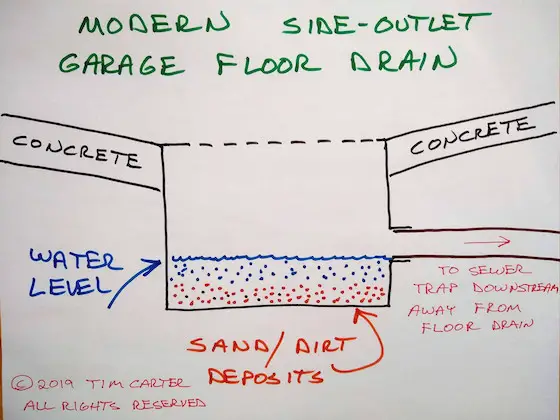
Garage Floor Drain Ideas | This is a simple illustration of a modern side-outlet garage floor drain. There's a small area at the bottom of the drain to capture sand, dirt, and debris so it doesn't clog the drain pipe.
Garage Floor Drain Ideas - Time Tested Technology
The inspiration for this column came from unexpected comments about a brief mention of garage floor drains in my December 1, 2019 AsktheBuilder newsletter and my December 9, 2019 AsktheBuilder newsletter.
The house I grew up in had a garage floor drain. The concrete floor was sloped like a giant shallow funnel so all water that got on the concrete flowed to the drain. That floor drain never caused any issues in all the years I lived in that home.
My current house doesn't have a garage floor drain. In fact, there's not even one in my all-important mechanical room where the boiler and water heater are located. You know at some point you'll have a leak in this room for goodness sake! I don't think plumbers in New Hampshire know about floor drains. My garage floor is sloped from the back of the garage to the doors.
I live in the snowy and cold Northeast USA where ice and snow are as common in the wintertime as whoopie pies in the grocery store. Water flows to the garage doors and puddles when snow and ice melt from my car and truck. Some seeps under the door and on cold days the garage door weatherstripping freeze to the floor!
It's ridiculous, as are many things in life! A floor drain or two in my garage would prevent this madness.
Silly Building Code Revisions - They're NOT Always Right
It's insane! The building code was altered some time ago prohibiting garage floor drains in certain cities and towns. The reasoning, I'm told, was that spilled gasoline and oil would cause explosions, death, and destruction.
Can you think of the last time in your city or town that you read about or saw on the local TV news that a house was destroyed and people killed by a garage floor drain or gasoline spilled in a garage without a floor drain?
Yeah, I thought so.

Did you know you can make your own silly TV news graphics like this one? Yes, you'll have eaten, drank, slept in a hammock, went kayaking, played epic games of ping pong against your nemesis, and maybe opened a prize or two before you ever hear about a garage explosion caused by a frivolous floor drain.
Newsletter Response - "Where's the Oil Separator, Tim!"
One or two subscribers who read my newsletter wondered if I had a special way to clean out debris from the floor drain. I've been a master plumber since age 29 and you bet I took that into consideration. Go back up and look at the illustration to see how debris is captured and prevented from entering the drain line.
It's important to realize you need to clean out the debris periodically so it doesn't accumulate to the height of the drain pipe. Look at the following illustration to understand how old floor drains, like the one in the house I grew up in, were piped.
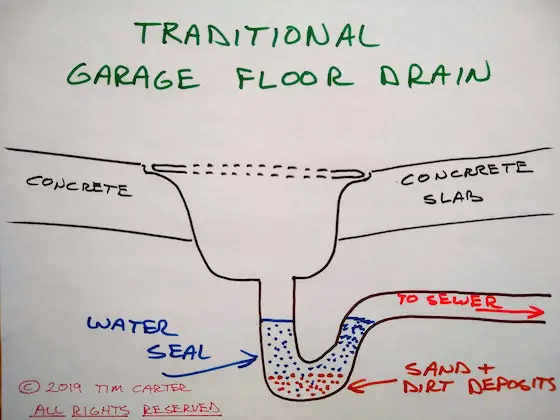
This is how hundreds of thousands, perhaps millions, of floor drains are piped. You can see that the bottom of the trap can fill with sand and debris. You can't get your hand down the pipe, but you can insert the end of a wet-dry vacuum hose!
You can see old floor drains are much like the p-traps under your bathroom or kitchen sink. It's easy for them to get clogged.
Why Put Traps in Garage Floor Drains?
Traps should be incorporated into garage floor drains to prevent vermin from entering the garage. This is especially true of drains that are piped directly outdoors on the land just outside the garage.
I'd never connect a garage floor drain to a septic system because I don't want any oil or mystery chemicals stored in the garage to have a chance to get into the septic tank.
It's unlikely that a plumbing inspector would allow a garage floor drain to be directly connected to a municipal sewer system. At the very least it should only be connected to a municipal stormwater drainage system.
The traps should be under the garage floor to help prevent them from freezing in cold climates. Water frozen in a p-trap will stop the flow of water out of the garage.
In April of 2019, I had to re-plumb the floor drains in my daughter's garage. The contractor who put them in didn't include a trap and he just ran the drainpipe to the footing drain. This allowed radon to fill the garage like hot air fills a political debate.

Look at how I installed the drain so it has a vertical riser that allows you easy access to the p-trap. That capped pipe is flush with the concrete floor now that the slab is in place. In addition, I made sure the drain line leaving the floor drain on the right was a straight shot into the p-trap for the same reason.
Quite a few subscribers were wondering where the drain water goes from the garage and if I had installed an oil separator.
The pipe drains to the ground outside about 40 feet from the garage door. I didn't install an oil separator and it's not required by the code.
Let's Apply Common Sense
What do you think the odds are of more than a tablespoon of oil reaching that floor drain on any given day? When was the last time you had a massive oil spill in your garage? If you did, did you clean it up or just hose it outside?
How many total gallons of oil drip from trucks, cars, and heavy equipment up on Mt Desert Island each day where my daughter will live?
What happens to that oil? Is most of it broken down in the soil at the side of the road and/or does a certain amount evaporate over time? Think about where you live. Think about how much oil is spilled on the ground in your town or city each day.
Much/most of the motor oil you put in your car or truck comes from the ground in the first place. It's as organic as it gets. Yes, it almost always needs to be extracted from bedrock, but there are natural seeps.
The point is most responsible people will clean up spilled oil in a garage. Most probably put down old cardboard under a tired engine or transmission.
Lastly, Mother Nature has great healing properties. She can and does clean up oil spills. It may take her more time than you would like, but She gets the job done.
Oil Separators
Let's imagine you're very concerned about getting oil on your land or into the ecosystem. You can install an oil separator as part of your drainage system. You just have to remember to get the oil out by pumping it or scooping it into bottles that you then drive to the recycle center.
It's important to realize the oil in the separator will be underground. You'll be on your hands and knees dealing with it.
If you have strong feelings about garage floor drains and oil, I urge you to spill your thoughts below in the comments. I moderate all comments to prevent SPAM, so it could take a day or two for your comment to appear. I publish all comments that aren't SPAM.

Tim built custom homes and did ultra-custom remodeling for 20+ years before launching his Ask the Builder media presence. He was selected as one of the Big 50 by Remodeling magazine in 1993. This award gave birth to Ask the Builder in October 1993. Tim also operates https://DrawPlumbingPlans.com. His @askthebuilder YouTube channel was the first home improvement channel on YouTube.
Great pics of your floor drain design. But - if it all drains to the ground 40' away, why do we need a trap at all?
For the same reason you need traps in house fixtures. Traps not only stop sewer gas, but vermin too. I don't think you want snakes, roaches, insects of all types taking the superhighway from outdoors up into your floor drain, right?
Plus Garage floor drain travels into the storm water system if you have one and if not into the sewage or septic system. Plus are you or can you
keep Gray and black water separate from each other and recycle the Gray water to water the lawn and etc. ?
I wish I had a garage floor drain in my garage in Boone, NC. But I am told that when my house was built in 1970 that all you needed to be a contractor in our area was a hammer and a pickup truck. I have heavy clay soil and so my wimpy footers have sunken sufficiently to create a slope to the back of the garage where the snow melt from our cars seeps under the framing and down the stucco wall of my basement workshop below. Great fun!
These drains are a great idea. Thanks for all the great ideas and the detailed explanations.
Wish I'd thought of this over 30 years ago when I built my house. We too have our garage door freeze shut sometimes in winter from the frozen snow melt. What a pain.
You indicated that your garage drains are piped outside, to daylight, about 40' from the garage door. I don't understand the need for a trap, what purpose does it serve? There are no system gases to be stopped. It might stop a mouse or two if they're not good swimmers. Cover the pea-rock with landscape fabric or a bail of grass hay, this will keep dirt from mixing into the pea-rock.
Excellent article on garage floor drain systems. The pics show how well laid out it is as well as your design.
I agree with the concept of using p-traps even where they're not required by code for the reasons you put forth. The type of floor drains that keep the dirt, etc. out of the pipes is also a great choice.
While your mention of your son-in-law's idea of washing his car in the garage with a special hot water connection sounds novel ( to clean off salt residue not noted in this column but elsewhere on ATB), That "could" be an issue in the garage with the possibility of mold/mildew issues assuming the garage is heated as some are.
I digress. I think the use of floor drains in the garage is a good choice. Regular cleaning of the floor with water can extend the life of floor coverings in the house especially if the garage is attached to the home.
Thanks for publishing this article.
It is against code to Not have a 1/4" pitch to door of garage invade gas leaks from car gas tank or gas lines. Gasoline fumes stay low. Best to have ht drain to outside. All need is a long drain at/before door to daylight. Doesn't gave this be uvderslab as yours and will meet Mass code.
What good is a sloped floor with respect to gasoline fumes if the door is CLOSED? When was the last time you ever saw in the news a house fire or explosion caused by a leaking gasoline line or gas tank in a car?
Pretty well written article Tim and very professional looking plumbing! I like that you covered most of the bases with regard to what could happen. There might be a lot of folks out in reader-land that may not think about all those possibilities. it is good to share our experience widely and responsibly. We are building a house in the northern tip of the Michigan mitt (we now live in Virginia). Building code there mandates foundations to be set 48" below the ground surface to protect against freezing. That would eliminate the trap.
Hi Tim for some reason the photo of your daughters new and improved drain system isn’t showing up for me. We’re going to add on an outbuilding with a lift for vehicle repair work, and a drain system would be a great idea too! Radon is high in this area, so I’d love to see the diagram/phots of how to do it RIGHT! Could you email the photos? Many Thanks!
About a cup of gasoline ran into my garage drain ... the entire house now smells of gas ... the landlord said the drain goes into a 50 gallon run off take ... what can I do ... I have had the garage door open with fans blowing outside for 2 days .. I opened the windows and doors in the house all day, but as soon as I close them it gets bad again ..I can stay there
I would like to put a floor drain in my garage and drain it into a sump pump pit. The sump pump would pump the water to my house sewer line. The code here requires it to go to the sewer line with a pit and free flow to the sewer line. When I asked about using a sump pump versus a pit, the city did not have an answer for me. To use a pit, I would have to dig a hole along the cement wall and drill through it. The sump pump (I feel) will do the same as the pit and collect dirt and provide a water trap with a check valve. Your thoughts?
Gaylen, Go read what Bill thinks about my thoughts. I've got MANY for you being a master plumber. https://shop.askthebuilder.com/15-minute-phone-or-video-conversation-with-tim/
Thanks for the common sense Tim!
Methane gas backing up in the mechanical room is why the mechanical code was written. It becomes an issue when the trap dries out from lack of use. If heating equipment uses combustion air from the room, methane gas can be pulled out of the floor drain when the trap dries out. Trap primers must be installed to prevent this.
Great article. I really appreciate the common sense points, something that seems to be lacking in many facet's of life today.
I was looking for different ideas for a trench drain that will capture dirt when I came across your article. Pretty much what I had in mind, but wasn't sure how it's typically done so your article was very helpful, thanks for taking the time to write it up.
I'm about to build a cleaning area for dirt bikes behind my commercial building. I'm going to be pouring a slab and plan to build a concrete drain trench with a steel grate. I plan to make it big enough to be able to clean out with a flat shovel.