Repair Blacktop Driveway Crumbling
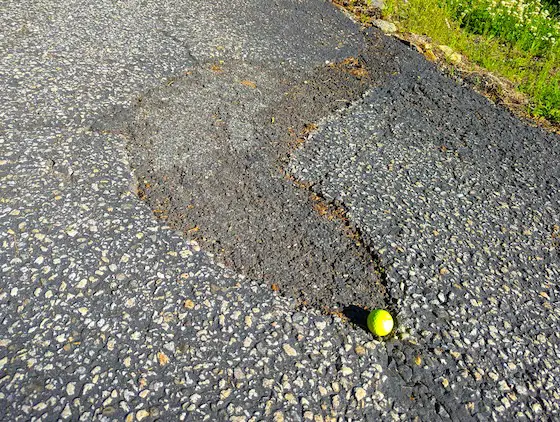
Repair Blacktop - This asphalt patch was installed two years ago. It was a product in a bag bought from a home center. It started to fail within one year. The golf ball is for scale. Copyright 2026 Tim Carter
Repair Blacktop Driveway Crumbling - Don't Use Cold Patch
You may have an asphalt or blacktop driveway as I do. Mine was installed twenty-five years ago and is in good condition. The mix ordered at the asphalt plant was key to its longevity. The stones in the mix are larger than normal.
Keep in mind that blacktop is much like concrete. It’s a blend of stones, sand, and liquid asphalt cement. The ingredients are tumbled in a large slanted drum, allowing the hot, sticky asphalt cement to thoroughly coat the stones and sand. Concrete uses Portland cement and water to interlock the stones with the sand.
My blacktop contains stones that range in size from BBs to ones that resemble large cashews. The stones or rocks produce the overall strength of the blacktop. Keep in mind, however, that asphalt roads and driveways derive the vast majority of their strength from the compacted crushed stone base underneath the black velvet paving you drive on.
Soft spots in the base beneath the blacktop can lead to depressions. In my case, the blacktop started to fracture into chunks about the size of a piece of pumpkin pie. Two years ago it was time to seal my driveway. I had to fill cracks and repair the crumbling asphalt in three different places.
I used my battery-powered hammer drill to break up the crumbling asphalt. I inserted a demolition tip, transforming the tool into a miniature jack hammer. This made quick work of removing the failed blacktop. I used the tool to make angled edges where I encountered solid asphalt paving. In other words, I undercut the asphalt so the bottom of the hole was larger than the top. This is what dentists do when they drill out a tooth cavity.
I purchased a high-quality cold-patch asphalt product that comes in bags. The product I purchased had just small rounded stones coated with emulsified asphalt cement. Once exposed to air, the patching material gets as hard as blacktop you get from the asphalt plant.
The lack of sand in the patching asphalt, in my opinion, is a major factor that contributes to its poorer performance. The sand in hot-mix blacktop fills all the voids between the stones in the mix. There’s far better bonding between the stones than in the cold-patch product you get in bags. All that work I put into patching my driveway only lasted one year. After two years, my cold patch is now losing stones faster than one looses money at a casino.
I’ve come up with what I believe is a much better, and long-lasting patch method for the DIY homeowner like you. I feel you should patch the larger holes, say anything bigger than ten square inches, with concrete. Yes, purchase bags of high-strength concrete mix. I know for a fact this product will last far longer than the bagged cold-patch blacktop.
Think about it, after you do the repair, you’re most likely going to seal your blacktop drive, right? The sealer will transform the gray concrete to jet black just as it will your existing blacktop. The only issue you’ll face is trying to get the concrete surface texture to match your existing blacktop. This is not too hard to do.
The following method is for residential driveways that receive light-weight traffic. Should you want to do this in a parking lot or a road, you just have to put in thicker concrete.
The next time I do a blacktop repair, I’ll remove the crumbling blacktop and then some of the gravel base. Once again, it’s important to angle the edges of the solid blacktop, making sure the bottom of the hole is bigger than the top by about 1/2 inch around the entire perimeter of the opening. I’ll install the concrete three inches thick. I’ll be sure to compact the gravel base before I mix and pour the concrete. I’ll also sprinkle the gravel with water just before adding the concrete.
I’ll add reinforcing steel to my concrete. You can purchase 3/8-inch rebar for this purpose. The rebar should have at least 1 inch of concrete under it. I’d space the steel bars about 1 foot on center.
The concrete mix should be the consistency of applesauce. You need to pat it with a trowel and smooth it so you have a sandy texture at the top. If you want to try to match the texture of your existing blacktop, you might save some of the pieces you took out. You can use a large hammer to break up the old blacktop chunks, creating a fine mix of stones and sand. No pieces should be bigger than the largest stone you see on the surface of your blacktop. Do all this work before you mix up your concrete.
You can broadcast this crushed blacktop immediately into the wet sandy concrete. Lightly tap it down into the fresh concrete so it looks as much as possible like your blacktop.
Cover the fresh concrete with plastic to help cure it. You don’t want the water in the concrete to evaporate too fast. Leave it covered with the plastic for at least 48 hours. I’d lift the plastic and wet it with water from a garden hose every morning and evening to ensure the concrete stays damp.
Column 1668

Tim built custom homes and did ultra-custom remodeling for 20+ years before launching his Ask the Builder media presence. He was selected as one of the Big 50 by Remodeling magazine in 1993. This award gave birth to Ask the Builder in October 1993. Tim also operates https://DrawPlumbingPlans.com. His @askthebuilder YouTube channel was the first home improvement channel on YouTube.