Build Gravel Parking Pad
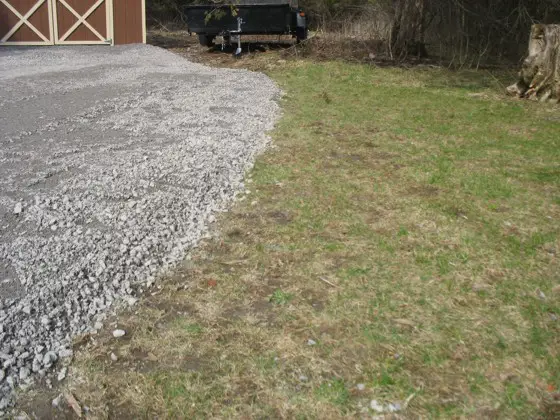
This gravel base was dumped directly onto the grass. That’s not acceptable. Copyright 2018 Tim Carter
".... your contractor should have come out and excavated out all of the topsoil where the new gravel was to be placed."
Build Gravel Parking Pad Checklist
- Remove 8 inches of soil
- Compact subsoil and consider a geo-textile fabric
- Install large base stones for strength
- Finish with choker angular gravel with fines
Related Links
Build a Great Gravel Drive - SECRET Information - Do NOT Share
Repairing Gravel Drive Erosion
Free & Fast Bids
CLICK HERE to get FREE & FAST BIDS from local gravel parking-pad installers.
DEAR TIM: I had a contractor come out to build a gravel parking pad next to my driveway. He just dumped smaller gravel, the size of golf balls, onto the grass.
This gravel did have some smaller crushed stone and sand mixed in. Then he rolled over it with his backhoe saying all would be fine.
Is this the right way to add gravel to make a driveway extension? I ask because my existing driveway has larger stones the size of softballs as the base. John O., Southern Ontario, Canada
Build Gravel Parking Pad To Last!
DEAR JOHN: The contractor you hired did the wrong thing in my opinion. It sounds like a classic dump-and-run scam. He rushes out with a dump truck or two, unloads the gravel, spreads it out, drives over it and cashes your check. There's a remote chance his work may stand up to moderate truck traffic, but only in very dry conditions.
Are Gravel Parking Pads Like Roads?
Gravel parking pads are just like roads. They're subject to the same concentrated loads as primary loads. My own driveway routinely gets delivery trucks on it that weigh in excess of 15, or more, tons. You should see the size of the 1,500-gallon tandem septic pumping truck that comes to my house every three years!
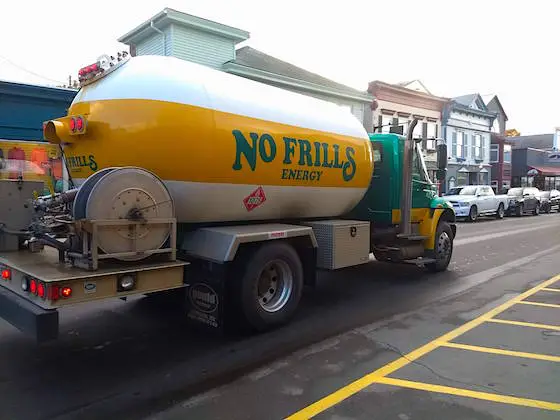
This is a propane delivery truck just like the one that comes on my driveway. Filled with propane my guess is it weighs in around 19,000 pounds. Copyright 2018 Tim Carter
How Old is Road-Building Technology?
Road building was perfected thousands of years ago. The Romans knew how to build roads that have stood the test of time, and many of their roads still exist today. To get lasting results, just mimic what they did.
Why is the Size of Parking Pad Gravel Important?
Here's an analogy to help explain why your contractor's work is going to fail. If you try to drive a heavy truck onto sand, there's a very good chance the truck will get stuck.
This is especially true if the sand is composed of tiny rounded pieces of rock. Some sand is made from angular pieces of rock or sea shells and you can drive on it with some success.
At the other extreme is driving on solid bedrock. You can drive an Abrams M1A1 battle tank that weighs over 62 tons and the rock will not sink. The Romans figured this out, but their chariots didn't weigh 62 tons!
Why Is it Easy to Dig Into Topsoil?
It's easy to dig into topsoil because it contains air, organic debris and loosely connected pieces of soil.
As you dig into regular topsoil, you'll discover that it's usually pretty easy to cut into the top layer, often referred to as the A profile. This topsoil is fluffy, it's got organic material in it and insects help aerate the soil. This is why rainwater soaks into topsoil readily. Topsoil is very weak. It can't support very much weight.
CLICK HERE to get FREE & FAST BIDS from local gravel parking-pad installers.
Why is Subsoil Stronger?
The subsoil is stronger because it contains little air, no organic debris, and the soil particles are typically interlocked.
But as you go deeper into soil, it contains less air, and it becomes more compact. This is why you're able to build buildings on the subsoils that are deeper in the ground. Some subsoils can support tremendous amounts of weight depending on the makeup of the soil.
How Should the Soil Be Prepared for the Parking Pad?
Knowing this, your contractor should have come out and excavated out all of the topsoil where the new gravel was to be placed. He should have then used a compacting roller to compress and compact the disturbed subsoil.
Should Geotextile Fabric Be Used?
I feel he should have then installed a layer of geotextile fabric. This is newer technology that helps keep mud from fouling the base layers of gravel roadbeds. If mud seeps up into a gravel roadbed, and it does when heavy vehicles pass over the road, the mud lubricates the interlocking pieces of gravel making the roadbed loose strength.
Once the geotextile fabric is spread out, you then place the softball-sized angular stones on top of it. I would put in at least a 6 to 8-inch layer of this stone. This stone is made from bedrock. It's important that these stones are very angular so they interlock with one another.
Never use rounded rocks of any size for the gravel roadbed. The rounded stones don't interlock, and they move around like ball bearings when driven upon.
After the 6-inch layer of stone is installed, use a roller compactor to get the stones to interlock as much as possible. This layer of stone is your simulated bedrock, and it's the foundation of your new driveway.
You then start to add layers of more crushed stone or rock, but the size of the stones gets progressively smaller as you get closer to the surface. Add about 4 inches per level and compact each layer. The smaller stones on top of the larger stones below choke in the larger stones making it nearly impossible for them to move when weight is applied from above.
This methodology produces an extremely strong roadbed or driveway as it creates simulated bedrock that's got a very smooth top surface. Keep in mind that the smaller the stones are at the surface, down to sand-sized particles, the less water it takes to wash them away. Be sure that the top surface of the driveway doesn't have too much angular sand in it, or a heavy rain will cause erosion.
The final reason why the contractor should have never poured the gravel onto the grass is that you never ever want organic material under a roadbed. This material will decompose and cause the roadbed to fail. The organic material will also become a lubricant and can cause the gravel to easily move and shift when weight is applied to it.
CLICK HERE to get FREE & FAST BIDS from local gravel parking-pad installers.
Column 991

Tim built custom homes and did ultra-custom remodeling for 20+ years before launching his Ask the Builder media presence. He was selected as one of the Big 50 by Remodeling magazine in 1993. This award gave birth to Ask the Builder in October 1993. Tim also operates https://DrawPlumbingPlans.com. His @askthebuilder YouTube channel was the first home improvement channel on YouTube.

Wow... 6-8 inches of softball size stone compacted ..with two textile fabric. Then several more inches of stone...all for a residential parking area..? While that would make a great base and is a "right" way to do it.. How much money would that cost? Do all customers have that kind of budget?? Be careful before you call something a scam..
Residential gravel drives in New Hampshire routinely get deliveries from propane trucks, septic pumping trucks and other delivery trucks that weigh in excess of 15 tons.
If you don't build a gravel drive as I suggest, you'll be repairing ruts all the time.
As for the cost, I can't quote you numbers because each person's job is different. Yes, some people have smaller budgets, fortunately, we live in a country where it takes just a little more effort to make more money.
One foot thick driveway! watch your step when parking.
I don't get why so-called experts feel the need to give complex solutions. Things aren't as complicated as they make it out to be. Wacky to advise the average DIYer to build a Roman roadway, let alone get softball-sized stones.
Arnold,
You left something out of your comment. Please share how you'd build a gravel driveway.
Jimmy,
Correct! If you just dump it onto the grass, you've got issues. This is why topsoil and some subsoil are removed when making a driveway.
Another problem is that the gravel goes right up to the wood siding violating your long standing rule about keeping wood away from the ground.
Doing this the right way costs the same as the wrong way. When you dig the foundation use the same equipment to dig the driveway. Bring in the apropriate stones for the drive and the foundation. All the equipment you need will be on site anyway. Over the course of construction the stone will be compacted and ready for concrete or your choice of finish material. You are wasting money on the concrete of the base is not prepared.
Looks like the shed door on the right side is out of alignment, and the grill needs a cover!
What you describe seems like a very nice, long lasting drive that also probably won't be full of weeds. But we commonly see the just dump gravel out on the ground and call it good. That is an "OK" solution, lasts a while, weeds grow in it, probably will be adding more gravel later on, gravel may spread wider than originally planned. The Tim way is the very nice result, the other way is the econo quick and dirty way.
Do it right the first time. (who says that all the time?)
Excavate, compact and put the right stone in. Ensure there is no organic material there or you will be forever weeding.
If not compacted and the right thickness of base not put in for the type of traffic that possibly will use it then - you will just keep spending money in the future (and 'blow' that budget) - or will be moaning all the time as you step out into puddles or dirt that has moved through the horizon.
My issue would be mowing around this. I can see needing to sharpen blades often or replacing. Why can't there be an edge put on there, or the soil sloped level with the driveway?
My initial observation was there is no edging, so rain will slowly wash away the edges of the gravel. It also looks like it was just dumped onto the existing soil and not dug into the ground to establish a solid base.
This sounds OK for a moderate to heavy use driveway. My question is how much of this would I need to follow if all I wanted is a level pad to park a 6,000 lb Travel Trailer between trips?
Do the math. You tell me how many PSI is being exerted by each of the 2 or 4 tires onto the gravel.
What's the surface area of the tire contact zone? Maybe 6 iches by 5 inches each?????
See where this is going???
Please do a column on repairing a 30+ year old gravel driveway. We had an enormous oak tree fall on our house and neighbors, requiring crane & other heavy equipment. Churned up all gravel with dirt, sawdust etc. Would the geotextile fabric work if applied before new gravel?
No need for a new different column. Just follow what I say to do above. REMOVE the damaged areas that contain wood chips and dirt and replace with what I say to use.
this procedure is the best way to have a long lasting driveway/parking lot, big stone, compaction stone, finished with small clear gravel. Cost is not the issue when you do things right the first time. Cost becomes an issue when you do it on the cheap the first time and then spend lots of labor and money to fix it right!
Love that messy driveway.. Old school, and good enough. Looks natural, not manufactured. Tired of this "new" look over OVER managing landscaping, stone, etc.. ends up looking fake, and doesn't blend in with the environment. Simple is best.. Good enough is fine, not always, but in this case, fine.