House Wrap vs Vapor Barrier
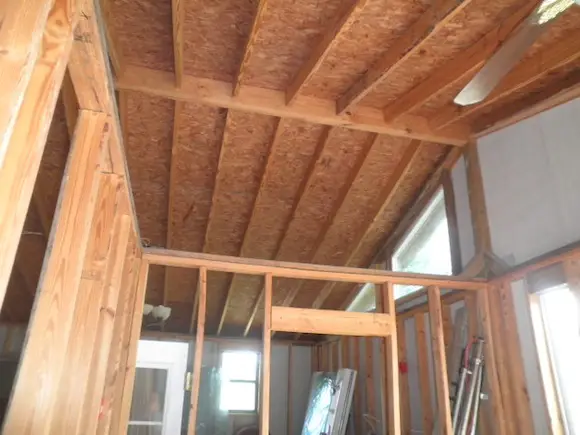
Here's the underside of Janice's vaulted addition ceiling. I sure wish the Star Trek transporter technology existed so I could get there in seconds to really look at what's going on. © Copyright 2021 Tim Carter
House Wrap and Vapor Barrier TIPS
- House wraps go on outside surface of house under siding
- Vapor barriers go on warm side of wall - See Below
- WATCH videos below for help
- Great improvements in newer house wraps
- CLICK HERE to Get Tim's FREE & FUNNY Newsletter!
Janice Rozier, who lives in Folkston, GA, sent me a fascinating email:
"I'm having an addition built onto my existing brick home. The question I have is about the house wrap vs vapor barrier.
The addition is framed wood structure with cement siding, (already installed), cathedral ceiling, and concrete floor. Do I need the vapor barrier or house wrap inside before drywall?
The insulation is not yet installed. I was told to buy Styrofoam Weathermate Plus house wrap, but they did not use it on the outside before the cement siding.
Thanks for taking the time to read this. All construction has stopped (another issue) so whenever you can get back to me is great. Thanks again."
Are House Wraps Different from Vapor Barriers?
Well Janice, let's discuss the two different materials as they are very different even though they may appear to the naked eye to be nearly identical products. Both usually come in large rolls and are thin coverings or wrappers.
What are House Wraps?
House wraps are innovative building products that were introduced in the 1970's into the marketplace. These products are designed to keep water away from a house's wood framing members like an umbrella keeps you dry in a rain shower.
They're a secondary defense against water damage.
Some newer house wraps are like giant rolls of contact paper. They GLUE themselves to the outside wood sheathing as well as the layer of house wrap just below. CLICK or TAP HERE to see an amazing photo of this amazing house wrap.
Is Felt Paper A Good Alternative House Wrap?
The time-tested house wrap was asphalt-saturated felt paper. I've taken apart many a home that had felt paper under the siding and the felt did a marvelous job of stopping water from getting to the wood framing.
Felt paper is a fantastic product that can last well over 100 years on a home. The issue is the felt paper is more labor intensive to install as it comes in 3-foot-wide rolls and the house wrap comes in 9-foot-wide rolls.
Will the Products Block Air & Water?
The air-infiltration barriers also do a great job of stopping air infiltration that can drive up heating and cooling costs.
These products must be applied outside the structure over the wood oriented-strand board (OSB) or plywood that's nailed to the wall studs. You then apply the finish exterior weather barrier, cement siding, brick, vinyl siding, wood siding, stone, etc. over the house wrap.
Air Infiltration Barrier Video
Watch this video to see one of the original air infiltration barriers being installed on a home.
Do the Products Keep Getting Better?
The second and third-generation house wraps are much better than the original ones in my opinion. The latest products have drainage channels built into them so any liquid water that somehow gets through to the house wrap easily can find its way down the wall and drips out to the ground below.
The first-generation products could trap water because the water couldn't easily escape.
Will Water Vapor Pass Through a House Wrap?
The house wraps are designed to allow water vapor to pass through them, but stop liquid water. They work just like fancy Gortex fabric in jackets and shoes.
It's very important for any water vapor that makes it to the backside of an air barrier to keep moving so it gets to the air around the home.
Vapor Barriers STOP Vapor
Vapor barriers are used to stop water vapor, a gas, from entering a wall cavity where it can turn into liquid water if the water vapor contacts a cool or cold surface. If this happens and the water can't evaporate rapidly back into a gas, wood rot, mold, and mildew become a reality.
My guess is you've seen condensation form on a cold surface when you place a cold can of beer or soda out on a picnic table in the summer. Within minutes, tiny drops of water are forming on the surface of the can.
After five or ten minutes, a puddle of water is at the base of the can. Imagine this happening on the inside of all your walls where you can't see the water!
Should Vapor Barriers Be On the Warm Side of the Wall?
Vapor barriers are put on the inside face of wall studs in cold climates and they're put on the exterior of homes in hot and humid climates. You want the vapor barrier as far away from the cooler wall surface as possible. In hot humid climates, the cool side of the wall is the inside of the home that's got air conditioning operating.
When Did Vapor Barriers Become Available?
Vapor barriers didn't come into existence until the 1960s when we saw the explosive growth of the plastics industry. Prior to that, there was no easy way to create a vapor barrier.
What's more, on uninsulated houses that didn't have air conditioning, a vapor barrier was not needed. The air circulation in the empty exterior wall cavity allowed any liquid water to evaporate and become a gas once again where it couldn't cause rot, mildew or mold.
The Fix
The bottom line, Janice, is you need to remove the cement siding and install some sort of house wrap that has the drainage channels. What's more, you're in an area of the country where you probably need to put the vapor barrier on the outside of your addition.
Talk with your building inspector and see what the building code mandates for your area for the placement of the vapor barrier.

Tim built custom homes and did ultra-custom remodeling for 20+ years before launching his Ask the Builder media presence. He was selected as one of the Big 50 by Remodeling magazine in 1993. This award gave birth to Ask the Builder in October 1993. Tim also operates https://DrawPlumbingPlans.com. His @askthebuilder YouTube channel was the first home improvement channel on YouTube.
Why is there no jack stud supporting the door header? Also looks like there is no header support on the narrow window on the right?
You need to go to Janice's house and ask her. Perhaps THAT'S why the contractor is no longer on the job. Did you read between the lines of what she said?
There is no load on the header. The mistake is installing a structural header in a non-load-bearing wall. Jack studs may still be beneficial to create a stronger opening and provide nailing for trim.
The best terminology for the product needed in Maryland is a vapor permeable air barrier. As an Architect I don't go around soliciting products, but I like the newer systems that have dimples or "sprinkles" on them that create the drainage plane between the siding or stucco materials. This not a rain screen system because the gap is still so small that the water can still make contact with the wrap and the back of the siding material, but the water is not trapped and can flow out the bottom. Typically sidings such as cedars and cementitious sidings and even stucco have surfactants that if allowed to make full contact with the building wrap and get wet, can deteriorate the building wrap material making it easier for water to penetrate. Living in Maryland we have the "best" of both north and south climates…. yes, where humidity and freezing cold seem to find the sweet spot for reaching dew point inside the wall from both interior and exterior. When you want a drainage plane and vapor permeability, look for a product that does all of these. I like Benjamin Obdyke's HydroGap because it has the spacers or dimples that look like little "blue sprinkles" like you might put on your ice-cream. You can use spacing drainage plane materials such as "Cedar Breather" in combination with other vapor/ air barriers to get air space you need, but as always verify with the siding manufacture the use of another manufactures material behind their product, they may have issues that you are not aware of such as nailing that will void the warranty.
Take a look at this link:http://construction.com/CE/articles/2013/Dec_Benjamin-Obdyke-and-RH-Tamlyn_Understanding_Housewraps.pdf
Also if you want to learn about the Study that U. Mass did on certain house wraps and felt that warns about surfactants in cedar, soaps and oils deteriorating the wraps. http://bct.eco.umass.edu/publications/by-title/housewraps-felt-paper-and-weather-penetration-barriers/
Dwayne Van Horn, AIA
Dwayne, I mention the newer products that create a drainage plane. Great improvement for second and third-generation weather barriers.
It was extremely difficult to read this article with 3 boxes over the text (Facebook,Twitter box) your subscribe box and a search box. You may want to have your designer add an option that will allow the reader to remove them if not wanted...
You may want to check the settings on your viewing device to make the screen wider. Those options you dislike are the PRIMARY things that generate REVENUE so you can get this information for FREE. Instead of thinking of yourself and your experience, try to think of OTHERS who are working for you at no cost. That would be radical, wouldn't it?
A great history lesson. I never thought about location for vapor barrier.
It does sometimes freeze in Ga where is the cutoff?
Tim -
From your last paragraph, it sounds like you are advising Janice to install both house wrap and vapor barrier. If that is the case, do you put them both on the outside surface of the OSB? If so, which one goes on top of the other?
I understand that one potential problem with house wrap and vapor barrier is that if you install them improperly, you will trap moisture in your walls, causing wood rot and attracting termites? Do you agree?
Blake, you better go back and read it again. I tell her exactly what and WHO to contact for clarity.
When remodeling a bathroom from the inside can you put housewrap on the interior of the exterior wall with the writing facing out? This is in a cold climate that also gets hot in the summer.
Ps there is tarpaper outside between cedar siding and sheeting
Instead of a lengthy infomercial about what water vapors & house wraps are, how about a short, brief recommendation?
Example:
1: Warm Climates: Exterior house wraps
2: Cold Climates: Exterior vapor barrier + house wraps
3: Mixed Climates: Vapor barriers
Please do not take these as actual recommendations, but please do try to follow a format similar to above for making it simpler for people to follow in the future.
Feel free to add several pages detailing the ins & outs of water vapor, condensation, rot, mildew, etc. in the paragraphs that come after the recommendations.
This would make things much simpler for people, without having to read through page after page of semi useful material & attempting to decipher what it what & for what reason.
Just make things simple.
Don't get me wrong, useful information is present.
It's just a little complicated following the pages of data.
Thanks!!!
All said, in northern Indiana with house wrap on outside, do I need a vapor barrier over the unfaced fiberglass
insulation in the walls? ( new construction)
I have open insulation in my basement. I was told to put house wrap to cover it for safety. I am working there a lot. Is this true? & if yes what type should I get.
(10 year construction)
Charles, I'd have to see photos and we'd have to talk it through so I'd feel COMFORTABLE that I was giving you the best advice. Here's how to set up the phone call: https://shop.askthebuilder.com/products/15-Minute-Phone-Conversation-with-Tim.html
We had to remove 2 sections of t-111 siding from the exterior of a bathroom wall and the Tyvek disappeared. (i.e. - husband threw it away) I don't want to spend a bunch of money on a roll of Tyvek to cover this small section, but considering there's a bathroom on the other side - not sure if that makes a difference - I don't know if I should or if tar paper or plastic is an alternative.
So what is needed on a structure in a northern climate in that will not have A/C only forced propane heat as needed during the night thru spring/summer/fall.
Typically the house will be "winterized" and vacant during the worst part of the winter. We are planning to use spray foam on the exterior walls, ceiling, flooring. That said, is House Wrap all that is needed?
Thanks for the information. It is straightforward and concise. I live/work in N. Florida but have done both in HI and CA. I have gotten confused on the issue of vapor vs house wrap. I have been using Tyvek for the last 15+/- years. Hot, humid summers but cool winters with frequent cold spells.