How Much Electricity Does an EV Consume When Charging
How Much Electricity Does an EV Consume When Charging?
The following was published in the January 21, 2024 issue of the AsktheBuilder.com newsletter. You can get your free subscription by clicking here.
Future Electric Brown & Blackouts at Your Home or Business
I'll bet you think of electricity like you do oxygen. It's just there. Your lungs go back and forth and you live because there's air all around you.
It's the same with electricity. This magic invisible power source is alive inside the walls and ceilings in your home or business.
Your refrigerator works without you doing a thing. Your electric oven bakes delicious cakes and blueberry, pumpkin, and pecan pies without you hoping it's going to heat up. It just does each and every time.
How would you feel if your utility company took away your electricity?
You know, they make it scarce.
What happens if it is 0 F or 105 F outdoors when they decide they need to give your electricity to someone else?
You couldn't go online to complain as your Wifi would be dead. It needs juice to work in addition to being connected to the cable or phone company.
You could use your cellphone, but do you think the utility company is going to magically restore your power because you complain?
BWAHAHAHAHAHAHAHAHAHAHA
Without electricity, your life GRINDS TO A HALT.
Events swirling around you right now that could make brown and blackouts a real possibility in your life. Not just one, but maybe several a day or many each week.
I want to thank John, Doug, and a handful of other fellow subscribers who have supplied information about this topic.
How Much Juice Does Your Home Consume?
Do you know how much electricity you consume each day? I'm willing to bet you don't.
This past Friday, January 19, 2024, my house gobbled up 54.13 kWh (kilowatt hours) in twenty-four hours. A kWh is a unit of energy. Utility companies sell energy. To determine how much energy you use measured in kWh, multiply kilowatts by hours.
Here is a bar chart of the usage per hour:
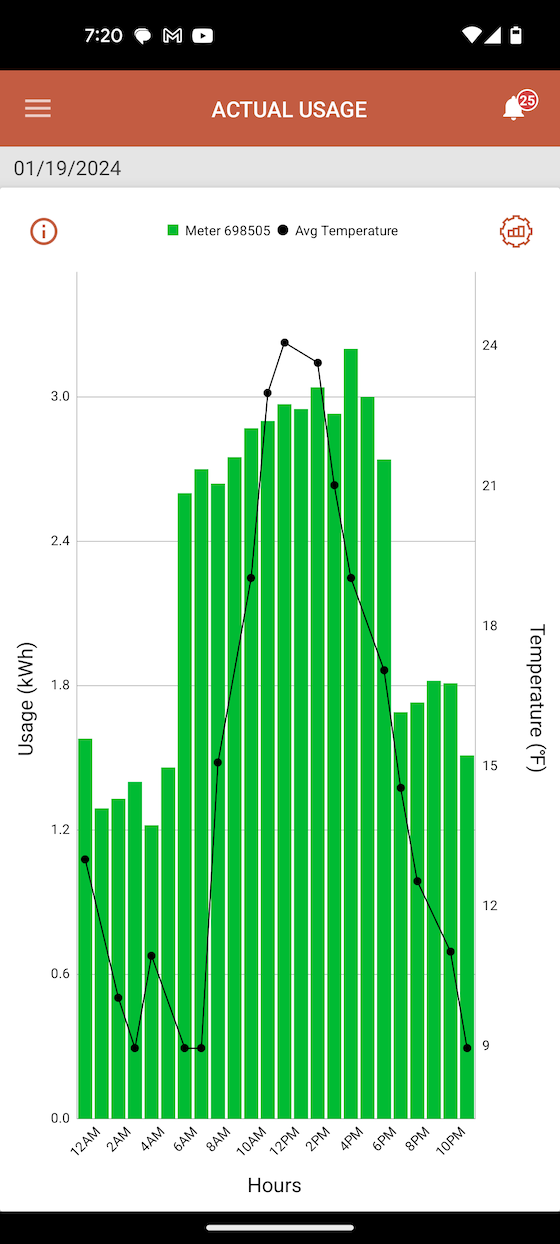
You can readily see that between 3 and 4 PM we used the most electricity. In those 60 minutes, we were sucking about 3.2 kW per hour from the grid.
A considerable portion of that is being used by the many grow lights my dear sweet wife Kathy has on to keep her hundreds of orchids blooming and growing.
She also has four humidifiers running. What's interesting about the chart is you can clearly see when the grow-light timers turn on and off. Those lights are responsible for half our usage each month!
Happy wife happy life!!
Other than that, the refrigerator and freezer are chugging away and two desktop computers are sending massive amounts of blue light into our eyes. I do have a small oil-filled radiator up in my man cave to keep that tiny room warm.
My guess is you consume about 1.5 kW per hour(kWh) at your home on average.
Keep in mind that kW shouldn't be confused with kW hours (kWh). A kilowatt is 1,000 watts. If you turn on ten 100-watt light bulbs, you're consuming 1,000 watts at that instant of time. Keep those ten bulbs burning for an hour, and you'll get charged for 1 kilowatt hour (kWh) of power usage by your utility company.
How Much Electricity Does an EV Consume When Connected to a Fast Charger?
Do you own a Tesla, Ford Lightning pickup truck, or similar electric vehicle (EV)? Just a few days ago I saw my first EV Rivian pickup truck.
Have you seen any news reports about how much electricity it takes to recharge the massive batteries that are under the seats in these vehicles?
I know I haven't.
To be honest, I never gave it much thought but my gut told me massive amounts of electricity were required to recharge those huge batteries in a short amount of time.
What I'm about to tell you will stun you. I know because it made my eyes open as big as silver dollars. A subscriber sent me a short video of a man charging his EV at a typical charging station.
Look at this screenshot taken from the video. The video was created while an EV charging station was injecting electricity into the battery of an EV like a 2.5-inch firehose spews water on a fire:
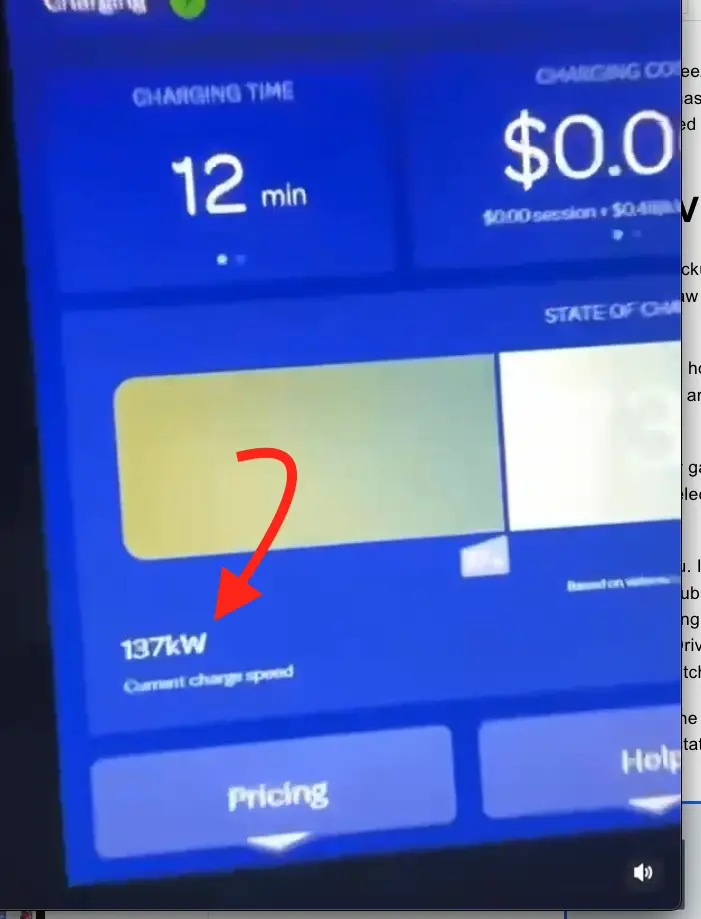
Assume to get a full charge this car will be there for about an hour. If so, it's going to suck 137 kWh from the grid. That same amount of power could have kept the lights on and refrigerators running for one hour in 91 houses.
That SINGLE charging station, not unlike the ones you see in your city or town, is capable of delivering 350 kW PER HOUR.
In this situation, the charging station was dispensing electricity into the man's EV - a vast amount of electricity. If the 137 kW charging rate stays constant and the car stays connected for one hour, 137 kWh worth of electricity will be dumped into the battery.
This is just ONE charging station for ONE EV. There were six stations, I believe, at this charging location.
Has that 137 kW number bounced around in your tiny gray cells like a shiny silver ball in a pinball machine?
The electricity being SUCKED from the grid to charge that ONE EV would power 91 houses like mine if the grow lights weren't on.
If there were six EVs at that location all charging up at the same time, those SIX CARS would take out of the grid the electricity that was destined to go to 546 houses.
One of those houses could be yours.
Do you see where this is headed?
I have five Tesla charging stations in my town of Meredith, NH. Here's the label from one of them:
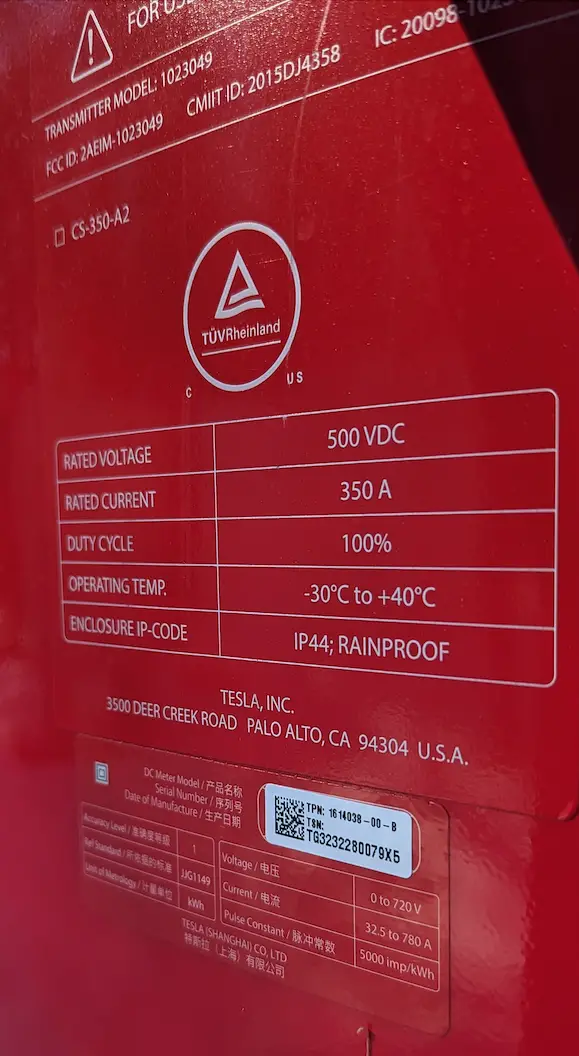
I was taught volts x amps = watts. If that's the case, this charger is capable of delivering 175,000 watts. If it does that for one hour, the amount of energy put into the vehicle would be 175 kWh. Copyright 2024 Tim Carter
A Texas Congressman does. WATCH THIS 60-second video where he exposes how you are being bamboozled.
Watch this video to see Andrew Boyle, an expert, share stories about how planned projects would require more power than an entire city:
What happens if you try to charge 100 EVs at once in your city? How about 1,000 EVs?
How many cars and pickup trucks are in your city or town?
Do you live in a big city? Have you seen how many cars fly down the interstate highway in an hour?
How many millions of cars are in Los Angeles?
How much POWER would it take to charge just 10 percent of them at once?
If you're already awake, fantastic. If not, please
WAKE UP NOW!
How Many New Power Plants are Being Built Across the Fruited Plain?
You don't have to be an Einstein to realize that if this EV unicorn-and-rainbows panacea the government is ramming down your throat comes to fruition there WILL BE brown and blackouts.
Numbers don't lie.
Each small city or town would have to have its OWN power plant! Do the math yourself. Just imagine that 10,000 EVs need to be recharged each day in your city or town.
I'll do the math for you. Without new power plants being built to handle this vast demand, 910,000 houses would NOT GET electricity.
That smart meter out on your exterior wall would remotely SHUT OFF your power.
Too bad so sad.
I can hear some of you now, "Tim, you're a fool. Solar and wind will save the day."
Please don't patronize me. I'm not an idiot.
Solar panels don't work here in New Hampshire 16 hours out of 24 in December. It's pitch black outside!
The wretched windmills in Rumney, NH that ruin the view often are not spinning.
Power plants MUST OPERATE 24/7/365.
Have you had enough?
STOP TRUSTING the government.
STOP TRUSTING your NEWS sources. They are LYING TO YOU about EVs, climate change, Russian collusion, etc.
They have not been telling you the whole truth about EVs.
A half-truth is a whole lie.
START questioning everything.
START USING YOUR GOD-GIVEN GRAY CELLS.
The following was sent to me after this page was published. Judi, one of my subscribers, packed lots of other information about EVs into a very small space:
"Thank you for this article on EV's and the power grid. The current Administration's shortsighted mandate on EV's (among other things!) is ridiculous and out of touch with the cross-section of America!
We simply don't have the infrastructure in place to support it, not only from the perspective of the power grid but from the very fact that most Americans cannot afford an EV and don't have the luxury of having an in-home charger. Think of the number of apartments, condos, and townhomes that lack personal parking spaces and the ability to just plug in their vehicles!
And think, too, of the cost of installing these charging stations and who will pay for them! Does anyone pay for my gasoline or provide me with a personal gas station? My HOA has looked into this issue and has found that older homes often don't even have the electrical capacity to support these chargers.
And let's not forget the time component needed to charge these vehicles! We live in a fast-paced highly mobile society where time is money! How many times have I looked at my fuel gauge and realized my gas was low? But with a myriad of gas stations in my area, it was no problem. I could stop and be on my way in 10 minutes! Not so with an EV charge!
There's also a ton of other EV considerations that nobody wants to talk about: the weight of the vehicles, which drags down the distance one can go in a charge and makes it difficult to locate a repair shop that can lift it.
Here's a short list of other issues with EVs:
- The weight of the battery wears down tires (all tires need to be replaced in only 30-40k miles), an issue for Goodyear is currently trying to develop an EV-specific tire
- There is a lack of space, especially in urban areas, for the necessary number of chargers
- The cost of replacing an EV battery (several thousand dollars) after a rather limited number of miles
- The fact that mechanics aren't needed for these cars, results in job loss across the country
- The fact that our auto industry is built on service, which is where the dealership makes its money;
- The fact that getting technicians skilled in EV vehicle maintenance will lag behind the mandated demand
I could go on and on but you know the issues...

Tim built custom homes and did ultra-custom remodeling for 20+ years before launching his Ask the Builder media presence. He was selected as one of the Big 50 by Remodeling magazine in 1993. This award gave birth to Ask the Builder in October 1993. Tim also operates https://DrawPlumbingPlans.com. His @askthebuilder YouTube channel was the first home improvement channel on YouTube.
In 2012, when we bought our first EV, a Nissan LEAF, we put 18 solar panels on our house. The EE we consulted with told us that the number of panels we needed to charge our LEAF was very close to what we would need to power our whole house, so we decided to go with our whole house, including charging our EV. In 2021, we traded in our last ICE on a Tesla Model 3 AWD LR. Now we charge both EVs and our whole house.
This is why I am in favor of hybrid vehicles which take advantage of much higher efficiency in their technology such as regenerative braking and no range anxiety. Couple that with new engine technology (check out Connecticut's Liquid Piston - see link below) that can enhance hybrid vehicle technology by leveraging renewable fuels like biodiesel to move us away from fossil fuels while also reducing the need for strip-mined metals like lithium due to the reduction in battery size. Question - has anyone analyzed the environmental impact of acquiring all those metals used in catalytic converters? I am curious how that compares to the mining required for the batteries we use in our mobile devices.
I agree that widespread use of EVs is not ready for prime time, but then again, I am sure most people 110 years ago said the same thing about horseless carriages. I would like to see sodium based battery technology make some strides first to see if it can eventually achieve the necessary energy density required for our portable devices. As we all know, sodium is much more readily available than lithium.
https://youtu.be/jLtyNtf9_ew?si=I1uWccTrYGcN_nve
This was an eye opener! Why do people fall for this garbage! My husband and I love reading your newsletters each week. I read all the way to the bottom of the page so I can see all of your sarcasm. I think I get the biggest kick out of your pronouns!
Tim, You are so right. To take this example further, you should have one of your experts calculate how much land it would take to replace your local natural-gas power plant with a solar or wind farm. Your local power plant that occupies several acres would take tens of square miles for a solar or wind farm to supply the same power, and then only when the wind blows or the sun shines. You never see that calculation published by the government or the media.
How much juice does it take to keep Joe Biteme going?
I didn't see any mention of Lithium batteries and temperature. Below 32 degrees, power drops sharply, and charging takes longer and draws more current from the charger.
(We have had single-digit temps in the Mid-South for more than a week.)
Although I do wholeheartedly agree with you that governments world wide are not responding to the need for significant new electrical generation due to the push to use of electrical power, I don't necessarily agree with your EV problem analysis - you only talk about use of Class 3 high power chargers but many EV owners charge at home using lower power Class 1 or 2 chargers (1.5 to 8 kWh/hr) and charge overnight when electrical consumption is generally low. No this is not a complete solution but it does mitigate the impact.
Nice call on solar and wind power. I've always maintained that every kWh generated by this type of green energy needs 100% backup to cover the not so unexpected periods with no wind or sun. Either that or some serious energy storage which significantly increases the cost of this type of energy when compared to historically proven reliable green energy from nuclear power plants.
True. Dumbed down schools so kids STUPID and cannot do constructive analysis. They believe the talking lamp altar of truth TV electric media. Just like 1984 and animal farm.
Amen. Been saying this since the early beginnings. Having been in a business where electric was a necessity to charge electric battery driven golf carts, I have always questioned the thinking of liberal environmentalists about their misguided thinking about how electric is going to really work....and a friend sent me a picture of lots of electric cars stalled in the -30 temps as they could not get batteries to charge in the freezing temps.
You always warn that half-truths are whole lies.
My EV has a 70 Kw battery and I charge it from about 50% to 90% about twice a week. That would take about 56 Kw a week. My electric costs 16 cents per Kw so my vehicle costs $8.96 per week or about 5 cents per mile.
Your image shows a charging rate of 173 Kw per hour. My vehicle would charge in 9.7 minutes and give me 1/2 a week of driving. In your example, the vehicle may have charged in 12 minutes.
I understand that my vehicle cost about $10k more that a gas vehicle (and I did not get a federal rebate) and I understand that mining lithium is dirty. I understand that my battery is warranted for 10 years but that does not mean it will die at 10 1/2 years. I understand that recycling lithium batteries is a developing industry.
I do not agree with Biden's liberal EV policies but like the Southern border wall, this EV policy may change in one to five years. I don't know what percentage of vehicles will be EV in 10 years and I don't know what percentage of our power will come from renewable sources. But in my 76 years I've seen technology advance by leaps and bounds. Go to Cape Canaveral and look at the Mercury Redstone that launched our first astronaut and ask who lit the match to launch that first "Roman Candle"
Too much - lots and not too much range for the amount of consumed electricity. Batteries will need to be vastly improved and charging will have to be spaced out over a 24 hour period. Lots more planning is needed to spare the existing grid. Even with many more power plants, they have to be supplied with energy to work, but where does that energy come from? Nuclear, to avoid emissions?
I follow the Electric Vehicle industry/technology via technical media, and have done so for several years. It is correct to be concerned about the availability and distribution of electricity, both for charging vehicle batteries and for domestic and commercial uses. But, we need not sensationalize it.
My biggest concern is that the promoters and media call EV's "zero-emission" vehicles. They may be zero point-source emission producers, but, until there is widespread renewable electricity available, these vehicles are the cause of nearly as much greenhouse gases (per mile traveled) as their liquid-fueled bretheren. Our renewable energy needs go well beyond what may be needed for transportation.
Your example needs some clarification: Your house used 54 Kw-hrs in 24 hours( (1 day), so your montly usage is about 1600 kw-hrs. I live in Indiana and use a heat pump for part of my heating. My monthly usage was 825 kw-hrs last month. Your wife's grow lamps really do gobble up the electrons!
Now - about charging an EV battery....say you traveled for 6-8 hrs and the EV needs about 15 hp to propel it. That is 120 hp-hrs consumed, or, about 80 kw-hrs. But, you want to recharge in a matter of minutes or maybe an hour. How do you put that 80 kw-hrs back in? About 6-8 times faster than you used it. Get the picture?
Tim your information is different than most of arguments about these vehicles, which are:
1) the consumption of raw materials (primarily lithium) and the damage to the environment the mining causes, including the fact that the main source of the raw materials is China or mines controlled by China in Africa;
2) these vehicles are much heavier than ICE powered vehicles, thus causing more wear and tear on the roadways and tires that wear out faster;
3) that they have very short ranges and long charging times plus in hot or cold weather the range (ie, battery life) is dramatically shorter;
4) they are a fire hazard and take many many times the amount of water to extinguish fires (plus that they have been known to combust in enclosed garages/parking garages, presenting a danger to others), AND
5) It's our precious hard-earned money, extracted by the government in the form of taxes, that have spurred the EV market -- in the form of tax credits to buyers, and subsidies to manufacturers. And government now is trying to mandate the move to EVs, despite clear and convincing evidence that our power grid cannot support it (eg, California rules are going to mandate EV delivery vehicles by the end of the 2020s).
PART 2
Currently per a friend in the trucking industry, whose company recently tested a few of the EV semi-trucks, they had a range of 65 miles before needing a recharge. Just think how much prices will increase with that type mandate -- nearly everything you buy at the store or online, at some point or possibly for the entire trek to the store, is shipped on a truck!
So this is VERY good information to share. IMHO, I see someone driving one of these and I think "how dumb are they?" I for sure wouldn't trust any of the owners of EVs to make an intelligent decision about anything of importance. DO YOUR RESEARCH people!
I'm thankful that some HAVE done the research - sales of EV are WAY off the predictions, 2023 sales were far less than the peak year 2022. And Hertz Car Rentals, which had formerly committed to a purchase of about 100K more EVs this year, recently announced that it not only was not going to buy them, but will be divesting itself of nearly half of the fleet of 50K EVs it currently has.
THE MARKET RULES. We need to inform our friends who may not do their own research but follow the latest "trend." Remember - tell them, just like in the stock market, the trend, in most instances, is NOT your friend.
I’m no electrical engineer, but I believe another way to look at this is to imagine you have a 100 W incandescent lightbulb. To draw just 1 kilowatt (kW), we need 10 of these turned on. After one hour, we would have used one kilowatt hour (kWh). If the charger shown in this video delivers 137 kW every hour, it would be the equivalent of having 1,370 of these light bulbs on for that same hour!
The screen you showed must be that of a Rivian which has a 149.0 kWh battery. Most vehicles are much smalled that that. I own a 2020 Kia Niro EV which has a 64 kWh battery. You are assuming 100s of people are all charging at the same time and they are all practically empty. We typically fill from 30% to 80%.
You stated 1.5 kW per hour at your home on average, so 24 hrs = 36 kW. For the period 11/29/23 - 01/02/24 our family used 896 kWh(896/34=26.4) and that includes use of my Level 2 EV charger.
Political swamp creatures and government agencies do things that are not necessarily good in different cases. or perhaps it is good for them and/or the elites and not the common folk. The EOA will "force" technology. They will require things that do not exist or are not ready for prime time with the idea that companies will step in and make fantasy to become reality. Costs may not be considered or calculated and predicted correctly. And anyway, the elites can afford costly things and say the government agencies and political people will have ways to get things provided to them, say take home EVs, and the common folk can just do without, like take public transportation, walk, or ride a bike, just like the elites are glad for you to do, but not them. So pushing EVs is fine for them. They are selling the EV idea and some have investments involved with EV and environmental type products and the leftists have made it part of their agendas and narratives and they demand conformity and never losing control or a battle. So they shove the EV things down the public throat and don't bother to mention the problems, just say look at what great things we are bringing to you and don't question it or you are an insurrectionist terrorist/
I am sure the vast majority of the EV crowd and the leftists that claim to be all for saving the environment also believe in allowing illegals to flood into our country.
I'm curious to know whether hybrids (Prius for example) are more environmentally friendly (I think so because of battery life) and economically rewarding than total EVs. Has there been studies doing comparisons?
You ain't seen nothing yet. Those big electric trucks with their megawatt-hour , MWh, batteries require megawatt, MW, chargers. The EV industry is rapidly moving toward 700-mile driving ranges and 10 minute charge times which will require MW chargers too. This is already in the works, billions $ have already been invested, 10's thousands of intellectual property patents have already been filed and granted, EV's ARE BIG business.
If you take the time to look at those big MW chargers, you will find they have internal MWh battery backup to supply those humongous charge currents. The current draw on the grid then becomes an average, not an instantaneous load.
And kWh does NOT mean kilowatts per hour, which makes no sense. kWh means kilowatts times hours, a unit of energy and not power. The power company is in the business of selling energy, not power, and that's why their rate schedule is in kWh.
Obviously the energy infrastructure of the entire country is in the process of being rebuilt. Many states are fed up with the delays and have enacted legislation authorizing the state government, and not the localities, to approve new projects like windmills, solar, and expanded transmission line rights of way, so stand by.
Another little known fact is the pollution created by increased tire wear. The extra weight and different driving characteristics of electric vehicles wear out tires faster than non electric vehicles. (tire wear is a polluter)
Also, have read in the WSJ that in areas of Europe it cost more to charge a EV than fill up a gas powered vehicle.
Dear Tim:
Deep thanks for this article on the truth about EVs - they are proliferating around me here in Western WA. You and Judi summed it up beautifully but I am uncertain how to get these truths out there in my area. It seems pretty obvious to me that we don’t have the infrastructure but you make it so clear. I am reeling looking at the kw it takes to charge on of those vehicles. I think I will put together a flyer and start posting it places - okay if I use your article as the basis? I don’t do social media so not able to get it there - can you or a lot of somebody elses?
My zolution: only one EV for every 91 homes. 91,000 ÷ 10,000. Hehe
I agree with you. Have been on this boat since the "climate experts" have been pushing EV's. I live in a remote area in Nebraska; 130 miles to the nearest Wal-Mart and EV's won't work here! I can go on giving more issues!