Lava Pods Snow & Ice Melt
Lava Pods Snow & Ice Melt - An Amazing Hot Product
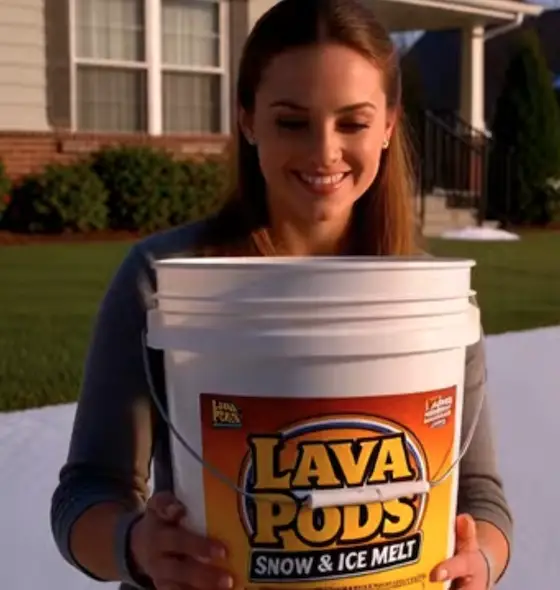
WATCH the DEMO video below!!
I shared with you weeks ago an article where the author maintains it’s best to use a pitchfork to remove ice from a sidewalk or driveway. It was obvious to me at the time that author had never tried using a pitchfork to remove ice. You have to be so very careful of what you read on the Interweb!
You, or someone else, must have shared that news item with a friend or relative who then shared it with someone else via the digital grapevine.
A man who has just announced a much better way to remove ice and snow from pavement got a copy of my newsletter and reached out to me. He maintains that the days of using rock salt to melt snow and ice are numbered.
Salt tracks into your home, it corrodes your car and truck, it poisons the soil on the edges of your driveway, and it can increase the alkalinity of the groundwater.
He asked me to share with you the news about his incredible discovery.
Herb Dupp is the man. He was overjoyed to share that his factory just started producing 20-pound bags and 40-pound buckets of a new charcoal briquette whose sole purpose is to melt ice and snow.
It’s called Lava Pods Ice & Snow Melt.
Herb made it clear to me that this product is not to be used in a cooking grill because it burns as hot as lava. Within minutes, it will melt the thin metal at the bottom of a Weber grill like a candle burning a piece of tissue paper. He compares his miracle briquettes to thermite that railroad construction crews use to weld railroad tracks together.
Herb explained that his special, proprietary ice-melter burns so hot that it produces superheated steam as it gnaws its way down through the ice and snow. The steam swirls around each briquette in a counterclockwise, ever-widening vortex, melting the surrounding frozen water like butter in a hot frying pan. The hot meltwater heats up the pavement such that it becomes bone dry within five minutes.
One 20-pound bag is enough to melt ten inches of snow or 1/2-inch of ice on a standard 500-square-foot driveway.
The first thought that crossed my mind was how does a person ignite the briquettes and distribute them on the snow and ice? If you were to start them on fire, as one does with normal charcoal, they’d burn your hands or melt the shovel you use to throw them on your snow-covered pavement.
Herb had the answer.
“Yes, I had to develop a special self-igniting coating on my Lava Pods Snow & Ice Melt. The coating had to protect the pods during shipping and handling in case they somehow got wet. The trick was to create a durable thin coating much like that on peanut M&Ms.
It took me many attempts to perfect it. The coating had to be stable when water dropped onto the briquettes, but then ignite when they touched frozen water in the form of ice or snow. Believe me, it was not an easy task.
As you might remember from your high school chemistry class, pure sodium reacts violently with water, creating both an explosion and a fire that burns as fiercely as a tiger that’s not eaten in six days. Through much experimentation, I discovered that a 2mm coating of sodium trihydrothermosidium was the best way to achieve safe self-ignition,” proclaimed Mr. Dupp.
The story of how Herb discovered this new ingenious product borders on unbelievable.
Several years ago, Herb visited Kelleys Island in the southwest corner of Lake Erie. One of Herb’s hobbies is geocaching. He’s also an amateur geologist.
Kelleys Island has some of the deepest continental glacial striations of anywhere in the world, They’re so deep they resemble the u-shaped fiberglass slides you find in a waterpark.

Glacial striations on Kelleys Island in Lake Erie. Look closely for vitrification on the inner concave surfaces that face southeast. Copyright Tim Carter 2025 ALL RIGHTS RESERVED
Herb noticed a very strange feature in most of the striations that had been cut into the fine-grained limestone. The face of the stone appeared to have been polished. The signage at the park said this was caused by the slick ice that slowly glided over the rock for thousands of years.
Herb wasn’t so sure, because he felt it looked just like the clear glazing you find on fine porcelain. He decided to hunt for the nearby geocache, and that’s when the cosmic tumblers aligned.
While wandering around the park, he came across a fenced-off area marked by bold DANGER - KEEP AWAY signs. Just beyond the fence was a cliff that extended down to the lakeshore. Many people in the past had been injured falling from the precipice.
Herb has always felt that signs, traffic laws, etc. were simply recommendations. He bushwacked through some thick brush and went around the fence.
Much to his surprise he discovered what appeared to be a well-disguised narrow trail cut into the solid bedrock cliff. He could see what appeared to be crude, eroded handholds that were cut into the cliff face. Who would have done this and why? His curiosity was now laser-focused. Herb had to find out what was at the end of the trail.
A fierce gale began to blow across Lake Erie. A cold water spray soon covered the cliff. It took every bit of dexterity in Herb’s feet and fingers to make his way across the slippery sheer rock face.
Herb was prepared. He was wearing his KEEN Targhee hiking boots that are designed to stick to bare rock like honey to your fingers. Minutes later, Herb was perched 100 feet above the crashing wind-whipped waves. One slip and he’d be human hamburger on the jagged rocks below.
After doing his best Spiderman imitation, clinging to the bare rock, Herb encountered a thick patch of English ivy. The ivy covered the cliff completely. Herb gingerly poked his hand through the ivy, probing for a solid place to grip the rock. All of a sudden, his hand hit a hollow spot. His entire arm disappeared into the ivy.
Much to his surprise, Herb had discovered a small cave cut into the side of the cliff.
Herb was prepared. He retrieved his SOG Flash AT pocketknife from his rear pocket. This dandy knife has a serrated blade that cuts through wood like paper cuts your fingertips. Herb was able to saw through the thick ivy stems. Soon, he created a large enough hole to gain entrance to the dark and dank recess.
Dim light filtered through the ivy. Herb’s eyes adjusted to the darkness. The walls of the cave were covered with a series of mesmerizing petroglyphs. At first, they appeared to be enigmatic, but within a few minutes, Herb saw that each panel was part of a story. He was having trouble processing that he was the first person to enter this cave in the past 13,000 years.
The first native Americans to step foot on what is now Kelleys Island had an oral history passed down to them from their ancestors about the creation of the glacial striations. This oral history was curated in the crude petroglyphs. Way back then, the tribe's leader knew that future generations might benefit.
Not only did Herb recognize the historical significance of the paintings, but he also realized the mythical oral history passed down might uncover a secret to a new product! The legend of the black-trees-that-make-lava was right in front of him in chronological order.
It turns out that over 500,000 years ago, during the tropical interglacial period between the Illinoian and Wisconsin continental glaciers, a dense forest covered tens of thousands of acres in what is now southern Canada.
The trees that grew here were unlike any others previously seen on Earth. A young buck caribou that lived in the eastern region of Siberia had created these trees quite by accident. One day while rutting, this muscular caribou got a small stem of a persimmon tree stuck in his antler.
The strong young buck wandered through the forest needing to remove the remainder of the velvet from his two racks of antlers. He came upon an osage orange tree and began to rub against it. The antlers cut into the bark, and the persimmon stem grafted onto the osage orange tree.
The graft produced a new species of tree, the perorangade tree - Arbor Nigra Calida. It combined the density of the osage orange tree with the fast-growing characteristic of the persimmon tree.
Herb’s dad, years ago, had taught him that osage orange trees extracted vast amounts of silica from the soil while growing. This silica made the trees so dense they caused chainsaw chains to spark when cutting the wood. The silica-rich wood of the osage orange tree also burns with a white-hot flame much like silica-rich magma that transforms into granite.
This new tree species spread across the Siberian tundra like Japanese knotweed grows today. The prevailing westerly winds blew the tree seeds across the land bridge to present-day Alaska. Thousands of years later, the trees were found in just about every province of Canada.
One of the petrograph panels in the cave showed a massive forest fire. Thousands of the perorangade trees were consumed by the fire, but their charred trunks stood out of the ground like a graveyard of obelisks. The trees were immune to rot and marked time for tens of thousands of years.
While immune to rot, these massive, thick trunks were not immune to the unspeakable power of the advancing Wisconsin continental glacier. The next petroglyph panel showed thousands of the charred perorangade trees being bulldozed in front of the snail-paced monster wall of ice.
These trees, because of their buoyancy, didn’t get overridden by the glacier as happens with boulders, rocks, and soil. They rode on top of the glacier covered with a skim of snow.
Just before arriving at the present-day Kelleys Island, a beam of concentrated sunlight at noon on the summer solstice bore a hole through the snow cover. The light beam refracted off a piece of crystal-clear glacial ice and ignited the charred logs. The first charcoal fire in history was glowing and growing. In fact, it grew to monster proportions.
The heat was so intense the charred tree trunks, the world’s largest briquettes ever, were cutting through over 3,000 feet of dense glacial ice. A super-heated steam was a byproduct. The hissing could be heard for miles. Eagles soaring above the glacier were the only living things to capture this cataclysmic wonder.
When the white-hot trees finally cut down through the massive glacier, they began to create limestone lava on what is now Kelly’s Island. This molten lava vitrified the limestone grooves as Herb had deduced.
The last petrograph panel was a cryptogram. It turns out that when the continental glacier retreated to the North Pole, it left behind several of the perorangade trees that contained frozen seed pods. The shaman in the tribe of Native Americans who first came to inhabit Kelly’s Island possessed a mystic power to communicate with animals.
The eagles, the most majestic of the North American birds, shared with the shaman the legend of the black lava trees. The eagles also shared the location of the trees that contained the seed pods. The indians harvested some of the perorangeade tree seeds and stored them in a buried clay pot.
Herb’s wife’s hobby was solving puzzles and decoding messages. He snapped a photo of the panel, went to the cave entrance to obtain a strong cellphone signal, and texted her the photo. Within minutes, she had solved the riddle.
Herb followed her instructions and dug up the pot. He brought the seeds back to his house and started to grow new perorangade trees. Their fast-growing properties allowed Herb to harvest enough within six months, allowing him to produce the first 100 pounds of his lava briquettes.
After ruining his blacktop driveway by using briquettes that were too big, Herb finally settled on ones that produce just enough heat to melt the ice and snow, but not so much that they continue to burn through the bitumen pavement.
Herb’s Lava Pods Ice & Snowmelt briquettes are not sold in stores.
Herb is experiencing some significant pushback from cities and towns. His Lava Pods are so good at melting snow and ice, there have been quite a few episodes of urban flooding. The meltwater has overwhelmed storm sewers, causing mayhem.
You’re only allowed to use Herb’s lava pods by going online and getting a permit. Towns and cities only issue a small limited number of permits depending on the amount of snow that falls in any given storm.
Let me know how Herb’s Lava Pods Snow & Ice Melt work for you! Oh, wait! It's impossible to get these fake pods so you'll never be able to let me know.
### Satire Disclaimer: The above fully fictitious article is the first of a series that will appear on the new AsktheBewilder.com website. Read the press release about WHY this new website was launched.
Ask the Bewilder Column 001

Tim
I’m going to call Kathy and tell her that she better check your “man Cage” and put a lock on the outside door
Now I did not sleep thru my high school or college chemistry
So I did read all your “stuff” about the sodium coated rocks only the disclaimer at the end
Do like your idea tho
So keep the humor coming
You friendly pharmacist form PRidge
Have a very merry Christmas
Jim, Please don't call Kathy!!! I don't want to call my new address "I-93 overpass at Exit 23".
I've always enjoyed reading a good fictional story and "Herbs Lava Pods Snow&Ice Melt" was no disappointment...Bravo!
funny! reminds me of the old radio show phone calls by Gary Burbank. they get crazier the longer it goes on.
Good one Tim!
Towards the end, I was starting to think this was far fetched! Where can I get some?
That was wonderful. I have gotten to the point where I am really skeptical about things posted to social media, all because of AI.
I have enjoyed you articles over the years. How about checking out Creation Ministries regarding the ice age.
I enjoyed your story. You would probably have been a good fiction author.
Tim Carter, You are a master storyteller … such a riveting, magical tale to deal with the forces of nature. God bless you for so generously sharing your talent.
Regards,
Bob
Got a good chuckle out of that Tim. I’ve been to Kelly’s Island and yes it is pretty amazing. Fishing for walleye in Lake Erie and Sandusky bay. Been Reading your newsletter, and leveraging your website for years. Thx