Installing Pocket Doors

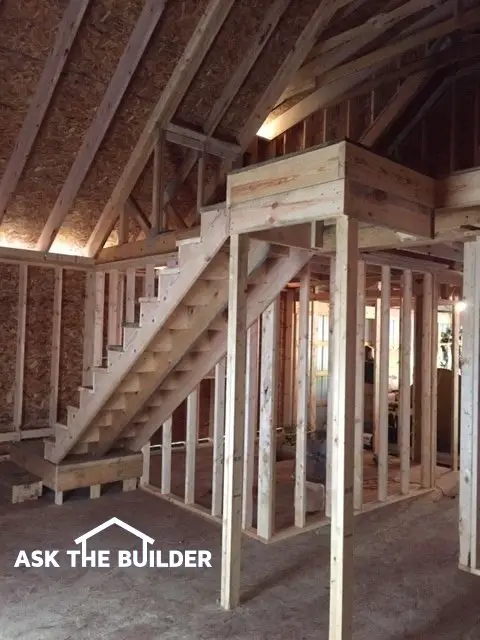
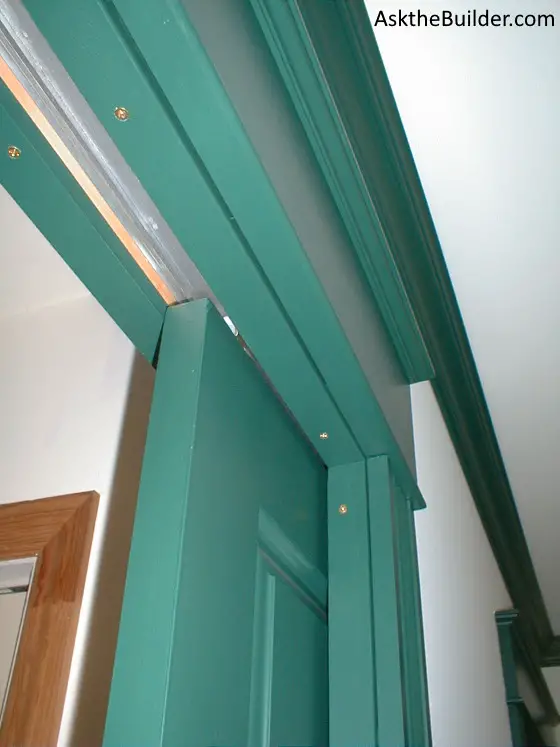
Pocket Door looking up

Installing Pocket Doors | Note the very important screws on the jambs. These allow you to access the door rollers.

DEAR TIM: I have a large archway between my home office and my dining room. I need to close off my office occasionally but do not want traditional swinging doors. I love pocket doors and want to add them. How much of a project is it to add these doors? Would the walls have to be completely torn out on either side of the opening to do the job? Karma T., Yulee, FL

DEAR KARMA: Pockets doors, in my opinion, are one of the top ten most overlooked items when many architects and builders plan a home. Even I underused this wonderful door option in my own home. If I had the chance to rebuild my home today, there are a minimum of 10 other rooms that would have pocket doors instead of the current swinging doors.

Why are pocket doors so wonderful?

Pocket doors are wonderful for many reasons, but I love the fact that they disappear into a wall. You can pick up an average of ten square feet of floor space when you use a pocket door instead of a traditional hinged swinging door. Modern high-quality pocket door hardware and frames allow these doors to remain trouble free for the life of the home.

Are pocket doors easy to install?

Pocket doors are easily added to a new home or one being remodeled, but installing one or two in an existing home is a little bit of work. Several years ago, I added a pocket door in my own home to separate the breakfast room from a hallway leading to our laundry room. My family and I endured the mess, but the final result has made everyone happy.

I had to do some demolition work to create the opening for my pocket door. You are correct in assuming that each side of your opening will have to be demolished since you want two pocket doors that will meet in the middle of the archway. The amount of wall space that needs to be opened up to create the pocket hideaway for each door is slightly greater than the overall width of each of the pocket doors.

Before starting installation, what is behind that wall?

But before you start swinging a sledgehammer or pounding a pry bar behind the existing trim, slow down and investigate what might be behind and above the wall. There can be all sorts of surprises behind the plaster, drywall or paneling. Plumbing waterlines and drain pipes, heating and cooling ducts, pipes and low voltage cables, and all sorts of electric and communication cables can be living comfortably where you want the pockets to take up residence. This is not to say all of these things can't be relocated, you simply should investigate and see what might be in your way.


Would you like to buy the exact pocket door frame I have in my own home? You know, the pocket door frames that are perhaps the best in the world? All you have to do is Click Here for Tim's Favorite Pocket Door Frame!
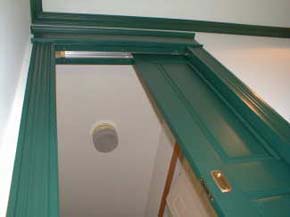

pocket door in Tim's house

This pocket door was installed in Tim's house.

The underside and top of walls often yield clues as to what is inside of them. If you can see pipes, cables, ducts and other things that extend from a floor up or down into the wall cavity, then you will undoubtedly have some extra work ahead of you to accomplish your goal. Rest assured though it will be worth it in the long run.

Furthermore, the wall might be a bearing wall. While this is a significant challenge, it is often possible to install a large beam over the opening that will carry the load above and transfer it just beyond the reach of the pockets.

What are the best type of pocket door frames?

For years of trouble-free life, be sure to get the absolute best pocket door frames. Look for ones that have metal wrapped studs that will not warp. The wheeled trucks that latch to the door and ride back and forth in the track must be ones that cannot jump out of the track. Certain pocket door frames and hardware come with this guarantee.

Be sure the rough opening is square and plumb and the top of the rough opening is absolutely level. This will ensure that the pocket doors will glide smoothly in and out of the pockets and that the doors will meet perfectly when they are closed.

It is vitally important that the rough opening is perfect before the pocket door frames are installed. The last vertical studs that create the opening can be plumb but the overall opening can be twisted or in a helix. If this happens, the doors will never meet properly or they might rub when they are slid back into the pockets.


To ensure the rough opening is perfect and not twisted, extend strings diagonally from opposite corners on one side of the opening to create a giant letter X. If the strings just touch each other the opening is perfect and in the same plane. If there is a gap greater than one eighth inch between the strings, you need to adjust one or both of the vertical studs that create the large rough opening. Once the opening is confirmed to be in the same plane and not twisted, you can install the pocket door frames.

Column 489
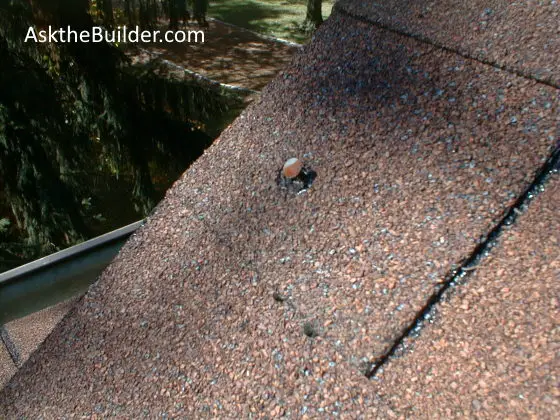
Roofing Nails That Pop Up

nail pop in shingle

A pesky roofing nail popping out on my own roof. Arrrggh!
This nail probably was driven very close to the horizontal seam of the sheets of plywood under the shingles.


DEAR TIM: Eight years ago, I had a new asphalt shingle roof installed on my 55-year-old home. Leaks recently started to appear in several areas of my home and upon inspection, roofing nails actually had backed out and popped through the shingles. Why did this happen? I hammered the nails back down and applied roofing cement over the holes. Is this the correct thing to do? Is there a permanent way to patch the holes in the face of the shingles? John D., Atlanta, GA

DEAR JOHN: Roofing nails that seem to defy gravity are more common than you might think. In fact, it has even happened on my own roof. There are all sorts of reasons why nails back out of seemingly solid wood, but perhaps the most common reason is that the nail did not get a good bite into the wood when it was first driven. It is vitally important that roofing nails of the correct length were used to secure the shingles. The sharp tip of the roofing nail should completely pass through and extend approximately 3/8 inch past the underside of the roof sheathing.

What type of roof sheathing was popular in the 1950's?

It is entirely possible that your roof sheathing might consist of numerous tongue and groove 1x6 boards. This was a very common roof sheathing product in the 1950's. Every 5.5 inches there is a horizontal seam where two 1x6s interlock. If the roofing nail happens to penetrate the sheathing along this seam, there is very little solid wood to hold the nail. In fact, the roofing nail can actually crack of the thin tongue along the seam. If this happens, there is virtually nothing holding onto the nail.

This same thing can happen on roofs that have large 4 x 8 pieces of plywood or oriented strandboard sheathing. Nails that hit weak spots in these products or along the seams where one sheet meets another are highly susceptible to backing out.

Does your roof and sheathing expand?

Each day and night your roof and the sheathing beneath it go through a heating and cooling cycle. Add to this the changes in humidity, and you can see that the wood sheathing not only expands and contracts but it can also do so with astonishing frequency. This movement can slowly and forcefully push a nail up and out of the wood. The movement is very slight each day, but it does indeed happen. In the most severe cases, as in yours and mine, the head of the nail actually breaks through the top layer of shingles. Many people have nails that have backed out, but they simply see a hump in a shingle.

How do you repair a roofing nail pop?

The repair method you followed will not be permanent. Since you did not relocate the nail, it continues to have minimal or no holding power. The nails should have been removed and relocated about one inch higher in an attempt to find solid wood. If you can enlist the help of someone, they might be able to go inside the attic and see the pesky nail as you pull it out. They can communicate with you and tell you which direction to go to get away from a seam, crack or a knot in the roof sheathing.

The asphalt cement you applied over the hole in the shingle is also not permanent. The sun's ultraviolet(UV) rays break down the asphalt and cause it to age prematurely. The colored ceramic granules that cover asphalt shingles, among other things, serve to shield the asphalt in your shingles from these harmful UV rays. At the very least while the asphalt cement was fresh, you might have collected some loose granules from a gutter to broadcast into the sticky asphalt cement.

I feel a better way to patch the hole is to do so from under the shingle. Cut a four by two inch rectangle of regular 15 pound felt paper and fold it into a two by two inch square. Lift the damaged shingle up and apply a half-teaspoon dab of asphalt cement directly over the nail shaft hole. Press the piece of felt paper into the fresh cement making sure the crease in the paper faces up towards the roof.

The shingle can now be laid back flat on the roof. If it is not flat, apply additional asphalt cement under the lower edge of the shingle and press down until the shingle behaves and lays flat. The hole in the surface of the shingle can be carefully patched with a small amount of asphalt cement. Liberally apply loose matching colored granules to the cement and press them into the sticky black goo. Once you are back on the ground I doubt you will be able to see the repaired hole.

When is the best time to work with shingles?

Repairing shingle leaks is very easy. The trick is to work with the shingles when they are warm. Cold, brittle shingles can crack easily. Use a wide, flat pry bar to break the seal between individual shingles. Slide the pry bar up under the shingle and it will eventually allow you to gently bend the bottom of the shingle up. Do not over bend the shingle as it can crack even if it is warm.

If you can't find any loose granules at your home, you can possibly get them for free at any business that sells shingles. They have thousands of them scattered on the floor or around the pallets where shingles are stored. Roofing manufacturers actually sell buckets of new granules if you need them in larger quantities.

Column 487

The Tim Carter Story

The Tim Carter Story

Life began for me in the early 1950's. I was born and raised in the University Heights suburb of Cincinnati, Ohio. As I replay the tape of my early childhood, it keeps turning up memories of great places to play. A dense stretch of woods started just up the street behind Joe Conrad's house and passed behind my house extending all the way down to McMicken Street. Within these woods one could find a wonderful creek and both the short and long trails that wound through the dense woods down to Central Parkway and the abandoned subway tunnels.

Across the street from my home, directly behind the Little Sisters of the Poor, there was another wooded ravine where the mysterious swamp could be found. The ravaged and charred remains of my Texaco tanker ship are still there. It exploded and sunk in the fabled swamp when an M-80 ignited with a cigarette timing fuse blew it to kingdom come.

Tim Carter photograph

I love my miter box saw and L.L. Bean!

In the early 1960's, the ravine was filled in with thousands of truck loads of dirt to create a new connector roadway between Dixmyth and Clifton Avenues. It didn't take long for my buddies Roger Boncutter, Pekka and Charles Mooar, Mike Wilson, Billy Gottesman and several others to discover that a few scrap pieces of wood and some rocks piled up on one of these mounds of dirt made a great fort to protect you from incoming mudballs. Many a day, my friends and I would play war among the piles of dirt. It was great fun, that is until you got hit in the head with one of those hard mud balls!

Scouting

I was really active in Boy Scouts. I didn't make it to Eagle Scout (I needed just 6 merit badges), because I could not swim. Two of the required merit badges were Swimming and Lifesaving. I had about as much chance of getting those merit badges as growing wings. However, two of the merit badges I did receive were Home Repairs and Journalism. Now isn't that a coincidence?

First Job

Not only that, my first job ever was collecting paper route money for The Cincinnati Enquirer. I was eight years old. Two years later, I had my own afternoon paper route delivering The Cincinnati Post Times Star. It was a one-hundred paper route and I made one penny per paper. That was huge money back then, as each week I got paid six dollars! To put that into perspective, some of my friends got 50 cents allowance each week while others got maybe a quarter.

High School

High school was a really fun time. I went to Roger Bacon High School. Many days after school, I worked at Skyline Chili. During my senior year in high school, I was the editor of my school's newspaper, The Baconian. Although I couldn't hear them, the cosmic tumblers were starting to interlock as I even had my own opinion column in each issue. The subject matter of this column was primarily to poke fun at the administration, classmates, and other schools.

My Wife

Kathy, my lovely and patient wife, also waltzed into my life during my high school years. The University of Cincinnati felt sorry for me or else they were shy of their enrollment quota. In any event, that's where I got my Bachelor of Science degree. My major was Geology. My brain finally got jump-started in college. I was offered a full scholarship and an assistant-ship for a Master's Degree in Engineering Geology. However, I turned it down. I wanted to go into business for myself.

Three months after graduating from college, Kathy and I got married. She worked as a clerk at a hospital. I went to work fixing up old houses. Small jobs led to bigger and bigger jobs. Before our first wedding anniversary, we bought our first house. It was in really bad shape. I fixed it up and turned a profit. The construction bug had bitten me and quite hard I might add.

Becoming a Builder

I rehabbed more houses, did contract work for other homeowners, and eventually began to build custom homes. The houses were always fun. It seemed like a picnic, as I could actually work on top of a foundation that was level and square! The remodeling jobs grew more complex. By the mid-1980's, I was constructing ultra-custom $250,000 room additions and $75,000 kitchen remodels.

Every aspect of residential construction interested me. I read technical journals about how to do everything. Then I tried to do the things myself. Soon I figured out that you can't do every task at the jobsite. You had to invest too much money in equipment that was seldom used and you couldn't multi-task. Once a job is under roof, several trades can work simultaneously. I gravitated towards carpentry, plumbing, ceramic tile and concrete. There is nothing quite like the feeling of completing a complex common framed roof or installing three floors of cast iron plumbing stacks.

Remodeling Magazine Award

In 1993, I was selected as one of the top 50 remodelers in the United States by Remodeling magazine. They publish an excellent trade magazine. This award enabled me to begin a new media career. Kathy suggested that I take my book idea and turn it into a syndicated column. I had always wanted to write a book about how the average homeowner gets taken by builders and remodelers, primarily because many workers simply do not do things the right way. She was right! It worked. AsktheBuilder was born on October 2, 1993, and continues to be sold to new newspapers each month.

On The Air

In March of 1994, I started my radio broadcasting career on 1450 WMOH in Hamilton, Ohio. I ended my radio career 12 years later in March of 2006 at WGRR-FM in Cincinnati, Ohio. I also did 90 second television segments each week on WLWT-TV in Cincinnati, Ohio.

Each year, I attend many shows and editors conferences. I have had the pleasure and good fortune to meet many other media personalities. What I have learned is that very few of them have an extensive background in residential building and remodeling, so be sure to keep that in mind when you read other columns or watch television shows where the advice seems a little too good to be true. I try to tell you how difficult something will really be, as I have done everything it takes to build a home from the ground up.

I am proud to say I worked for nearly twenty years, five days a week, in the field with a tool belt on. I didn't ride around in a truck and call subcontractors on my bag phone. What? You don't know what a bag phone is? They were one of the first cellular phones!

AsktheBuilder.com

Well, that's the scoop. Hey, are you still awake? If so, I hope you enjoy this and future visits to the AsktheBuilder.com. If you have a question, be sure to use the navigation key words on the left of each page on this website. You can also use the Search Engine in the upper left corner of each page. As a last resort, you can tim @ askthebuilder.com, but keep in mind I get over 100 emails a day and can't answer each one.


Interior Framing

Interior Framing


Interior Framing

After building homes for nearly 20 years, I still love to see the look on customers' faces when they visit the jobsite just after the house frame is complete. The skeletal frame of the home allows people to make the jump from the two-dimensional blueprints into the three-dimensional world of what the living spaces will be like. That same enjoyment can be seen in Cary Grant's face when he stops by to check on progress in the classic movie Mr. Blandings Builds His Dream House.

But if you want to avoid problems in the future, there are certain things you need to tell your builder, or rough carpenters, before they build the walls. Don't make the same mistake Cary Grant made and talk about changes after the work is in place. If you want to:

  • eliminate wavy walls where cabinets will hang
  • minimize or totally eliminate wall anchors when hanging fixtures or paintings of any type
  • guarantee crisp lines along chair rails or wainscoting in long hallways

Then, you must make sure the rough carpenters employ some very simple framing techniques that they know about, but don't always do. To make sure these things happen, you need to put them in writing and make sure they appear in the plans and specifications for your new home.

The traditional dimensional framing lumber, that is used in many of today's new homes, is a great material. But, it is far from perfect. Hybridization by the forest products industry has created many species of trees that grow much faster than older lumber. This rapid-growth characteristic can create problems with certain wall studs as the wide light-colored spring wood growth rings stabilize once exposed to the atmosphere in and about your new home site. This drying-out process can cause the lumber to twist and bow.


How would you like me to build your new home? It's probably impossible for me to fit your job into my schedule, but I will gladly share hundreds of my tricks and building secrets with you and your builder. Check out my New House Specifications.


Slight imperfections in wall studs are not a problem in most walls, but they can create huge problems in kitchens, bathrooms or family rooms where wall and base cabinetry and countertops will be installed. The wavy walls can cause all sorts of fitting problems for finish carpenters and those that install other finish materials. In these areas, it might be a better idea to use steel wall studs or special engineered lumber that is perfectly straight and will remain so even as the house acclimates. The rough carpenters can include solid wood blocking in these walls at prescribed heights so the finish carpenter does not have to hunt and peck for wall stud locations as the cabinets are installed.

CLICK or TAP HERE to get FREE quotes from local companies to build your house.

These same framing materials also produce perfectly flat walls in hallways, stairwells and other rooms where trim moldings, wainscoting and even staircases must fit perfectly. Working with these materials is not difficult. They may cost a little bit more, but the long term benefits are worth double or triple what you will pay today.

I doubt you are devoting much thought to towel bars, toilet paper holders, drapery rods, paintings, shower grab bars, dart boards, stair handrails, shelving and electrical light switches, etc. at this time. But you may be broadcasting unkind thoughts to those unnamed carpenters and your builder as you discover nothing but air behind the drywall as you start to hang things on walls, during the weeks or months after you move in to your new home.

These nightmares can be avoided with some forethought. If you plan ahead and know where you will be hanging things on walls, the carpenters can spend just a few hours installing scrap lumber blocking. These slabs of wood insure you will hit solid lumber each time you drill a hole in a wall. Use your existing home as a template. If you like the location and height of your current toilet paper holder, towel bars, etc., tell your builder where to put the new ones. The same goes for anything you currently have hanging on your walls.

Once the carpenters are finished, and before the plumbers and electricians arrive, double check the locations yourself and take photographs of the blocking. Use a large permanent marker and write the centerline height and distance from the nearest corner on the block. A close up photo in addition to a wide angle photo will allow you to easily locate the block, once it is hidden by drywall or tile. But, visit the home days before the drywall will be installed. Some of the blocking may be missing as the other tradespeople might have knocked it out. Unless they are instructed to work around the blocking, an impatient subcontractor might remove one or more pieces of blocking.

A pet peeve of mine happens to be light switches. When I visit homes I haven't built, I hate how the cover plate is always so close to the wood trim around doors. Adding a simple scrap of 2x4 lumber to the rough door frame at each switch location gently nudges the switch away from the finished trim lumber.

Column NH003

Pressure Washing Wood Decks

! ! Please Read Author's Notes at the end of this column ! !

Pressure Wash Wood Decks - Not a Good Idea!

DEAR TIM: It's time again to clean and seal our wood deck. I have watched a number of TV shows that advocate the use of pressure washers and a mixture of chlorine bleach and water. I am afraid that a pressure washer will harm my wood deck, but the TV shows made it seem so simple and easy to use. What is a good way to safely clean a wood deck? What is the best sealer to use once I have finished? Jackie F., Versailles, KY

DEAR JACKIE: Many of those TV shows bring a smile to my face. They often create a fantasy land where household projects go smoothly, the workers rarely sweat, and there are never any problems. My twenty plus years of experience in the field tell me that the exact opposite is true of most home improvement projects. Cleaning wood decks is no different. If you want excellent results you have to do some work, but it is not that hard.

How Do Pressure Washers Harm Wood Decks?

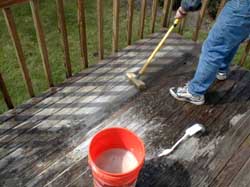
scrubbing a wood deck with Stain Solver

Using a pressure washer to clean a wood deck is a huge mistake in my opinion. High-pressure streams of water easily erode the soft light-colored spring wood that is found in between the darker bands of summerwood on each piece of lumber. I have actually cut my hand on pressure cleaned deck handrails. So much softwood was eroded by a pressure washer that sharp slivers of summer grain wood were left behind. The surface of the handrail resembled an upside-down multiple blade razor.

To make matters worse, many of the pressure washed decks I have examined were cleaned by professional deck cleaning companies. If you have no experience working with a pressure washer, the last place to start is a wood deck.

If you want to make an even bigger mistake, then use chlorine bleach to clean your deck! In my opinion, it is the absolute worst ingredient to apply to a wood deck. Chlorine bleach, better identified on deck cleaning product labels as sodium hypochlorite, removes the natural color from your wood, it destroys the lignin or glue that holds together the wood deck fibers, is toxic to surrounding vegetation, and is corrosive to all metal fasteners and components that hold your deck together.

What's a Better Way To Clean Wood Decks?

A far better wood deck cleaner is oxygen bleach. Stain Solver is a certified organic oxygen bleach formulated for cleaning wood decks.

Stain Solver Oxygen Bleach

Stain Solver is MADE in the USA with USA ingredients that are food-grade quality. CLICK THE IMAGE to order some NOW.

Will Stain Solver Kill Mildew and Algae?

This powdered product when mixed with water releases non-toxic oxygen ions that kill mildew and algae. In addition, the foaming oxygen bleach loosens grey weathered wood fibers and dirt from the deck surface. In the process, it does not remove natural wood color, nor does it hurt nails and joist hangers. Possibly one of oxygen bleach's best attributes is that it will not harm plants, vegetation or you.


Wood deck surfaces need to be cleaned and sealed to keep them in good condition. The cleaner I recommend is oxygen bleach.


EB015 Cleaning & Sealing Deck eBoo Cover

How Do You Use Stain Solver?

I have found that the best way to clean a wood deck is to mix the powdered oxygen bleach with warm water. Once the powder is dissolved, you liberally apply the solution to the wood surface. It immediately foams up as the oxygen ions attack the mildew, algae, and dirt. I prefer to let the solution sit for 10 or 15 minutes. Using a scrub brush on a pole or a large push broom to gently scrub the surface to lift-wood fibers and dirt. To complete the cleaning process you simply use a regular garden hose to rinse away all traces of dirt and grime.

Over the past few years, popular consumer magazines have revealed that many deck sealers perform poorly. Most, if not all of the ones tested, contain animal fat, vegetable, linseed, and other natural oils that are food for mildew and algae. It is no wonder decks turn black and green after the water-soluble mildewcides contained in these products are washed away by repeated rainfall. If you want lasting results from a deck sealer, you should apply one that contains synthetic resins.

Be sure to purchase a synthetic resin deck water repellent that penetrates into the wood. Do not buy a product that forms a film on the wood surface. Film-forming wood sealants will eventually peel. I have applied penetrating wood water repellents to my outdoor wood porches and have achieved extraordinary results. I prefer to use ones that have some pigment in them. The pigment or color helps to slow down the wear caused by the sun's ultraviolet rays.


Author's Notes:

June 1, 2004

I just got this wonderful e-mail from a person who has been victimized. Read this:

Hi Tim ,

I've read everything you've written about cleaning and sealing decks and am even purchasing your Oxygen Bleach - Stain Solver tonight. However, the one thing you don't write about at all is what to do with deck wood that has been blasted to pieces by previous pressure washing so that now, it's like a bunch of razor blades on edge. I want to clean and seal the deck but it will then be a clean, sealed bunch of razor blades. Do you have any advice on how to repair this problem? It's apparent on the deck surface and on the railings and rail slats, as well as on the tops of the vertical deck posts supporting the deck.

I appreciate any help you can offer.

Thank you.
Buck Smolow

- - -

Buck,

Great question! You have two choices: Sand the deck before cleaning or after cleaning with my product. If I was doing it, I would clean the deck with my Stain Solver, then I would wait until the deck was nice and dry and sand it with any number of electric sanding tools. You may have to rent a big pad sander, or at the very least use a belt sander for the large flat deck area. The spindles and railing will need lots of attention with palm sanders or even hand-held sanding blocks.


Read Sheryl's comments about using a pressure washer on her deck.

"Tim,

I am going to order some of your oxygen bleach to clean my wooden deck that is on "the list" this summer. I sure wish I had known about this product before I power washed it two years ago - as I wondered why the wood looked messed up afterwards."

- Sheryl W., State Park, SC


Message from Tim:

Years ago while researching a column about cleaning decks, I discovered the wonders of Oxygen Bleach. It is perhaps the 'greenest' cleaner I know of as it uses oxygen ions to break apart stains, dirt and odor molecules. There are no harsh chemicals, and it works on just about anything that is water washable.

I decided to create my own special blend using ingredients made in the USA. In fact, the raw materials in the active ingredient are food-grade quality registered with the FDA. I call my product Stain Solver. I urge you to use it to help clean your deck. You will be amazed at the results!

Column 315

Building Small Model Cars

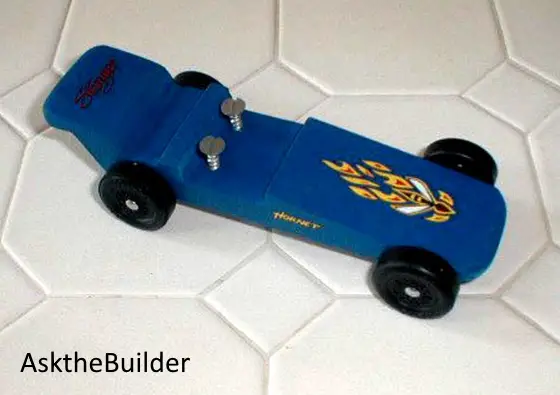
model race car

DEAR TIM: My mom and dad read your column each week. You help them a lot. But I need your help now. My girl scout troop has a Powder Puff derby competition each spring and we build small model cars that race down a sloped track. I would really like to get a medal for the fastest car. Looks don't mean as much to me. Can you help me? What do I need to do to make my little race car go fast? Bridget M., Denver, CO

DEAR BRIDGET: So you feel the need, the need for speed? My children are just like you. They both enjoy scouting as did I when I was a child. Each year, I help them work on their gravity powered race cars. We have built some screaming machines but I have also had a few slackers as well. I'm more than happy to share some of my secrets.

What is friction?


Your biggest enemy in this car race is friction. This happens when two moving parts rub against one another. Since these cars don't have any motors, the friction happens at each wheel and as air passes over the car. You need to do everything possible to reduce friction where the plastic wheels touch the car body and the steel axle. Keep in mind that certain girl and boy scout councils have strict rules with respect to what you can and can't do to each of the cars.

Should a model race car be balanced?

The second enemy is balance. The kits that are often provided to you by your troop leaders need to have weight added to them. This weight needs to be spread out as much as possible over the length of the car. If too much weight ends up on either the front or rear end, you increase friction on those wheels. Unbalanced cars are also very unstable on the race course and can actually jump off the track. If this happens, you will experience the agony of defeat.

How do you reduce friction?

To reduce friction at the wheels use fine sandpaper to remove any plastic burrs that might be on the inside edge of the wheel or the hub that is near the axle hole. If you are permitted to sand the hub, make it slightly rounded so that when it touches the body of the car just a small amount of plastic contacts the wood, not the entire hub. Use emery cloth to polish the shafts of the small nails that act as the car axles. Check for metal burrs under the heads of each nail at this time. Remove the burrs with a small file if this is permitted. Sand the sides of the wood car and coat the areas near each wheel with multiple coats of high gloss polyurethane after the car has been painted. It is much easier to paint the car before you assemble the wheels.

Check wheel spin on each axle before you assemble the car. You want the wheels to rotate with ease. When you attach the wheels and axles to the car, be sure that you don't drive the nails too tightly. If this happens, the wheels will not spin freely on the axles. Use powdered graphite to lubricate the wheels.

Should weight be added to the model car?

I like to add weight using pieces of solder. I create a 3/16 inch deep recess that is 1.25 inches wide by 3 inches long in between the saw cut axle channels on the bottom of the wood car. It is best to create this channel before you cut out the shape of your car. Your mom or dad can do this with a router or a sharp wood chisel. Cut out the car shape next. Sand the car and paint it at this time. Allow the paint to dry thoroughly.

I then place the car upside down on a highly accurate postal scale so that the recess area is level. Use one of the car wheels to do this if necessary. Place the remaining wheels, axles and any decals on the scale. Cut pieces of plumber's roll solder that are just the right length to fit into the recess. Make them as straight as possible and glue them into the recessed area. Glue just enough solder to take the car up to its maximum allowable weight.

Does the design of the model race car matter?

Your car design doesn't need to be fancy to win. A simple wedge shape produces minimal air friction. Be sure to cut out some material from the rear bottom of the block of wood. This excess wood can rub on the track when the car gets to the bottom of the hill. One last thing: try to remember that the car race is about working together and having fun. The thrill of victory lasts but a few minutes. The joy of competing fairly and working hard towards a goal is much more fulfilling and long lasting.

Walk Through Inspection Checklist

Walk Through Inspection Checklist

Discover Defects BEFORE You
Close on Your New Home
! Instant Download PDF Document !

Just $19.95 - Instant Download!

! 100% Money-Back Guarantee !

Order Now

Morning Tim,

Just wanted to share my opinion with you, I have down loaded the checklist I purchased from you. I have to say you knocked the ball out of the park. Thank you for a excellent job, my gain.
- Jim Richardson

Here is how it helped Ethan Chamberlin:

"Tim, Thank you very much for the Walk Through Inspection Checklist. It was invaluable. Using the list, I found 40 items that need to be repaired/completed before I make my final payment to the builder. The checklist is well worth the $17.00.00. Thanks again!"

And Holley S. of Nashville, TN had this to say:

"I used your checklist for the condo I plan to buy and really surprised all involved. They had only allocated 30 minutes for my walk through since it's just a condo, but I kept them there longer and feel much better. There were only a few things that need attention, but I would have never noticed them if it weren't for your packet. So, thank you."

A walk through inspection can be very stressful. It is often your last chance to discover flaws in your new home. The last thing you need is to completely miss one or two mistakes that might cost you thousands of dollars after your warranty expires. Ouch!

I can relieve and remove that stress.

You will be empowered when you meet with your builder armed with my Walk Through Inspection Checklist.

My Walk Through Inspection Checklist costs just $19.95.

The cool thing about my Checklist is that it is a tool that can help you long after the inspection. Why? The checklist, once completed, acts as an important benchmark. You have a snapshot of the EXACT condition of all things in your new home the day of the walk-through. There will not be any arguments as to what something really looked like. Your builder will not have any wiggle room 6 months or 1 year down the road just before your warranty expires.

My checklist can and will save you heartache and lots of money.

 DELIVERED INSTANTLY!

This checklist contains over 215 checklist items. Each item needs to be inspected to make sure you are getting what you paid for. The checklist allows you to protect thousands of dollars of your money. Once completed, you have a written record of the condition of your home before you close on your new home loan. The checklist allows you to quickly identify flaws, mistakes, poor workmanship and other defects.

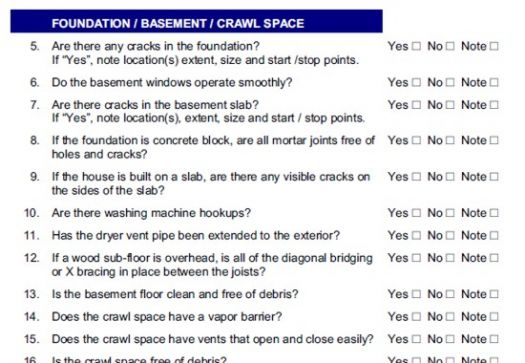
Below is a screenshot of some of the questions from the foundation section of this Checklist.

sample questions in the walk through checklist

Order Now

If the defects can't be cured before the closing you can request that the bank withhold an agreed to sum of your money until such time as you are satisfied. I guarantee that the checklist will help you find flaws in your home that you might have overlooked! It worked for Ed Jendon. Here is what he told me:

"I purchased and utilized your checklist for the walk-through inspection of our new house. The number of items in the checklist was incredible. It saved both myself and the builder a lot of time."

HOW WOULD YOU LIKE?

  • Over 215 detailed checklist items
  • Written tips that help you maximize the power of the checklist
  • Professional Home Inspection Association listings in case you decide to have a professional assist you
  • Instant Download as an attached Adobe PDF Format file

My Walk Through Inspection Checklist costs just $19.95.
 
It is delivered to you the instant your credit is approved in the common PDF format that can be viewed with free Adobe Acrobat Reader software. Click the Adobe graphic just below to download the latest version of this free software. Many modern computers already have this software installed at the factory. You simply double click the attached file icon in the email that is sent to you and the Checklist automatically opens.

Purchase my products online at my AsktheBuilder Store. Online ordering is secure.

Minimize Cracks while Pouring Concrete

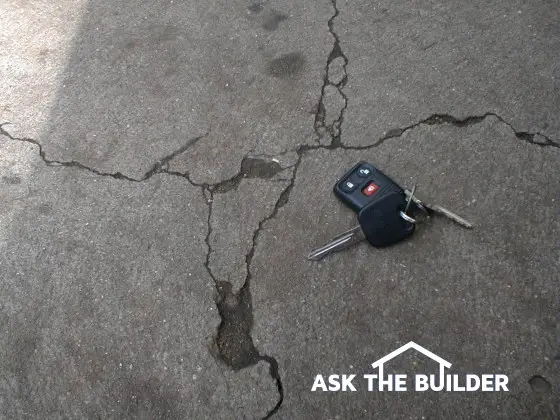
Cracks in concrete

Minimize Cracks while Pouring Concrete


DEAR TIM: Is there a magical trick or an incantation one has to recite to make sure ugly cracks don't appear in new concrete work? There must be something the contractors can do to minimize or eliminate cracks. Tell me it can be done? Marsha B., Fort Pierce, FL

DEAR MARSHA: I'm sorry to say that even the best voodoo princess can't guarantee you crack free concrete. Concrete is indeed a magical material when you think of it. It begins its life as a fluid or plastic material and then within a few hours it becomes solid. This transformation is actually a chemical reaction and the hardness occurs because billions of microscopic crystals grow in between the sand and rock particles to make up a solid matrix.

What causes the cracks while pouring concrete?

The crack trouble can sometimes be traced to the water used in the concrete mix. As the water is consumed by the chemical reaction that creates the crystals, the concrete actually shrinks. Typical concrete used in residential work tends to shrink about 1/16th inch for every ten lineal feet. This shrinkage produces a tension force within the slab and the concrete can and will tear itself apart just as you can tear a piece of paper.

What are control joints?

The trick is to persuade the concrete to crack where you want it to crack. You can do this by creating weak zones within the slab. Contractors call these control joints. To the average homeowner these joints look like decorative lines. The principal is to make the slab thinner by cutting a line in the slab or by removing actual material so that the concrete doesn't crack randomly. It is no different than creasing a piece of paper several times before you rip it apart. Do this and frequently you get a straight line when pulling the paper apart. Concrete reacts in the same way if you make the cut or the line deep enough.


Want perfect concrete work? Find a pro by using my Concrete Work (Sidewalks, Driveways, Patios & Steps) Checklist. I offer a 100% Money Back Guarantee.


But concrete masons often fail to do this. The control joint depth needs to be a minimum of one fourth the slab thickness. If the slab is four inches thick, the control joint needs to be a minimum of one inch deep. Frequently the tool a mason uses only cuts a line 5/8 inch deep. If the contractor chooses to saw cut the joint, he should frequently check the depth of the saw blade to insure that the saw cut line meets or exceeds the minimum depth.

How can cracks be minimized?

Cracks can also be minimized before the concrete is poured. The ground beneath the slab needs to be solid. Don't pour concrete over trenches that were filled with uncompacted material. If a utility line trench passes under a driveway or sidewalk, be sure the contractor fills this portion of the trench with self-compacting gravel or a special lower cost mixture of concrete, sand and fly ash. Soil should be compacted with machines that eliminate air pockets within the soil. Concrete will crack readily if subjected to tension forces. This is exactly what happens if a car drives over concrete that is bridging a hollow spot in the soil.

Reinforcing steel is also a great preventative crack control measure. This steel holds the concrete together and is often 100 times stronger in tension than the actual concrete itself. If your contractor uses reinforcing steel be sure it is suspended within the concrete and not laying on the soil before the pour. Steel at the bottom of a slab is virtually useless.

You can also order concrete that contains millions of polypropylene fibers. These fibers knit the concrete together and help to prevent random cracking. They are often inexpensive and once the concrete is finished they tend to blend in with the finished surface.

Handicap Ramps

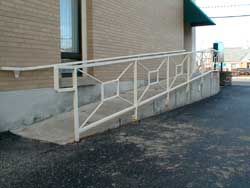
DEAR TIM: After years of using a walker, my father's condition has worsened. He is now confined to a wheel chair. I have to have a ramp built so that he can get into and out of our home. I have seen many ramps but what are the necessary specifications to build one? How wide should they be? What is the slope? How do you calculate the slope? What is the best material to use for the ramp? Is this a do-it-yourself project? Becky D., Visalia, CA

DEAR BECKY: Years ago, I had a business partner who required a wheelchair. His sons built a circuitous ramp from his driveway up to the living level of his home. Although the ramp worked for him, I doubt it would meet the minimum specifications outlined in the Americans with Disabilities Act (ADA) for handicap ramps. Fortunately, for you and your dad, there is an enormous variety of handicap ramp systems available to you. Some are even factory-built and can be shipped to your home.

What is the code for a handicap ramp?

Handicap Ramps

There are minimum specifications that have been developed for handicap ramps. These specifications are not mandated for ramps built at private homes, but they do work well for many people who are confined to wheel chairs. Certain aspects of the specifications can be fairly complicated if the ramp has lots of turns and has to climb a significant vertical distance. If your ramp is simply a straight shot from bottom to top, then the job is somewhat straightforward.

The most basic specifications for handicap ramps are as follows:

  • the maximum slope of the ramp is one inch of rise for each linear foot of run
  • the minimum clear inside width of the ramp between guardrails is 36 inches
  • the maximum rise for any given ramp segment is 30 inches. After rising 30 inches in elevation, a flat rest platform must be provided before the ramp continues to climb
  • flat landings must be at the top and bottom of all ramps
  • landings should always be as wide as the ramp itself and a minimum of 60 inches in length
  • handrails/guardrails must be on each side of the ramp. The top of the handrail must be at least 30 inches above the ramp and no more than 38 inches above the ramp measured vertically


Keep in mind that some of these specifications are minimum standards. In other words, if your father is very frail, a slope of one inch rise per one foot of run may be too steep for him. You may be forced to build a ramp that has a slope of one inch of rise for every 18 inches of run. The recommended specifications say a 36 inch width will work. In reality, you may find this to be too tight. You may want a 42 or even 48 inch wide ramp should you have the space.

What should the slope be for the ramp?

When calculating total slope for your ramp, you must determine the end point of the ramp. The total vertical rise of the ramp is not equal to the vertical distance or sum total of the stair risers of your current front or back steps. Keep in mind that the sidewalk leading up to a flight of steps might also be sloped. This additional vertical distance must be factored into your total rise. Be aware that there are all sorts of ramp designs that can work in very tight situations. Although a straight ramp is often the most desirable, you may find that your ramp will have several switchbacks with 180 degree turns. Every situation is a little different.

What type of ramp is the best?

A concrete ramp offers superior slip resistance if the final surface is finished with a wood or magnesium float. This creates a sandy surface that provides fantastic traction even in wet weather. But concrete ramps are a challenge to build. You can purchase factory-built ramps made from steel or aluminum. They meet all ADA standards. But if you live in a cold climate, they may ice up in certain weather conditions. Wood ramps are an affordable alternative, but they can get very slippery. Wood ramps must be kept clean or be covered with a slip resistant material such as rolled roofing, which has a slip resistant ceramic granular surface.

Is a handicap ramp a do-it-yourself project?

Unless you have significant building experience, ramp construction is not a do-it-yourself project. A project of this nature requires several skill sets. The best thing to do first is to have the ramp designed by a professional architect or other individual who can visit your home and make an assessment of what can and can't be done. Once you see the final plans of exactly how the ramp needs to be built, you will most certainly have a grasp of what it takes to do such a project. It is also a good idea to contact your local building and zoning department. You must make certain that your ramp will not be in violation of any ordinances or code requirements.

Tar and Chip Driveway Update

Tar and chip drive (Tim)

Tar and Chip Driveway Update | Even on a cloudy day, my tar and chip drive looks so much different than the blacktop roadway.

Tar and chip pavement surfaces are nothing new. In fact, they have been around for well over 100 years. The blacktop you see installed today is a hybrid of traditional tar and chip.

DEAR TIM: It is time for a new driveway at my home. Neither concrete nor traditional blacktop appeal to me. The look I desire is that of a groomed gravel drive similar to ones I often see on British television shows. But I do not want the dust that goes with gravel surfaces. Is it possible to get what I want? If so, how is it done? Cindy M., Waterloo, IA

DEAR CINDY: Don't be too harsh on concrete and blacktop surfaces. Many people do not like the stark look of regular concrete, even if it has a handsome broom-finish or an expertly applied swirl trowel finish. Even the rich velvet-smooth appearance of a new ebony blacktop drive also can be a turn-off. But keep in mind that both concrete and blacktop can be installed with faux finishes. They can be colorized and stamped with patterns that allow them to look like brick, cobblestones, stone, etc.

The driveway you want is at my own home. For the past 15 years, I have driven up and down my eye-popping tar and chip driveway. It looks exactly like - well, actually better than - the driveways leading up to the gorgeous castles and country homes featured in many British TV shows. Can you imagine a deep-brown colored gravel driveway? That is what I have. How about one that is light green, red or even buff colored. Would you like a driveway that had gravel chips that have multi-colored sparkling minerals in each stone? All of this and more is possible.


Get the best-looking Tar and Chip Driveway around!
Use my Asphalt/Blacktop/Tar & Chip Installation & Repair Checklist and learn what to ask your contractor.
I offer a 100% Money Back Guarantee.


When my wife and I built our new home we had the same feelings as you did. We did not want concrete or blacktop. I chose tar and chip for many reasons:

  • It is durable;
  • It provides excellent traction;
  • It is virtually maintenance free;
  • It can be very affordable;
  • It is drop-dead gorgeous!

Tar and chip pavement surfaces are nothing new. In fact, they have been around for well over 100 years. The blacktop you see installed today is a hybrid of traditional tar and chip. Many years ago hot liquid tar or asphalt cement would be sprayed on a gravel surface. Within minutes, small, clean and dry stone chips would be broadcast into the liquid tar. As the tar cooled, it grabbed onto each of the stone chips. The resulting surface was nearly identical to blacktop that you see on many roadways around the nation. In fact, virtually every asphalt roadway or highway built in America prior to 1930 was done in this way. Many secondary county roadways are still paved with tar and chip. It is a time-tested paving method that is affordable and long-lasting.


Would you like to have a gorgeous driveway? How about step-by-step photos and instructions that show you how I had my own tar and chip drive installed? If so, you might want my Instant Download Tar and Chip eBook.


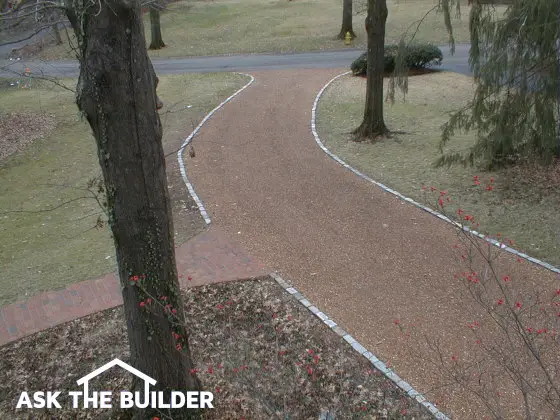
granite cobblestone edging

The granite cobblestone edging adds a distinctive look and keeps the chips out of the grass.

But the tar and chip method of making roads was pushed aside by central mixed asphalt and blacktop plants. Blacktop today is made very much as is concrete. The ingredients are mixed at a central plant and shipped by truck to the jobsite. Blacktop can be installed in weather conditions that are not favorable for tar and chip. The installation season can be extended when using blacktop. Tar and chip is still done in many states, but it is not nearly as common as it once was.

Click here to watch Tim describe his Tar and Chip Driveway.

Click here to watch Tim describe his Tar and Chip Driveway.

I am astonished at the enormous business opportunity that tar and chip driveways represent. Tens of thousands of people love the look, yet I find blacktop installers ignore this demand. The equipment needed to install the tar and chip surfaces is already owned by many blacktop contractors. For residential applications the only specialized piece of equipment is a truck with an insulated tank used for transporting the hot liquid tar to the jobsite.

Onboard this truck is a small engine that is connected to a pump. The pump delivers the tar through a hose and nozzle to a trained operator. He carefully applies the hot tar to the gravel base and laborers broadcast the stone chips immediately into the liquid tar. Once all of the stone chips are applied, a powered roller no different than the one used for blacktop compacts the stones into the tar. New driveways require two applications of the tar and chips.

The different colored stone chips are the hardest thing to find. Mine came from gravel pits in Missouri. Visit a progressive landscape supply store. Often they have different colored decorative stone chips for garden pathways. Locate the sources of these stones and see if you can't buy them in bulk quantities. The tar or asphalt cement is the easiest thing to find. It is sold at just about any central plant that makes blacktop. This tar is the same ingredient used to make blacktop.

Locating a tar and chip contractor is done one of two ways. Open your Yellow Pages and call each and every blacktop contractor. If you strike out, contact large paving contractors who do public roadways. They just might have a division that does smaller commercial or residential tar and chip jobs. Finally, contact the blacktop plants. Any contractor who does tar and chip must buy their tar from these businesses. Call the plants on a rainy day when they are slow. Don't bother them on sunny days when the demand for blacktop is high.

State Route 29 Fresh Tar sign

This photo was taken on September 22, 2004, on State Route 29, just northwest of where Route 29 passes over Interstate 75. People out West see these signs each summer.

old road surface vs new road surface - tar and chip

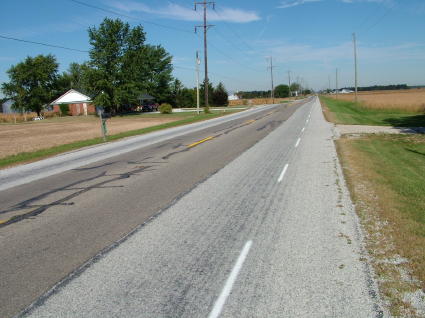
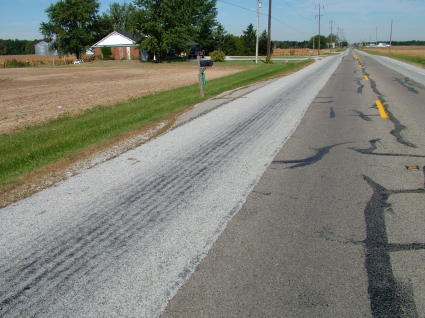
This is a rare situation where you can see the old road surface - in the center of the road - next to a fresh tar and chip application. The new tar and chip surface starts at the edge of the road on each side and extends towards the centerline about 6 feet in each direction. I assume the road crew is coming back to coat the center of the road. You should be able to determine that the thickness of the new tar and chip is no more than 1/2 inch. But it will wear like iron for perhaps 7 - 10 years.

tar and chip road

I can't say enough good things about tar and chip. It is an excellent surface for moderate to lightly traveled roadways.

tar and chip drive with fire engine

Are you worried that a couple of thin layers of tar and chip can't support the weight of trucks? This fire engine is parked on my driveway and its wheels are not sinking a fraction of an inch. The truck weighs 50,000 pounds or more! It is a combination aerial ladder truck and 1,500 gpm pumper! It also carries 500 gallons of water. Just the water alone weighs 4,144 pounds. Remember, tar and chip and blacktop driveways gather their strength from the crushed gravel base beneath the finished surfaces.